l
l
blogger better. Powered by Blogger.

Search

Labels

blogger better

Followers

Blog Archive

Total Pageviews

Labels

Download

Blogroll

Featured 1

Curabitur et lectus vitae purus tincidunt laoreet sit amet ac ipsum. Proin tincidunt mattis nisi a scelerisque. Aliquam placerat dapibus eros non ullamcorper. Integer interdum ullamcorper venenatis. Pellentesque habitant morbi tristique senectus et netus et malesuada fames ac turpis egestas.

Featured 2

Curabitur et lectus vitae purus tincidunt laoreet sit amet ac ipsum. Proin tincidunt mattis nisi a scelerisque. Aliquam placerat dapibus eros non ullamcorper. Integer interdum ullamcorper venenatis. Pellentesque habitant morbi tristique senectus et netus et malesuada fames ac turpis egestas.

Featured 3

Curabitur et lectus vitae purus tincidunt laoreet sit amet ac ipsum. Proin tincidunt mattis nisi a scelerisque. Aliquam placerat dapibus eros non ullamcorper. Integer interdum ullamcorper venenatis. Pellentesque habitant morbi tristique senectus et netus et malesuada fames ac turpis egestas.

Featured 4

Curabitur et lectus vitae purus tincidunt laoreet sit amet ac ipsum. Proin tincidunt mattis nisi a scelerisque. Aliquam placerat dapibus eros non ullamcorper. Integer interdum ullamcorper venenatis. Pellentesque habitant morbi tristique senectus et netus et malesuada fames ac turpis egestas.

Featured 5

Curabitur et lectus vitae purus tincidunt laoreet sit amet ac ipsum. Proin tincidunt mattis nisi a scelerisque. Aliquam placerat dapibus eros non ullamcorper. Integer interdum ullamcorper venenatis. Pellentesque habitant morbi tristique senectus et netus et malesuada fames ac turpis egestas.

Friday, April 20, 2018

SmugMug acquires Flickr

Two photo-sharing services are teaming up, as SmugMug buys Flickr from Verizon’s digital media subsidiary Oath.

USA Today broke the news and interviewed SmugMug CEO Don MacAskill, who said he hopes to revitalize Flickr.

At the same time, he said he’s still figuring out his actual plans: “It sounds silly for the CEO to not to totally know what he’s going to do, but we haven’t built SmugMug on a master plan either. We try to listen to our customers and when enough of them ask for something that’s important to them or to the community, we go and build it.”

Flickr was founded in 2004 and sold to Yahoo a year later. Yahoo, in turn, was acquired by Verizon, which brought it together with AOL to create a new subsidiary called Oath.

Over the past couple months, Oath (which owns TechCrunch) has been selling off some of its AOL and Yahoo properties, including Moviefone (sold to the company behind MoviePass, which Oath now has a stake in) and Polyvore (assets sold to Ssense).

In an FAQ about the deal, SmugMug says it will continue to operate Flickr as a separate site, with no merging of user accounts or photos: “Over time, we’ll be migrating Flickr onto SmugMug’s technology infrastructure, and your Flickr photos will move as a part of this migration — but the photos themselves will remain on Flickr.”

The company also uses the FAQ to describe its vision for the combined services:

SmugMug and Flickr represent the world’s most influential community of photographers, and there is strength in numbers. We want to provide photographers with both inspiration and the tools they need to tell their stories. We want to bring excitement and energy to inspire more photographers to share their perspective. And we want to be a welcome place for all photographers: hobbyist to archivist to professional.

The financial terms were not disclosed.


from Social – TechCrunch https://ift.tt/eA8V8J SmugMug acquires Flickr Anthony Ha https://ift.tt/2qNqEjP
via IFTTT

German Supreme Court dismisses Axel Springer lawsuit, says ad blocking is legal

{rss:content:encoded} German Supreme Court dismisses Axel Springer lawsuit, says ad blocking is legal https://ift.tt/2K4euLp https://ift.tt/2qQuVCj April 20, 2018 at 10:24PM

Germany’s Supreme Court dismissed a lawsuit yesterday from Axel Springer against Eyeo, the company behind AdBlock Plus.

The European publishing giant (which acquired Business Insider in 2015) argued that ad-blocking, as well as the business model where advertisers pay to be added to circumvent the white list, violated Germany’s competition law. Axel Springer won a partial victory in 2016, when a lower court ruled that it shouldn’t have to pay for white listing.

However, the Supreme Court has now overturned that decision. In the process, it declared that ad-blocking and Eyeo’s white list are both legal. (German speakers can read the court’s press release.)

After the ruling, Eyeo sent me the following statement from Ben Williams, its head of operations and communications:

Today, we are extremely pleased with the ruling from Germany’s Supreme Court in favor of Adblock Plus/eyeo and against the German media publishing company Axel Springer. This ruling confirms — just as the regional courts in Munich and Hamburg stated previously — that people have the right in Germany to block ads. This case had already been tried in the Cologne Regional Court, then in the Regional Court of Appeals, also in Cologne — with similar results. It also confirms that Adblock Plus can use a whitelist to allow certain acceptable ads through. Today’s Supreme Court decision puts an end to Axel Springer’s claim that they be treated differently for the whitelisting portion of Adblock Plus’ business model.

Axel Springer, meanwhile, described ad-blocking as “an attack on the heart of the free media” and said it would appeal to the country’s Constitutional Court.

Startup ecosystem report: China is rising while the US is waning

Startups are a gamble, but it’s possible to better understand why some thrive and many more die by looking at the ecosystems in which they operate. Such is the mission of eight-year-old Startup Genome, composed of a group of researchers and entrepreneurs who, every year, interview thousands of founders and investors around the world to get a better handle on what’s changing in the regions where they operate, and what remains stubbornly the same.

The larger objective is to figure out how to help more startups succeed, and the outfit — which this year surveyed 10,000 founders with the help of partners like Crunchbase and Dealroom — produced some data that should perhaps concern those in the U.S. To wit, China looks positioned to overtake U.S. dominance when it comes to numerous tech sectors. Consider: In 2014, just 14 percent of so-called unicorns were based in China. Between the start of last year through today, that percentage has shot up to 35 percent, while in the U.S., the number of homegrown unicorns has fallen from 61 percent to 41 percent of the overall global number.

You could argue that investors are simply assigning China-based startups overly lofty valuations, as happened here in the U.S., and we partly believe that to be true. But China is also clearly “in it to win it,” based on a look at patents, with four times as many AI-related applications and three times as many crypto- and blockchain-related patents registered in China last year. With so much of the tech industry now focused on deep tech, it’s worth noting. In fact, as much as we loathed the January Financial Times column penned by famed VC Michael Moritz, who suggested that U.S. companies follow China’s lead, his underlying call to arms was probably, gulp, prescient in its own way.

What else should startups know? According to Startup Genome’s findings, in addition to the rise of AI, blockchain and robotics manufacturing, there are clearly declining sub sectors, too, including, least surprisingly, adtech, which has seen a roughly 35 percent drop in funding over the last five years. No doubt that ties directly to the growing dominance of Facebook and Google, which accounted for 73 percent of all U.S. digital advertising last year, according to the equity research firm Pivotal.

That doesn’t mean adtech startups are cooked, notes the study’s authors. Rather, declining sub-sectors are often “mature” but can be revived by new technologies. In this case, while funding for adtech has dropped, virtual reality and augmented reality could well inject some new growth into the industry at some point. Maybe.

Either way, to us, the most interesting facets of this report — and it really is worth poring over — are the connections it’s able to make by talking with so many people around the world. It addresses, for example, how Stockholm, a relatively small startup ecosystem, is able to produce sizable startups at a meaningful rate, versus Chicago, whose ecosystem is ostensibly three times bigger. (The answer: Stockholm’s startup founders are apparently better connected to the world’s top seven ecosystems.)

Also quite interesting is the report’s findings about women founders, who build more relationships with regional founders and are more locally connected than their male counterparts — except with investors. That’s bad news for both women founders and investors, as local connectedness is associated with better startup performance.

To read the report in full, click over here. You have to fork over your email address, but with 240 pages filled with fascinating nuggets and other useful information, you’ll likely find it well worth it.


https://ift.tt/eA8V8J Startup ecosystem report: China is rising while the US is waning https://ift.tt/2K21Uwj

Twitter banned Russian security firm Kaspersky Lab from buying ads

The U.S. government isn’t the only one feeling skittish about Kaspersky Lab. On Friday, the Russian security firm’s founder Eugene Kaspersky confronted Twitter’s apparent ban on advertising from the company, a decision it quietly issued in January.

“In a short letter from an unnamed Twitter employee, we were told that our company ‘operates using a business model that inherently conflicts with acceptable Twitter Ads business practices,'” Kaspersky wrote.

“One thing I can say for sure is this: we haven’t violated any written – or unwritten – rules, and our business model is quite simply the same template business model that’s used throughout the whole cybersecurity industry: We provide users with products and services, and they pay us for them.”

He noted that the company has spent around than €75,000 ($93,000 USD) to promote its content on Twitter in 2017.

Kaspersky called for Twitter CEO Jack Dorsey to specify the motivation behind the ban after failing to respond to an official February 6 letter from his company.

“More than two months have passed since then, and the only reply we received from Twitter was the copy of the same boilerplate text. Accordingly, I’m forced to rely on another (less subtle but nevertheless oft and loudly declared) principle of Twitter’s – speaking truth to power – to share details of the matter with interested users and to publicly ask that you, dear Twitter executives, kindly be specific as to the reasoning behind this ban; fully explain the decision to switch off our advertising capability, and to reveal what other cybersecurity companies need to do in order to avoid similar situations.”

In a statement about the incident, Twitter reiterated that Kaspersky Lab’s business model “inherently conflicts with acceptable Twitter Ads business practices.” In a statement to CyberScoop, Twitter pointed to the late 2017 Department of Homeland Security directive to eliminate Kaspersky software from Executive Branch systems due to the company’s relationship with Russian intelligence.

“The Department is concerned about the ties between certain Kaspersky officials and Russian intelligence and other government agencies, and requirements under Russian law that allow Russian intelligence agencies to request or compel assistance from Kaspersky and to intercept communications transiting Russian networks,” DHS asserted in the directive at the time.


from Social – TechCrunch https://ift.tt/eA8V8J Twitter banned Russian security firm Kaspersky Lab from buying ads Taylor Hatmaker https://ift.tt/2HB7h7n
via IFTTT

Twitter is down again for some [Update: It’s Back]

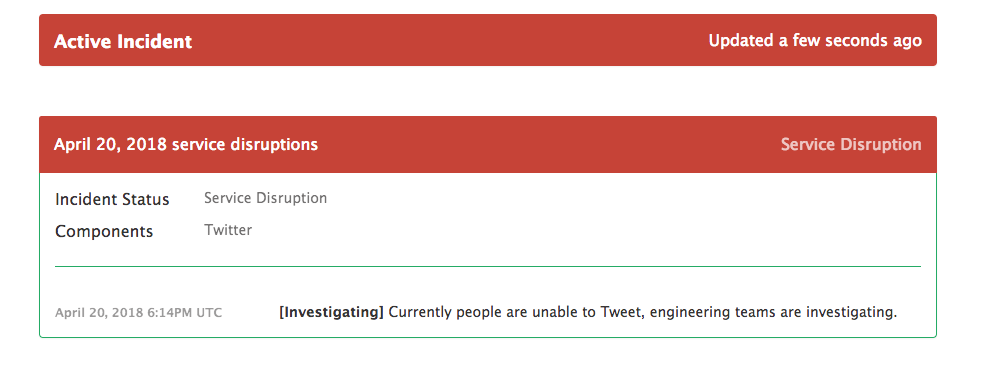
Rough week to be in Twitter support. Three days after the site experienced downtime across the globe, the site was hit by another outage. Status.io’s service site is currently listing an “active incident,” leaving many users unable to tweet. In other cases, the site isn’t loading at all, instead serving up internal server errors or messages stating that the service is “over capacity.”

Here in the States, at least, the issue doesn’t appear to be quite as widespread as Tuesday’s incident. We’ve reached out to Twitter for comment and will update as soon as we hear more.

Update: Twitter says it’s resolved the momentary outage, telling TechCrunch in a statement, “Earlier today, people were unable to send Tweets for about 30 minutes. We’ve resolved the internal issue and we’re sorry for the disruption.”


from Social – TechCrunch https://ift.tt/2qMEPoo Twitter is down again for some [Update: It’s Back] Brian Heater https://ift.tt/2Hfs5ln
via IFTTT

ZTE says export ban will ‘severely impact’ its survival

{rss:content:encoded} ZTE says export ban will ‘severely impact’ its survival https://ift.tt/2K0ptFX https://ift.tt/2qOwoJp April 20, 2018 at 08:23PM

It’s been a hell of a week for ZTE. News Monday that it was being hit with a seven-year export ban sent the company scrambling. The Chinese handset maker suspended its earnings report and reportedly sent its lawyers to meet with Google to see if anything could be worked out about a punishment that could hamper its ability to utilize Android and various key services.

Four days after we first reached out, ZTE has finally offered us an official reaction to the news. And it’s a doozy. The six-paragraph official statement from corporate mulls over the punishment and reasserts ZTE’s compliance to international law, which it “regard[s] as the foundation and bottom-line of the company’s operation.”

ZTE adds that it invested “over $50 million in its export control compliance program and is planning to invest more resources in 2018.” So, why did the company get dinged by the U.S. Department of Commerce for failure to significantly reprimand staff after pleading guilty to violating sanctions on Iran and North Korea?

The company contends that the U.S. Bureau of Industry and Security “ignored” its “diligent work” and progress it has made in complying with the law, calling the punishment, “unfair.” Seven years is certainly severe, given that U.S.-based companies make north of a quarter of the components used in the company’s handsets, according to estimates.

That, coupled with U.S.-based software makers, Google included, put the company in an extremely tight spot moving forward, and will likely require a complete rethink of ZTE’s business model, if upheld.

“The Denial Order will not only severely impact the survival and development of ZTE,” the company says, “but will also cause damages to all partners of ZTE including a large number of U.S. companies.” ZTE adds that it will continue to fight the ruling, taking “judicial measures,” if necessary.

The punishment comes as ZTE finds itself targeted by the U.S. government over spying charges, alongside fellow Chinese handset maker, Huawei.


iOS 11’s new App Store boosts downloads by 800% for Featured apps

{rss:content:encoded} iOS 11’s new App Store boosts downloads by 800% for Featured apps https://ift.tt/2JcSvkl https://ift.tt/2HAfvfR April 20, 2018 at 07:45PM

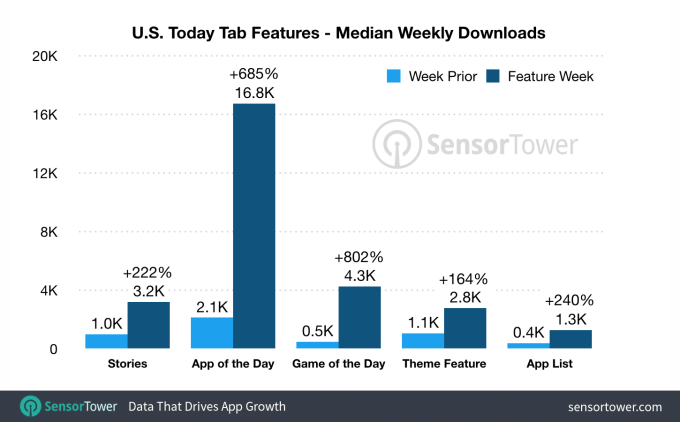
When Apple launched its new App Store in iOS 11 back in September, it aimed to offer app developers better exposure, as well as a better app discovery experience for consumers. A new study from Sensor Tower out today takes a look at how well that’s been working in the months since. According to its findings, getting a featured spot on the new App Store can increase downloads by as much as 800 percent, with the “App of the Day” or “Game of the Day” spots offering the most impact.

The app store intelligence firm examined data from September 2017 to present day to come to its conclusions, it says.

During this time, median U.S. iPhone downloads for apps that snagged the “Game of the Day” spot increased by 802 percent for the week following the feature, compared to the week prior to being featured.

“App of the Day” apps saw a boost of 685 percent.

Being featured in other ways – like in one of the new App Store Stories or in an App List – also drove downloads higher, by 222 percent and 240 percent, respectively.

The numbers seem to indicate that Apple is achieving the results it wanted with the release of its redesigned App Store.

Over the years, Apple’s app marketplace had grown so large that finding new apps had become challenging. And developers sometimes found ways to bump their apps higher in the top charts for exposure, leaving iPhone owners wondering if a new app was really that popular, or if it was some sort of paid promotion.

The iOS 11 App Store, on the other hand, has taken more of an editorial viewpoint to its app recommendations. While the top charts haven’t gone away, the focus these days is on what Apple thinks is best – not the wisdom of the masses. Apple has applied its editorial eye to things like timely round-ups of apps; curated, thematic collections; as well as articles about apps and interviews with developers. Apple also picks an app and game to feature daily, so the App Store always has fresh content and a reason for users to return.

The end result is something that’s more akin to a publication about apps, instead of a just an app marketplace.

What’s most interesting, then, in Sensor Tower’s report, are what sort of app publishers Apple has chosen to feature.

Apple had touted the App Store changes would be a way to give smaller developers more exposure. But if you’ve popped into the App Store from time to time, you may have noticed that big publishers – not indies – were having their apps featured.

In fact, an early report about the App Store revamp criticized Apple for giving big publishers too much attention. It said that apps from brands like Starbucks and CBS, or game makers like EA and Glu, weren’t exactly hurting for downloads.

But Apple’s favoring of big publishers is only true to a point, says Sensor Tower.

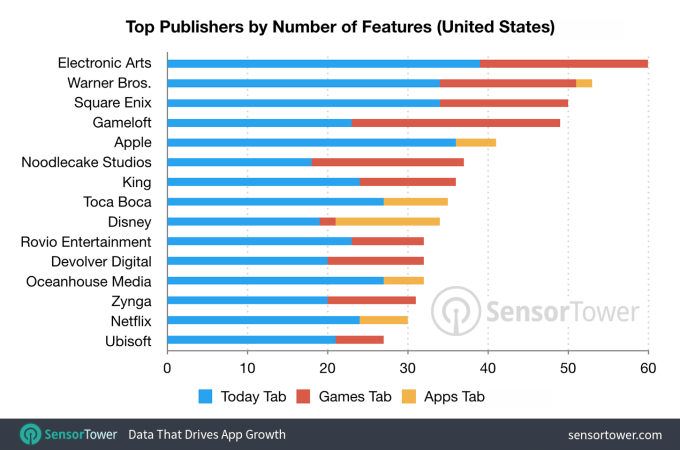
It found that 13 of the top 15 featured publishers (by number of features) had at least one million U.S. iPhone downloads since the launch of the new App Store last September. It’s not surprising that Apple wants to highlight these publishers. Many of them, and particularly the game publishers, have multiple popular apps. So when their apps get an update or they have a new release, consumers pay attention.

Apple, of course, wants to capitalize on that consumer interest because it shares in the revenue app publishers generate through things like paid downloads, in-app purchases and subscriptions.

However, Apple isn’t only giving the limelight to large publishers, says Sensor Tower.

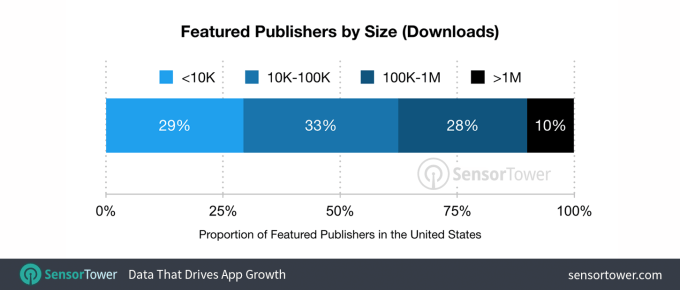
It also found that 29 percent of the apps it has feature since the launch of the revamped App Store were from publishers who had fewer than 10,000 downloads during that time.

“While it’s clearly the case that big publishers are more likely to receive the largest number of features, small publishers still very much have their chance to benefit from a feature on the App Store,” said Sensor Tower’s Mobile Insights Analyst, Jonathan Briskman.

Though Sensor Tower’s published report focused only on the iOS App Store, it’s worth noting how it compares with Google Play.

Getting a featured spot on Google’s app store isn’t as impactful, the firm tells TechCrunch. The largest week-over-week increase to the median it saw there was only around 200 percent.

Image credits, all: Sensor Tower 

Facebook has auto-enrolled users into a facial recognition test in Europe

Facebook users in Europe are reporting the company has begun testing its controversial facial recognition technology in the region.

Jimmy Nsubuga, a journalist at Metro, is among several European Facebook users who have said they’ve been notified by the company they are in its test bucket.

The company has previously said an opt-in option for facial recognition will be pushed out to all European users next month. It’s hoping to convince Europeans to voluntarily allow it to expand its use of the privacy-hostile tech — which was turned off in the bloc after regulatory pressure, back in 2012, when Facebook was using it for features such as automatically tagging users in photo uploads.

Under impending changes to its T&Cs — ostensibly to comply with the EU’s incoming GDPR data protection standard — the company has crafted a manipulative consent flow that tries to sell people on giving it their data; including filling in its own facial recognition blanks by convincing Europeans to agree to it grabbing and using their biometric data after all. 

Notably Facebook is not offering a voluntary opt-in to Europeans who find themselves in its facial recognition test bucket. Rather users are being automatically turned into its lab rats — and have to actively delve into the settings to say no.

In a notification to affected users, the company writes [emphasis ours]: “You control face recognition. This setting is on, but you can turn it off at any time, which applies to features we may add later.”

Not only is the tech turned on, but users who click through to the settings to try and turn it off will also find Facebook attempting to dissuade them from doing that — with manipulative examples of how the tech can “protect” them.

As another Facebook user who found herself enrolled in the test — journalist Jennifer Baker — points out, what it’s doing here is incredibly disingenuous because it’s using fear to try to manipulate people’s choices.

Under the EU’s incoming data protection framework Facebook will not be able to automatically opt users into facial recognition — it will have to convince people to switch the tech on themselves.

But the experiment it’s running here (without gaining individuals’ upfront consent) looks very much like a form of A/B testing — to see which of its disingenuous examples is best able to convince people to accept the highly privacy-hostile technology by voluntarily switching it on.

But given that Facebook controls the entire consent flow, and can rely on big data insights gleaned from its own platform (of 2BN+ users), this is not even remotely a fair fight.

Consent is being manipulated, not freely given. This is big data-powered mass manipulation of human decisions — i.e. until the ‘right’ answer (for Facebook’s business) is ‘selected’ by the user.

Data protection experts we spoke to earlier this week do not believe Facebook’s approach to consent will be legal under GDPR. Legal challenges are certain at this point.

But legal challenges also take time. And in the meanwhile Facebook users will be being manipulated into agreeing with things that align with the company’s data-harvesting business interests — and handing over their sensitive personal information without understanding the full implications.

It’s also not clear how many Facebook users are being auto-enrolled into this facial recognition test — we’ve put questions to it and will update this post with any reply.

Last month Facebook said it would be rolling out “a limited test of some of the additional choices we’ll ask people to make as part of GDPR”.

It also said it was “starting by asking only a small percentage of people so that we can be sure everything is working properly”, and further claimed: “[T]he changes we’re testing will let people choose whether to enable facial recognition, which has previously been unavailable in the EU.”

Facebook’s wording in those statements is very interesting — with no number put on how many people will be made into test subjects (though it is very clearly trying to play the experiment down; “limited test”, “small”) — so we simply don’t know how many Europeans are having their facial data processed by Facebook right now, without their upfront consent.

Nor do we know where in Europe all these test subjects are located. But it’s pretty likely the test contravenes even current EU data protection laws. (GDPR applies from May 25.)

Facebook’s description of its testing plan last month was also disingenuous as it implied users would get to choose to enable facial recognition. In fact, it’s just switching it on — saddling test subjects with the effort of opting out.

The company was likely hoping the test would not attract too much attention — given how much GDPR news is flowing through its PR channels, and how much attention the topic is generally sucking up — and we can see why now because it’s essentially reversed its 2012 decision to switch off facial recognition in Europe (made after the feature attracted so much blow-back), to grab as much data as it can while it can.

Millions of Europeans could be having their fundamental rights trampled on here, yet again. We just don’t know what the company actually means by “small”. (The EU has ~500M inhabitants — even 1%, a “small percentage”, of that would involve millions of people… )

Once again Facebook isn’t telling how many people it’s experimenting on.


from Social – TechCrunch https://ift.tt/eA8V8J Facebook has auto-enrolled users into a facial recognition test in Europe Natasha Lomas https://ift.tt/2vr2zEe
via IFTTT

AT&T CEO says a new $15-per-month, sports-free streaming service is launching in a few weeks

{rss:content:encoded} AT&T CEO says a new $15-per-month, sports-free streaming service is launching in a few weeks https://ift.tt/2qLINhZ https://ift.tt/2HODaXP April 20, 2018 at 04:07PM

AT&T CEO Randall Stephenson revealed on Thursday the carrier’s plans to launch another live TV service called “AT&T Watch,” which would offer a cheap, $15-per-month bundle of channels for customers, and be provided to AT&T Wireless subscribers for free. At this price point, the service would be one of the lowest on the market – less than Sling TV’s entry-level, $20-per-month package, and just a bit less than Philo’s low-cost, sports-free offering, priced at $16 per month.

Stephenson, who’s in court defending the proposed $85 billion merger with Time Warner against antitrust claims, announced the service on the witness stand. He held up the soon-to-arrive AT&T Watch as a rebuttal of sorts to the Justice Department’s point about the company’s continually climbing prices for its DirecTV satellite service, according to a report from Variety.

The Justice Department is concerned that, if the merger goes through, AT&T will then raise prices on Time Warner’s Turner networks, like TNT, TBS and CNN in a way that would hurt other pay TV providers.

Few other details were offered regarding AT&T Watch, beyond its price point – which is due to the fact that it will also be sports-free offering, like Philo.

But AT&T’s advantage over competitors is the distribution provided by its AT&T Wireless business. Although its existing streaming service DirecTV Now is one of the newest on the market, it has already reached number two in terms of subscribers, falling behind Sling TV.

Beyond its lack of sports, the channel lineup for AT&T Watch was not discussed, nor was an exact launch date.

Stephenson said the company hoped to launch it in the next few weeks.

This robot can build your Ikea furniture

There are two kinds of people in the world: those who hate building Ikea furniture and madmen. Now, thanks to Ikeabot, the madmen can be replaced.

Ikeabot is a project built at Control Robotics Intelligence (CRI) group at NTU in Singapore. The team began by teaching robots to insert pins and manipulate Ikea parts and then, slowly, began to figure out how to pit the robots against the furniture. The results, if you’ve ever fought with someone trying to put together a Billy, are heartening.

From Spectrum:

The assembly process from CRI is not quite that autonomous; “although all the steps were automatically planned and controlled, their sequence was hard-coded through a considerable engineering effort.” The researchers mention that they can “envision such a sequence being automatically determined from the assembly manual, through natural-language interaction with a human supervisor or, ultimately, from an image of the chair,” although we feel like they should have a chat with Ross Knepper, whose IkeaBot seemed to do just fine without any of that stuff.

In other words the robots are semi-autonomous but never get frustrated and can use basic heuristics to figure out next steps. The robots can now essentially assemble chairs in about 20 minutes, a feat that I doubt many of us can emulate. You can watch the finished dance here, in all its robotic glory.

The best part? Even robots get frustrated and fling parts around:

I, for one, welcome our Ikea chair manufacturing robotic overlords.


https://ift.tt/eA8V8J This robot can build your Ikea furniture https://ift.tt/2JccBeC

Twitter doesn’t care that someone is building a bot army in Southeast Asia

Facebook’s lack of attention to how third parties are using its service to reach users ended up with CEO Mark Zuckerberg taking questions from Congressional committees. With that in mind, you’d think that others in the social media space might be more attentive than usual to potentially malicious actors on their platforms.

Twitter, however, is turning the other way and insisting all is normal in Southeast Asia, despite the emergence of thousands of bot-like accounts that have followed prominent users in the region en masse over the past month.

Scores of reporters and Twitter users with large followers — yours truly included — have noticed swarms of accounts with generic names, no profile photo, no bio and no tweets have followed them over the past month.

These accounts might be evidence of a new ‘bot farm’ — the creation of large numbers of accounts for sale or usage on-demand which Twitter has cracked down on — or the groundwork for more nefarious activities, it’s too early to tell.

In what appears to be the first regional Twitter bot campaign, a flood of suspicious new followers has been reported by users across Southeast Asia and beyond, including Thailand, Myanmar Cambodia, Hong Kong, China, Taiwan, Sri Lanka among other places.

While it is true that the new accounts have done nothing yet, the fact that a large number of newly-created accounts have popped up out of nowhere with the aim of following the region’s most influential voices should be enough to concern Twitter. Especially since this is Southeast Asia, a region where Facebook is beset with controversies — from its role inciting ethnic hatred in Myanmar, to allegedly assisting censors in Vietnam, witnessing users jailed for violating lese majeste in Thailand, and aiding the election of controversial Philippines leader Duterte.

Then there are governments themselves. Vietnam has pledged to build a cyber army to combat “wrongful views,” while other regimes in Southeast Asia have clamped down on social media users.

Despite that, Twitter isn’t commenting.

The U.S. company issued a no comment to TechCrunch when we asked for further information about this rush of new accounts, and what action Twitter will take.

A source close to the company suggested that the sudden accumulation of new followers is “a pretty standard sign-up, or onboarding, issue” that is down to new accounts selecting to follow the suggested accounts that Twitter proposes during the new account creation process.

Twitter is more than 10 years old, and since this is the first example of this happening in Southeast Asia that explanation already seems inadequate at face value. More generally, the dismissive approach seems particularly naive. Twitter should be looking into the issue more closely, even if for now the apparent bot army isn’t being put to use yet.

Facebook is considered to be the internet by many in Southeast Asia, and the social network is considerably more popular than Twitter in the region, but there remains a cause for concern here.

“If we’ve learned anything from the Facebook scandal, it’s that what can at first seem innocuous can be leveraged to quite insidious and invasive effect down the line,” Francis Wade, who recently published a book on violence in Myanmar, told the Financial Times this week. “That makes Twitter’s casual dismissal of concerns around this all the more unsettling.”


from Social – TechCrunch https://ift.tt/eA8V8J Twitter doesn’t care that someone is building a bot army in Southeast Asia Jon Russell https://ift.tt/2qMdaot
via IFTTT

Thursday, April 19, 2018

Technique to beam HD video with 99 percent less power could sharpen the eyes of smart homes

{rss:content:encoded} Technique to beam HD video with 99 percent less power could sharpen the eyes of smart homes https://ift.tt/2vyYYEk https://ift.tt/2HhQsPC April 20, 2018 at 01:13AM

Everyone seems to be insisting on installing cameras all over their homes these days, which seems incongruous with the ongoing privacy crisis — but that’s a post for another time. Today, we’re talking about enabling those cameras to send high-definition video signals wirelessly without killing their little batteries. A new technique makes beaming video out more than 99 percent more efficient, possibly making batteries unnecessary altogether.

Cameras found in smart homes or wearables need to transmit HD video, but it takes a lot of power to process that video and then transmit the encoded data over wi-fi. Small devices leave little room for batteries, and they’ll have to be recharged frequently if they’re constantly streaming. Who’s got time for that?

The idea behind this new system, created by a University of Washington team led by prolific researcher Shyam Gollakota, isn’t fundamentally different from some others that are out there right now. Devices with low data rates, like a digital thermometer or motion sensor, can something called backscatter to send a low-power signal consisting of a couple bytes.

Backscatter is a way of sending a signal that requires very little power, because what’s actually transmitting the power is not the device that’s transmitting the data. A signal is sent out from one source, say a router or phone, and another antenna essentially reflects that signal, but modifies it. By having it blink on and off you could indicate 1s and 0s, for instance.

UW’s system attaches the camera’s output directly to the output of the antenna, so the brightness of a pixel directly correlates to the length of the signal reflected. A short pulse means a dark pixel, a longer one is lighter, and the longest length indicates white.

Some clever manipulation of the video data by the team reduced the number of pulses necessary to send a full video frame, from sharing some data between pixels to using a “zigzag” scan (left to right, then right to left) scan pattern. To get color, each pixel needs to have its color channels sent in succession, but this too can be optimized.

Assembly and rendering of the video is accomplished on the receiving end, for example on a phone or monitor, where power is more plentiful.

In the end, a full-color HD signal at 60FPS can be with less than a watt of power, and a more modest but still very useful signal — say, 720p at 10FPS — can be sent for under 80 microwatts. That’s a huge reduction in power draw, mainly achieved by eliminating the entire analog to digital converter and on-chip compression. At those levels, you can essentially pull all the power you need straight out of the air.

They put together a demonstration device with off-the-shelf components, though without custom chips it won’t reach those

A frame sent during one of the tests. This transmission was going at about 10FPS.

microwatt power levels; still, the technique works as described. The prototype helped them determine what type of sensor and chip package would be necessary in a dedicated device.

Of course, it would be a bad idea to just blast video frames into the ether without any compression; luckily, the way the data is coded and transmitted can easily be modified to be meaningless to an observer. Essentially you’d just add an interfering signal known to both devices before transmission, and the receiver can subtract it.

Video is the first application the team thought of, but there’s no reason their technique for efficient, quick backscatter transmission couldn’t be used for non-video data.

The tech is already licensed to Jeeva Wireless, a startup founded by UW researchers (including Gollakota) a while back that’s already working on commercializing another low-power wireless device. You can read the details about the new system in their paper, presented last week at the Symposium on Networked Systems Design and Implementation.

blogger better Headline Animator