l
l
blogger better. Powered by Blogger.

Search

Labels

blogger better

Followers

Blog Archive

Total Pageviews

Labels

Download

Blogroll

Featured 1

Curabitur et lectus vitae purus tincidunt laoreet sit amet ac ipsum. Proin tincidunt mattis nisi a scelerisque. Aliquam placerat dapibus eros non ullamcorper. Integer interdum ullamcorper venenatis. Pellentesque habitant morbi tristique senectus et netus et malesuada fames ac turpis egestas.

Featured 2

Curabitur et lectus vitae purus tincidunt laoreet sit amet ac ipsum. Proin tincidunt mattis nisi a scelerisque. Aliquam placerat dapibus eros non ullamcorper. Integer interdum ullamcorper venenatis. Pellentesque habitant morbi tristique senectus et netus et malesuada fames ac turpis egestas.

Featured 3

Curabitur et lectus vitae purus tincidunt laoreet sit amet ac ipsum. Proin tincidunt mattis nisi a scelerisque. Aliquam placerat dapibus eros non ullamcorper. Integer interdum ullamcorper venenatis. Pellentesque habitant morbi tristique senectus et netus et malesuada fames ac turpis egestas.

Featured 4

Curabitur et lectus vitae purus tincidunt laoreet sit amet ac ipsum. Proin tincidunt mattis nisi a scelerisque. Aliquam placerat dapibus eros non ullamcorper. Integer interdum ullamcorper venenatis. Pellentesque habitant morbi tristique senectus et netus et malesuada fames ac turpis egestas.

Featured 5

Curabitur et lectus vitae purus tincidunt laoreet sit amet ac ipsum. Proin tincidunt mattis nisi a scelerisque. Aliquam placerat dapibus eros non ullamcorper. Integer interdum ullamcorper venenatis. Pellentesque habitant morbi tristique senectus et netus et malesuada fames ac turpis egestas.

Monday, April 23, 2018

Bluedot Innovation gets $5.5 million in funding to track smartphone users more precisely

{rss:content:encoded} Bluedot Innovation gets $5.5 million in funding to track smartphone users more precisely https://ift.tt/2HoS8CT https://ift.tt/2HqeXu0 April 23, 2018 at 06:08PM

When it comes to the promises of persistent location hyper-awareness, the promises of mobile have largely fallen flat. While this has been a bummer for consumers looking for more contextual services from the apps they have installed, this also has been a pain for marketers keen to get their hands on more quality user data.

Bluedot Innovation wants to tackle this by building out tech that can zero-in on smartphone users’ locations in the background. Bluedot announced today they have raised $5.5 million in Series A funding led by a major toll road company, Transurban. The Melbourne startup has raised $13 million to date.

The startup’s tech focuses on dialing-in user location data to just a few meters so that companies utilizing the API can tell whether their marketing efforts are actually turning into consumers visiting physical locations. There are no shortage of players in this space; what makes Bluedot unique, the company insists, is their focus on R&D to develop more precise, low-power solutions that rely on networks and a variety of sensors in the phone to deliver data insightful enough that customers can distinguish what users are doing in tighter urban areas and how they’re getting around.

Bluedot had initially focused its efforts entirely on developing a service that could make mobile payments for toll roads, the idea being that rather than having to install something on your windshield, you could just download an app, allowing persistent location access so whenever you drove through a tollway that had been mapped within the app, you’d make a payment without any friction.

The startup’s ambitions have certainly expanded since then, particularly through a partnership with Salesforce, though given the fact that this round was led by a toll road company it suffices to say that this use case is still firmly within their sights. In November, the startup released the LinktGO app with Transurban, which allows Australian users to make toll road payments from their phone.

The startup says it’s using this latest fund raise to build out its U.S. office in San Francisco and its Melbourne HQ, where it plans to double its current staff of 30 employees.


Bluedot Innovation gets $5.5 million in funding to track smartphone users more precisely

When it comes to the promises of persistent location hyper-awareness, the promises of mobile have largely fallen flat. While this has been a bummer for consumers looking for more contextual services from the apps they have installed, this also has been a pain for marketers keen to get their hands on more quality user data.

Bluedot Innovation wants to tackle this by building out tech that can zero-in on smartphone users’ locations in the background. Bluedot announced today they have raised $5.5 million in Series A funding led by a major toll road company, Transurban. The Melbourne startup has raised $13 million to date.

The startup’s tech focuses on dialing-in user location data to just a few meters so that companies utilizing the API can tell whether their marketing efforts are actually turning into consumers visiting physical locations. There are no shortage of players in this space; what makes Bluedot unique, the company insists, is their focus on R&D to develop more precise, low-power solutions that rely on networks and a variety of sensors in the phone to deliver data insightful enough that customers can distinguish what users are doing in tighter urban areas and how they’re getting around.

Bluedot had initially focused its efforts entirely on developing a service that could make mobile payments for toll roads, the idea being that rather than having to install something on your windshield, you could just download an app, allowing persistent location access so whenever you drove through a tollway that had been mapped within the app, you’d make a payment without any friction.

The startup’s ambitions have certainly expanded since then, particularly through a partnership with Salesforce, though given the fact that this round was led by a toll road company it suffices to say that this use case is still firmly within their sights. In November, the startup released the LinktGO app with Transurban, which allows Australian users to make toll road payments from their phone.

The startup says it’s using this latest fund raise to build out its U.S. office in San Francisco and its Melbourne HQ, where it plans to double its current staff of 30 employees.


https://ift.tt/eA8V8J Bluedot Innovation gets $5.5 million in funding to track smartphone users more precisely https://ift.tt/2HoS8CT

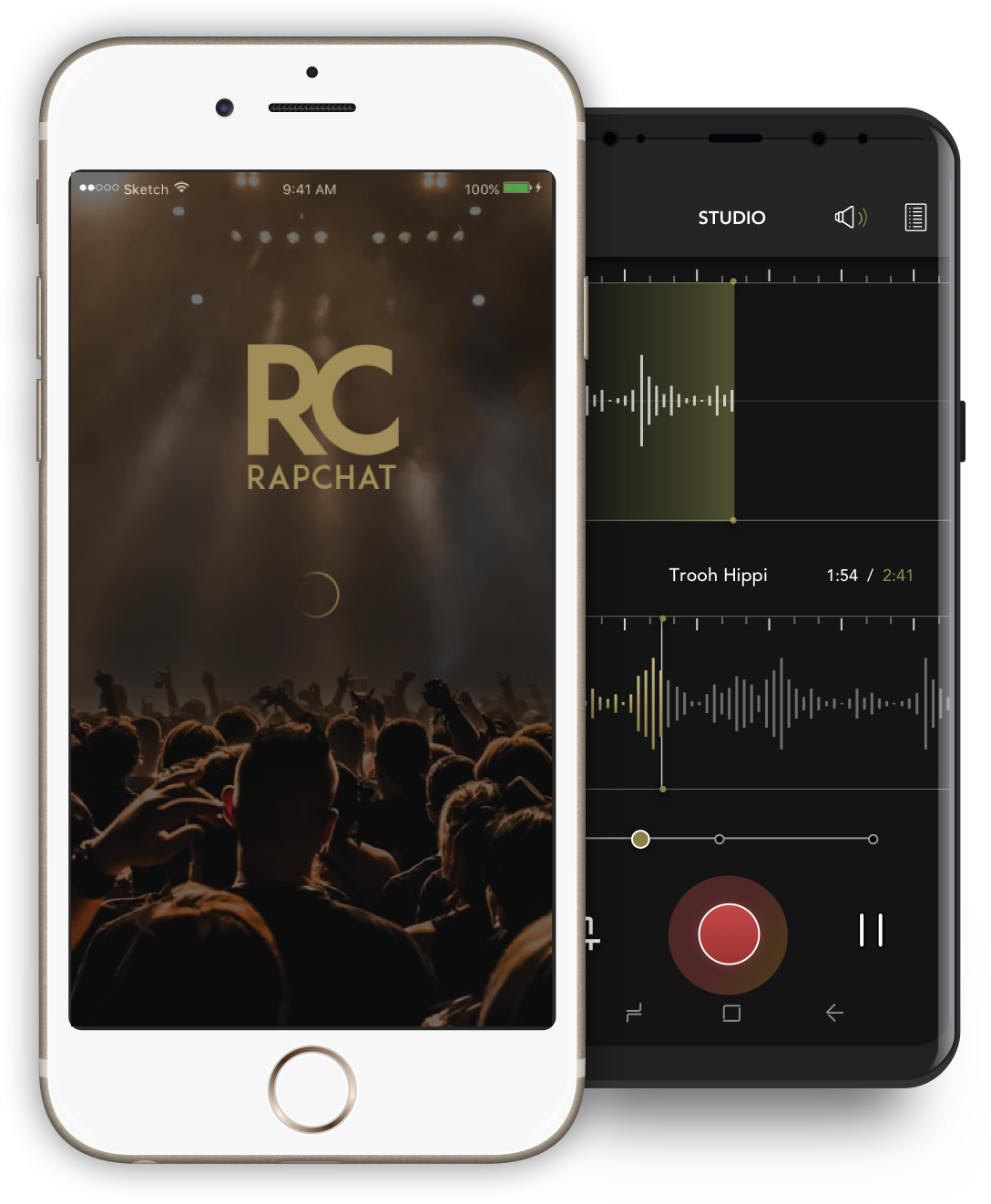
RapChat raises $1.6 million to help you make and share your def jams

The first thing to understand about media sharing app RapChat is that co-founder Seth Miller is not a rapper and his friend, Pat Gibson, is. Together they created RapChat, a service for making and sharing raps, and the conjunction of rapper and nerd seems to be really taking off.

Since we last looked at the app in 2016 (you can see Tito’s review below), a lot has changed. The team has raised $1.6 million in funding from investors out of Oakland and the midwest. Their app, which is sort of a musical.ly for rap, is a top 50 music app on iOS and Android and hit 100 million listens since launch. In short, their little social network/sharing platform is a “millionaire in the making, boss of [its] team, bringin home the bacon.”

The pair’s rap bonafides are genuine. Gibson has opened or performed with with Big Sean, Wiz Khalifa, and Machine Gun Kelly and he’s sold beats to MTV. “My music has garnered over 20M+ plays across YouTube, SoundCloud and more,” he wrote me, boasting in the semi-churlish manner of a rapper with a “beef.” Miller, on the other hand, likes to freestyle.

“I grew up loving to freestyle with friends at OU and I noticed lots of other millennials did this too (even if most suck lol) … at any party at 3am – there would always be a group of people in the corner freestyling,” he said. “At the same time Snapchat was blowing up on campus and just thought you should be able to do the same exact thing for rap.”

Gibson, on the other hand, saw it as a serious tool to help him with his music.

“I spent a lot of time, energy and resources making music,” he said. “I was producing the beats, writing the songs, recording/mixing the vocals, mastering the project, then distributing & promoting the music all by myself. With Rapchat, there’s a library of 1,000+ beats from top producers, an instant recording studio in your pocket, and the network to distribute your music worldwide and be discovered…. all from a free app. Rapchat is disrupting the creation, collaboration, distribution, & discovery of music via mobile

“We have a much bigger but also more active community than any other music creation app,” said Miller.

While it’s clear the wold needs another sharing platform like it needs a hole in the head, thanks to a rabid fanbase and a great idea the team has ensured that RapChat is not, as they say, wicka-wicka-whack. That, in the end, is all that matters.


https://ift.tt/2Ji3xVo RapChat raises $1.6 million to help you make and share your def jams https://ift.tt/2vC9NFs

Deliv now offers same-day delivery for Shopify retailers

Deliv, which partners with retailers like Macy’s, Best Buy and Petsmart to offer same-day delivery, is enabling Shopify retailers to offer scheduled, same-day delivery to customers.

This is thanks to a partnership with Zapiet, a store pickup and local delivery plug-in for Shopify. Zapiet helps Shopify retailers manage store inventories and configure the confines of the deliveries. This greater expansion into small businesses comes a couple of months after Deliv launched DeIiv RX for same-day delivery of prescriptions.

“Part of our business model is we are an assets-free logistics company,” Deliv CEO Daphne Carmeli told TechCrunch. “When it comes to storage, the retailers are one place of where storage is.”

For the retailers without storage of their own, Deliv partners with third parties like on-demand fulfillment startup Darkstore and others. When it comes to actual deliveries, Deliv relies on 1099 contractors. Across all of its 35 markets, Deliv has a network of tens of thousands of delivery drivers on board.

“If you think about us in the world of driving, think of us as the airport shuttle versus the taxi,” Carmeli said. “By definition, if we’re focused on scheduled deliveries, our focus and technology is about adding as many stops to our routes as possible.”

This comes shortly after UberRUSH announced it would be shutting down nationwide.

“It wasn’t a surprise to us,” Carmeli said. “Moving people and moving packages are entirely different and requires very different things.”


https://ift.tt/eA8V8J Deliv now offers same-day delivery for Shopify retailers https://ift.tt/2FaEtNA

Slite raises $4.4M to create a smarter internal notes tool

{rss:content:encoded} Slite raises $4.4M to create a smarter internal notes tool https://ift.tt/2Fa7k4E https://ift.tt/2FddPUA April 23, 2018 at 09:01AM

Slack exposed the demand for a dead-simple internal communications tool, which has inspired a wave of startups trying to pick apart the rest of a company’s daily activities — including Slite, which hopes to take on internal notes with a fresh round of new capital.

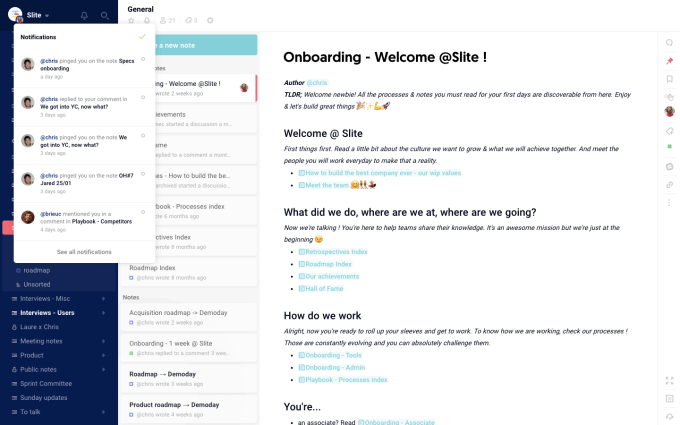
Slite is more or less an attempt at a replacement for a Google Doc or something in Dropbox Paper that is sprawling and getting a little out of control. An employee might create a Slite note like an onboarding manual or an internal contact list, and the hope is to replace the outdated internal wiki and offer employees a hub where they can either go and start stringing together important information, or find it right away. The company today said it has raised $4.4 million in a new seed funding round led by Index Ventures after coming out of Y Combinator’s 2018 winter class. Ari Helgason is joining Slite’s board of directors as part of the deal.

“We now have to develop this product enough to show we can actually replace large amounts of things,” co-founder Christophe Pasquier said. “Today we have more than 300 active teams, and we have to show that we can make it scale. In the short term is just we’re replacing Google Docs because these tools ahven’t evolved and we’re bringing something super fresh. The longer-term vision of really bringing all the information that has value from a team and becoming this single source of truth for teams.”

Slite tracks permissions and changes to the notes in order to allow companies to do a better job of maintaining them, rather than sharing around links and having different people jump in and make changes. The part about sharing links is one in particular that stung for Pasquier, as even larger companies can have issues with employees asking in Slack what policies are — or even for links to parts of the internal wiki where that important information is buried.

Getting there certainly won’t be easy. Companies like Dropbox continuing to invest in these kinds of collaborative note-taking tools — that could easily evolve into internal hubs of information. And as Pasquier tries to liken the development arc to Slack, which showed employees wanted some more seamless tool for communication, that company is also working on making its search tools smarter, like helping employees find the right person to ask a question. It doesn’t look like an asynchronous notes tool just yet, but if all the information is somewhere in Slack already, a smart search tool may be the only thing necessary to find all that information.

Facebook face recognition error looks awkward ahead of GDPR

A Facebook face recognition notification slip-up hints at how risky the company’s approach to compliance with a tough new European data protection standard could turn out to be.

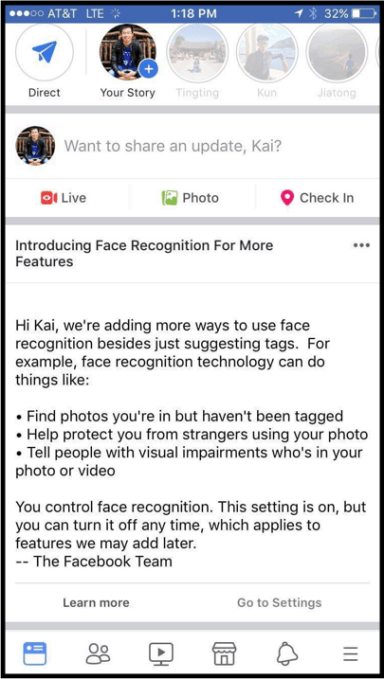
On Friday a Metro journalist in the UK reported receiving a notification about the company’s face recognition technology — which told him “the setting is on”.

The wording was curious as the technology has been switched off in Europe since 2012, after regulatory pressure, and — as part of changes related to its GDPR compliance strategy — Facebook has also said it will be asking European users to choose individually whether or not they want to switch it on. (And on Friday begun rolling out its new consent flow in the region, ahead of the regulation applying next month.)

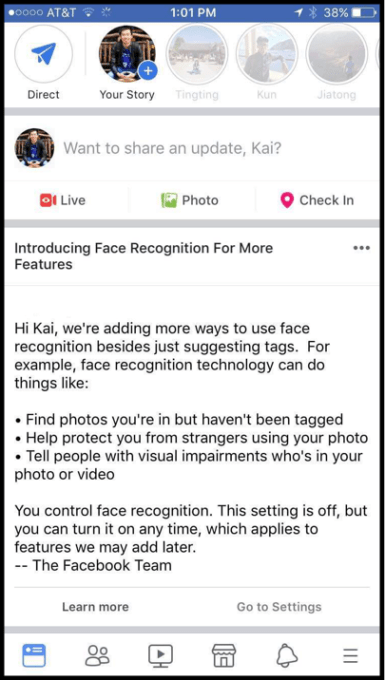
The company has since confirmed to us that the message was sent to the user in error — saying the wording came from an earlier notification which it sent to users who already had its facial recognition tech enabled, starting in December. And that it had intended to send the person a similar notification — containing the opposite notification, i.e. that “the setting is off”.

“We’re asking everyone in the EU whether they want to enable face recognition, and only people who affirmatively give their consent will have these features enabled. We did not intend for anyone in the EU to see this type of message, and we can confirm that this error did not result in face recognition being enabled without the person’s consent,” a Facebook spokesperson told us.

Here are the two notifications in question — showing the setting on vs the setting off wordings:

This is interesting because Facebook has repeatedly refused to confirm it will be universally applying GDPR compliance measures across its entire global user-base.

Instead it has restricted its public commitments to saying the same “settings and controls” will be made available for users — which as we’ve previously pointed out avoids committing the company to a universal application of GDPR principles, such as privacy by design.

Given that Facebook’s facial recognition feature has been switched off in Europe since 2012 “the setting is on” message would presumably have only been sent to users in the US or Canada — where Facebook has been able to forge ahead with pushing people to accept the controversial, privacy-hostile technology, embedding it into features such as auto-tagging for photo uploads.

But it hardly bodes well for Facebook’s compliance with the EU’s strict new data protection standard if its systems are getting confused about whether or not a user is an EU person.

Facebook claims no data was processed without consent as a result of the wrong notification being sent — but under GDPR it could face investigations by data protection authorities seeking to verify whether or not an individual’s rights were violated. (Reminder: GDPR fines can scale as high as 4% of a company’s global annual turnover so privacy enforcement is at last getting teeth.)

Facebook’s appetite for continuing to push privacy hostile features on its user-base is clear. This strategic direction also comes from the very top of the company.

Earlier this month CEO and founder Mark Zuckerberg urged US lawmakers not to impede US companies from be using people’s data for sensitive use-cases like facial recognition — attempting to gloss that tough sell by claiming pro-privacy rules would risk the US falling behind China.

Meanwhile, last week it also emerged that Zuckerberg’s company will switch the location where most international users’ data is processed from its international HQ, Facebook Ireland, to Facebook USA. From next month only EU users will have their data controller located in the EU — other international users, who would have at least technically fallen under GDPR’s reach otherwise, on account of their data being processed in the region, are being shifted out of the EU jurisdiction — via a unilateral T&Cs change.

This move seems intended to try to shrink some of Facebook’s legal liabilities by reducing the number of international users that would, at least technically, fall under the reach of the EU regulation — which both applies to anyone in the EU whose data is being processed and also extends EU fundamental rights extraterritorially, carrying the aforementioned major penalties for violations.

However Facebook’s decision to reduce how many of its users have their data processed in the EU also looks set to raise the stakes — if, as it appears, the company intends to exploit the lack of a comprehensive privacy framework in the US to apply different standards for North American users (and from next month also for non-EU international users, whose data will be processed there).

The problem is, if Facebook does not perform perfect segregation and management of these two separate pools of users it risks accidentally processing the personal data of Europeans in violation of the strict new EU standard, which applies from May 25.

Yet here it is, on the cusp of the new rules, sending the wrong notification and incorrectly telling an EU user that facial recognition is on.

Given how much risk it’s creating for itself by trying to run double standards for data protection you almost have to wonder whether Facebook is trying to engineer in some compliance wiggle room for itself — i.e. by positioning itself to be able to claim that such and such’s data was processed in error.

Another interesting question is whether the unilateral switching of ~1.5BN non-EU international users to Facebook USA as data controller could be interpreted as a data transfer to a third country — which would trigger other data protection requirements under EU law, and further layer on the legal complexity…

What is clear is that legal challenges to Facebook’s self-serving interpretation of EU law are coming.


from Social – TechCrunch https://ift.tt/2HUmjmf Facebook face recognition error looks awkward ahead of GDPR Natasha Lomas https://ift.tt/2qQPnDR
via IFTTT

Mobile guru Amol Sarva talks about the future of work

Amol Sarva has done some amazing stuff. The founder of Virgin Mobile, Sarva went on to create the Peek email device created back when cheap, ubiquitous mobile devices were nowhere to be found. Now he runs Knotel, a unique workspace aimed at up and coming startups.

In this episode of Technotopia I asked Sarva about his thoughts on work, interaction, and the future of offices. In his vision we are all working together remotely using tools that could allow us to all directly interact simply by using our brains. It’s an odd – and cool – idea and he’s a fun interview subject.

Technotopia is a podcast by John Biggs about a better future. You can subscribe in Stitcher, RSS, or iTunes and listen the MP3 here.


https://ift.tt/eA8V8J Mobile guru Amol Sarva talks about the future of work https://ift.tt/2HWdd8Q

Netflix looks to raise $1.5 billion in debt financing

In the span of 20 years, Netflix has gone from a (super convenient) Blockbuster knockoff to one of the most powerful players in media. Partially, that’s credited to Netflix’s technology, bringing streaming content to the mainstream. But Netflix’s success is also owed in part to its willingness to invest in its content library.

Netflix continues that investment today with the announcement that it will raise another $1.5 billion in debt.

From the official statement:

Netflix intends to use the net proceeds from this offering for general corporate purposes, which may
include content acquisitions, production and development, capital expenditures, investments, working
capital and potential acquisitions and strategic transactions.

While that might sound vague, Netflix is most certainly going to invest this capital in original content, as it has with earlier debt capital.

In fact, this is not a new strategy from Netflix. The company has raised many billions in debt to accelerate its push into original content.

The announcement comes shortly after a stellar Q1 earnings report, with 7.41 million new streaming subscribers, outperforming estimates and handily beating out last year’s growth of 4.95 million new subscribers. In total, Netflix now has 125 million subscribers across the globe.


https://ift.tt/eA8V8J Netflix looks to raise $1.5 billion in debt financing https://ift.tt/2K86FUZ

Let’s meet today in New York for some ICO talk

I’ll be helping build a larger meetup focused on pre-ICO companies in New York on April 23 and I’d love to see you there. It will be held at Knotel on April 23 at 7pm and will feature a pitch-off with eight startups — I will write about the best ones — and two panels with some yet-unnamed stars in the space.

I’d love to see you there, so please sign up here. We’ll have some beers and pizza for the attendees.

The event will be held at 551 Fifth Avenue on the 9th Floor. See you tonight!


https://ift.tt/eA8V8J Let’s meet today in New York for some ICO talk https://ift.tt/2HVbArY

Slite raises $4.4M to create a smarter internal notes tool

Slack exposed the demand for a dead-simple internal communications tool, which has inspired a wave of startups trying to pick apart the rest of a company’s daily activities — including Slite, which hopes to take on internal notes with a fresh round of new capital.

Slite is more or less an attempt at a replacement for a Google Doc or something in Dropbox Paper that is sprawling and getting a little out of control. An employee might create a Slite note like an onboarding manual or an internal contact list, and the hope is to replace the outdated internal wiki and offer employees a hub where they can either go and start stringing together important information, or find it right away. The company today said it has raised $4.4 million in a new seed funding round led by Index Ventures after coming out of Y Combinator’s 2018 winter class. Ari Helgason is joining Slite’s board of directors as part of the deal.

“We now have to develop this product enough to show we can actually replace large amounts of things,” co-founder Christophe Pasquier said. “Today we have more than 300 active teams, and we have to show that we can make it scale. In the short term is just we’re replacing Google Docs because these tools ahven’t evolved and we’re bringing something super fresh. The longer-term vision of really bringing all the information that has value from a team and becoming this single source of truth for teams.”

Slite tracks permissions and changes to the notes in order to allow companies to do a better job of maintaining them, rather than sharing around links and having different people jump in and make changes. The part about sharing links is one in particular that stung for Pasquier, as even larger companies can have issues with employees asking in Slack what policies are — or even for links to parts of the internal wiki where that important information is buried.

Getting there certainly won’t be easy. Companies like Dropbox continuing to invest in these kinds of collaborative note-taking tools — that could easily evolve into internal hubs of information. And as Pasquier tries to liken the development arc to Slack, which showed employees wanted some more seamless tool for communication, that company is also working on making its search tools smarter, like helping employees find the right person to ask a question. It doesn’t look like an asynchronous notes tool just yet, but if all the information is somewhere in Slack already, a smart search tool may be the only thing necessary to find all that information.


https://ift.tt/2FddPUA Slite raises $4.4M to create a smarter internal notes tool https://ift.tt/2Fa7k4E

Facebook hit with defamation lawsuit over fake ads

In an interesting twist, Facebook is being sued in the UK for defamation by consumer advice personality, Martin Lewis, who says his face and name have been repeatedly used on fake adverts distributed on the social media giant’s platform.

Lewis, who founded the popular MoneySavingExpert.com tips website, says Facebook has failed to stop the fake ads despite repeat complaints and action on his part, thereby — he contends — tarnishing his reputation and causing victims to be lured into costly scams.

“It is consistent, it is repeated. Other companies such as Outbrain who have run these adverts have taken them down. What is particularly pernicious about Facebook is that it says the onus is on me, so I have spent time and effort and stress repeatedly to have them taken down,” Lewis told The Guardian.

“It is facilitating scams on a constant basis in a morally repugnant way. If Mark Zuckerburg wants to be the champion of moral causes, then he needs to stop its company doing this.”

In a blog post Lewis also argues it should not be difficult for Facebook — “a leader in face and text recognition” — to prevent scammers from misappropriating his image.

“I don’t do adverts. I’ve told Facebook that. Any ad with my picture or name in is without my permission. I’ve asked it not to publish them, or at least to check their legitimacy with me before publishing. This shouldn’t be difficult,” he writes. “Yet it simply continues to repeatedly publish these adverts and then relies on me to report them, once the damage has been done.”

“Enough is enough. I’ve been fighting for over a year to stop Facebook letting scammers use my name and face to rip off vulnerable people – yet it continues. I feel sick each time I hear of another victim being conned because of trust they wrongly thought they were placing in me. One lady had over £100,000 taken from her,” he adds.

Some of the fake ads appear to be related to cryptocurrency scams — linking through to fake news articles promising “revolutionary Bitcoin home-based opportunity”.

So the scammers look to be using the same playbook as the Macedonian teens who, in 2016, concocted fake news stories about US politics to generate a mint in ad clicks — also relying on Facebook’s platform to distribute their fakes and scale the scam.

In January Facebook revised its ads policy to specifically ban cryptocurrency, binary options and initial coin offerings. But as Lewis’ samples show, the scammers are circumventing this prohibition with ease — using Lewis’ image to drive unwitting clicks to a secondary offsite layer of fake news articles that directly push people towards crypto scams.

It would appear that Facebook does nothing to verify the sites to which ads on its platform are directing its users, just as it does not appear to proactive police whether ad creative is legal — at least unless nudity is involved.

Here’s one sample fake ad that Lewis highlights:

And here’s the fake news article it links to — touting a “revolutionary” Bitcoin opportunity, in a news article style mocked up to look like the Daily Mirror newspaper…

The lawsuit is a personal action by Lewis who is seeking exemplary damages in the high court. He says he’s not looking to profit himself — saying he would donate any winnings to charities that aim to combat fraud. Rather he says he’s taking the action in the hopes the publicity will spotlight the problem and force Facebook to stamp out fake ads.

In a statement, Mark Lewis of the law firm Seddons, which Lewis has engaged for the action, said: “Facebook is not above the law – it cannot hide outside the UK and think that it is untouchable.  Exemplary damages are being sought. This means we will ask the court to ensure they are substantial enough that Facebook can’t simply see paying out damages as just the ‘cost of business’ and carry on regardless. It needs to be shown that the price of causing misery is very high.”

In a response statement to the suit, a Facebook spokesperson told us: “We do not allow adverts which are misleading or false on Facebook and have explained to Martin Lewis that he should report any adverts that infringe his rights and they will be removed. We are in direct contact with his team, offering to help and promptly investigating their requests, and only last week confirmed that several adverts and accounts that violated our Advertising Policies had been taken down.”

Facebook’s ad guidelines do indeed prohibit ads that contain “deceptive, false, or misleading content, including deceptive claims, offers, or business practices” — and, as noted above, they also specifically prohibit cryptocurrency-related ads.

But, as is increasingly evident where big tech platforms are concerned, meaningful enforcement of existing policies is what’s sorely lacking.

The social behemoth claims to have invested significant resources in its ad review program — which includes both automated and manual review of ads. Though it also relies on users reporting problem content, thereby shifting the burden of actively policing content its systems are algorithmically distributing and monetizing (at massive scale) onto individual users (who are, by the by, not being paid for all this content review labor… hmmm… ).

In Lewis’ case the burden is clearly also highly personal, given the fake ads are not just dodgy content but are directly misappropriating his image and name in an attempt to sell a scam.

“On a personal note, as well as the huge amount of time, stress and effort it takes to continually combat these scams, this whole episode has been extremely depressing – to see my reputation besmirched by such a big company, out of an unending greed to keep raking in its ad cash,” he also writes.

The sheer scale of Facebook’s platform — which now has more than 2BN active users globally — contrasts awkwardly with the far smaller number of people the company employs for content moderation tasks.

And unsurprisingly, given that huge discrepancy, Facebook has been facing increasing pressure over various types of problem content in recent years — from Kremlin propaganda to hate speech in Myanmar.

Last year it told US lawmakers it would be increasing the number of staff working on safety and security issues from 10,000 to 20,000 by the end of this year. Which is still a tiny drop in the ocean of content distributed daily on its platform. We’ve asked how many people work in Facebook’s ad review team specifically and will update this post with any response.

Given the sheer scale of content continuously generated by a 2BN+ user-base, combined with a platform structure that typically allows for instant uploads, a truly robust enforcement of Facebook’s own policies is going to require legislative intervention.

And, in the meanwhile, Facebook operating a policy that’s essentially unenforceable risks looking intentional — given how much profit the company continues to generate by being able to claim it’s just a platform, rather than be ruled like a publisher.


from Social – TechCrunch https://ift.tt/2HShIku Facebook hit with defamation lawsuit over fake ads Natasha Lomas https://ift.tt/2HKDhWw
via IFTTT

Sunday, April 22, 2018

Google confirms some of its own services are now getting blocked in Russia over the Telegram ban

A shower of paper airplanes darted through the skies of Moscow and other towns in Russia today, as users answered the call of entrepreneur Pavel Durov to send the blank missives out of their windows at a pre-appointed time in support of Telegram, a messaging app he founded that was blocked last week by Russian regulator Roskomnadzor (RKN) that uses a paper airplane icon. RKN believes the service is violating national laws by failing to provide it with encryption keys to access messages on the service (Telegram has refused to comply).

The paper plane send-off was a small, flashmob turn in a “Digital Resistance” — Durov’s preferred term — that has otherwise largely been played out online: currently, nearly 18 million IP addresses are knocked out. And in the latest development, Google has now confirmed to us that its own services are now also being impacted.

From what we understand, Google Search, Gmail and push notifications for Android apps are among the products being affected.

“We are aware of reports that some users in Russia are unable to access some Google products, and are investigating those reports,” said a Google spokesperson in an emailed response. We’ve been trying to contact Google all week about the Telegram blockade, and this is the first time that the company has both replied and acknowledged something related to it.

(Amazon has acknowledged our messages but has yet to reply to them.)

Google’s comments come on the heels of RKN itself also announcing today that it had expanded its IP blocks to Google’s services. At its peak, RKN had blocked nearly 19 million IP addresses, with dozens of third-party services that also use Google Cloud and Amazon’s AWS, such as Twitch and Spotify, also getting caught in the crossfire,

Russia is among the countries in the world that has enforced a kind of digital firewall, blocking periodically or permanently certain online content. Some turn to VPNs to access that content anyway, but it turns out that Telegram hasn’t needed to rely on that workaround to get used.

“RKN is embarrassingly bad at blocking Telegram, so most people keep using it without any intermediaries,” said Ilya Andreev, COO and co-founder of Vee Security, which has been providing a proxy service to bypass the ban. Currently, it is supporting up to 2 million users simultaneously, although this is a relatively small proportion considering Telegram has around 14 million users in the country (and, likely, more considering all the free publicity it’s been getting).

As we described earlier this week, the reason so many IP addresses are getting blocked is because Telegram has been using a technique that allows it to “hop” to a new IP address when the one that it’s using is blocked from getting accessed by RKN. It’s a technique that a much smaller app, Zello, had also resorted to using for nearly a year when the RKN announced its own ban.

Zello ceased its activities when RKN got wise to Zello’s ways and chose to start blocking entire subnetworks of IP addresses to avoid so many hops, and Amazon’s AWS and Google Cloud kindly asked Zello to stop as other services also started to get blocked. So, when Telegram started the same kind of hopping, RKN, in effect, knew just what to do to turn the screws.

So far Telegram’s cloud partners have held strong and have not taken the same route, although getting its own services blocked could see Google’s resolve tested at a new level.

Some believe that one outcome could be the regulator playing out an elaborate game of chicken with Telegram and the rest of the internet companies that are in some way aiding and abetting it, spurred in part by Russia’s larger profile and how such blocks would appear to international audiences.

“Russia can’t keep blocking random things on the Internet,” Andreev said. “Russia is working hard to make its image more alluring to foreigners in preparation for the World Cup,” which is taking place this June and July. “They can’t have tourists coming and realising Google doesn’t work in Russia.”


We’ll update this post and continue to write on further developments as we learn more.


from Social – TechCrunch https://ift.tt/eA8V8J Google confirms some of its own services are now getting blocked in Russia over the Telegram ban Ingrid Lunden https://ift.tt/2F8cL40
via IFTTT

blogger better Headline Animator