l
l
blogger better. Powered by Blogger.

Search

Labels

blogger better

Followers

Blog Archive

Total Pageviews

Labels

Download

Blogroll

Featured 1

Curabitur et lectus vitae purus tincidunt laoreet sit amet ac ipsum. Proin tincidunt mattis nisi a scelerisque. Aliquam placerat dapibus eros non ullamcorper. Integer interdum ullamcorper venenatis. Pellentesque habitant morbi tristique senectus et netus et malesuada fames ac turpis egestas.

Featured 2

Curabitur et lectus vitae purus tincidunt laoreet sit amet ac ipsum. Proin tincidunt mattis nisi a scelerisque. Aliquam placerat dapibus eros non ullamcorper. Integer interdum ullamcorper venenatis. Pellentesque habitant morbi tristique senectus et netus et malesuada fames ac turpis egestas.

Featured 3

Curabitur et lectus vitae purus tincidunt laoreet sit amet ac ipsum. Proin tincidunt mattis nisi a scelerisque. Aliquam placerat dapibus eros non ullamcorper. Integer interdum ullamcorper venenatis. Pellentesque habitant morbi tristique senectus et netus et malesuada fames ac turpis egestas.

Featured 4

Curabitur et lectus vitae purus tincidunt laoreet sit amet ac ipsum. Proin tincidunt mattis nisi a scelerisque. Aliquam placerat dapibus eros non ullamcorper. Integer interdum ullamcorper venenatis. Pellentesque habitant morbi tristique senectus et netus et malesuada fames ac turpis egestas.

Featured 5

Curabitur et lectus vitae purus tincidunt laoreet sit amet ac ipsum. Proin tincidunt mattis nisi a scelerisque. Aliquam placerat dapibus eros non ullamcorper. Integer interdum ullamcorper venenatis. Pellentesque habitant morbi tristique senectus et netus et malesuada fames ac turpis egestas.

Tuesday, October 9, 2018

Comparing Google Home Hub vs Amazon Echo Show 2 vs Facebook Portal

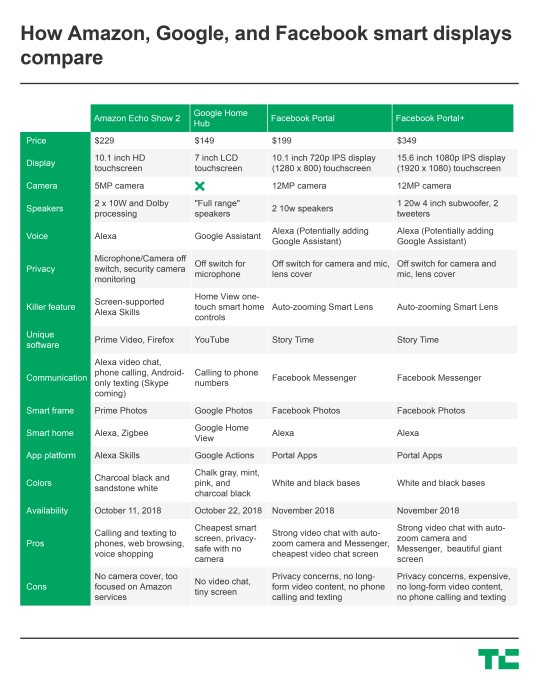
The war for the countertop has begun. Google, Amazon, and Facebook all revealed their new smart displays this month. Each hopes to become the center of your internet of things-equipped home and a window to your loved ones. The $149 Google Home Hub is  cheap and privacy-safe smart home controller. The $229 Amazon Echo Show 2 gives Alexa a visual complement. And the $199 Facebook Portal and $349 Portal+ offer a Smart Lens that automatically zooms in and out to keep you in frame while you video chat.

For consumers, the biggest questions to consider are how much you care about privacy, whether you really video chat, which smart home ecosystem you’re building around, and how much you want to spend.

  • For the privacy obsessed, Google’s Home Hub is the only one without a camera and it’s dirt cheap at $149.
  • For the privacy agnostic, Facebook’s Portal+ offers the best screen and video chat functionality
  • For the chatty, Amazon Echo Show 2 can do message and video chat over Alexa, call phone numbers, and is adding Skype

If you want to go off-brand, there’s also the Lenovo Smart Display with stylish hardware in a $249 10-inch 1080p version and a $199 8-inch 720p version. And for the audiophile, there’s the $199 JBL Link View. While those hit the market earlier than the platform-owned versions we’re reviewing here, they’re not likely to benefit from the constant iteration Google, Amazon, and Facebook are working on for their tabletop screens.

Here’s a comparison of the top smart displays, including their hardware specs, unique software, killer features, and pros and cons:


from Social – TechCrunch https://ift.tt/2IKLgkF Comparing Google Home Hub vs Amazon Echo Show 2 vs Facebook Portal Josh Constine https://ift.tt/2pLHBdK
via IFTTT

Making A Murderer returns on October 18

Making A Murderer is coming back to Netflix on October 18.

In 2015, Netflix released the 10-episode docuseries Making A Murderer, created by Laura Ricciardi and Moira Demos. The picture looked at the mystery surrounding the murder of Teresa Halbach. Steven Avery, a Manitowoc County man charged with the murder in 2007, was wrongfully convicted of sexual assault at the age of 22, and was exonerated by DNA evidence after serving 18 years in prison.

Making A Murderer examined the original allegations, the events surrounding the murder of Teresa Halbach, all laid within the context of Avery’s wrongful conviction and subsequent lawsuit against Manitowoc County.

The docuseries quickly gripped the attention of millions.

The trailer for Making A Murderer Part 2 shows attorney Kathleen Zellner joining Avery’s team as they seek to appeal the 2007 conviction.

You can check out the full trailer below. The series returns October 18.


https://ift.tt/eA8V8J Making A Murderer returns on October 18 https://ift.tt/2y6eaaI

Emmanuel Macron meets with the French tech community

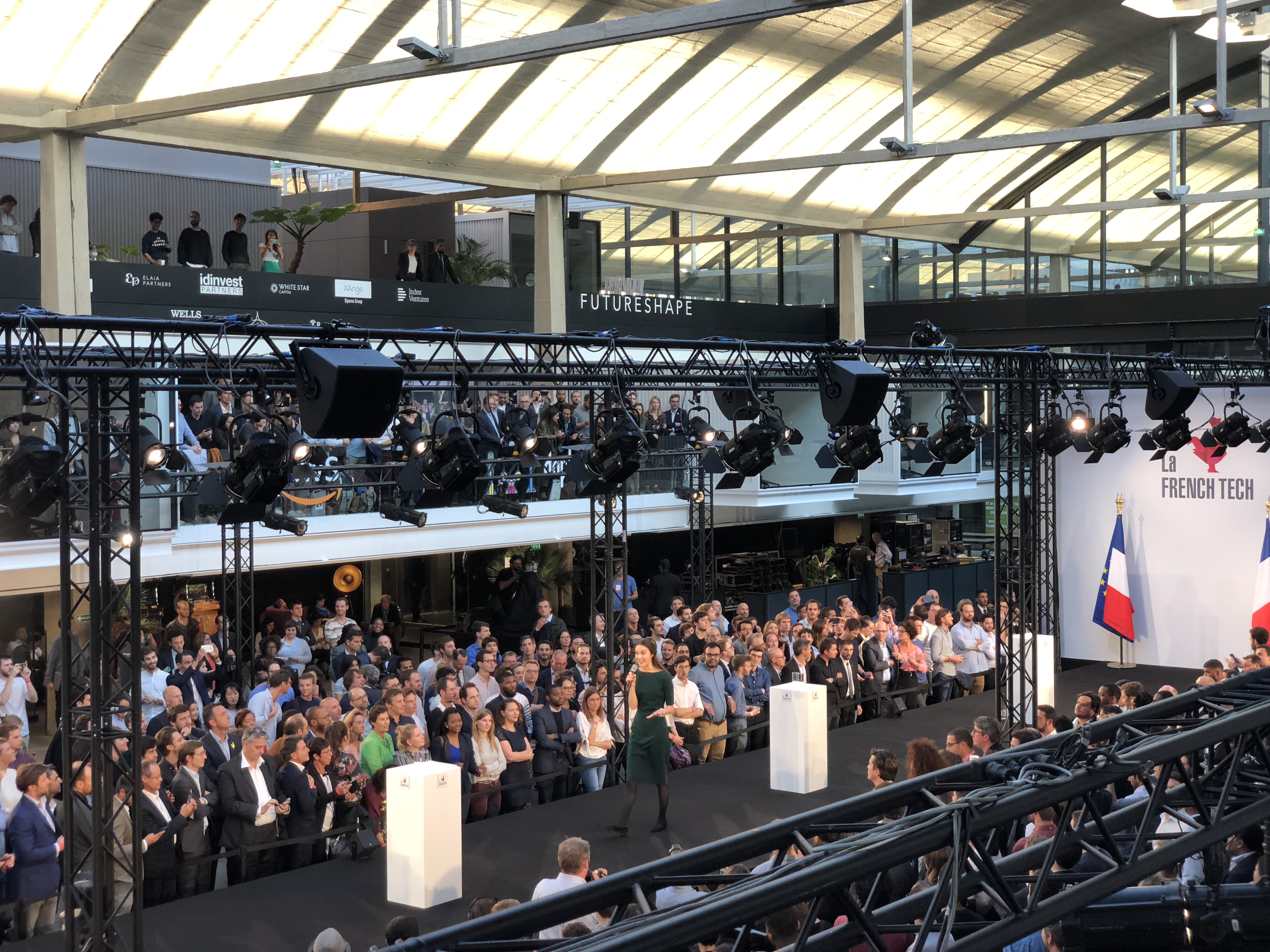
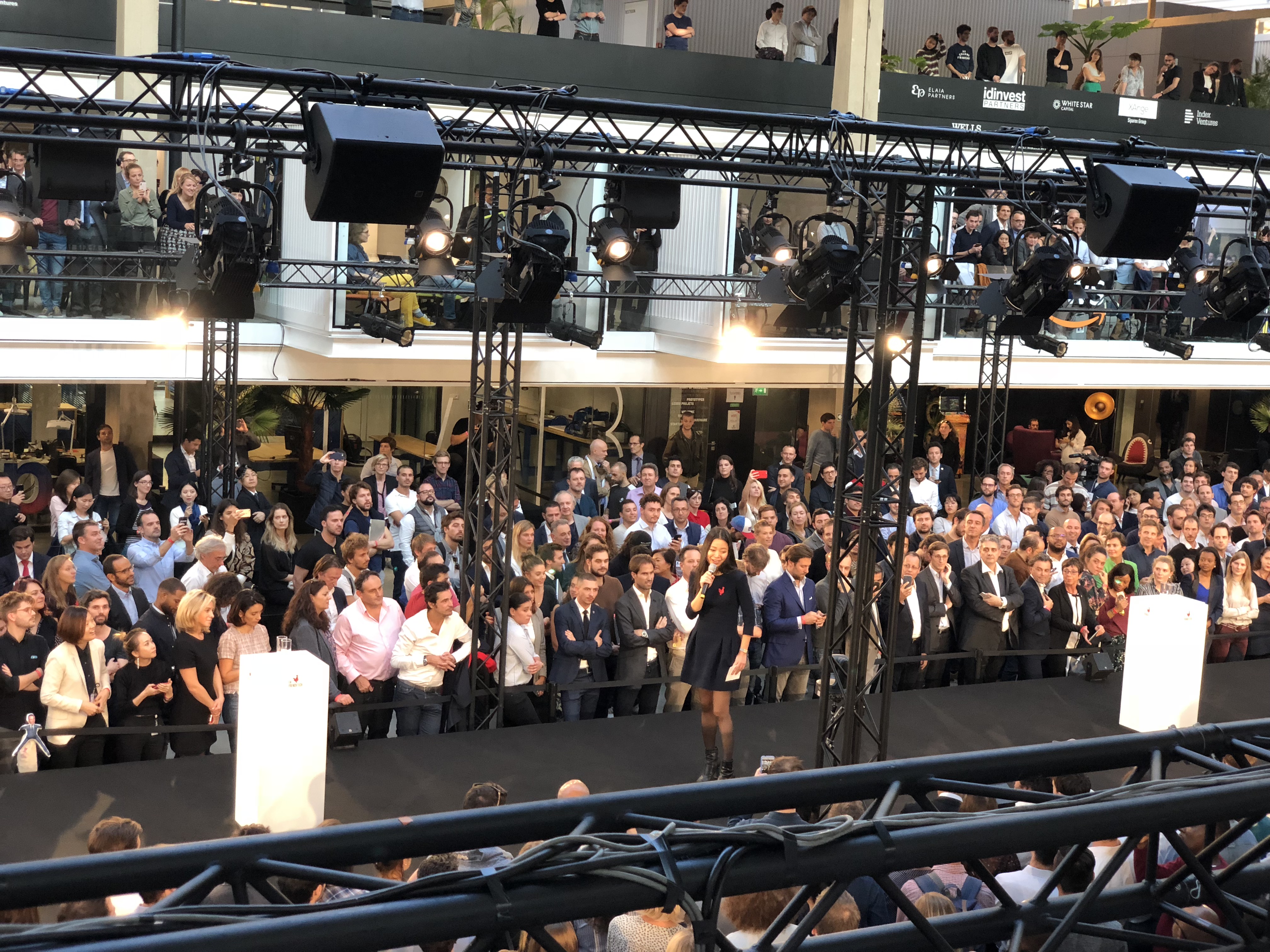
Emmanuel Macron came to France’s ginormous startup campus Station F to talk to the French tech community. The event is organized by La French Tech, the government initiative to promote and foster the startup community in France.

Station F director Roxanne Varza first took the stage to introduce the event. She announced that there will be more startups in the Fighters Program. Station F has created this program so that entrepreneurs from diverse backgrounds get a chance to relocate to Station F.

La French Tech new director Kat Borlongan then talked for a few minutes about the public initiative. “My firm belief is that La French Tech should operate just like all the startups in this room today,” she said.

According to her, it means that La French Tech should think about its users first, have a data-driven approach, and test and iterate.

Emmanuel Macron gave a very short speech and then held a Q&A sessions with tech entrepreneurs. This is a surprising format for Macron.

He mostly reassured entrepreneurs that things are changing and France is on the right path. He announced that the French Tech Visa would be simplified by March 2019.

Some entrepreneurs said there were paying too many taxes to hire talent in France. Macron refuted that. “I like to compare a researcher in Harvard with a researcher in France,” he said. “[In France], school is free and excellent, healthcare is free, there's a retirement system. On the other side, there's nothing.”

He also promised stronger antitrust rules at the European level. Tech giants sometimes dominate in Europe living no room for competition.

Macron finished by saying that tech companies also need to promote France’s system. They need to pay fair taxes, they need to think about tech’s effect on society. “I know one thing, the system will implode if you’re not responsible enough,” he said.

Things have changed in just over a year. When Macron first came to Station F for its grand opening, it was shortly after the elections. He was a popular President.

Now, most people dislike him, just like his predecessors François Hollande and Nicolas Sarkozy when they were in office. According to a source, he even thought about canceling today’s event given that he’s about to appoint some new faces in his government.

But Macron built his reputation on the so-called startup nation. He first became a public figure thanks to a grassroots approach built on top of the startup community. That’s why the startup community is still overwhelmingly in favor of Macron’s policies. And yet, there’s now a clear divide between the startup nation and the middle class at large, who think the President is out of touch and doesn’t care about them.


https://ift.tt/2PsGTNP Emmanuel Macron meets with the French tech community https://ift.tt/2pIWY6D

Google partners with tech retailer b8ta to let people demo smart home products

Try before you buy is the new name of the game. With items costing upwards of $100, people want to know what they’re getting themselves into before they commit to a costly gizmo — at least that’s what Google is betting on right now. Aligned with Google’s Made by Google event, the company is partnering with startup b8ta to create an interactive experience around its products.

These experiences are live at seven of b8ta’s flagship locations, which enable people to try out new tech products. Each demo experience is modeled after the different rooms of a home — living room, kitchen, home office and so on.

“We’re excited that Made by Google products are now available in the majority of b8ta locations across the country,” Google Director of Retail Marketing Janell Fischer said in a statement. “We’re always looking to make it easier for customers to try and shop our products, and this is a great example of that coming to life.”

It’s been a big year for b8ta. In April, the startup unveiled a Shopify-like solution for retailers called Built by b8ta, with Netgear as one of its first customers. Then, in June, Macy’s partnered with b8ta to enhance its experiential-based retail concept and went on to lead the startup’s $19 million Series B round.


https://ift.tt/eA8V8J Google partners with tech retailer b8ta to let people demo smart home products https://ift.tt/2Cy5jlR

Google Lens comes to the Pixel 3 camera, can identify products

{rss:content:encoded} Google Lens comes to the Pixel 3 camera, can identify products https://ift.tt/2A0rWNp https://ift.tt/2Cy6oKK October 09, 2018 at 06:25PM

Google Lens, the technology that combines the smartphone camera’s ability to see the world around you with A.I. technology, is coming to the Pixel 3 camera, Google announced this morning. That means you’ll be able to point your phone’s camera at something – like a movie poster to get local theater listings, or even look up at actor’s bio, or to translate a sign in another language – and see results right in the camera app itself.

The integration is thanks to Google’s investment in A.I. technologies, something that was the underlying tie to everything Google announced today at its hardware event.

Lens, in particular, was first shown off at Google I/O back in 2017, before rolling out to new products like Google Image Search just weeks ago. Now, it’s in the camera itself – the most obvious place for the technology.

With Lens, you can point your camera at a takeout menu, Google says, and it will highlight the number to call.

Another feature is centered around shopping. With a long press, you can have Lens identify a product the camera sees in the viewfinder, and have it match it to real products. This is called “Style Search,” Google says.

As Google explained at the event, you can point your Pixel 3 camera at a friend’s cool new pair of sunglasses or some shoes you like in a magazine, and Lens will point you to where you can find them online and browse similar styles. The feature is similar to Pinterest’s visual search, which has been available for some time.

Also of note, Lens will be able to take some of its more common actions instantly in the camera, without the need for a data connection.

Google says this is possible by combining Pixel’s visual core with its years of work in search and computer vision.

“Being able to search the world around you is the next logical step and organizing the world’s information and making it more useful for people,” said Brian Rakowski, VP Product Management at Google.


Google unveils the Pixel 3 XL, with a 6.3-inch screen and an $899 price tag

{rss:content:encoded} Google unveils the Pixel 3 XL, with a 6.3-inch screen and an $899 price tag https://ift.tt/2IOcfeU https://ift.tt/2C4x9VX October 09, 2018 at 06:20PM

As part of this morning’s official unveiling of the Pixel 3, Google also announced its larger sibling, the Pixel 3 XL.

The news wasn’t a surprise, given the photos that leaked months ago (something that Google itself acknowledged by kicking off the event with a little montage of videos responding to early details). And Engadget’s Richard Lai had already gotten his hands on the phone in Hong Kong.

But what hadn’t actual come out were the details from the company tiself. As the name implies, a bigger version of the Pixel 3 (which has a 5.5 inch screen), with a 6.30inch screen. Google’s Liza Ma said the company was working to create an “edge-to-edge viewing experience” with a better screen-to-body ratio than previous screens.

One of the big selling points emphasized in Google’s presentation is the camera, including the Top Shot capability, which captures a number of alternate images when you take a photo, so you’re less likely to be cursing your timing if it isn’t just right. Naturally, all of that will be included in the Pixel 3 XL as well, along with other new features like call screening.

Pricing for the Pixel 3 XL starts at $899 and will arrive in the United States on October 18.

more Google Event 2018 coverage

Instagram’s app-based 2FA is live now, here’s how to turn it on

If you’d like to be sure you’re the only one posting elaborately staged yet casual selfies to your Instagram feed, there’s now a powerful new option to help you keep your account safe.

In late September, Instagram announced that it would be adding non SMS-based two-factor authentication to the app. Instagram confirmed to TechCrunch that the company rolled out the security feature last week and that non-SMS two-factor authentication is live now for all users.

Enabling two-factor authentication (2FA) adds an additional “check” to an account so you can be sure you’re the only one who can log in. Instagram previously only offered less secure SMS-based 2FA, which is vulnerable to SIM hijacking attacks but still better than nothing.

Now, the app supports authenticator apps that generate a code or send a user a prompt in order to prove that they are in fact the authorized account holder. When it’s available, enabling 2FA is one of the easiest, most robust basic security precautions anyone can take to protect any kind of account.

If you’d like to enable app-based 2FA now, and you really should, here’s how to do it.

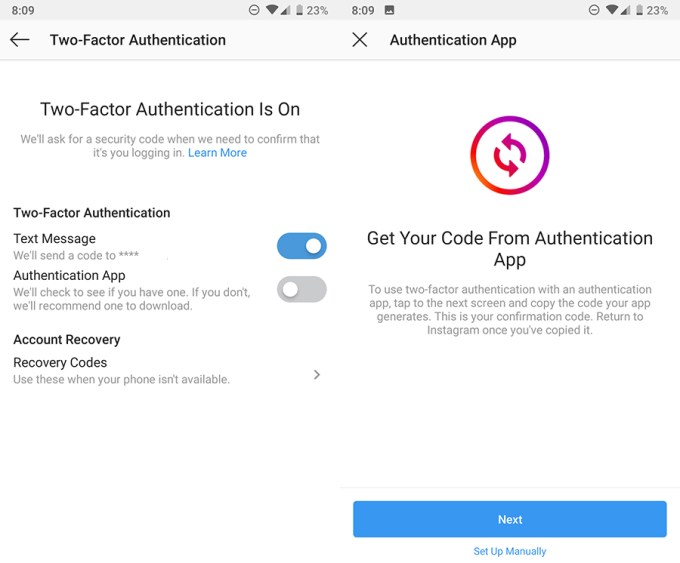
Open Instagram and navigate to the Settings menu. Scroll down into the Privacy and Security section and select Two-Factor Authentication. There, you’ll see two toggle options: Text Message and Authentication App. Choose Authentication App. On the next screen, Instagram will either detect existing authentication apps on your device, invite you to download one (Google Authenticator by default, Authy is a fine option too) or allow you to set up 2FA manually. Follow whichever option works best for you.

You’ll be asked to authenticate the device you’re on now, but you won’t have to do this every time for trusted devices once they have been authenticated. See? Not so bad. It was a long time for such a popular, well-resourced app to leave users unprotected by proper 2FA, but we’re glad it’s here now.

Additional reporting by Sarah Perez.


from Social – TechCrunch https://ift.tt/2Eij5L4 Instagram’s app-based 2FA is live now, here’s how to turn it on Taylor Hatmaker https://ift.tt/2RzFOFn
via IFTTT

Google’s Pixel phones will soon get mobile Smart Compose in Gmail

{rss:content:encoded} Google’s Pixel phones will soon get mobile Smart Compose in Gmail https://ift.tt/2IOXFUQ https://ift.tt/2C4x9VX October 09, 2018 at 05:22PM

Google today announced that its Pixel phones will soon get support for Smart Compose in Gmail. Smart Compose automatically finishes your sentences for you as you type, based on what Google knows about how you and others write similar sentences. Smart Compose can also auto-complete addresses for you.

Google first launched this feature with its redesigned Gmail for the web, but it’s now bringing this to mobile, too. On mobile, of course, a feature like this is even more interesting since typing on mobile is obviously harder. Google says that on the web, Smart Compose is already saving people a billion characters of typing per week.

It’s interesting that Google is launching this feature first on its Pixel phones. Maybe that’s because those phones also feature Google’s own AI chip.

In my own experience, Smart Compose is great when it works. Too often, it still doesn’t, but the good thing is that you can always ignore it and go your merry way without Smart Compose’s suggestions getting in your way.

Google did not say when this feature would launch, but chances are it’ll go live in the next few days or weeks.

more Google Event 2018 coverage

China’s fast-rising Bullet Messenger hit with copyright complaint

Bullet Messenger, a fast-rising Chinese messaging upstart that’s gunning to take on local behemoth, WeChat, has been pulled from the iOS App Store owing to what its owners couch as a copyright complaint.

Reuters reported the development earlier, saying Bullet’s owner, Beijing-based Kuairu Technology, claimed in a social media posting that the app had been taken down from Apple’s app store because of a complaint related to image content provided by a partner.

“We are verifying the situation with the partner and will inform you as soon as possible when download capabilities are resumed,” it said in a statement on its official Weibo account.

The company did not specify which part of the app has been subject to a complaint.

We’ve reached out to Apple to ask if it can provide any more details.

According to checks by Reuters earlier today, the Bullet Messenger app was still available on China’s top Android app stores — including stores owned by WeChat owner Tencent, as well as Baidu and Xiaomi stores — which the news agency suggests makes it less likely the app has been pulled from iOS as a result of censorship by the state, saying apps targeted by regulators generally disappear from local app stores too.

Bullet Messenger only launched in August but quickly racked up four million users in just over a week, and also snagged $22M in funding.

By September it had claimed seven million users, and Chinese smartphone maker Smartisan — an investor in Bullet — said it planned to spend 1 billion yuan (~$146M) over the next six months in a bid to reach 100M users. Though in a battle with a competitive Goliath like WeChat (1BN+ active users) that would still be a relative minnow.

The upstart messenger has grabbed attention with its fast growth, apparently attracting users via its relatively minimal messaging interface and a feature that enables speech-to-text transcription text in real time.

Albeit the app has also raised eyebrows for allowing pornographic content to be passed around.

It’s possible that element of the app caught the attention of Chinese authorities which have been cracking down on Internet porn in recent years — even including non-visual content (such as ASMR) which local regulators have also judged to be obscene.

Although it’s equally possible Apple itself is responding to a porn complaint about Bullet’s iOS app.

Earlier this year the Telegram messaging app fell foul of the App Store rules and was temporarily pulled, as a result of what its founder described as “inappropriate content”.

Apple’s developer guidelines for iOS apps include a section on safety that proscribes “upsetting or offensive content” — including frowning on: “Apps with user-generated content or services that end up being used primarily for pornographic content.”

In Telegram’s case, the App Store banishment was soon resolved.

There’s nothing currently to suggest that Bullet’s app won’t also soon be restored.


from Social – TechCrunch https://ift.tt/eA8V8J China’s fast-rising Bullet Messenger hit with copyright complaint Natasha Lomas https://ift.tt/2C5Wwqv
via IFTTT

The Wing, a co-working space for women, opens its doors in San Francisco

Women-focused co-working space The Wing has made its way to California, opening its first of two planned locations in the state this morning.

On Sansome Street in San Francisco’s Financial District, The Wing hopes to attract professional women able to shell out $215 per month for access to its 8,000-square-foot workspace, which is complete with conference rooms, a cafe, a library stocked with books on feminist theory, a lactation room and more.

In addition to its chic decor and feminist messaging, The Wing is also known for its programming. Headquartered in New York City, where the company operates three of its four existing spaces, The Wing has hosted events with former Secretary of State Hillary Clinton, actress Jennifer Lawrence and New York Senator Kirsten Gillibrand, to name a few. The San Francisco location will be no different.

A spokesperson for The Wing tells me they have a fully booked calendar of politics, tech, entertainment and lifestyle-focused events prepped for members. In the first month, San Francisco Mayor London Breed will stop by, as will Democratic House Minority Leader Nancy Pelosi and Oakland Mayor Libby Schaaf.

[gallery ids="1729017,1729018,1729019,1729020,1729021"]

As a brand founded by women — Audrey Gelman and Lauren Kassan — and inspired by the women’s club movement of the 19th century, The Wing and its majority female staff very carefully and skillfully practice what they preach. In building their spaces, for example, they hire female architects to design and perfect the location. Their conference rooms are named for notable women. One, in particular, named for Dr. Christine Blasey Ford, stands out.

The dozens of art pieces scattered throughout The Wing are by female artists. The menu at The Wing’s cafe, which has a sign above it that reads “I’ll have what she’s having,” showcases women of the Bay Area’s food and beverage industries. Even the wines served at The Wing are made by female wine makers in California.

If there’s on thing about The Wing that stands out, it’s the startup’s attention to detail.

Founded in 2016, The Wing plans to open its next location, in West Hollywood, in early 2019.

The Wing is backed by venture capital firms NEA, Kleiner Perkins, Forerunner Ventures and BBG Ventures, as well as co-working unicorn WeWork. It has raised just over $40 million to date to expand its co-working spaces throughout the U.S. and beyond.


https://ift.tt/eA8V8J The Wing, a co-working space for women, opens its doors in San Francisco https://ift.tt/2Nxoqh4

Netlify just got $30 million to change the way developers build websites

Netlify wants to revolutionize the way developers build websites, abstracting away the web server and breaking web sites into microservices, making the process more like building a mobile application than a traditional website. Today, the company announced a $30M Series B investment to help continue to build on that vision.

Kleiner Perkins led the round. Andreessen Horowitz and the founders of Slack (Stewart Butterfield), Yelp (Jeremy Stoppelman) and Figma (Dylan Field) all participated. Today’s investment brings the total raised to over $44 million, according to Crunchbase data.

Chris Bach, co-founder and president and Matt Biilmann, co-founder and CEO see the change they are trying to make as part of the larger shift to an API economy. They want to take the same ease of development APIs have given programmers in a mobile context and bring that to web development.

As I wrote earlier this year when they announced support for AWS Lambda, they want to reduce the complexity around web development:

“Netlify has abstracted away the concept of a web server, which it says is slow to deploy and hard to secure and scale. By shifting from a monolithic website to a static front end with back-end microservices, it believes it can solve security and scaling issues and deliver the site much faster.”

The founders have a grand vision, “We are basically out to replace all web servers with a with a global application delivery network,” Bach explained.

Mamoon Hamid, general partner at investor Kleiner Perkins says that while the website backend has evolved over recent years, the front end has remained static, and that’s what Netlify is addressing with their microservices-based approach to web development. “Netlify smack dab hits our view of where we need to go for the web to flourish,” Hamid told TechCrunch.

He believes the last shift of this magnitude in web development at the presentation layer was the advent of the CMS 15 years ago, and we are starting to see developers attracted to the Netlify approach in a big way. “We really believe that with this 300,000 strong developer force that’s already behind Netlify that they’re showing early signs of tapping into what could be  the platform from which a significant portion of the web content is served from [in the future],” Hamid said.

Netlify is working to increase the number of websites running on their approach in the coming years and see this as a mission to change the web. “For us, it’s very important to keep being a place where developers want to go and very easily can get something up and running. And then you can scale from there,” Bach said.

The company wants to build out a more organized sales and marketing team to sell the Netlify approach to larger organizations, while continuing to build out the product and developer outreach. All of this takes money and that’s why they went for such a large round today.


https://ift.tt/eA8V8J Netlify just got $30 million to change the way developers build websites https://ift.tt/2EaX1lI

Tim Berners-Lee is on a mission to decentralize the web

“I’ve always believed the web is for everyone,” wrote Tim Berners-Lee, the well-known (and knighted) creator of the World Wide Web.

“The web has evolved into an engine of inequity and division; swayed by powerful forces who use it for their own agendas,” he added. “Today, I believe we’ve reached a critical tipping point, and that powerful change for the better is possible — and necessary.”

Late last month, he published the above in a blog post announcing inrupt, a startup that would finally execute on his vision for the information superhighway he built nearly 30 years ago. Backed with an undisclosed amount of funding from Glasswing Ventures, the startup is emerging from stealth today with a plan to decentralize the web and restore power to the people rather than the companies that have exploited user trust for their own financial gains.

The timing couldn’t be better. The last year has been plagued with scandals, from Cambridge Analytica, a data analysis firm that used Facebook data to target voters for President Donald Trump’s presidential campaign, to most recently a data-exposing hack on Google+ that relinquished the private information of hundreds of thousands of unsuspecting users.

Internet privacy and security are hot-button issues, to say the least. Users are rapidly losing trust in the companies that became institutions in the digital age — and they’re demanding solutions.

The race to restore control of data and the web at large has begun; inrupt is looking to the finish line.

The father of the World Wide Web

Berners-Lee is a British engineer and professor of computer science who famously gave away the web, which allows anyone with a computer to access the internet, for free.

For the past few years, he’s been quietly working on a project called Solid with a small team at the Massachusetts Institute of Technology. Solid is an open-source project built on the existing web meant to give people control over their own data. Using Solid, users can keep their data wherever they choose, rather than being forced to store it on centralized servers.

The world we’ve created on the web [is] not the right one. — John Bruce, co-founder of inrupt.

Despite its populist ambitions, Solid has failed to garner the momentum necessary to truly disrupt the web.

Berners-Lee realized Solid needed commercial backing, a real business behind it to earn the interests of open-source developers who have to build decentralized apps on the Solid platform for it to be useful.

Thus, inrupt was born. Berners-Lee tapped John Bruce, a fellow British engineer and serial entrepreneur, to lead the company as its chief executive officer. Most recently, Bruce co-founded Resilient, an incident response platform later acquired by IBM. Before that, he was the chairman and CEO of Quickcomm and the vice president of Symantec.

Bruce resigned from IBM in April to focus on inrupt full time.

“The world we’ve created on the web [is] not the right one,” Bruce told TechCrunch. “Maybe, just maybe, we can put it in the place it was originally intended to be.”

“Inrupt’s mission, at this point, is to bring resources, process and skills to galvanize the open-source effort that Tim was leading out of MIT to help [Solid] become, truly, a force to be reckoned with,” he added. “We are at the stage of the new web that Tim was at when he first started the World Wide Web.”

Bruce says that since Berners-Lee announced inrupt in late September, open-source developers have poured into the Solid platform in droves.

Now, the pair are gearing up to raise another round of funding, hire, expand the Solid platform and work on a digital assistant tool called Charlie, which the company describes as a “decentralized version of Alexa.”

For Berners-Lee, inrupt is Act II of a much larger story. For Bruce, it’s the opportunity to work with a legend.

“This is a man that understands the web truly better than anyone else on the planet,” Bruce said. “And the wheels of innovation have really just started to turn.”


https://ift.tt/eA8V8J Tim Berners-Lee is on a mission to decentralize the web https://ift.tt/2C2F0Dv

blogger better Headline Animator