l
l
blogger better. Powered by Blogger.

Search

Labels

blogger better

Followers

Blog Archive

Total Pageviews

Labels

Download

Blogroll

Featured 1

Curabitur et lectus vitae purus tincidunt laoreet sit amet ac ipsum. Proin tincidunt mattis nisi a scelerisque. Aliquam placerat dapibus eros non ullamcorper. Integer interdum ullamcorper venenatis. Pellentesque habitant morbi tristique senectus et netus et malesuada fames ac turpis egestas.

Featured 2

Curabitur et lectus vitae purus tincidunt laoreet sit amet ac ipsum. Proin tincidunt mattis nisi a scelerisque. Aliquam placerat dapibus eros non ullamcorper. Integer interdum ullamcorper venenatis. Pellentesque habitant morbi tristique senectus et netus et malesuada fames ac turpis egestas.

Featured 3

Curabitur et lectus vitae purus tincidunt laoreet sit amet ac ipsum. Proin tincidunt mattis nisi a scelerisque. Aliquam placerat dapibus eros non ullamcorper. Integer interdum ullamcorper venenatis. Pellentesque habitant morbi tristique senectus et netus et malesuada fames ac turpis egestas.

Featured 4

Curabitur et lectus vitae purus tincidunt laoreet sit amet ac ipsum. Proin tincidunt mattis nisi a scelerisque. Aliquam placerat dapibus eros non ullamcorper. Integer interdum ullamcorper venenatis. Pellentesque habitant morbi tristique senectus et netus et malesuada fames ac turpis egestas.

Featured 5

Curabitur et lectus vitae purus tincidunt laoreet sit amet ac ipsum. Proin tincidunt mattis nisi a scelerisque. Aliquam placerat dapibus eros non ullamcorper. Integer interdum ullamcorper venenatis. Pellentesque habitant morbi tristique senectus et netus et malesuada fames ac turpis egestas.

Thursday, November 22, 2018

October lets 11 public companies borrow money on its platform

French crowd-lending platform October (formerly known as Lendix), wants to educate more people about new ways to borrow money. That’s why the company is launching a project called Grandir Ensemble (grow together).

11 big companies are borrowing €100,000 each on October at a 2.5 percent interest rate. October users will be able to lend as little as €20 to one of these companies.

If you look at the list of companies, all those names will sound familiar to French readers and beyond. Most of them are public companies, most of them are originally from France — AccorHotels, Adecco Group, Allianz France, Arkéa, Edenred, Engie, Iliad, JCDecaux, Suez, Unibail-Rodamco-Westfield and Webhelp.

According to October, annual revenue of those companies ranges from €1.8 billion to €122 billion, with Allianz generating more revenue than anyone else.

At a press conference, October co-founder and CEO Olivier Goy explained the idea behind this project. Those credit lines won’t change anything for big public companies. But many of those companies work with small and medium companies.

Today’s partners will be able to refer small companies. October will wave the application fees for those companies up to €11 million in loans.

Thanks to this vote of confidence, you could imagine small companies applying to October because a big company they trust has done it before.

France’s Economy Minister Bruno Le Maire recorded a video message for the press conference, saying that he supports October and today’s campaign.

One of October’s key advantages compared to borrowing money from the bank is that it’s much faster. You can apply to a credit line and get an answer just a few days later. This is quite useful if you need to move quickly to launch a new product, open a new office and more.

October currently operates in France, Spain, Italy and soon the Netherlands. I already covered the company in depth back in June if you want to read more.


https://ift.tt/eA8V8J October lets 11 public companies borrow money on its platform https://ift.tt/2DRsbOa

Wednesday, November 21, 2018

Teaching STEM through the wonders of larva harvesting

There’s hardly enough room to turn around in Livin Farms’ office. Pretty standard, really, in Central, Hong Kong, where space is at a perpetual premium. It’s a small operation for the HAX-backed startup — there’s space for a few desks and not much more. The startup’s last product, the Hive, stands next to the door. It’s a series of innocuous trays stacked atop one another.

But it’s the Hive Explorer I’m here to see. The small tray sits in the middle of the room. Its top is open, the brightly colored bits of plastic drawing the eye from the moment you step through the door. Its contents pulsate with strange, random rhythms. Upon closer inspection, the browns are whites and blacks are alive, a small bed of mealworms wriggle atop one other, chowing down of the remnants of oats left behind by the team.

Above them, a neon yellow tray houses a trio of fully grown beetles and a couple dozen pupae. The former are constant on the move, butting up against one another and sometimes doing more with aims of continuing the life cycle. The pupae lie around, seemingly lifeless, occasionally twitching out a reminder that there’s still life inside.

The Explorer finds Livin Farms broadening its horizons into the world of STEM education. Where past products were focused on scalable sustainability, the new Kickstarter project is firmly targeted at youngsters. And there’s a fair amount to be learned in the bucket full of beetles. Mortality, for one. Founder Katharina Unger grabs a nearby jar and twists off the cap.

It’s filled to the top with dried mealworms. She pulls one out and pops it in her mouth, handing it to me, hopefully. I follow suit. It’s crispy. Not flavorless, exactly, but not particularly distinct. Maybe a bit salty. Mostly it just feels overwhelmingly morbid, showing down on on a little larva as its brothers continue to feast a few inches away.

Protein source of the future, now, to quote The Mountain Goats. Livin Farms also produces a unflavored larva-based powder and a surprising tasty granola as a kind of proof concept for its sustainable high-protein foodstuffs. The mission hits home here in one of the world’s most densely packed places.

[She gave me some to take home, if anyone’s hungry.]

The Explorer also offers youngsters a peak at what many consider the future of sustainable farming — assuming food manufacturers are ever able to break through the stigma of eating insects. Kids are encourage to harvest the larva to avoid overpopulation with a bit of dry roasting. The box serves as a relatively odor-free form of composting. Feeding the bugs simply entails tossing excess foodstuffs into the bin. The little buggers will tear through it, leaving a thin powder of waste in a tray below.

The setup also features a heat plate to keep the worms warm and a fan to regulate humidity, assuring that settings are ideal for the beetles to do their thing. Livin Farms is also opening up the controls to the system via Swift, in an attempt to bring a coding component to the system.

The Explorer went live on Kickstarter this week. Early bird pledges can pick up a the box of worms for ~$113.


https://ift.tt/2OWJCxL Teaching STEM through the wonders of larva harvesting https://ift.tt/2zp2f8u

LinkedIn cuts off email address exports with new privacy setting

A win for privacy on LinkedIn could be a big loss for businesses, recruiters, and anyone else expecting to be able to export the email addresses of their connections. LinkedIn just quietly introduced a new privacy setting that defaults to blocking other users from exporting your email address. That could prevent some spam, and protect users who didn’t realize anyone who they’re connected to could download their email address into a giant spreadsheet. But the launch of this new setting without warning or even a formal announcement could piss off users who’d invested tons of time into the professional networking site in hopes of contacting their connections outside of it.

TechCrunch was tipped off by a reader that emails were no longer coming through as part of LinkedIn’s Archive tool for exporting your data. Now LinkedIn confirms to TechCrunch that “This is a new setting that gives our members even more control their email address on LinkedIn. If you take a look at the setting titled “Who can download your email”, you’ll see we’ve added a more detailed setting that defaults to the strongest privacy option. Members can choose to change that setting based on their preference. This gives our members control over who can download their email address via a data export.”

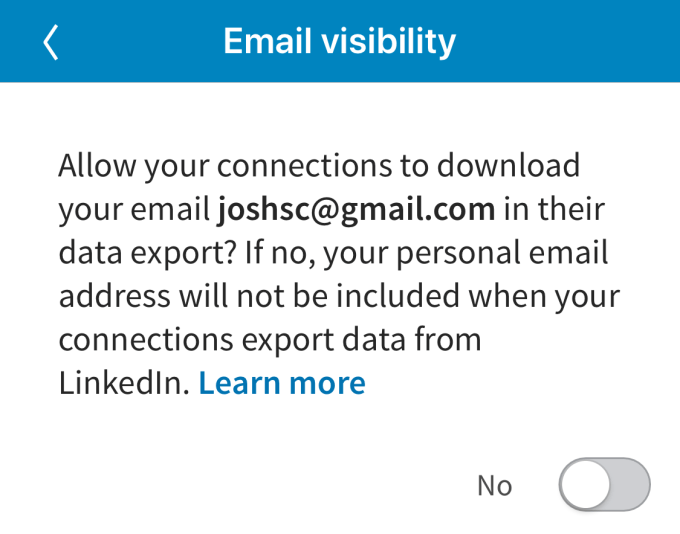
That new option can be found under Settings & Privacy -> Privacy -> Who Can See My Email Address? This “Allow your connections to download your email [address of user] in their data export?” toggle defaults to ‘No’. Most users don’t know it exists since LinkedIn didn’t announce it, there’s merely been a folded up section added to the Help center on email visibility, and few might voluntarily change it to ‘Yes’ since there’s no explanation of why you’d want to. That means nearly no one’s email addresses will appear in LinkedIn Archive exports any more. Your connections will still be able to see your email address if they navigate to your profile, but they can’t grab those from their whole graph.

Facebook came to the same conclusion about restricting email exports back when it was in a data portability fight with Google in 2010. Facebook had been encouraging users to import their Gmail contacts, but refused to let users export their Friends’ email addresses. It argued that users own their own email addresses, but not those of their Friends, so they couldn’t be downloaded — though that stance conveniently prevented any other app from bootstrapping a competing social graph by importing your Facebook friend list in any usable way. I’ve argued that Facebook needs to make friend lists interoperable to give users choice about what apps they use, both because it’s the right thing to do but also because it could deter regulation.

On a social network like Facebook, barring email exports makes more sense. But on LinkedIn’s professional network where people are purposefully connecting with those they don’t know, and where exporting has always been allowed, making the change silently seems surreptitious. Perhaps LinkedIn didn’t want to bring attention to the fact it was allowing your email address to be slurped up by anyone you’re connected with given the current media climate of intense scrutiny regarding privacy in social tech. But trying to hide a change that’s massively impactful to businesses that rely on LinkedIn could erode the trust of its core users.


from Social – TechCrunch https://ift.tt/2DR4o0L LinkedIn cuts off email address exports with new privacy setting Josh Constine https://ift.tt/2R2gNSe
via IFTTT

Facebook has poached the DoJ’s Silicon Valley antitrust chief

Facebook has recruited Kate Patchen, a veteran of the U.S. Department of Justice who led its antitrust office in Silicon Valley, to be a director and associate general counsel of litigation.

Patchen takes up her post amid ongoing scandals and reputation crises for her new employer, joining Facebook this month according to her LinkedIn profile.

The move was spotted earlier by the FT, which reports that Facebook also posted a job listing on LinkedIn for a “lead counsel” in Washington to handle competition issues two weeks ago — suggesting a broader effort to bulk up its in-house expertise.

Patchen brings a wealth of experience on the antitrust topic to her new employer, having spent 16 years at the DoJ, where she began as a trial attorney before becoming an assistant chief in the antitrust division in 2014. Two years later she was made chief.

We reached out to Facebook about the hire and it acknowledged our email but did not immediately provide comment on its decision to recruit an specialist in antitrust enforcement.

The social media giant certainly has plenty playing on its mind on this front.

In 2016 it landed firmly on lawmakers’ radars and in hot political waters when the extent of Kremlin-funded election interference activity on the platform first emerged. Since then a string of security and data misuse scandals have only dialled up the political pressure on Facebook.

Domestic lawmakers are now most actively discussing how to regulate social media. Although competition scrutiny is increasing on big tech in general, with calls from some quarters to break up platform giants as a fix for a range of damaging impacts.

The FT notes, for example, that democratic lawmakers recently introduced legislation to address “the threat of economic concentration”. And the sight of Democrats pushing for tougher competition enforcement suggests the party’s love affair with Silicon Valley tech giants is well and truly over.

In Europe competition regulators have already moved against big tech, issuing two very large fines in recent years against Google products, with more investigations ongoing.

Amazon is also now on the Commission’s radar. While, at a national level, EU competition regulators have been paying increasing attention to how the adtech industry is dominated by the duopoly of Google and Facebook.

Patchen, meanwhile, joins Facebook at the same time as some long-serving veterans are headed out the door — including public policy chief, Elliot Schrage.

Schrage’s departure has been in train for some months but a leaked internal memo we obtained this week suggests he’s being packaged up as a convenient fall guy for a freshly cracked public relations scandal.

Last month Facebook announced it was hiring more new blood: Former deputy prime minister of the UK, Nick Clegg, to be its new head of global policy and comms — with Schrage slated then to be staying on in an advisory capacity.

In other recent senior leadership moves Facebook CSO Alex Stamos also left the company this summer. While chief legal officer, Colin Stretch, announced he would leave at the end of the year.

But according to a Recode report this month Stretch has now put his exit on hold — until at least next summer — apparently deciding to stay to help out with ongoing legal and political crises.


from Social – TechCrunch https://ift.tt/eA8V8J Facebook has poached the DoJ’s Silicon Valley antitrust chief Natasha Lomas https://ift.tt/2DzAT2C
via IFTTT

Google Assistant iOS update lets you say ’Hey Siri, OK Google’

{rss:content:encoded} Google Assistant iOS update lets you say ’Hey Siri, OK Google’ https://ift.tt/2BoCve7 https://ift.tt/2A9uBmL November 21, 2018 at 07:26PM

Apple probably didn’t intend to let competitors take advantage of Siri Shortcuts this way, but you can now launch Google Assistant on your iPhone by saying “Hey Siri, OK Google”.

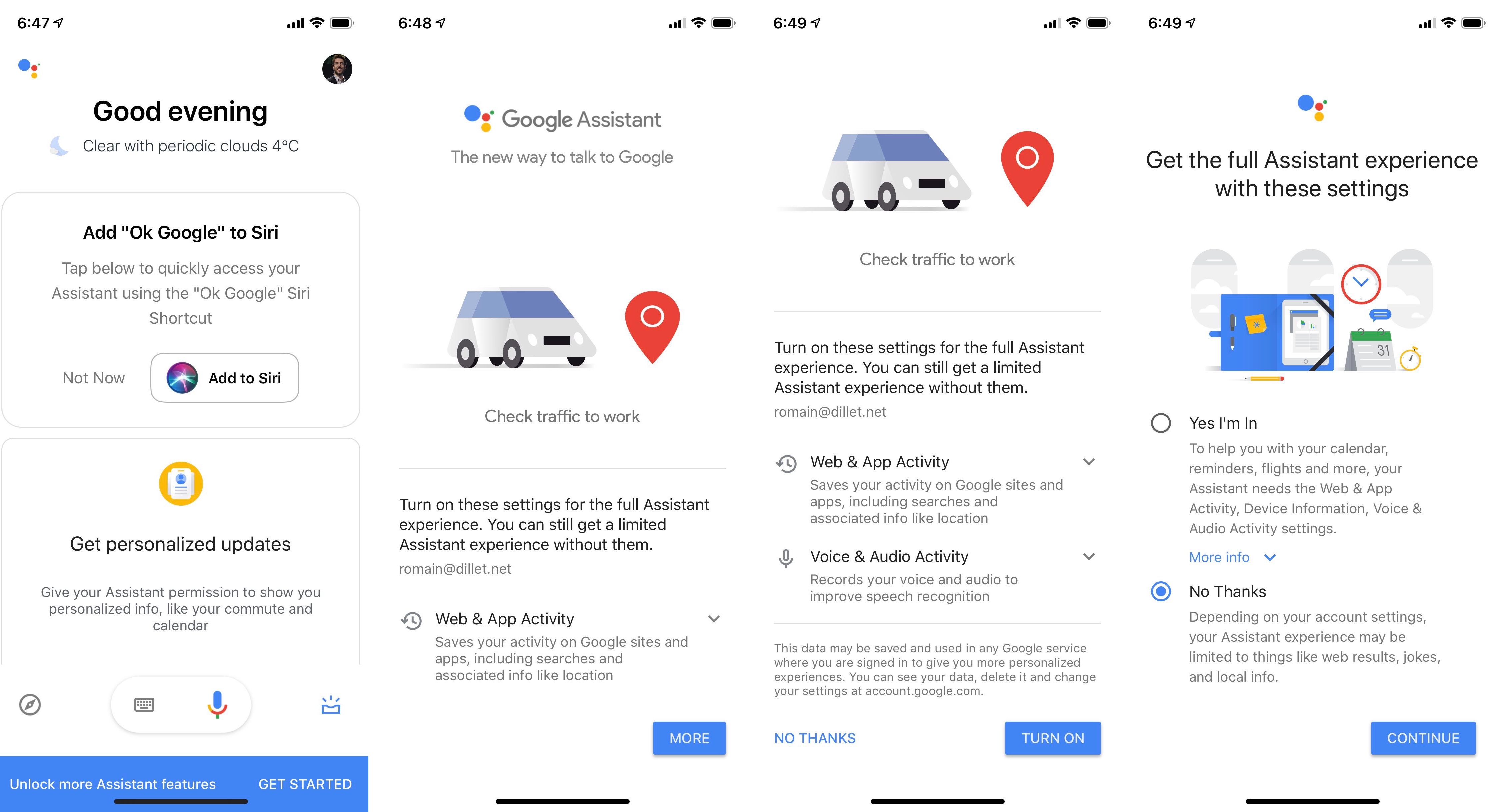
But don’t expect a flawless experience — it takes multiple steps. After updating the Google Assistant app on iOS, you need to open the app to set up a new Siri Shortcut for Google Assistant.

As the name suggests, Siri Shortcuts lets you record custom phrases to launch specific apps or features. For instance, you can create Siri Shortcuts to play your favorite playlist, launch directions to a specific place, text someone and more. If you want to chain multiple actions together, you can even create complicated algorithms using Apple’s Shortcuts app.

By default, Google suggests the phrase “OK Google”. You can choose something shorter, or “Hey Google” for instance. After setting that up, you can summon Siri and use this custom phrase to launch Google’s app.

You may need to unlock your iPhone or iPad to let iOS open the app. The Google Assistant app then automatically listens to your query. Again, you need to pause and wait for the app to appear before saying your query.

This is quite a cumbersome walk-around and I’m not sure many people are going to use it. But the fact that “Hey Siri, OK Google” exists is still very funny.

On another note, Google Assistant is still the worst when it comes to your privacy. The app pushes you to enable “web & app activity”, the infamous all-encompassing privacy destroyer. If you activate that setting, Google will collect your search history, your Chrome browsing history, your location, your credit card purchases and more.

It’s a great example of dark pattern design. If you haven’t enabled web & app activity, there’s a flashy blue banner at the bottom of the app that tells you that you can “unlock more Assistant features”.

When you tap it, you get a cute little animated drawing to distract you from the text. There’s only one button that says “More”. If you tap it, the “More” button becomes “Turn on” — many people are not even going to see “No thanks” on the bottom left.

It’s a classic persuasion method. If somebody asks you multiple questions and you say yes every time, you’ll tend to say yes to the last question even if you don’t agree with it. You tapped on “Get started” and “More” so you want to tap on the same button one more time. If you say no, Google asks you one more time if you’re 100 percent sure.

So make sure you read everything and you understand that you’re making a privacy tradeoff by using Google Assistant.

Facebook appeals UK data watchdog’s £500k Cambridge Analytica fine

Facebook has said it will appeal against a £500,000 penalty issued by the UK’s data watchdog this summer following a lengthy investigation into the Cambridge Analytica data misuse scandal.

Facebook told the regulator an estimated one million UK users were among the 87M of its users whose private data was harvested by Dr. Aleksandr Kogan and his company Global Science Research — which passed the data to the now defunct political consultancy, Cambridge Analytica.

In July, the ICO announced it intended to fine Facebook the maximum possible amount under the UK’s old data protection regime — saying it was “clear” the company had contravened the law “by failing to keep users data safe” when its systems allowed Kogan’s app to scrape Facebook user data.

It confirmed the penalty a month ago, with commissioner Elizabeth Denham saying then: “Facebook failed to sufficiently protect the privacy of its users before, during and after the unlawful processing of this data. A company of its size and expertise should have known better and it should have done better.”

Although the text of its October decision includes the admission that the ICO had not found evidence that any UK Facebook users’ data had actually been passed to Kogan.

“Facebook has asserted that the only individuals whose personal data was used in this way [shared by Kogan with third parties including Cambridge Analytica] were US residents,” it writes on this, before adding that even if Facebook’s assertion is correct some US residents would also have been UK users “from time to time” (e.g. if visiting the UK) — and thus would fall under its remit.

It also pointed to “serious risk” to UK users’ data being material to its decision, writing: “Dr. Kogan and/or GSR were put in a position where they were effectively at liberty (if they so chose) to use the personal data of UK residents for such purposes, or to share such data with persons or companies who would use it for such purposes.”

On that basis, Facebook appears to be resting its appeal against the ICO decision on its own assertion to the ICO that there’s no evidence of UK users’ data being used.

Commenting on its decision to appeal against the ICO’s fine in a statement, Anna Benckert, its EMEA VP & associate general counsel, said:

We have said before that we wish we had done more to investigate claims about Cambridge Analytica in 2015. We made major changes to our platform back then and have also significantly restricted the information app developers can access. And we are investigating all historic apps that had access to large amounts of information before we changed our platform policies in 2014.

The ICO’s investigation stemmed from concerns that UK citizens’ data may have been impacted by Cambridge Analytica, yet they now have confirmed that they have found no evidence to suggest that information of Facebook users in the UK was ever shared by Dr Kogan with Cambridge Analytica, or used by its affiliates in the Brexit referendum.

Therefore, the core of the ICO’s argument no longer relates to the events involving Cambridge Analytica. Instead, their reasoning challenges some of the basic principles of how people should be allowed to share information online, with implications which go far beyond just Facebook, which is why we have chosen to appeal.

For example, under ICO’s theory people should not be allowed to forward an email or message without having agreement from each person on the original thread. These are things done by millions of people every day on services across the internet, which is why we believe the ICO’s decision raises important questions of principle for everyone online which should be considered by an impartial court based on all the relevant evidence.

We’ve reached out to the ICO for comment. Update: An ICO spokesperson said: “Any organisation issued with a monetary penalty notice by the Information Commissioner has the right to appeal the decision to the First-tier Tribunal. The progression of any appeal is a matter for the tribunal. We have not yet been notified by the Tribunal that an appeal has been received.”

Last month Denham explained the decision to impose the maximum penalty on Facebook by saying: “We considered these contraventions to be so serious we imposed the maximum penalty under the previous legislation. The fine would inevitably have been significantly higher under the GDPR. One of our main motivations for taking enforcement action is to drive meaningful change in how organizations handle people’s personal data.”

This summer her office issued its first ever enforcement notice under the new GDPR data protection regime against Canadian data firm AIQ, which had supplied software and services to the disgraced Cambridge Analytica.

But last month the ICO issued a narrower enforcement notice, replacing the earlier notice, after AIQ appealed.


from Social – TechCrunch https://ift.tt/eA8V8J Facebook appeals UK data watchdog’s £500k Cambridge Analytica fine Natasha Lomas https://ift.tt/2r6Isq9
via IFTTT

CVCompiler is an robot that fixes your resume to make you more competitive

Machine learning is everywhere now, including recruiting. Take CVCompiler, a new product by Andrew Stetsenko and Alexandra Dosii. This web app uses machine learning to analyze and repair your technical resume, allowing you too shine to recruiters at Google, Yahoo, and Facebook.

The founders are marketing and HR experts who have a combined fifteen years experience in making recruiting smarter. Stetsenko founded Relocate.me and GlossaryTech while Dosii worked at a number of marketing firms before settling on CVCompiler.

The app essentially checks your resume and tells you what to fix and where to submit it. It’s been completely bootstrapped thus far and they’re working on new and improved machine-learning algorithms while maintaining a library of common CV fixes.

“There are lots of online resume analysis tools, but these services are too generic, meaning they can be used by multiple professionals and the results are poor and very general. After the feedback is received, users are often forced to buy some extra services,” said Stetsenko. “In contrast, the CV Compiler is designed exclusively for tech professionals. The online review technology scans for keywords from the world of programming and how they are used in the resume, relative to the best practices in the industry.”

The product was born out of Stetsenko’s work at GlossaryTech, a Chrome extension that helps users understand tech terms. He used a great deal of natural language processing and keyword taxonomy in that product and, in turn, moved some of that to his CV service.

“We found that many job applications were being rejected without even an interview, because of the resumes. Apparently, 10 seconds is long enough for a recruiter to eliminate many candidates,” he said.

The service is live now and the team expects the corpus of information to grow and improve over time. Until then, why not let a machine-learning robot tell you what you’re doing wrong in trying to get a job? That is, before it replaces you completely.


https://ift.tt/eA8V8J CVCompiler is an robot that fixes your resume to make you more competitive https://ift.tt/2Bo9AXy

Quantum Machines raises $5.5M to build control and operational layer for quantum computers

Quantum Machines, an Israeli startup launched by three Ph.D. physicists, wants to build the operational and control layer for quantum computing. Today, it announced a $5.5 million seed investment led by TLV ventures with participation from Battery Ventures.

The three principals have been studying quantum computing for a decade and they understand that to commercialize it, it’s going to require a complete solution. Right now the majority of the research is centered on increasing the number qubits at the processor level. Co-founder and CEO Itamar Sivan says in order to advance the technology, it’s going to take an operational and control layer to make it all work, and that is what the founders decided to concentrate the company’s efforts, he said.

Sivan explained that there is a point where the classical computers we use today and the quantum computers of the future will have to work together to pass data and interpret commands. He described three layers in a quantum computing stack. The first is the quantum processor. Next is a classical computing control layer with classical electronics you would find on any computer today. Finally, there is the software layer where you program a classical algorithm that has to be passed to the quantum processor.

He ways some companies are trying to build full stacks, but the bulk of research as been concentrated on building quantum processors. Quantum Machines decided to focus on one part of the stack. “We have come to the conclusion, that there must be a company laser-focused on a vertically integrated control solution that includes the classical hardware and software,” Sivan said.

“The power of quantum computers stems from their complexity and richness, though it is also this complexity which makes them incredibly difficult to control and operate— this is the problem our company is attempting to solve,” he added in a statement.

The company is currently working on prototype hardware to build this layer and is working with several Beta customers at the moment. It’s early days for the company, but the seed money should help them accelerate that vision and get a product to market more quickly.


https://ift.tt/eA8V8J Quantum Machines raises $5.5M to build control and operational layer for quantum computers https://ift.tt/2DAW3x6

Facebook failed to stop a child bride being auctioned on its platform

Facebook failed to prevent its platform being used to auction a 16-year-old girl off for marriage in South Sudan.

Child early and forced marriage (CEFM) is the most commonly reported form of gender-based violence in South Sudan, according to a recent Plan International report on the myriad risks for adolescent girls living in the war-torn region.

Now it seems girls in that part of the world have to worry about social media too.

Vice reported on the story in detail yesterday, noting that Facebook took down the auction post but not until after the girl had already been married off — and more than two weeks after the family first announced the attention to sell the child via its platform, on October 25.

Facebook said it first learned about the auction post on November 9, after which it says it took it down within 24 hours. It’s not clear how many hours out of the 24 it took Facebook to take the decision to remove the post.

A multimillionaire businessman from South Sudan’s capital city reportedly won the auction after offering a record ‘price’ — of 530 cows, three Land Cruiser V8 cars and $10,000 — to marry the child, Nyalong Ngong Deng Jalang.

Plan International told Vice it’s the first known incident of Facebook being used to auction a child bride.

“It is really concerning because, as it was such a lucrative transaction and it attracted so much attention, we are worried that this could act as an incentive for others to follow suit,” the development organization told Vice.

A different human rights NGO posted a screengrab of the deleted auction post to Twitter, writing: “Despite various appeals made by human rights group, a 16 year old girl child became a victim to an online marriage auction post, which was not taken down by Facebook in South Sudan.”

We asked Facebook to explain how it failed to act in time to prevent the auction and it sent us the following statement, attributed to a spokesperson:

Any form of human trafficking — whether posts, pages, ads or groups is not allowed on Facebook. We removed the post and permanently disabled the account belonging to the person who posted this to Facebook. We’re always improving the methods we use to identify content that breaks our policies, including doubling our safety and security team to more than 30,000 and investing in technology.

The more than two week delay between the auction post going live and the auction post being removed by Facebook raises serious questions about its claims to have made substantial investments in improving its moderation processes.

Human rights groups had directly tried to flag the post to Facebook. The auction had also reportedly attracted heavy local media attention. Yet it still failed to notice and act until weeks later — by which time it was too late because the girl had been sold and married off.

Facebook does not release country-level data about its platform so it’s not clear how many users it has in the South Sudan region.

Nor does it offer a breakdown of the locations of the circa 15,000 people it employs or contracts to carry out content review duties across its global content platform (which has 2BN+ users).

Facebook admits that the content reviewers it uses do not speak every language in the world where its platform is used. Nor do they even speak every language that’s widely used in the world. So it’s highly unlikely it has any reviewers at all with a strong grasp of the indigenous languages spoken in the South Sudan region.

We asked Facebook how many moderators it employs who speak any of the languages in the South Sudan region (which is multilingual). A spokeswoman was unable to provide an immediate answer.

The upshot of Facebook carrying out retrospective content moderation from afar, relying on a tiny number of reviewers (relative to its total users), is that the company is failing to respond to human rights risks as it should.

Facebook has not established on-the-ground teams across its international business with the necessary linguistic and cultural sensitivities to be able to respond directly, or even quickly, to risks being created by its platform in every market where it operates. (A large proportion of its reviewers are sited in Germany — which passed a social media hate speech law a year ago.)

AI is not going to fix that very hard problem either — not in any human time-scale. And in the meanwhile Facebook is letting actual humans take the strain.

But two weeks to notice and takedown a child bride auction is not the kind of metric any business wants to be measured by.

It’s increasingly clear that Facebook’s failure to invest adequately across its international business to oversee and manage the human rights impacts of its technology tools can have a very high cost indeed.

In South Sudan a lack of adequate oversight has resulted in its platform being repurposed as the equivalent of a high-tech slave market.

Facebook also continues to be on the hook for serious failings in Myanmar, where its platform has been blamed for spreading hate speech and accelerating ethnic violence.

You don’t have to look far to see other human rights abuses being aided and abetted by access to unchecked social media tools.


from Social – TechCrunch https://ift.tt/eA8V8J Facebook failed to stop a child bride being auctioned on its platform Natasha Lomas https://ift.tt/2FwKRUL
via IFTTT

African investors and founders to judge Startup Battlefield competition in Nigeria

TechCrunch will soon be returning to Africa to hold its Startup Battlefield competition dedicated to the African continent, in Lagos, Nigeria, on December 11th.

The event will showcase the launch of 15 of the hottest startups in Africa on stage for the first time. We’ll also be joined by some of the leading investment firms in the region. If you want to be in the same room, you’d better grab your tickets now.

Here are just some of the investors and founders who will be judging the startups competing for US$25,000.

Eleni Gabre-Madhin, blueMoon

Dr. Eleni Gabre-Madhin is founder and chief executive of blueMoon, Ethiopia’s first youth agribusiness/agritech incubator and seed investor. Prior to this, she founded eleni LLC, Africa’s leader in designing, building and supporting the operations of commodity exchange eco-systems in frontier markets. Dr. Gabre-Madhin is also founder and former CEO of Ethiopia Commodity Exchange (ECX), having successfully traded $1.2 billion annually after three years of operation.

Erik Hersman, BRCK

Erik Hersman is the CEO of BRCK a rugged wireless WiFi device designed and engineered in Kenya for use throughout the emerging markets. In 2010 he founded the iHub, Nairobi’s innovation hub for the technology community, bringing together entrepreneurs, hackers, designers and the investment community.

Minette Havemann, Naspers Ventures

Minette Havemann is strategy director at Naspers Ventures, which finds and backs promising technology startups across the world. She plays a leading role in identifying consumer and market trends shaping the team’s overall investment agenda and represents the team in Africa. Before this, Minette worked as General Manager of Strategy and Research at Media24 where she focused on business strategy development across a diverse portfolio spanning media, B2C e-commerce and classifieds assets.

Sangu Delle, Africa Health Holdings

Sangu is the co-founder and managing director of Africa Health Holdings, a company based in West Africa and focused on “building Africa’s healthcare future.” He also serves as Chairman of Golden Palm Investments Corporation, a holding company that has backed startups, including Andela, mPharma and Flutterwave. GPI portfolio companies have raised over $300 million in venture financing.

Wale Ayeni, International Finance Corporation

Wale Ayeni leads the IFC’s Venture Capital practice focused on Africa, South of the Sahara – the International Finance Organization is part of the World Bank Group. The IFC’s Venture capital team invests in technology companies in frontier markets, and has deployed over ~$800 million in early/growth stage tech investments over the past decade. Prior to the IFC, Wale led venture capital early-stage investments in disruptive startups across various technology sectors for Orange in Silicon Valley with representative investments in the U.S.

Get your tickets

Tickets to this event cost $10 (N3600 +VAT), and you can buy them right here.

Startup Battlefield consists of three preliminary rounds with 15 teams — five startups per round — who have only six minutes to pitch and present a live demo to a panel of expert technologists and VC investors. After each pitch, the judges have six minutes to grill the team with tough questions. This is all after the free pitch-coaching they receive from TechCrunch editors.

One startup will emerge the winner of TechCrunch Startup Battlefield Africa 2018 — and receive a US$25,000 no-equity cash prize and win a trip for two to compete in the Startup Battlefield at TechCrunch Disrupt in 2019 (assuming the company still qualifies to compete at the time).


https://ift.tt/2A88ddD African investors and founders to judge Startup Battlefield competition in Nigeria https://ift.tt/2Qb2Mol

Berlin-based Wind Mobility raises $22M for its e-scooter rental service

Wind Mobility, a Berlin-based mobility startup that offers “dockless” e-scooter (and electric bicycle) rentals, has raised $22 million in seed funding, throwing its hat into the European competitor to Bird and Lime ring.

It follows recent raises by Sweden’s VOI ($50 million Series A led by Balderton) and Germany’s Tier (€25 million Series A led by Northzone). All three companies are attempting to be pan-European from the get-go.

In other words, you wait all year for the ‘Bird or Lime of Europe’ to appear and three contenders get funded at once. And that’s before we mention Taxify’s entrance into e-scooter rentals or Delivery Hero and Team Europe founder Lukasz Gadowski’s reported plans to enter the space, having picked up backing from the mobility arm of Target global.

Meanwhile, despite being U.S. companies, Bird and Lime have received substantial investment from three of Europe’s top venture capital firms. Index and Accel have backed Bird, and Atomico has backed Lime.

But I digress…

Investing in Wind Mobility’s rather large seed round is Chinese Source Code Capital, and Europe’s HV Holtzbrinck Ventures. The company says the investment will be used for global expansion and to further develop its e-scooter product. Wind current operates its e-scooter rental service in various cities in Spain, France, and the U.S., and its dockless bicycle rental service Byke in Germany.

Notably, Wind is currently developing its first proprietary model of electric scooters specifically designed for the sharing market, which co-founder and CEO Eric Wang tells me will become a significant differentiator going forward.

“Currently, almost all the scooters on the market are from Ninebot, which is designed for personal use rather than sharing,” he says. “Our own scooters are specifically designed for sharing: longer battery range, swappable battery, more capability to climb hills, sturdy and more fit for sharing. We can also tailor our scooters to the requirement of certain cities. This gives us an edge in continuing to adopt to customer needs and regulatory requirements”.

Alongside this, Wind Mobility has developed a proprietary “IoT technology and communication module” that it says gives it better location accuracy of its scooters. The system is also capable of delivering over-the-air updates to the Wind communication module to control certain functionality of its scooters remotely.

For example, it can tell a scooter light to flash via a tap on the Wind app so that users and operational personnel can spot the scooter more easily at night. “We can change the speed limit of the fleet in each city or certain scooters via our servers. We also limit the speed to zero via the communication module once a scooter is taken outside of the operating area,” adds Wang.

Like other European players in the space, Wind says it works in co-operation with local governments, with the goal of solving mobility problems and reducing congestion in urban areas.

“The scooter market in Europe is still relatively new,” says the Wind CEO. “The bigger competition is still to convert more users from using cars to using scooters along with public transportation. We are at the forefront of this transformation. We look forward to working with cities and authorities to serve this growing demand”.


https://ift.tt/eA8V8J Berlin-based Wind Mobility raises $22M for its e-scooter rental service https://ift.tt/2DC3iVP

Tuesday, November 20, 2018

Internal Facebook memo sees outgoing VP of comms Schrage take blame for hiring Definers

TechCrunch has obtained an internal memo published by Facebook’s outgoing head of public policy Elliot Schrage in which he blames himself for hiring PR firm Definers. He admits to having the company push negative narratives about competitors, but says Facebook did not ask or pay Definers to publish fake news. COO Sheryl Sandberg left a comment on the memo, saying it was never Facebook’s intention to play into anti-semitic theories about George Soros.

The memo includes a Q&A regarding points raised by a New York Times article detailing how Definers worked to spread negative publicity about Google and other tech giants to make Facebook look better, and that the firm’s employees also published biased articles bashing Facebook’s competitors and critics through a news site called NTK Network that’s affiliated with Definers.

In the memo, Schrage justifies the use of opposition research, and chastizes Facebook employees for allowing internal finger pointing surrounding its troubled past two years to become public. He also notes that his replacement, Facebook’s new head of global policy and former UK deputy Prime Minster Nick Clegg will be reviewing its work with all political consultants, which could turn up more skeletons.

Facebook’s former head of policy and comms Elliot Schrage (left)

Schrage announced in June that he’d be stepping down in the wake of the Cambridge Analytica scandal, but would stay on to help find a replacement. Many have asked who, if anyone, would be fired for putting Facebook in cahoots with Definers. As TechCrunch previously reported, Schrage was atop the chain of command here. Given his extensive experience in public policy, was likely well aware of the nature of Definers’ work. Schrage taking the blame provides a convenient solution to the issue, as he’s already on his way out.

“Responsibility for these decisions rests with leadership of the Communications team. That’s me. Mark and Sheryl relied on me to manage this without controversy” Schrage writes. “I knew and approved of the decision to hire Definers and similar firms. I should have known of the decision to expand their mandate . . . I’m sorry I let you all down. I regret my own failure here.” This explanation serves to protect Zuckerberg and Sandberg from additional blame, even as Sandberg strives to show she’s not passing the buck by noting “I want to be clear that I oversee our Comms team and take full responsibility for their work and the PR firms who work with us.”

Schrage’s defense of his bosses provides additional cover for Zuckerberg’s comments from a CNN interview that ran tonight in which he said he won’t step down as Facebook’s chairman and hopes to continue working alongside Sandberg for decades to come. The memo could have been aimed at quieting internal unrest about Facebook’s chief lobbyist Joel Kaplan. His ties to the GOP, support for Supreme Court Justice Brett Kavanaugh, and involvement with Facebook’s latest PR troubles had led some employees to question his employment. Now Facebook has someone else to take the heat.

Schrage is effectively jumping on the grenade here.

The memo and comment can be found below:

Internal Facebook Memo By Elliot Schrage

Many of you have raised questions about our relationship with the Definers consulting firm. We’ve been looking into this and though it is close to a holiday for many of you I wanted to share an update on what we’ve learned and where things stand:

Why did we hire Definers?

We hired Definers in 2017 as part of our efforts to diversify our DC advisors after the election. Like many companies, we needed to broaden our outreach. We also faced growing pressure from competitors in tech, telcos and media companies that want government to regulate us.

This pressure became particularly acute in September 2017 after we released details of Russian interference on our service. We hired firms associated with both Republicans and Democrats — Definers was one of the Republican-affiliated firms.

What did we ask them to do and what did they do?

While we’re continuing to review our relationship with Definers, we know the following: We asked Definers to do what public relations firms typically do to support a company — sending us press clippings, conducting research, writing messaging documents, and reaching out to reporters.

Some of this work is being characterized as opposition research, but I believe it would be irresponsible and unprofessional for us not to understand the backgrounds and potential conflicts of interest of our critics. This work can be used internally to inform our messaging and where appropriate it can be shared with reporters. This work is also useful to help respond to unfair claims where Facebook has been singled out for criticism, and to positively distinguish us from competitors.

As the pressure on Facebook built throughout the year, the Communications team used Definers more and more. At Sheryl’s request, we’re going through all the work they did, but we have learned that as the engagement expanded, more people worked with them on more projects and the relationship was less centrally managed.

Did we ask them to do work on George Soros?

Yes. In January 2018, investor and philanthropist George Soros attacked Facebook in a speech at Davos, calling us a “menace to society.” We had not heard such criticism from him before and wanted to determine if he had any financial motivation. Definers researched this using public information.

Later, when the “Freedom from Facebook” campaign emerged as a so-called grassroots coalition, the team asked Definers to help understand the groups behind them. They learned that George Soros was funding several of the coalition members. They prepared documents and distributed these to the press to show that this was not simply a spontaneous grassroots movement.

Did we ask them to do work on our competitors?

Yes. As I indicated above, Definers helped us respond to unfair claims where Facebook was been [sic] singled out for criticism. They also helped positively distinguish us from competitors.

Did we ask them to distribute or create fake news?

No.

Who knew about this work, and who signed off on it?

Responsibility for these decisions rests with leadership of the Communications team. That’s me. Mark and Sheryl relied on me to manage this without controversy.

I knew and approved of the decision to hire Definers and similar firms. I should have known of the decision to expand their mandate. Over the past decade, I built a management system that relies on the teams to escalate issues if they are uncomfortable about any project, the value it will provide or the risks that it creates. That system failed here and I’m sorry I let you all down. I regret my own failure here.

Why have we stopped working with them?

Mark has asked us to reevaluate how we work with communications consultants. It’s not about Definers. It is about us, not them.

Mark has made clear that because Facebook is a mission driven company, he wants to hold us to a higher standard. He is uncomfortable relying on any outside firm to make decisions about how to make our case about our mission, policies, competitors and critics until he can become comfortable with our management, oversight and escalation.

Where are we now?

Many people across the company feel uncomfortable finding out about this work. Many people on the Communications team feel under attack from the press and even from their colleagues. I’m deeply disappointed that so much internal discussion and finger pointing has become public. This is a serious threat to our culture and ability to work together in difficult times.

Our culture has long been to move fast and take risks. Many times we have moved too quickly and we always learn and keep trying to do our best. This will be no exception.

What happens next?

Our legal team continues to review our work with Definers to understand what happened. Mark and Sheryl have also asked Nick Clegg to review all our work with communications consultants and propose principles and management processes to guide the team’s work going forward. We all want to ensure that we, our advisors and consultants better reflect Facebook’s values and culture.

Comment On The Memo From Sheryl Sandberg

Thank you for sharing this, Elliot.
I want to be clear that I oversee our Comms team and take full responsibility for their work and the PR firms who work with us. I truly believe we have a world class Comms team and I want to acknowledge the enormous pressure the team has faced over the past year.

When I read the story in New York Times last week, I didn’t remember a firm called Definers. I asked our team to look into the work Definers did for us and to double-check whether anything had crossed my desk. Some of their work was incorporated into materials presented to me and I received a small number of emails where Definers was referenced.

I also want to emphasize that it was never anyone’s intention to play into an anti-Semitic narrative against Mr. Soros or anyone else. Being Jewish is a core part of who I am and our company stands firmly against hate. The idea that our work has been interpreted as anti-Semitic is abhorrent to me — and deeply personal.

I know this has been a distraction at a time when you’re all working hard to close out the year — and I am sorry. As I said at the All Hands, I believe so deeply in the work we do and feel so grateful to all of you for doing so much every day. Thanksgiving seems like the right time to say a big thank you once again.

Additional reporting by Taylor Hatmaker


from Social – TechCrunch https://ift.tt/2QXPeJR Internal Facebook memo sees outgoing VP of comms Schrage take blame for hiring Definers Josh Constine https://ift.tt/2PITiB2
via IFTTT

blogger better Headline Animator