l
l
blogger better. Powered by Blogger.

Search

Labels

blogger better

Followers

Blog Archive

Total Pageviews

Labels

Download

Blogroll

Featured 1

Curabitur et lectus vitae purus tincidunt laoreet sit amet ac ipsum. Proin tincidunt mattis nisi a scelerisque. Aliquam placerat dapibus eros non ullamcorper. Integer interdum ullamcorper venenatis. Pellentesque habitant morbi tristique senectus et netus et malesuada fames ac turpis egestas.

Featured 2

Curabitur et lectus vitae purus tincidunt laoreet sit amet ac ipsum. Proin tincidunt mattis nisi a scelerisque. Aliquam placerat dapibus eros non ullamcorper. Integer interdum ullamcorper venenatis. Pellentesque habitant morbi tristique senectus et netus et malesuada fames ac turpis egestas.

Featured 3

Curabitur et lectus vitae purus tincidunt laoreet sit amet ac ipsum. Proin tincidunt mattis nisi a scelerisque. Aliquam placerat dapibus eros non ullamcorper. Integer interdum ullamcorper venenatis. Pellentesque habitant morbi tristique senectus et netus et malesuada fames ac turpis egestas.

Featured 4

Curabitur et lectus vitae purus tincidunt laoreet sit amet ac ipsum. Proin tincidunt mattis nisi a scelerisque. Aliquam placerat dapibus eros non ullamcorper. Integer interdum ullamcorper venenatis. Pellentesque habitant morbi tristique senectus et netus et malesuada fames ac turpis egestas.

Featured 5

Curabitur et lectus vitae purus tincidunt laoreet sit amet ac ipsum. Proin tincidunt mattis nisi a scelerisque. Aliquam placerat dapibus eros non ullamcorper. Integer interdum ullamcorper venenatis. Pellentesque habitant morbi tristique senectus et netus et malesuada fames ac turpis egestas.

Monday, November 26, 2018

Enterprise messaging startup Eko Communications raises $20M for its European expansion

After focusing on Asian markets, particularly in Southeast Asia, Bangkok-based Eko Communications is getting ready to take on Slack, Microsoft Teams, and other enterprise messaging apps in Europe. The startup announced today that it has raised a Series B of $20 million and opened offices in London (which will serve as its new commercial headquarters), Amsterdam, and Berlin.

The funding, led by SMD Ventures, with participation from AirAsia’s digital investment arm Redbeat Ventures, Gobi Partners, East Ventures, and returning investors, brings Eko Communication’s total raised to $28.7 million. The company’s Series A was announced in 2015, followed by $2 million in strategic funding from Japanese conglomerate Itochu last year. Eko Communications (not to be confused with Eko, an interactive video startup) has already served clients like Thai mobile operator True, Radisson, and 7-Eleven.

Eko Communications’ Series B is earmarked for its ambitious global expansion plans in the first quarter of 2019. Korawad Chearavanont, the company’s CEO and co-founder, told TechCrunch in an email that it has already localized products for target markets including the UK, Ireland, Benelux, and the DACH region (Germany, Austria, and Switzerland).

Eko Communications wants to expand in the European Union and the United States because their economies are both significantly larger than Southeast Asia’s, said Chearavanont. This, plus the fact that both have larger enterprise IT markets thanks to higher spending on software by companies, means that “for Eko to achieve the necessary scale to become a global player in the mobile enterprise market, continued growth in these markets is critical,” he added.

The company claims that its revenues have more than tripled in the past year and that it now has more than 500,000 recurring paid users. Of course, any enterprise messaging startup has to contend with the specter of Slack and Microsoft Teams. Positioning Eko Communications as a rival to those services, however, isn’t totally accurate because they are aimed at different customers.

Slack and Microsoft Teams are “primarily utilized by ‘knowledge workers’ and these systems are priced for these types of users,” Chearavanont said. “Being a mobile-first company, we target companies that have a large presence of mobile-first staff traditionally in industries like retail and hospitality (the services sector in general).” Many employees in those sectors still rely on messaging apps like WhatsApp or email to communicate, so Eko Communications seeks to make it easy for companies to transition from their ad hoc communication methods to a more secure and efficient system with tools like APIs to help them integrate legacy systems.


https://ift.tt/eA8V8J Enterprise messaging startup Eko Communications raises $20M for its European expansion https://ift.tt/2zuuId6

That night, a forest flew: DroneSeed is planting trees from the air

Wildfires are consuming our forests and grasslands faster than we can replace them. It’s a vicious cycle of destruction and inadequate restoration rooted, so to speak, in decades of neglect of the institutions and technologies needed to keep these environments healthy.

DroneSeed is a Seattle-based startup that aims to combat this growing problem with a modern toolkit that scales: drones, artificial intelligence, and biological engineering. And it’s even more complicated than it sounds.

Trees in decline

A bit of background first. The problem of disappearing forests is a complex one, but it boils down to a few major factors: climate change, outdated methods, and shrinking budgets (and as you can imagine, all three are related).

Forest fires are a natural occurrence, of course. And they’re necessary, as you’ve likely read, to sort of clear the deck for new growth to take hold. But climate change, monoculture growth, population increases, lack of control burns, and other factors have led to these events taking place not just more often, but more extensively and to more permanent effect.

On average, the U.S. is losing 7 million acres a year. That’s not easy to replace to begin with — and as budgets for the likes of national and state forest upkeep have shrunk continually over the last half century, there have been fewer and fewer resources with which to combat this trend.

The most effective and common reforestation technique for a recently burned woodland is human planters carrying sacks of seedlings and manually selecting and placing them across miles of landscapes. This back-breaking work is rarely done by anyone for more than a year or two, so labor is scarce and turnover is intense.

Even if the labor was available on tap, the trees might not be. Seedlings take time to grow in nurseries and a major wildfire might necessitate the purchase and planting of millions of new trees. It’s impossible for nurseries to anticipate this demand, and the risk associated with growing such numbers on speculation is more than many can afford. One missed guess could put the whole operation underwater.

Meanwhile if nothing gets planted, invasive weeds move in with a vengeance, claiming huge areas that were once old growth forests. Lacking the labor and tree inventory to stem this possibility, forest keepers resort to a stopgap measure: use helicopters to drench the area in herbicides to kill weeds, then saturate it with fast-growing cheatgrass or the like. (The alternative to spraying is, again, the manual approach: machetes.)

At least then, in a year, instead of a weedy wasteland, you have a grassy monoculture — not a forest, but it’ll do until the forest gets here.

One final complication: helicopter spraying is a horrendously dangerous profession. These pilots are flying at sub-100-foot elevations, performing high-speed maneuvers so that their sprays reach the very edge of burn zones but they don’t crash head-on into the trees. This is an extremely dangerous occupation: 80 to 100 crashes occur every year in the U.S. alone.

In short, there are more and worse fires and we have fewer resources — and dated ones at that — with which to restore forests after them.

These are facts anyone in forest ecology and logging are familiar with, but perhaps not as well known among technologists. We do tend to stay in areas with cell coverage. But it turns out that a boost from the cloistered knowledge workers of the tech world — specifically those in the Emerald City — may be exactly what the industry and ecosystem require.

Simple idea, complex solution

So what’s the solution to all this? Automation, right?

Automation, especially via robotics, is proverbially suited for jobs that are “dull, dirty, and dangerous.” Restoring a forest is dirty and dangerous to be sure. But dull isn’t quite right. It turns out that the process requires far more intelligence than anyone was willing, it seems, to apply to the problem — with the exception of those planters. That’s changing.

Earlier this year, DroneSeed was awarded the first multi-craft, over-55-pounds unmanned aerial vehicle license ever issued by the FAA. Its custom UAV platforms, equipped with multispectral camera arrays, high-end lidar, 6-gallon tanks of herbicide, and proprietary seed dispersal mechanisms have been hired by several major forest management companies, with government entities eyeing the service as well.

These drones scout a burned area, mapping it down to as high as centimeter accuracy, including objects and plant species, fumigate it efficiently and autonomously, identify where trees would grow best, then deploy painstakingly designed seed-nutrient packages to those locations. It’s cheaper than people, less wasteful and dangerous than helicopters, and smart enough to scale to national forests currently at risk of permanent damage.

I met with the company’s team at their headquarters near Ballard, where complete and half-finished drones sat on top of their cases and the air was thick with capsaicin (we’ll get to that).

The idea for the company began when founder and CEO Grant Canary burned through a few sustainable startup ideas after his last company was acquired, and was told, in his despondency, that he might have to just go plant trees. Canary took his friend’s suggestion literally.

“I started looking into how it’s done today,” he told me. “It’s incredibly outdated. Even at the most sophisticated companies in the world, planters are superheroes that use bags and a shovel to plant trees. They’re being paid to move material over mountainous terrain and be a simple AI and determine where to plant trees where they will grow — microsites. We are now able to do both these functions with drones. This allows those same workers to address much larger areas faster without the caloric wear and tear.”

It may not surprise you to hear that investors are not especially hot on forest restoration (I joked that it was a “growth industry” but really because of the reasons above it’s in dire straits).

But investors are interested in automation, machine learning, drones, and especially government contracts. So the pitch took that form. With the money Droneseed secured, it has built its modestly sized but highly accomplished team and produced the prototype drones with which is has captured several significant contracts before even announcing that it exists.

“We definitely don’t fit the mold or metrics most startups are judged on. The nice thing about not fitting the mold is people double take and then get curious,” Canary said. “Once they see we can actually execute and have been with 3 of the 5 largest timber companies in the US for years, they get excited and really start advocating hard for us.”

The company went through Techstars, and Social Capital helped them get on their feet, with Spero Ventures joining up after the company got some groundwork done.

If things go as Droneseed hopes, these drones could be deployed all over the world by trained teams, allowing spraying and planting efforts in nurseries and natural forests to take place exponentially faster and more efficiently than they are today. It’s genuine change-the-world-from-your-garage stuff, which is why this article is so long.

Hunter (weed) killers

The job at hand isn’t simple or even straightforward. Every landscape differs from every other, not just in the shape and size of the area to be treated but the ecology, native species, soil type and acidity, type of fire or logging that cleared it, and so on. So the first and most important task is to gather information.

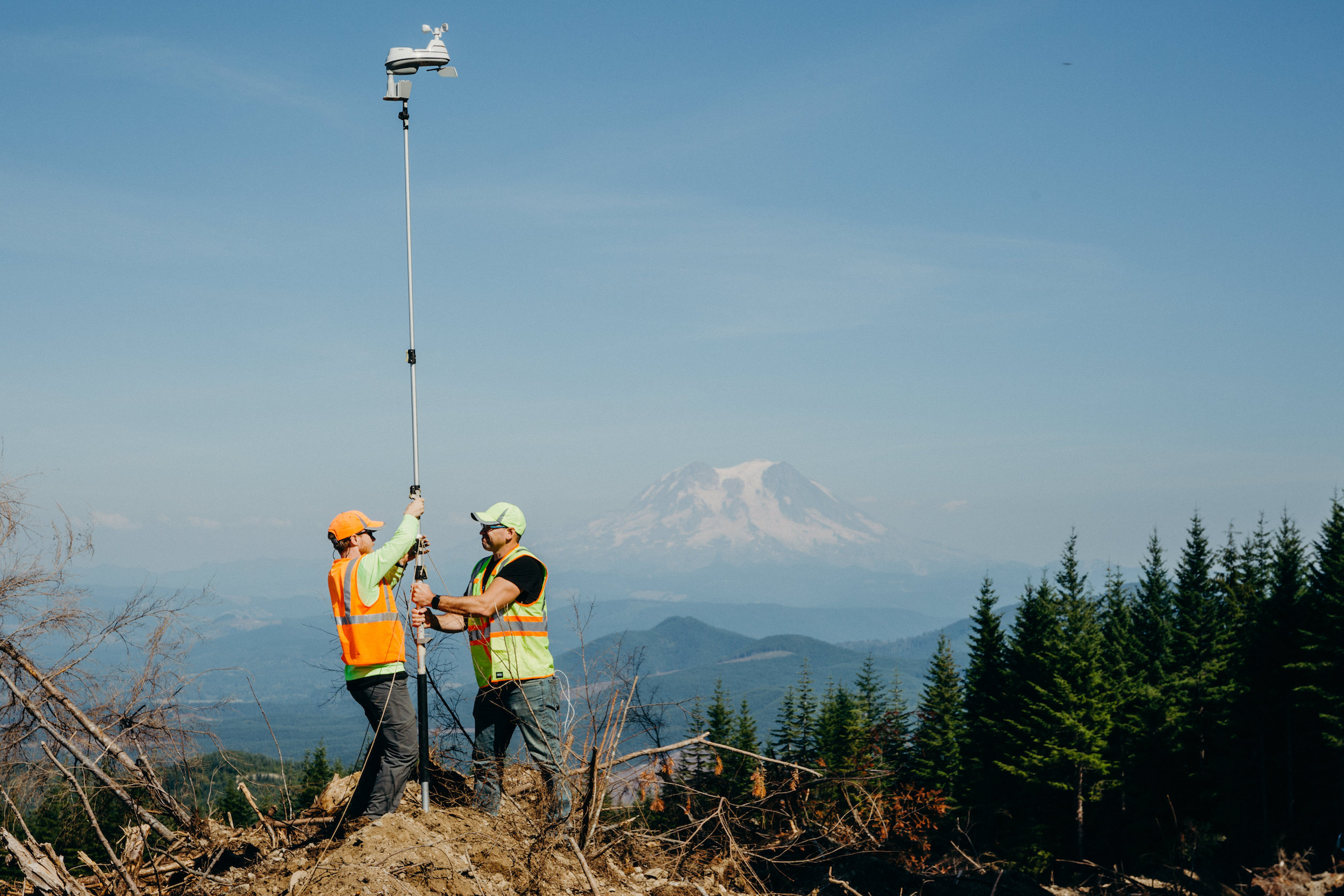
For this Droneseed has a special craft equipped with a sophisticated imaging stack. This first pass is done using waypoints set on satellite imagery.

The information collected at this point is really far more detailed than what’s actually needed. The lidar, for instance, collects spatial information at a resolution much beyond what’s needed to understand the shape of the terrain and major obstacles. It produces a 3D map of the vegetation as well as the terrain, allowing the system to identify stumps, roots, bushes, new trees, erosion, and other important features.

This works hand in hand with the multispectral camera, which collects imagery not just in the visible bands — useful for identifying things — but also in those outside the human range, which allows for in-depth analysis of the soil and plant life.

The resulting map of the area is not just useful for drone navigation, but for the surgical strikes that are necessary to make this kind of drone-based operation worth doing in the first place. No doubt there are researchers who would love to have this data as well.
Now, spraying and planting are very different tasks. The first tends to be done indiscriminately using helicopters, and the second by laborers who burn out after a couple years — as mentioned above, it’s incredibly difficult work. The challenge in the first case is to improve efficiency and efficacy, while in the second case is to automate something that requires considerable intelligence.

Spraying is in many ways simpler. Identifying invasive plants isn’t easy, exactly, but it can be done with imagery like that the drones are collecting. Having identified patches of a plant to be eliminated, the drones can calculate a path and expend only as much herbicide is necessary to kill them, instead of dumping hundreds of gallons indiscriminately on the entire area. It’s cheaper and more environmentally friendly. Naturally, the opposite approach could be used for distributing fertilizer or some other agent.

I’m making it sound easy again. This isn’t a plug and play situation — you can’t buy a DJI drone and hit the “weedkiller” option in its control software. A big part of this operation was the creation not only of the drones themselves, but the infrastructure with which to deploy them.

Conservation convoy
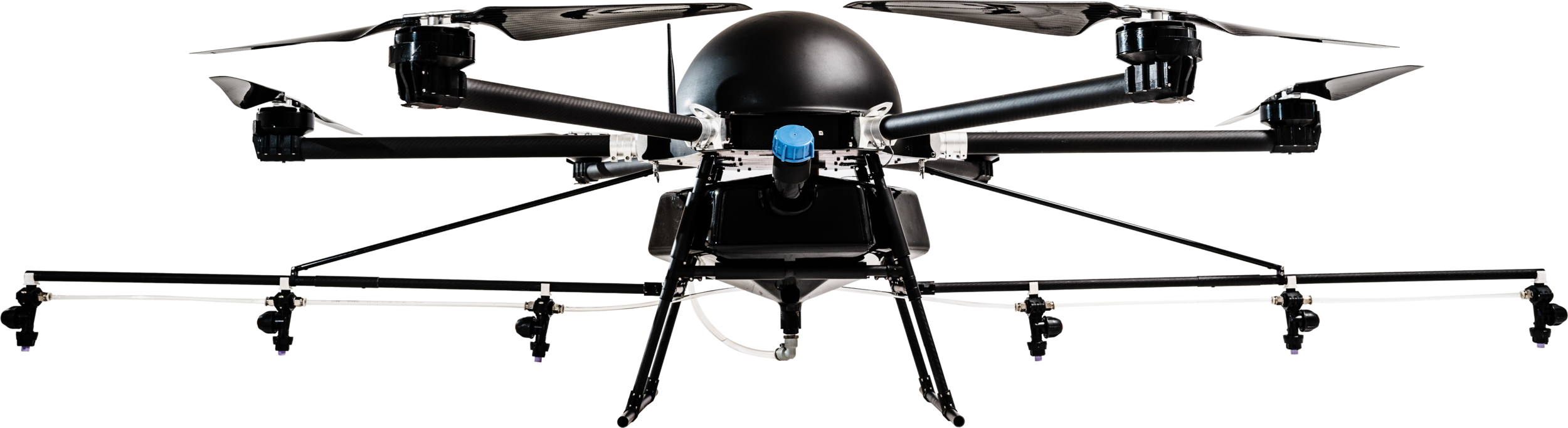
The drones themselves are unique, but not alarmingly so. They’re heavy-duty craft, capable of lifting well over the 57 pounds of payload they carry (the FAA limits them to 115 pounds).

“We buy and gut aircraft, then retrofit them,” Canary explained simply. Their head of hardware, would probably like to think there’s a bit more to it than that, but really the problem they’re solving isn’t “make a drone” but “make drones plant trees.” To that end, Canary explained, “the most unique engineering challenge was building a planting module for the drone that functions with the software.” We’ll get to that later.

DroneSeed deploys drones in swarms, which means as many as five drones in the air at once — which in turn means they need two trucks and trailers with their boxes, power supplies, ground stations, and so on. The company’s VP of operations comes from a military background where managing multiple aircraft onsite was part of the job, and she’s brought her rigorous command of multi-aircraft environments to the company.
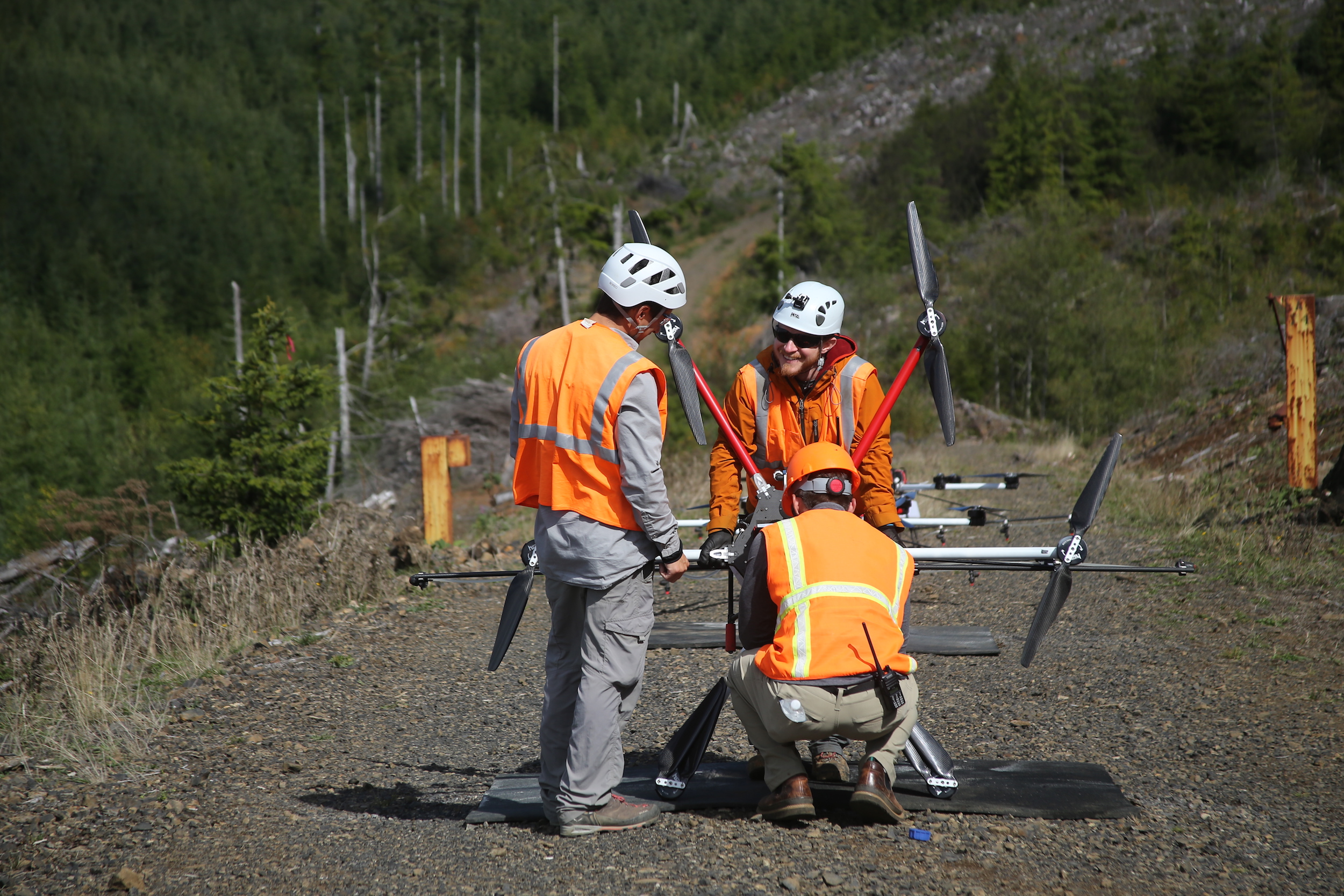
The drones take off and fly autonomously, but always under direct observation by the crew. If anything goes wrong, they’re there to take over, though of course there are plenty of autonomous behaviors for what to do in case of, say, a lost positioning signal or bird strike.

They fly in patterns calculated ahead of time to be the most efficient, spraying at problem areas when they’re over them, and returning to the ground stations to have power supplies swapped out before returning to the pattern. It’s key to get this process down pat, since efficiency is a major selling point. If a helicopter does it in a day, why shouldn’t a drone swarm? It would be sad if they had to truck the craft back to a hangar and recharge them every hour or two. It also increases logistics costs like gas and lodging if it takes more time and driving.

This means the team involves several people as well as several drones. Qualified pilots and observers are needed, as well as people familiar with the hardware and software that can maintain and troubleshoot on site — usually with no cell signal or other support. Like many other forms of automation, this one brings its own new job opportunities to the table.

AI plays Mother Nature

The actual planting process is deceptively complex.

The idea of loading up a drone with seeds and setting it free on a blasted landscape is easy enough to picture. Hell, it’s been done. There are efforts going back decades to essentially load seeds or seedlings into guns and fire them out into the landscape at speeds high enough to bury them in the dirt: in theory this combines the benefits of manual planting with the scale of carpeting the place with seeds.

But whether it was slapdash placement or the shock of being fired out of a seed gun, this approach never seemed to work.

Forestry researchers have shown the effectiveness of finding the right “microsite” for a seed or seedling; in fact, it’s why manual planting works as well as it does. Trained humans find perfect spots to put seedlings: in the lee of a log; near but not too near the edge of a stream; on the flattest part of a slope, and so on. If you really want a forest to grow, you need optimal placement, perfect conditions, and preventative surgical strikes with pesticides.

Although it’s difficult it’s also the kind of thing that a machine learning model can become good at. Sorting through messy, complex imagery and finding local minima and maxima is a specialty of today’s ML systems, and the aerial imagery from the drones is rich in relevant data.

The company’s CTO led the creation of an ML model that determines the best locations to put trees at a site — though this task can be highly variable depending on the needs of the forest. A logging company might want a tree every couple feet even if that means putting them in sub-optimal conditions — but a few inches to the left or right may make all the difference. On the other hand, national forests may want more sparse deployments or specific species in certain locations to curb erosion or establish sustainable firebreaks.

Once the data has been crunched, the map is loaded into the drones’ hive mind and the convoy goes to the location, where the craft are loaded up with seeds instead of herbicides.

But not just any old seeds! You see, that’s one more wrinkle. If you just throw a sagebrush seed on the ground, even if it’s in the best spot in the world, it could easily be snatched up by an animal, roll or wash down to a nearby crevasse, or simply fail to find the right nutrients in time despite the planter’s best efforts.

That’s why DroneSeed’s Head of Planting and his team have been working on a proprietary seed packet that they were unbelievably reticent to detail.

From what I could gather, they’ve put a ton of work into packaging the seeds into nutrient-packed little pucks held together with a biodegradable fiber. The outside is dusted with capsaicin, the chemical that makes spicy food spicy (and also what makes bear spray do what it does). If they hadn’t told me, I might have guessed, since the workshop area was hazy with it, leading us all to cough tear up a little. If I were a marmot, I’d learn to avoid these things real fast.

The pucks, or “seed vessels,” can and must be customized for the location and purpose — you have to match the content and acidity of the soil, things like that. DroneSeed will have to make millions of these things, but it doesn’t plan to be the manufacturer.

Finally these pucks are loaded in a special puck-dispenser which, closely coordinating with the drone, spits one out at the exact moment and speed needed to put it within a few centimeters of the microsite.

All these factors should improve the survival rate of seedlings substantially. That means that the company’s methods will not only be more efficient, but more effective. Reforestation is a numbers game played at scale, and even slight improvements — and DroneSeed is promising more than that — are measured in square miles and millions of tons of biomass.

Proof of life

DroneSeed has already signed several big contracts for spraying, and planting is next. Unfortunately the timing on their side meant they missed this year’s planting season, though by doing a few small sites and showing off the results, they’ll be in pole position for next year.

After demonstrating the effectiveness of the planting technique, the company expects to expand its business substantially. That’s the scaling part — again, not easy, but easier than hiring another couple thousand planters every year.

Ideally the hardware can be assigned to local teams that do the on-site work, producing loci of activity around major forests from which jobs can be deployed at large or small scales. A set of 5 or 6 drones does the work of a helicopter, roughly speaking, so depending on the volume requested by a company or forestry organization you may need dozens on demand.

That’s all yet to be explored, but DroneSeed is confident that the industry will see the writing on the wall when it comes to the old methods, and identify them as a solution that fits the future.

If it sounds like I’m cheerleading for this company, that’s because I am. It’s not often in the world of tech startups that you find a group of people not just attempting to solve a serious problem — it’s common enough to find companies hitting this or that issue — but who have spent the time, gathered the expertise, and really done the dirty, boots-on-the-ground work that needs to happen so it goes from great idea to real company.

That’s what I felt was the case with DroneSeed, and here’s hoping their work pays off — for their sake, sure, but mainly for ours.


https://ift.tt/2E0bpfM That night, a forest flew: DroneSeed is planting trees from the air https://ift.tt/2zr3Fzs

Corvus Insurance lands a fresh $8 million to turn sensor data into actionable info for its food and pharma customers

Corvus Insurance, a two-year-old, Boston-based insurance company that uses data across more than 50 criteria to predict and prevent losses for its corporate customers in the food and pharmaceutical industries, has attracted $8 million in funding, shows a newly processed SEC filing that says the capital came from six investors.

The company had previously raised $4 million seed funding led by Bain Capital Ventures. The filing shows a target of $10 million.

It’s an interesting company. Much of the data it extracts comes from Internet of Things sensors that can be used to predict the likelihood of a claim, including pressure on a roof owing to the weight of snow, for example. But it also relies on other data from all around, including videos, mobile phones and social media and turns them into tools for risk management.

Founder Philip Edmundson is a veteran of the insurance industry, having previously founded and sold a brokerage business in 2015. As he told the outlet Business Insurance earlier this year, he jumped back into the business after spying a fresh opportunity to focus not on getting rid of the middleman — which is the objective of many insurtech startups — but instead on the claims piece of the insurance business, which consumes far more of each dollar spent in the industry.

When it comes to shipping, for example, he’d said that if a company has a claim or multiple claims around food spoilage with a certain shipper or region, similar instances can be avoided by planning around those situations with recommendations from Corvus. (An agreement between Corvus and one of the largest temperature sensor companies in the world, Sensitech, certainly helps on this front.)

The company is focused for now on the food and pharmaceutical industries because both use sensors everywhere — on vehicles, machines, HVAC systems — for insurance and for regulatory reasons. But presumably, if it can prove its use case, it will expand its target market over time.

In the meantime, it’s part of a fast-growing, and increasingly crowded, landscape. As of last month, global fundraising for insurtech startups surpassed the volume reached in all of 2017, according to advisory firm Hampleton Partners’ latest insurtech M&A market report, which says 204 deals had been closed as of October, compared with 202 last year and 174 in 2016. All told, investors plugged $2.6 billion into those 204 deals — nearly the $2.7 billion that was plugged into insurtech startups in 2015.

Apparently all of those deals are leading to a lot of dealmaking, too. According to the report, the insurtech sector has seen 151 acquisitions since 2016, including by legacy players, as well as private equity firms.


https://ift.tt/eA8V8J Corvus Insurance lands a fresh $8 million to turn sensor data into actionable info for its food and pharma customers https://ift.tt/2AnevWL

Banuba raises $7M to supercharge any app or device with the ability to really see you

{rss:content:encoded} Banuba raises $7M to supercharge any app or device with the ability to really see you https://ift.tt/2zrYAqv https://ift.tt/2QnuC0A November 26, 2018 at 05:12PM

Walking into the office of Viktor Prokopenya – which overlooks a central London park – you would perhaps be forgiven for missing the significance of this unassuming location, just south of Victoria Station in London. While giant firms battle globally to make Augmented Reality a ‘real industry’, this jovial businessman form Belrarus is poised to launch a revolutionary new technology for just this space. This is the kind of technology some of the biggest companies in the world are snapping up right now, and yet, scuttling off to make me a coffee in the kitchen is someone who could be sitting on just such a company.

Regardless of whether it’s immediate future is obvious or not, AR has a future if the amount of investment pouring into the space is anything to go by.

In 2016 AR and VR attracted $2.3 billion worth of investments (a 300% jump from 2015) and is expected to reach $108 billion by 2021 – 25% of which will be aimed at the AR sector. But, according to numerous forecasts, AR will overtake VR in 5-10 years.

Apple is clearly making headway in its AR developments, having recently acquired AR lens company Akonia Holographics and in releasing iOS 12 this month, it enables developers to fully utilize ARKit 2, no doubt prompting the release of a new wave of camera-centric apps. This year Sequoia Capital China, SoftBank invested $50M in AR camera app Snow. Samsung recently introduced its version of the AR cloud and a partnership with Wacom that turns Samsung’s S-Pen into an augmented reality magic wand.

The IBM/Unity partnership allows developers to integrate Watson cloud services such as visual recognition, speech to text, and more into their Unity applications.

So there is no question that AR is becoming increasingly important, given the sheer amount of funding and M&A activity.

Joining the field is Prokopenya’s “Banuba” project. For although you can download a Snapchat-like app called ‘Banuba’ from the App Store right now, underlying this is a suite of tools of which Prokopenya is the founding investor, and who is working closely to realize a very big vision with the founding team of AI/AR experts behind it.

The key to Banuba’s pitch is the idea that its technology could equip not only apps but even hardware devices with “vision”. This is a perfect marriage of both AI and AR. What if, for instance, Amazon’s Alexa couldn’t just hear you? What if it could see you and interpret your facial expressions or perhaps even your mood? That’s the tantalizing strategy at the heart of this growing company.

Better known for its consumer apps, which have been effectively testing their concepts in the consumer field for the last year, Banuba is about to move heavily into the world of developer tools with the release of its new Banuba 3.0 mobile SDK. (Available to download now in the App Store for iOS devices and Google Play Store for Android). It’s also now secured a further $7m in funding from Larnabel Ventures, the fund of Russian entrepreneur Said Gutseriev, and Prokopenya’s VP Capital.

This move will take its total funding to $12m. In the world of AR, this is like a Romulan warbird de-cloaking in a scene from Star Trek.

Banuba hopes that its SDK will enable brands and apps to utilise 3D Face AR inside their own apps, meaning users can benefit from cutting-edge face motion tracking, facial analysis, skin smoothing and tone adjustment. Banuba’s SDK also enables app developers to utilise background subtraction, which is similar to ‘green screen’ technology regularly used in movies and TV shows, enabling end-users to create a range of AR scenarios. Thus, like magic, you can remove that unsightly office surrounding and place yourself on a beach in the Bahamas…

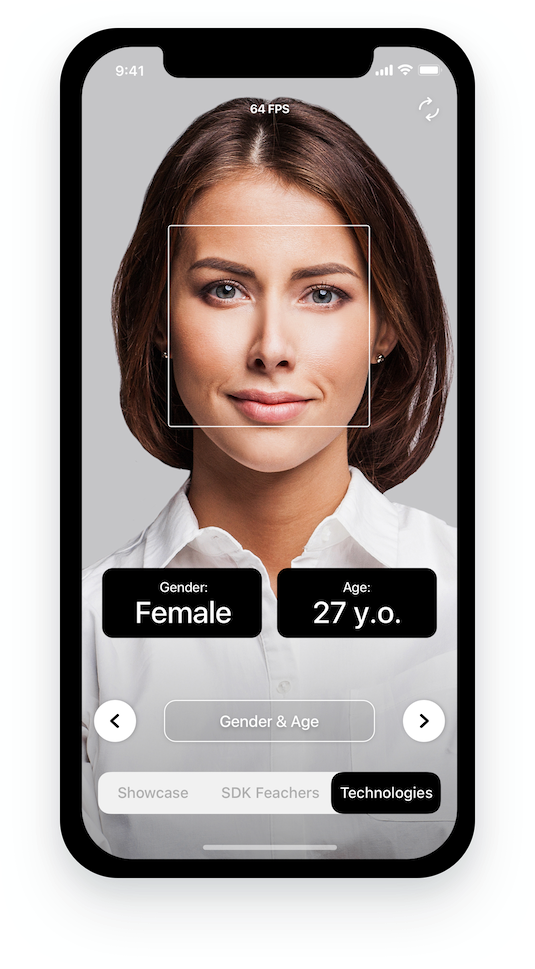
Because Banuba’s technology equips devices with ‘vision’, meaning they can ‘see’ human faces in 3D and extract meaningful subject analysis based on neural networks, including age, gender, it can do things that other apps just cannot do. It can even monitor your heart rate via spectral analysis of the time-varying color tones in your face.

It has already been incorporated into an app called Facemetrix, which can track a child’s eyes to ascertain whether they are reading something on a phone or tablet or not. Thanks to this technology, it is possible to not just to “track” a person’s gaze, but also to control a smartphone’s function with a gaze. To that end, the SDF can detect micro-movements of the eye with subpixel accuracy in real-time, and also detects certain points of the eye. The idea behind this is to “Gamify education”, rewarding a child with games and entertainment apps if the Facemetrix app has duly checked that they really did read the e-book they told their parents they’d read.

If that makes you think of a parallel with a certain Black Mirror episode where a young girl is prevented from seeing certain things via a brain implant, then you wouldn’t be a million miles away. At least this is a more benign version…

Banuba’s SDK also includes ‘Avatar AR’, empowering developers to get creative with digital communication by giving users the ability to interact with – and create personalized – avatars using any iOS or Android device.

Prokopenya says: “We are in the midst of a critical transformation between our existing smartphones and future of AR devices, such as advanced glasses and lenses. Camera-centric apps have never been more important because of this.” He says that while developers using ARKit and ARCore are able to build experiences primarily for top-of-the-range smartphones, Banuba’s SDK can work on even low-range smartphones.

The SDK will also feature Avatar AR, which allows users to interact with fun avatars or create personalised ones for all iOS and Android devices. Why should users of Apple’s iPhone X be the only people to enjoy Animoji?

Banbua is also likely to take advantage of the news that Facebook recently announced it was testing AR ads in its newsfeed, following trials for businesses to show off products within Messenger.

Banuna’s technology won’t simply be for fun apps however. Inside 2 years, the company has filed 25 patent applications with the the US patent office and of six of those were processed in record time compared with the average. Its R&D center, staffed by 50 people and based in Minsk, is focused on developing a portfolio of technologies.

Interestingly, Belarus has become famous for AI and facial recognition technologies.

For instance, cast your mind back to early 2016, when Facebook bought Masquerade, a Minsk-based developer of a video filter app, MSQRD, which at one point was one of the most popular apps in the App Store. And in 2017, another Belarusian company, AIMatter, was acquired by Google, only months after raising $2M. It too took an SDK approach, releasing a platform for real-time photo and video editing on mobile, dubbed Fabby. This was built upon a neural network-based AI platform. But Prokopenya has much bolder plans for Banuba.

In early 2017, he and Banuba launched a “technology-for-equity” program to enroll app developers and publishers across the world. This signed up Inventain, another startup from Belarus, to develop AR-based mobile games.

Prokopenya says the technologies associated with AR will be “leveraged by virtually every kind of app. Any app can recognize its user through the camera: male or female, age, ethnicity, level of stress, etc.” He says the app could then respond to the user in any number of ways. Literally, your apps could be watching you.

So for instance, a fitness app could see how much weight you’d lost just by using the Banuba SDF to look at your face. Games apps could personalize the game based on what it knows about your face, such as reading your facial cues.

Back in his London office, overlooking a small park, Prokopenya waxes lyrical about the “incredible concentration of diversity, energy and opportunity” of London. “Living in London is fantastic,” he says. “The only thing I am upset about, however, is the uncertainty surrounding Brexit and what it might mean for business in the UK in the future.”

London may be great (and will always be), but sitting on his desk though is a laptop with direct links back to Minsk, a place where the facial recognition technologies of the future are only now just emerging.

Banuba raises $7M to supercharge any app or device with the ability to really see you

Walking into the office of Viktor Prokopenya – which overlooks a central London park – you would perhaps be forgiven for missing the significance of this unassuming location, just south of Victoria Station in London. While giant firms battle globally to make Augmented Reality a ‘real industry’, this jovial businessman form Belrarus is poised to launch a revolutionary new technology for just this space. This is the kind of technology some of the biggest companies in the world are snapping up right now, and yet, scuttling off to make me a coffee in the kitchen is someone who could be sitting on just such a company.

Regardless of whether it’s immediate future is obvious or not, AR has a future if the amount of investment pouring into the space is anything to go by.

In 2016 AR and VR attracted $2.3 billion worth of investments (a 300% jump from 2015) and is expected to reach $108 billion by 2021 – 25% of which will be aimed at the AR sector. But, according to numerous forecasts, AR will overtake VR in 5-10 years.

Apple is clearly making headway in its AR developments, having recently acquired AR lens company Akonia Holographics and in releasing iOS 12 this month, it enables developers to fully utilize ARKit 2, no doubt prompting the release of a new wave of camera-centric apps. This year Sequoia Capital China, SoftBank invested $50M in AR camera app Snow. Samsung recently introduced its version of the AR cloud and a partnership with Wacom that turns Samsung’s S-Pen into an augmented reality magic wand.

The IBM/Unity partnership allows developers to integrate Watson cloud services such as visual recognition, speech to text, and more into their Unity applications.

So there is no question that AR is becoming increasingly important, given the sheer amount of funding and M&A activity.

Joining the field is Prokopenya’s “Banuba” project. For although you can download a Snapchat-like app called ‘Banuba’ from the App Store right now, underlying this is a suite of tools of which Prokopenya is the founding investor, and who is working closely to realize a very big vision with the founding team of AI/AR experts behind it.

The key to Banuba’s pitch is the idea that its technology could equip not only apps but even hardware devices with “vision”. This is a perfect marriage of both AI and AR. What if, for instance, Amazon’s Alexa couldn’t just hear you? What if it could see you and interpret your facial expressions or perhaps even your mood? That’s the tantalizing strategy at the heart of this growing company.

Better known for its consumer apps, which have been effectively testing their concepts in the consumer field for the last year, Banuba is about to move heavily into the world of developer tools with the release of its new Banuba 3.0 mobile SDK. (Available to download now in the App Store for iOS devices and Google Play Store for Android). It’s also now secured a further $7m in funding from Larnabel Ventures, the fund of Russian entrepreneur Said Gutseriev, and Prokopenya’s VP Capital.

This move will take its total funding to $12m. In the world of AR, this is like a Romulan warbird de-cloaking in a scene from Star Trek.

Banuba hopes that its SDK will enable brands and apps to utilise 3D Face AR inside their own apps, meaning users can benefit from cutting-edge face motion tracking, facial analysis, skin smoothing and tone adjustment. Banuba’s SDK also enables app developers to utilise background subtraction, which is similar to ‘green screen’ technology regularly used in movies and TV shows, enabling end-users to create a range of AR scenarios. Thus, like magic, you can remove that unsightly office surrounding and place yourself on a beach in the Bahamas…

Because Banuba’s technology equips devices with ‘vision’, meaning they can ‘see’ human faces in 3D and extract meaningful subject analysis based on neural networks, including age, gender, it can do things that other apps just cannot do. It can even monitor your heart rate via spectral analysis of the time-varying color tones in your face.

It has already been incorporated into an app called Facemetrix, which can track a child’s eyes to ascertain whether they are reading something on a phone or tablet or not. Thanks to this technology, it is possible to not just to “track” a person’s gaze, but also to control a smartphone’s function with a gaze. To that end, the SDF can detect micro-movements of the eye with subpixel accuracy in real-time, and also detects certain points of the eye. The idea behind this is to “Gamify education”, rewarding a child with games and entertainment apps if the Facemetrix app has duly checked that they really did read the e-book they told their parents they’d read.

If that makes you think of a parallel with a certain Black Mirror episode where a young girl is prevented from seeing certain things via a brain implant, then you wouldn’t be a million miles away. At least this is a more benign version…

Banuba’s SDK also includes ‘Avatar AR’, empowering developers to get creative with digital communication by giving users the ability to interact with – and create personalized – avatars using any iOS or Android device.

Prokopenya says: “We are in the midst of a critical transformation between our existing smartphones and future of AR devices, such as advanced glasses and lenses. Camera-centric apps have never been more important because of this.” He says that while developers using ARKit and ARCore are able to build experiences primarily for top-of-the-range smartphones, Banuba’s SDK can work on even low-range smartphones.

The SDK will also feature Avatar AR, which allows users to interact with fun avatars or create personalised ones for all iOS and Android devices. Why should users of Apple’s iPhone X be the only people to enjoy Animoji?

Banbua is also likely to take advantage of the news that Facebook recently announced it was testing AR ads in its newsfeed, following trials for businesses to show off products within Messenger.

Banuna’s technology won’t simply be for fun apps however. Inside 2 years, the company has filed 25 patent applications with the the US patent office and of six of those were processed in record time compared with the average. Its R&D center, staffed by 50 people and based in Minsk, is focused on developing a portfolio of technologies.

Interestingly, Belarus has become famous for AI and facial recognition technologies.

For instance, cast your mind back to early 2016, when Facebook bought Masquerade, a Minsk-based developer of a video filter app, MSQRD, which at one point was one of the most popular apps in the App Store. And in 2017, another Belarusian company, AIMatter, was acquired by Google, only months after raising $2M. It too took an SDK approach, releasing a platform for real-time photo and video editing on mobile, dubbed Fabby. This was built upon a neural network-based AI platform. But Prokopenya has much bolder plans for Banuba.

In early 2017, he and Banuba launched a “technology-for-equity” program to enroll app developers and publishers across the world. This signed up Inventain, another startup from Belarus, to develop AR-based mobile games.

Prokopenya says the technologies associated with AR will be “leveraged by virtually every kind of app. Any app can recognize its user through the camera: male or female, age, ethnicity, level of stress, etc.” He says the app could then respond to the user in any number of ways. Literally, your apps could be watching you.

So for instance, a fitness app could see how much weight you’d lost just by using the Banuba SDF to look at your face. Games apps could personalize the game based on what it knows about your face, such as reading your facial cues.

Back in his London office, overlooking a small park, Prokopenya waxes lyrical about the “incredible concentration of diversity, energy and opportunity” of London. “Living in London is fantastic,” he says. “The only thing I am upset about, however, is the uncertainty surrounding Brexit and what it might mean for business in the UK in the future.”

London may be great (and will always be), but sitting on his desk though is a laptop with direct links back to Minsk, a place where the facial recognition technologies of the future are only now just emerging.


https://ift.tt/2QnuC0A Banuba raises $7M to supercharge any app or device with the ability to really see you https://ift.tt/2zrYAqv

Amazon exec Dave Stephenson tapped to lead Airbnb to the public markets

Airbnb has completed a much-needed hire ahead of its rumored 2019 initial public offering.

The hospitality giant has brought on Dave Stephenson, a long-time Amazon vice president and former president of Big Fish Games, as its chief financial officer. Stephenson replaces the company’s head of global financial planning and analysis, Ellie Mertz, who served as interim head of finance as Airbnb searched for its former CFO Laurence Tosi’s replacement.

Tosi, who had previously led finance at The Blackstone Group, left Airbnb in February to focus on his investment firm, Weston Capital Partners, amid a report from The Information that he and Airbnb co-founder and chief executive officer Brian Chesky had disagreed over “how to balance the financial stability needed to go public.” The Wall Street veteran was focused on financial discipline, while Chesky wanted to invest in innovation and “areas that might not yield profits for a while.”

Tosi was credited with leading the company to profitability quicker than many of its fellow technology ‘unicorns.’ Airbnb says it’s profitable on an EBITDA basis and cash flow positive with a $5.5 billion balance sheet. It reportedly recorded upwards of $3 billion in revenue in 2017.

Stephenson joined Amazon in 1999 and ended his tenure at the e-commerce powerhouse as the vice president and CFO of its worldwide consumer business. He left Amazon for a brief stint between 2011 and 2013 to head up the Seattle-based game developer Big Fish Games.

“In the years ahead, [Stephenson] will be Airbnb’s quarterback for long-term growth, driving us to be even more efficient and leverage what makes Airbnb unique to create new businesses and continue to expand,” Chesky wrote in a blog post this morning.

Stephenson is the second Amazon executive to jump ship to San Francisco-based Airbnb this year. He follows Amazon’s former VP of prime & delivery experience Greg Greeley, who was hired as the home-sharing company’s president of homes in March. Greeley similarly spent nearly two decades under Jeff Bezos and was credited with helping build Amazon Prime, as well as Amazon’s European business.

The well-funded company now employs more than 4,000 and boasts a $31 billion valuation — making it one of the most valuable private companies in the world. Since it was founded by Chesky, Joe Gebbia and Nathan Blecharczyk in 2008, it’s raised $4.4 billion in venture capital funding, most recently securing a $1 billion Series F from Capital G, TCV, Temasek, Bracket Capital and others.

Airbnb is expected to bring liquidity to its investors via a highly-anticipated IPO as soon as June 30, 2019. It will likely chase Uber to the public markets, giving 2019 two of the largest IPOs of the decade.

Uber, in a similar fashion, recently hired a CFO, too — a role crucial for any company eyeing an IPO. The ride-hailing businesses’ choice was Nelson J. Chai, the former CEO of insurance and warranty provider Warranty Group.


https://ift.tt/eA8V8J Amazon exec Dave Stephenson tapped to lead Airbnb to the public markets https://ift.tt/2DX5QP7

Black Friday drove half a million new users to the top shopping apps

{rss:content:encoded} Black Friday drove half a million new users to the top shopping apps https://ift.tt/2KxwNJN https://ift.tt/2ScDxz9 November 26, 2018 at 04:22PM

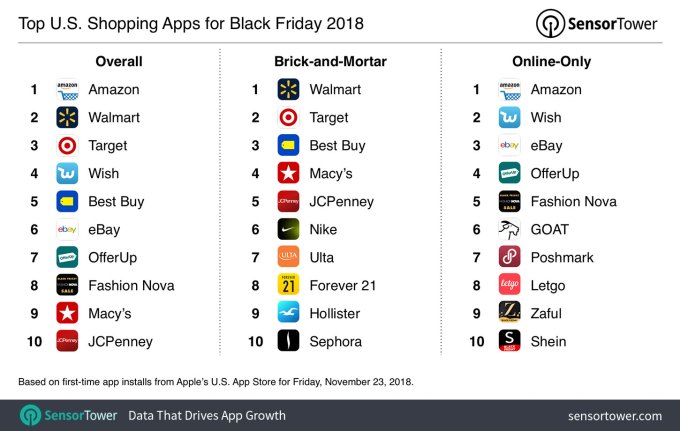
More U.S. consumers were shopping on mobile devices on Black Friday this year, with $2.1 billion in sales coming from smartphones. This trend was also reflected across the U.S. App Store. According to new data from Sensor Tower out this morning, the top 10 shopping apps on the App Store added half a million first-time users on Black Friday. That’s up 16.3 percent from the same day in 2017, the firm found.

Overall, new shopping app installs grew 9 percent over last year to reach approximately 1.8 million. To be clear, this number is new downloads, not re-downloads from someone who previously had the app installed on their device, but deleted it at some point. (Of course, those consumers may have already been customers on the web.)

Not surprisingly, Amazon’s app was the most installed, as it has been in years past. But Walmart’s app gained steam as it saw more significant year-over-year growth, the report said.

This year, Amazon added around 115,000 new app users, up 11.7 percent from 2017. Walmart, however, added 95,000 first-time users, up 39.7 percent over last year. Target’s app, which was the third most installed this year, grew 3.3 percent from 2017 with around 62,000 new users.

The rest of the top 10 was rounded out by Wish, Best Buy, eBay, Offer Up, Fashion Nova, Macy’s and JCPenney. This includes both brick-and-mortar and online retailers.

In terms of online-only retailers, the list looked a little different. Amazon was still in the lead, but was then followed by Wish, eBay, Offer Up, Fashion Nova, GOAT, Poshmark, Letgo, Zaful, and Shein.

Walmart, meanwhile, was the most-downloaded app out of all the brick-and-mortar retailers, followed by Target, Best Buy, Macy’s, JCPenney, Nike, Ulta, Forever 21, Hollister, and Sephora.

Overall, new downloads from the brick-and-mortar apps were up 24.7 percent over last year’s Black Friday, while the online-only apps grew around 20 percent.

Of these, Best Buy also had a good year in terms of new installs, the firm said. Around 34.5 percent new users installed its app for the first time, with about 39,000 new downloads in 2018 compared to 29,000 in 2017.

Sensor Tower wasn’t the only App Store intelligence firm predicting a boost in mobile shopping for this year’s Black Friday. App Annie had also forecast the sales holiday in 2018 would break new records.

In the two-week period including Thanksgiving, Black Friday and Cyber Monday, App Annie was predicting a 25 percent increase in time spent in shopping apps on Android devices – nearly double from the four years prior.

However, the Google Play numbers aren’t in yet because there’s a 3-plus day delay on Google Play between downloads and chart ranking changes. That means we won’t have accurate Android app store’s numbers until later in the week.


Sunday, November 25, 2018

Tech giants offer empty apologies because users can’t quit

A true apology consists of a sincere acknowledgement of wrong-doing, a show of empathic remorse for why you wronged and the harm it caused, and a promise of restitution by improving ones actions to make things right. Without the follow-through, saying sorry isn’t an apology, it’s a hollow ploy for forgiveness.

That’s the kind of “sorry” we’re getting from tech giants — an attempt to quell bad PR and placate the afflicted, often without the systemic change necessary to prevent repeated problems. Sometimes it’s delivered in a blog post. Sometimes it’s in an executive apology tour of media interviews. But rarely is it in the form of change to the underlying structures of a business that caused the issue.

Intractable Revenue

Unfortunately, tech company business models often conflict with the way we wish they would act. We want more privacy but they thrive on targeting and personalization data. We want control of our attention but they subsist on stealing as much of it as possible with distraction while showing us ads. We want safe, ethically built devices that don’t spy on us but they make their margins by manufacturing them wherever’s cheap with questionable standards of labor and oversight. We want groundbreaking technologies to be responsibly applied, but juicy government contracts and the allure of China’s enormous population compromise their morals. And we want to stick to what we need and what’s best for us, but they monetize our craving for the latest status symbol or content through planned obsolescence and locking us into their platforms.

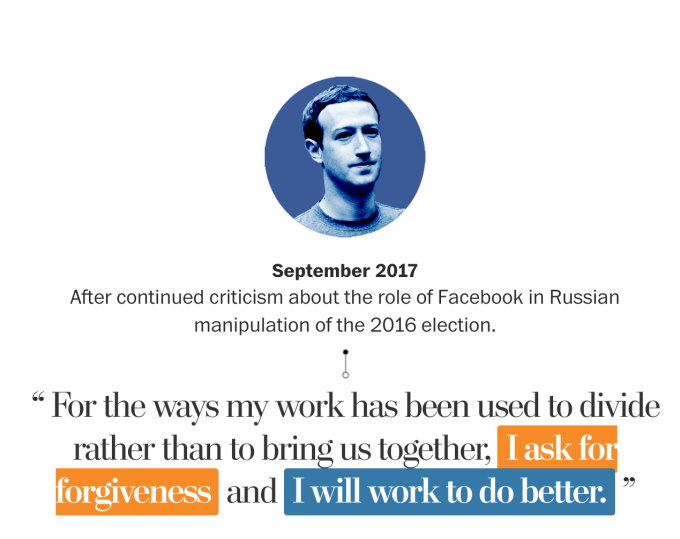
The result is that even if their leaders earnestly wanted to impart meaningful change to provide restitution for their wrongs, their hands are tied by entrenched business models and the short-term focus of the quarterly earnings cycle. They apologize and go right back to problematic behavior. The Washington Post recently chronicled a dozen times Facebook CEO Mark Zuckerberg has apologized, yet the social network keeps experiencing fiasco after fiasco. Tech giants won’t improve enough on their own.

Addiction To Utility

The threat of us abandoning ship should theoretically hold the captains in line. But tech giants have evolved into fundamental utilities that many have a hard time imagining living without. How would you connect with friends? Find what you needed? Get work done? Spend your time? What hardware or software would you cuddle up with in the moments you feel lonely? We live our lives through tech, have become addicted to its utility, and fear the withdrawal.

If there were principled alternatives to switch to, perhaps we could hold the giants accountable. But the scalability, network effects, and aggregation of supply by distributors has led to near monopolies in these core utilities. The second-place solution is often distant. What’s the next best social network that serves as an identity and login platform that isn’t owned by Facebook? The next best premium mobile and PC maker behind Apple? The next best mobile operating system for the developing world beyond Google’s Android? The next best ecommerce hub that’s not Amazon? The next best search engine? Photo feed? Web hosting service? Global chat app? Spreadsheet?

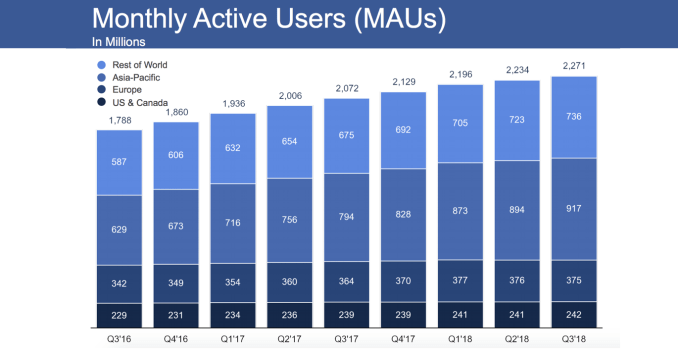
Facebook is still growing in the US & Canada despite the backlash, proving that tech users aren’t voting with their feet. And if not for a calculation methodology change, it would have added 1 million users in Europe this quarter too.

One of the few tech backlashes that led to real flight was #DeleteUber. Workplace discrimination, shady business protocols, exploitative pricing and more combined to spur the movement to ditch the ridehailing app. But what was different here is that US Uber users did have a principled alternative to switch to without much hassle: Lyft. The result was that “Lyft benefitted tremendously from Uber’s troubles in 2018” eMarketer’s forecasting director Shelleen Shum told the USA Today in May. Uber missed eMarketer’s projections while Lyft exceeded them, narrowing the gap between the car services. And meanwhile, Uber’s CEO stepped down as it tried to overhaul its internal policies.

But in the absence of viable alternatives to the giants, leaving these mainstays is inconvenient. After all, they’re the ones that made us practically allergic to friction. Even after massive scandals, data breaches, toxic cultures, and unfair practices, we largely stick with them to avoid the uncertainty of life without them. Even Facebook added 1 million monthly users in the US and Canada last quarter despite seemingly every possible source of unrest. Tech users are not voting with their feet. We’ve proven we can harbor ill will towards the giants while begrudgingly buying and using their products. Our leverage to improve their behavior is vastly weakened by our loyalty.

Inadequate Oversight

Regulators have failed to adequately step up either. This year’s congressional hearings about Facebook and social media often devolved into inane and uninformed questioning like how does Facebook earn money if its doesn’t charge? “Senator, we run ads” Facebook CEO Mark Zuckerberg said with a smirk. Other times, politicians were so intent on scoring partisan points by grandstanding or advancing conspiracy theories about bias that they were unable to make any real progress. A recent survey commissioned by Axios found that “In the past year, there has been a 15-point spike in the number of people who fear the federal government won’t do enough to regulate big tech companies — with 55% now sharing this concern.”

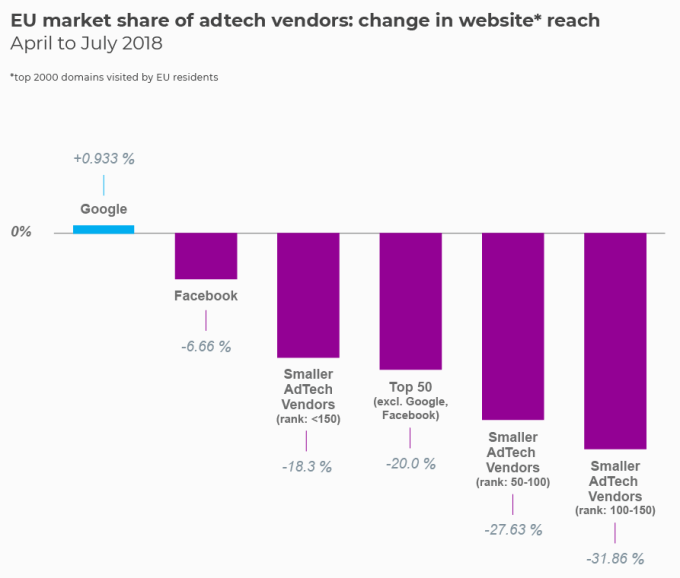
When regulators do step in, their attempts can backfire. GDPR was supposed to help tamp down on the dominance of Google and Facebook by limiting how they could collect user data and making them more transparent. But the high cost of compliance simply hindered smaller players or drove them out of the market while the giants had ample cash to spend on jumping through government hoops. Google actually gained ad tech market share and Facebook saw the littlest loss while smaller ad tech firms lost 20 or 30 percent of their business.

Europe’s GDPR privacy regulations backfired, reinforcing Google and Facebook’s dominance. Chart via Ghostery, Cliqz, and WhoTracksMe.

Even the Honest Ads act, which was designed to bring political campaign transparency to internet platforms following election interference in 2016, has yet to be passed even despite support from Facebook and Twitter. There’s hasn’t been meaningful discussion of blocking social networks from acquiring their competitors in the future, let alone actually breaking Instagram and WhatsApp off of Facebook. Governments like the U.K. that just forcibly seized documents related to Facebook’s machinations surrounding the Cambridge Analytica debacle provide some indication of willpower. But clumsy regulation could deepen the moats of the incumbents, and prevent disruptors from gaining a foothold. We can’t depend on regulators to sufficiently protect us from tech giants right now.

Our Hope On The Inside

The best bet for change will come from the rank and file of these monolithic companies. With the war for talent raging, rock star employees able to have huge impact on products, and compensation costs to keep them around rising, tech giants are vulnerable to the opinions of their own staff. It’s simply too expensive and disjointing to have to recruit new high-skilled workers to replace those that flee.

Google declined to renew a contract with the government after 4000 employees petitioned and a few resigned over Project Maven’s artificial intelligence being used to target lethal drone strikes. Change can even flow across company lines. Many tech giants including Facebook and Airbnb have removed their forced arbitration rules for harassment disputes after Google did the same in response to 20,000 of its employees walking out in protest.

Thousands of Google employees protested the company’s handling of sexual harassment and misconduct allegations on Nov. 1.

Facebook is desperately pushing an internal communications campaign to reassure staffers it’s improving in the wake of damning press reports from the New York Times and others. TechCrunch published an internal memo from Facebook’s outgoing VP of communications Elliot Schrage in which he took the blame for recent issues, encouraged employees to avoid finger-pointing, and COO Sheryl Sandberg tried to reassure employees that “I know this has been a distraction at a time when you’re all working hard to close out the year — and I am sorry.” These internal apologizes could come with much more contrition and real change than those paraded for the public.

And so after years of us relying on these tech workers to build the product we use every day, we must now rely that will save us from them. It’s a weighty responsibility to move their talents where the impact is positive, or commit to standing up against the business imperatives of their employers. We as the public and media must in turn celebrate when they do what’s right for society, even when it reduces value for shareholders. And we must accept that shaping the future for the collective good may be inconvenient for the individual.

For more on this topic:


from Social – TechCrunch https://ift.tt/2r2PNqD Tech giants offer empty apologies because users can’t quit Josh Constine https://ift.tt/2DWTFlg
via IFTTT

Tech giants offer empty apologies because users can’t quit

{rss:content:encoded} Tech giants offer empty apologies because users can’t quit https://ift.tt/2DWTFlg https://ift.tt/2r2PNqD November 25, 2018 at 07:31PM

A true apology consists of a sincere acknowledgement of wrong-doing, a show of empathic remorse for why you wronged and the harm it caused, and a promise of restitution by improving ones actions to make things right. Without the follow-through, saying sorry isn’t an apology, it’s a hollow ploy for forgiveness.

That’s the kind of “sorry” we’re getting from tech giants — an attempt to quell bad PR and placate the afflicted, often without the systemic change necessary to prevent repeated problems. Sometimes it’s delivered in a blog post. Sometimes it’s in an executive apology tour of media interviews. But rarely is it in the form of change to the underlying structures of a business that caused the issue.

Intractable Revenue

Unfortunately, tech company business models often conflict with the way we wish they would act. We want more privacy but they thrive on targeting and personalization data. We want control of our attention but they subsist on stealing as much of it as possible with distraction while showing us ads. We want safe, ethically built devices that don’t spy on us but they make their margins by manufacturing them wherever’s cheap with questionable standards of labor and oversight. We want groundbreaking technologies to be responsibly applied, but juicy government contracts and the allure of China’s enormous population compromise their morals. And we want to stick to what we need and what’s best for us, but they monetize our craving for the latest status symbol or content through planned obsolescence and locking us into their platforms.

The result is that even if their leaders earnestly wanted to impart meaningful change to provide restitution for their wrongs, their hands are tied by entrenched business models and the short-term focus of the quarterly earnings cycle. They apologize and go right back to problematic behavior. The Washington Post recently chronicled a dozen times Facebook CEO Mark Zuckerberg has apologized, yet the social network keeps experiencing fiasco after fiasco. Tech giants won’t improve enough on their own.

Addiction To Utility

The threat of us abandoning ship should theoretically hold the captains in line. But tech giants have evolved into fundamental utilities that many have a hard time imagining living without. How would you connect with friends? Find what you needed? Get work done? Spend your time? What hardware or software would you cuddle up with in the moments you feel lonely? We live our lives through tech, have become addicted to its utility, and fear the withdrawal.

If there were principled alternatives to switch to, perhaps we could hold the giants accountable. But the scalability, network effects, and aggregation of supply by distributors has led to near monopolies in these core utilities. The second-place solution is often distant. What’s the next best social network that serves as an identity and login platform that isn’t owned by Facebook? The next best premium mobile and PC maker behind Apple? The next best mobile operating system for the developing world beyond Google’s Android? The next best ecommerce hub that’s not Amazon? The next best search engine? Photo feed? Web hosting service? Global chat app? Spreadsheet?

Facebook is still growing in the US & Canada despite the backlash, proving that tech users aren’t voting with their feet. And if not for a calculation methodology change, it would have added 1 million users in Europe this quarter too.

One of the few tech backlashes that led to real flight was #DeleteUber. Workplace discrimination, shady business protocols, exploitative pricing and more combined to spur the movement to ditch the ridehailing app. But what was different here is that US Uber users did have a principled alternative to switch to without much hassle: Lyft. The result was that “Lyft benefitted tremendously from Uber’s troubles in 2018” eMarketer’s forecasting director Shelleen Shum told the USA Today in May. Uber missed eMarketer’s projections while Lyft exceeded them, narrowing the gap between the car services. And meanwhile, Uber’s CEO stepped down as it tried to overhaul its internal policies.

But in the absence of viable alternatives to the giants, leaving these mainstays is inconvenient. After all, they’re the ones that made us practically allergic to friction. Even after massive scandals, data breaches, toxic cultures, and unfair practices, we largely stick with them to avoid the uncertainty of life without them. Even Facebook added 1 million monthly users in the US and Canada last quarter despite seemingly every possible source of unrest. Tech users are not voting with their feet. We’ve proven we can harbor ill will towards the giants while begrudgingly buying and using their products. Our leverage to improve their behavior is vastly weakened by our loyalty.

Inadequate Oversight

Regulators have failed to adequately step up either. This year’s congressional hearings about Facebook and social media often devolved into inane and uninformed questioning like how does Facebook earn money if its doesn’t charge? “Senator, we run ads” Facebook CEO Mark Zuckerberg said with a smirk. Other times, politicians were so intent on scoring partisan points by grandstanding or advancing conspiracy theories about bias that they were unable to make any real progress. A recent survey commissioned by Axios found that “In the past year, there has been a 15-point spike in the number of people who fear the federal government won’t do enough to regulate big tech companies — with 55% now sharing this concern.”

When regulators do step in, their attempts can backfire. GDPR was supposed to help tamp down on the dominance of Google and Facebook by limiting how they could collect user data and making them more transparent. But the high cost of compliance simply hindered smaller players or drove them out of the market while the giants had ample cash to spend on jumping through government hoops. Google actually gained ad tech market share and Facebook saw the littlest loss while smaller ad tech firms lost 20 or 30 percent of their business.

Europe’s GDPR privacy regulations backfired, reinforcing Google and Facebook’s dominance. Chart via Ghostery, Cliqz, and WhoTracksMe.

Even the Honest Ads act, which was designed to bring political campaign transparency to internet platforms following election interference in 2016, has yet to be passed even despite support from Facebook and Twitter. There’s hasn’t been meaningful discussion of blocking social networks from acquiring their competitors in the future, let alone actually breaking Instagram and WhatsApp off of Facebook. Governments like the U.K. that just forcibly seized documents related to Facebook’s machinations surrounding the Cambridge Analytica debacle provide some indication of willpower. But clumsy regulation could deepen the moats of the incumbents, and prevent disruptors from gaining a foothold. We can’t depend on regulators to sufficiently protect us from tech giants right now.

Our Hope On The Inside

The best bet for change will come from the rank and file of these monolithic companies. With the war for talent raging, rock star employees able to have huge impact on products, and compensation costs to keep them around rising, tech giants are vulnerable to the opinions of their own staff. It’s simply too expensive and disjointing to have to recruit new high-skilled workers to replace those that flee.

Google declined to renew a contract with the government after 4000 employees petitioned and a few resigned over Project Maven’s artificial intelligence being used to target lethal drone strikes. Change can even flow across company lines. Many tech giants including Facebook and Airbnb have removed their forced arbitration rules for harassment disputes after Google did the same in response to 20,000 of its employees walking out in protest.

Thousands of Google employees protested the company’s handling of sexual harassment and misconduct allegations on Nov. 1.

Facebook is desperately pushing an internal communications campaign to reassure staffers it’s improving in the wake of damning press reports from the New York Times and others. TechCrunch published an internal memo from Facebook’s outgoing VP of communications Elliot Schrage in which he took the blame for recent issues, encouraged employees to avoid finger-pointing, and COO Sheryl Sandberg tried to reassure employees that “I know this has been a distraction at a time when you’re all working hard to close out the year — and I am sorry.” These internal apologizes could come with much more contrition and real change than those paraded for the public.

And so after years of us relying on these tech workers to build the product we use every day, we must now rely that will save us from them. It’s a weighty responsibility to move their talents where the impact is positive, or commit to standing up against the business imperatives of their employers. We as the public and media must in turn celebrate when they do what’s right for society, even when it reduces value for shareholders. And we must accept that shaping the future for the collective good may be inconvenient for the individual.

For more on this topic:

UK parliament seizes cache of internal Facebook documents to further privacy probe

Facebook founder Mark Zuckerberg may yet regret underestimating a UK parliamentary committee that’s been investigating the democracy-denting impact of online disinformation for the best part of this year — and whose repeat requests for facetime he’s just as repeatedly snubbed.

In the latest high gear change, reported in yesterday’s Observer, the committee has used parliamentary powers to seize a cache of documents pertaining to a US lawsuit to further its attempt to hold Facebook to account for misuse of user data.

Facebook’s oversight — or rather lack of it — where user data is concerned has been a major focus for the committee, as its enquiry into disinformation and data misuse has unfolded and scaled over the course of this year, ballooning in scope and visibility since the Cambridge Analytica story blew up into a global scandal this April.

The internal documents now in the committee’s possession are alleged to contain significant revelations about decisions made by Facebook senior management vis-a-vis data and privacy controls — including confidential emails between senior executives and correspondence with Zuckerberg himself.

This has been a key line of enquiry for parliamentarians. And an equally frustrating one — with committee members accusing Facebook of being deliberately misleading and concealing key details from it.

The seized files pertain to a US lawsuit that predates mainstream publicity around political misuse of Facebook data, with the suit filed in 2015, by a US startup called Six4Three, after Facebook removed developer access to friend data. (As we’ve previously reported Facebook was actually being warned about data risks related to its app permissions as far back as 2011 — yet it didn’t full shut down the friends data API until May 2015.)

The core complaint is an allegation that Facebook enticed developers to create apps for its platform by implying they would get long-term access to user data in return. So by later cutting data access the claim is that Facebook was effectively defrauding developers.

Since lodging the complaint, the plaintiffs have seized on the Cambridge Analytica saga to try to bolster their case.

And in a legal motion filed in May Six4Three’s lawyers claimed evidence they had uncovered demonstrated that “the Cambridge Analytica scandal was not the result of mere negligence on Facebook’s part but was rather the direct consequence of the malicious and fraudulent scheme Zuckerberg designed in 2012 to cover up his failure to anticipate the world’s transition to smartphones”.

The startup used legal powers to obtain the cache of documents — which remain under seal on order of a California court. But the UK parliament used its own powers to swoop in and seize the files from the founder of Six4Three during a business trip to London when he came under the jurisdiction of UK law, compelling him to hand them over.

According to the Observer, parliament sent a serjeant at arms to the founder’s hotel — giving him a final warning and a two-hour deadline to comply with its order.

“When the software firm founder failed to do so, it’s understood he was escorted to parliament. He was told he risked fines and even imprisonment if he didn’t hand over the documents,” it adds, apparently revealing how Facebook lost control over some more data (albeit, its own this time).

In comments to the newspaper yesterday, DCMS committee chair Damian Collins said: “We are in uncharted territory. This is an unprecedented move but it’s an unprecedented situation. We’ve failed to get answers from Facebook and we believe the documents contain information of very high public interest.”

Collins later tweeted the Observer’s report on the seizure, teasing “more next week” — likely a reference to the grand committee hearing in parliament already scheduled for November 27.

But it could also be a hint the committee intends to reveal and/or make use of information locked up in the documents, as it puts questions to Facebook’s VP of policy solutions…

That said, the documents are subject to the Californian superior court’s seal order, so — as the Observer points out — cannot be shared or made public without risk of being found in contempt of court.

A spokesperson for Facebook made the same point, telling the newspaper: “The materials obtained by the DCMS committee are subject to a protective order of the San Mateo Superior Court restricting their disclosure. We have asked the DCMS committee to refrain from reviewing them and to return them to counsel or to Facebook. We have no further comment.”

Facebook’s spokesperson added that Six4Three’s “claims have no merit”, further asserting: “We will continue to defend ourselves vigorously.”

And, well, the irony of Facebook asking for its data to remain private also shouldn’t be lost on anyone at this point…

Another irony: In July, the Guardian reported that as part of Facebook’s defence against Six4Three’s suit the company had argued in court that it is a publisher — seeking to have what it couched as ‘editorial decisions’ about data access protected by the US’ first amendment.

Which is — to put it mildly — quite the contradiction, given Facebook’s long-standing public characterization of its business as just a distribution platform, never a media company.

So expect plenty of fireworks at next week’s public hearing as parliamentarians once again question Facebook over its various contradictory claims.

It’s also possible the committee will have been sent an internal email distribution list by then, detailing who at Facebook knew about the Cambridge Analytica breach in the earliest instance.

This list was obtained by the UK’s data watchdog, over the course of its own investigation into the data misuse saga. And earlier this month information commissioner Elizabeth Denham confirmed the ICO has the list and said it would pass it to the committee.

The accountability net does look to be closing in on Facebook management.

Even as Facebook continues to deny international parliaments any face-time with its founder and CEO (the EU parliament remains the sole exception).

Last week the company refused to even have Zuckerberg do a video call to take the committee’s questions — offering its VP of policy solutions, Richard Allan, to go before what’s now a grand committee comprised of representatives from seven international parliaments instead.

The grand committee hearing will take place in London on Tuesday morning, British time — followed by a press conference in which parliamentarians representing Facebook users from across the world will sign a set of ‘International Principles for the Law Governing the Internet’, making “a declaration on future action”.

So it’s also ‘watch this space’ where international social media regulation is concerned.

As noted above, Allan is just the latest stand-in for Zuckerberg. Back in April the DCMS committee spend the best part of five hours trying to extract answers from Facebook CTO, Mike Schroepfer.

“You are doing your best but the buck doesn’t stop with you does it? Where does the buck stop?” one committee member asked him then.

“It stops with Mark,” replied Schroepfer.

But Zuckerberg definitely won’t be stopping by on Tuesday.


from Social – TechCrunch https://ift.tt/eA8V8J UK parliament seizes cache of internal Facebook documents to further privacy probe Natasha Lomas https://ift.tt/2DY4XpD
via IFTTT

blogger better Headline Animator