l
l
blogger better. Powered by Blogger.

Search

Labels

blogger better

Followers

Blog Archive

Total Pageviews

Labels

Download

Blogroll

Featured 1

Curabitur et lectus vitae purus tincidunt laoreet sit amet ac ipsum. Proin tincidunt mattis nisi a scelerisque. Aliquam placerat dapibus eros non ullamcorper. Integer interdum ullamcorper venenatis. Pellentesque habitant morbi tristique senectus et netus et malesuada fames ac turpis egestas.

Featured 2

Curabitur et lectus vitae purus tincidunt laoreet sit amet ac ipsum. Proin tincidunt mattis nisi a scelerisque. Aliquam placerat dapibus eros non ullamcorper. Integer interdum ullamcorper venenatis. Pellentesque habitant morbi tristique senectus et netus et malesuada fames ac turpis egestas.

Featured 3

Curabitur et lectus vitae purus tincidunt laoreet sit amet ac ipsum. Proin tincidunt mattis nisi a scelerisque. Aliquam placerat dapibus eros non ullamcorper. Integer interdum ullamcorper venenatis. Pellentesque habitant morbi tristique senectus et netus et malesuada fames ac turpis egestas.

Featured 4

Curabitur et lectus vitae purus tincidunt laoreet sit amet ac ipsum. Proin tincidunt mattis nisi a scelerisque. Aliquam placerat dapibus eros non ullamcorper. Integer interdum ullamcorper venenatis. Pellentesque habitant morbi tristique senectus et netus et malesuada fames ac turpis egestas.

Featured 5

Curabitur et lectus vitae purus tincidunt laoreet sit amet ac ipsum. Proin tincidunt mattis nisi a scelerisque. Aliquam placerat dapibus eros non ullamcorper. Integer interdum ullamcorper venenatis. Pellentesque habitant morbi tristique senectus et netus et malesuada fames ac turpis egestas.

Monday, October 7, 2019

Instagram is killing its creepy stalking feature, the Following tab

Instagram is removing its Following tab, a feature that became better known as a stalking tool than one to aid with new account discovery, as the company had intended. Today, Instagram says that its Explore tab is the go-to place to find new people, places and hashtags to follow. Meanwhile, the Following tab is now only used by a small number of people on a regular basis.

Combined, those factors were the key reasons behind its shutdown, we understand.

But the Following tab wasn’t just unhelpful and therefore ignored by Instagram users — a number of people forgot, or never even knew, it existed in the first place. There are numerous stories of people’s illicit or private activities being outed because of what they were liking and following on Instagram.

The tab was fairly notorious for the transparency it brought to our online lives. It was often a place where “micro-cheating” activity was caught, for example. That is, it could reveal when a person in a committed relationship was spending just a little too much time liking someone else’s posts, engaging with an ex’s content, or networking with series of potential “backup partners” on a regular basis.

iOS Before Following


It could also easily reveal when someone’s main use case for Instagram was to like and follow IG “models” — something that didn’t seem like the kind of activity most would want to be offered in a trackable format. (And information that was particularly awkward to see when the person in question was not a close friend, but rather a work colleague of some sort.)

The tab was known to have impacted or even ended friendships, too — like in the case where someone wouldn’t respond to their friend’s texts, or claim they were “busy.” Meanwhile, they were consistently active on Instagram, and very obviously lying.

Gossip followers also liked the tab, as it would reveal who celebs were following — sometimes an indication of a new relationship, either personal or professional in nature.

Overall, the tab generally became known as a creepy tool, and not one that offered any significant benefit to users in terms of being a legitimate discovery mechanism.

Android After Activity


Though Instagram is only announcing this change today, many users had already lost access to the tab. Back in August, for example, a big thread on Reddit saw users complaining their Following tab had disappeared. They assumed it was a bug, however.

After the tab’s removal, you’ll only see your own activity, as before, when you click the Heart button.

The company says the Following tab is being removed starting today, but it will take the rest of the week for the rollout to complete.


from Social – TechCrunch https://ift.tt/2APsjtN Instagram is killing its creepy stalking feature, the Following tab Sarah Perez https://ift.tt/339ETQJ
via IFTTT

Sequoia shares wisdom with Disrupt SF Battlefield competitors and Startup Alley Top Picks

Editor’s note: James Buckhouse is design partner at Sequoia. 

Last Tuesday, the teams competing in Startup Battlefield at Disrupt SF, as well as founders chosen as Top Picks in Startup Alley, visited Sequoia Capital’s office in San Francisco for a discussion with partners Jess Lee, Roelof Botha, Mike Vernal, Alfred Lin and James Buckhouse. The following is a partial transcript of the session, which was moderated by Buckhouse.

James Buckhouse: We partner from idea to IPO and beyond, but it’s partnering at the idea stage that we love the most — that moment when anything is possible. And it’s happened throughout Sequoia’s history. YouTube incubated in our office. Dropbox was an unreleased demo. Stripe didn’t have a single line of code. Apple was just two dudes named Steve. And so our favorite place to be is in the earliest moments.

We’re not here tonight to share with you lessons of our great wisdom on how company building ought to go. We’re here tonight to say that we understand how hard it is. And the three partners that you’ve got here to talk with tonight — Roelof BothaJess Lee and Mike Vernal — are people who have actually been in the trenches building companies themselves.

Customers

James Buckhouse: Great companies like Apple, Amazon and Zoom all have this one thing in common: customer obsession. That’s an easy thing to think about when you already have a billion customers, and you already have a bunch of money. But what do you do when you’re at the pre-seed stage and you want to be customer-obsessed but you don’t even have a product yet, let alone any customers? How do you even begin?

Jess Lee: I think at the very earliest of stages, all that really matters is product market fit. A common mistake we see is that a founder is only obsessed with the product, and then goes on to think, “I have my product. Let me go find a market that works for this,” when it should actually be the other way around. You should look at the market first, and then get to know the customers in that market by doing customer research.

There’s a great book by Erika Hall where she discusses how to ask the right questions to customers in order to really understand their pain points, their motivations and their needs. That’s a hallmark of some of the best companies that we’ve seen, even at the earliest stages. They spend a lot of time talking to customers and understanding what they want. Something we at Sequoia like to recommend when we work with seed and pre-seed-stage companies is to actually take the time to write down a set of customer personas. Who are your prototypical or your archetypes of different types of customers? In the very early days, you might think, “I know the customer. I can remember this. I don’t need to write it down.” But as soon as you add one new team member, who maybe isn’t as familiar with your customer, a lot of things get lost in translation.

For my company Polyvore, which was in the women’s fashion space, I had a lot of engineers on my team who were men and didn’t understand women’s fashion very well. I would always beat my head against the wall wondering why a feature they designed didn’t quite make sense, and it’s because we did the personas exercise a little bit too late. It made me wish we’d done it earlier. Once we had three very clear personas, I started to notice everything ran more smoothly. I found, whether it was the sales team or the engineering team, people started to clearly communicate the idea of what our customer really wanted. People made better decisions at all levels. That’s why at Sequoia we always encourage even our earliest-stage companies to write their customer research down immediately, way before they think they need it.

Product

James Buckhouse: How does an early-stage startup make sure that they’re on the right track and building the right product?

Mike Vernal: The key thing to me is actually not being data-driven; it’s much more about being hypothesis-driven. The problem is people think about product as art. But I actually think of product as being equal parts art and science. And I think the science part of it, which is really important, especially at an early stage, is being clear about what your hypotheses are, what you think is going to work, why you think it’s going to work and really sort of pressure-testing that on a logical level. And, if you are able to, actually pressure-testing it with real data.

One of Jess’s techniques, which I think is great, is the notion of fake doors. If you want to know whether something’s actually going to hum in the market, whether people are going to care about it, build a landing page for it. Build a sign-up button for it. Run a bunch of ads for it. Test a bunch of different marketing copy and see if people actually want the product. I’ve seen a bunch of companies use this to great effect.

I think that in general the mistakes people make with product is, one, being too artistic and not scientific enough about things. And then two, to Jess’s point, the most important thing before you have a product is finding product market fit. Usually, finding product market fit in a category is a function of two or three important things. Identifying those important things and testing them to get clarity around that first, then designing the full product, is way better than just starting with a masterpiece, and then slowly painting over and over the masterpiece until you get to something that is great.

James Buckhouse: For enterprise companies, Roelof, can you talk a little bit about the Sales Ready Product and Templeton compression approach?

Roelof Botha: If you go to our website and search for Sequoia Sales Ready Product or Templeton, you’ll find very useful content that we put together. The insight came from one of the best leaders that we’ve worked with, in a variety of companies, who argued to not just go for an MVP, a Minimal Viable Product, if you’re building an enterprise company, but what he termed a Sales Ready Product, an SRP.

The difference is that a Minimal Viable Product just gets over the hurdle but doesn’t convince your customer to jump out of their seats to buy your product. When we invested in Cisco in the late 1980s, the first product they shipped had so many bugs it didn’t work. But the product solved such an important need for the customer that they came back to Cisco and asked if they could fix it since they needed the product to work so badly because there was a fundamental problem in trying two networks at the time. And that to me was a Sales Ready Product. You’ve got something that, even if it’s not perfect, really solves your customer’s pain point.

And so to condense the whole theory behind this: Spend a little bit more time, probably another three months, maybe another four, five months, from when you would otherwise ship an MVP to ship an SRP. The reason it matters for an enterprise company is that your sales organization will be so much more effective. Your sales team will ramp up a curve far more steeply and you’ll get sales momentum much, much faster if you sell an SRP.

Culture

James Buckhouse: I’m going to do something a little bit unexpected here and call on Alfred in the back. Could you talk a little bit about what it was like at Airbnb, where they started with culture very early on?

Alfred Lin: Brian, Joe and Nate came and visited Zappos, where we offered tours, to see what the culture was all about (Alfred was COO of Zappos). At Zappos, we started writing down our core values a little late, when we were at about 300 people. And I told Brian, Joe and Nate that that was too late.

After that trip, they went back and wrote down their core values, before hiring their first employee. They knew that they had to create a new category. Home-sharing was not something that people really thought about. And so they needed people who were willing to champion the mission. And that was one of the first core values that they wrote down.

James Buckhouse: Oftentimes, people think that culture is the thing you do later on, once your business has grown large and suddenly you have a lot of people. But that’s not true. Culture matters a lot more than people think. And it matters earlier than people think. Jess, can you talk about your framework on core values?

Jess Lee: This is something we spend a lot of time on with seed and pre-seed companies, who think, “Oh, I already know my culture. I’ll wait to write it down later.” But it’s important to get it right up front. We encourage people to not pick too many core values. Generally, you want a framework that’s a core value and the behaviors you want that exemplify that core value. And most importantly, you need a story. You need some legendary anecdote or example from inside the company that really brings the core value to life.

To use Airbnb as an example, one of its core values is to be a cereal entrepreneur. The reason it’s cereal with a “C” is because at the time, Airbnb was running out of money. They weren’t sure they had product market fit, but they went to the Democratic National Convention to try the Airbnb idea when they were down to the wire in terms of money. In order to just get the word out about the business they made boxes of cereal that said “Obama-Os” and “Captain McCain.” It’s a good example of rolling up your sleeves and doing whatever it takes to get your business launched. Somehow, they actually managed to generate revenue that they put back into the business. The really memorable part of that is the cereal anecdote. Whatever it might be at your company, make sure that the lore lives on. That’s really what brings culture to life. It’s not just the value itself.

James Buckhouse: Roelof, can you talk a little bit about the culture at PayPal in the early days?

Roelof Botha: There are a couple of elements in that. One is this idea of intercept versus slope. For those of you that are fans of math or science, it comes naturally, but sometimes you get to hire people who have a high intercept. They have a lot of experience. In our case, we needed to hire people who knew a lot about financial services, because we as the early, young team didn’t. You hire people with intercept, but then you want people with slope. People who are going to learn very quickly. And at the end of the day, part of what made PayPal successful was that we had a good slope and we learned very, very quickly.

Our culture was very hard-working. We faced a bit of a crunch in June of 2000. We’d raised a bunch of money during the dot-com era, and then we were sitting with seven months of runway and no revenue, burning $10 million a month. It was a “you’re all-in” culture. Management meetings were on Saturdays, because that’s the kind of sacrifice we were going to make as a team to get to the other side. Culture was really important to the success of the company. We had a strong bond between us as team members because we were in the trenches. We had to figure out how to make this business work when the odds were against us and the press had given up on us.

Most people on the outside are going to think that you’re going to fail. Expect that. Don’t be surprised by that. Draw strength from that, and rally your team around your cause. You should ignore that kind of feedback.

Leadership

James Buckhouse: How do you discern a strong founding team?

Roelof Botha: My favorite, especially with companies at the seed stage, is to have no slides and to have a conversation with you about your business. What I find compelling is, the more I dig, the more excited I get, because your depth of knowledge, of understanding the problem that you’re trying to solve, shows itself. There are a lot of people who start companies for the wrong reasons, and they have very superficial knowledge. So as soon as you start to pressure test it, it’s clear that there’s no depth.

The founders who are the best are the ones that are so motivated to solve the problem they’re working on, they’ve researched everything. You would have found a simpler solution to the problem if you could, and you didn’t. That inspired you to start this company. As I ask you questions, you just have this depth of knowledge. You’ve thought about it so many levels deep. Those founders are the ones that keep coming up with new ideas, and that’s why their imitators don’t do so well. We see this in our industry. You come up with a great idea, TechCrunch writes about it, everybody around the world reads about it and now you’ve got 15 competitors in other countries going after what you’re doing. But guess what? They didn’t have the idea, you did. Since you had the original idea, you’ve thought about it more deeply and you can iterate faster than they can.

James Buckhouse: Jess, how about you? What do you look for to discern a strong founding team?

Jess Lee: I do agree, and I think different investors look for very different things. There is probably a notion of founder/investor fit to some extent. For me, I especially appreciate a unique insight and depth of understanding of that customer and that market. But on top of that, the other thing I think about is grit. I think that being a founder is so hard. I felt like I was on the struggle bus the entire time. Either we weren’t doing well, which was a struggle, or we were doing really well and then we were in a state of hyper-growth, and that’s also really hard. Your job changes underneath you every six months. Because even if you’re successful, everything that used to work for you as the CEO or founder is now broken because your team is now 50 people instead of 10.

What is it driving you, to either solve this problem or just driving you in general? Because it’s just not easy, and folks who give up too easily or came into this because they thought being a founder was going to be really cool, it’s not that cool all the time, so I look for that. Sometimes it shows up in the form being really mission-driven, and you have some burning desire to solve the problem. Sometimes it’s just that you’ve been underestimated your whole life and you’re really mad about it, and you want to prove yourself. There are a lot of different ways to suss out grit, but that’s one big thing that I look for.

One thing I also like to see, that is not a must-have but I find very compelling, is if you’re a good storyteller. I think that at the end of the day you have to convince your family that you’re not crazy for quitting your job to pursue this thing. You’ve got to convince early employees to join you when you can’t pay them any money. You’ve got to convince early-stage seed investors to take a chance on you and give you money when there is nothing there yet. And you’ve got to convince customers. Being able to tell a good story, both taking something complicated and making it sound simple, as well as being able to influence and talk about why your approach is interesting and different, not just better than the competitors. I look for that as well. I think that’s important.

One area where I do disagree with Roelof is that I do prefer to see slides. I think it showcases your storytelling ability. I look at a lot of consumer companies and your attention to design and detail is also an interesting thing that you can suss out with slides.

James Buckhouse: How about you, Mike?

Mike Vernal: If you can’t describe the business in a minute or two, then you need to keep iterating. Some bad meetings end up as the following: Someone will come in with 40 slides and want to convey all of the knowledge in the 40 slides in excruciating detail.

I think a couple of things. One is, many investors look at a lot of companies all day long so they might actually know more about your space than you might think. Then two, if you need 40 minutes to explain the business, marketing and all of these other things, then for an investor meeting that might work because you have that time scheduled, but for the random engineer you meet at a party who you want to get excited about joining your company, that’s going to be really hard.

The best pitch is when I’m two minutes in and I’m like, “I get the business. This is super interesting. Let’s ask all these questions.” The tough ones are 40 minutes of being talked at, where there is no real interaction.

Capital strategies

James Buckhouse: Different types of companies need different types of capital strategies. How do you all think about how founders ought to think about their strategy for capital?

Jess Lee: It’s really important to think about three things: First, what is the actual cash you need for your business? If you’re a pure software business you don’t usually need as much as if you’re building hardware or you’re making physical goods.

Second, what is the valuation that actually makes sense? True valuation, when you become a public company, when you do M&A, is actually a function of your free cash flow, or a multiple of your revenue, so just being able to understand in the long, long-term what is a likely five, 10-year-out valuation, and then making sure you don’t overshoot that just because you can. That’s another first principle.

The third thing is ownership. Doing the math, if you don’t need to raise a lot of money, if you don’t need to raise as many rounds, at the end of the day when ideally your company is acquired for hundreds of millions of dollars, or billions of dollars, or you IPO, what is your ownership at that moment? We have founders like Dropbox, that when they went public, Drew and Arash owned nearly 40% of the company. So you have to think — would you rather have 40% of a $10 billion company, or would you rather have 2% of a $20 billion company? That ownership at the end of the day is really important. So you have to think about those three things, which is a pretty complicated equation.

It really hit home for me when my company, Polyvore, went through the M&A process and it suddenly hit me that all the acquirers were not using funny VC math. They were looking at our cash flow and the multiple of revenue. Luckily, we hadn’t raised that much money, as I’d wanted to keep as much ownership as possible. I was optimizing for ownership for the team. Because of that, we actually had a really nice outcome, where everybody made money because we hadn’t over-raised since we didn’t need to. We were a pure software-based, capital-efficient kind of company, but I think not enough founders think about that from first principles, starting from the early days. They just look at who’s raising what, and how much they could possibly get. They want to maximize that, when in reality, it’s not actually the right way to think about it.

Roelof Botha: When you raise money, you’re recruiting a partner. I see too many companies, especially seed-stage companies, make the mistake of accepting funding from whoever shows up, when that’s probably the most expensive equity you’ll ever sell in your business. You could potentially be selling it to people that are not going to be there six months or six years from now, helping you close a candidate, helping you wrestle with an important strategic decision or helping you refine your business model. Those people aren’t going to be there, so it’s a recruiting decision. Take it seriously. It’s also important to check their references. Your investor is going to do references on you. Why aren’t you doing references on them?


https://ift.tt/eA8V8J Sequoia shares wisdom with Disrupt SF Battlefield competitors and Startup Alley Top Picks https://ift.tt/339w8Gl

Laurel Bowden of VC firm 83North on the European deep tech and startup ecosystems

London and Tel Aviv based VC firm 83North has closed out its fifth fund at $300 million, as we reported earlier. It last raised a $250 million fund in 2017 and expects to continue the same investment mix, while tracking developments in emerging areas like healthcare AI and autonomous vehicles.

In a conversation with general partner Laurel Bowden, the veteran investor shared a few further thoughts with Extra Crunch — talking about the tech scene in Europe vs Israel, what the firm looks for in a team and tips on scaling globally.

The interview has been lightly edited for clarity. 

TechCrunch: Is Europe starting to catch up to Israel when it comes to deep tech startups?

Laurel Bowden: We clearly think we have in our portfolio some deep tech. And in other VC portfolios too — there’s clearly some deep tech [coming out of Europe]. And then on the reverse side you’ve seen more consumer-related stuff coming out of Israel. But still if you take a blanket look, we see more data infrastructure, security, storage coming out of Israel than we see in Europe — that’s for sure.


https://ift.tt/eA8V8J Laurel Bowden of VC firm 83North on the European deep tech and startup ecosystems https://ift.tt/2novWnq

Daily Crunch: Render wins the Startup Battlefield

The Daily Crunch is TechCrunch’s roundup of our biggest and most important stories. If you’d like to get this delivered to your inbox every day at around 9am Pacific, you can subscribe here.

1. And the winner of Startup Battlefield at Disrupt SF 2019 is… Render

In the beginning, there were 20 startups. After three days of fierce competition, we now have a Battlefield champion.

That winner is Render, which has created a managed cloud platform to serve as an alternative to traditional cloud providers such as AWS, Azure and GCP. And the runner-up is OmniVis, which aims to make cholera detection as quick, simple and cheap as a pregnancy test.

2. Next Insurance raises $250M from Munich Re, becomes a unicorn

Next Insurance sells insurance products to small businesses. And Germany-based Munich Re, one of the world’s largest reinsurers, was the sole investor in its new round.

3. Roku to launch low-cost versions of its soundbar and subwoofer under Walmart’s onn brand

In September, Roku debuted the Smart Soundbar and Wireless Subwoofer, both at $180 each. The Walmart onn-branded Smart Soundbar and Wireless Subwoofer, meanwhile, will only cost $129 each.

4. No one could prevent another ‘WannaCry-style’ attack, says DHS official

Jeanette Manfra, the assistant director for cybersecurity for Homeland Security’s Cybersecurity and Infrastructure Security Agency, said at Disrupt SF that the 2017 WannaCry cyberattack was uniquely challenging because it spread so quickly: “I don’t know that we could ever prevent something like that.”

5. NASA shares 3D Moon data for CG artists and creators

The data set includes not just imagery but depth data, making it simple to build an incredibly detailed 3D map of the Moon.

6. As Sinai Ventures returns first fund, partner Jordan Fudge talks new LA focus

Fudge and co-founder Eric Reiner are centralizing the Sinai Ventures team in Los Angeles for its next fund — a bet on the rising momentum of the local startup ecosystem and their vision to be the city’s leading Series A and B firm. (Extra Crunch membership required.)

7. This week’s TechCrunch podcasts

We’ve got a new episode of Equity recorded at Disrupt, with Alex and Kate discussing why San Francisco remains a startup hub. (And keep an eye out later today for a bonus episode of Original Content.)


https://ift.tt/2CoAoqu Daily Crunch: Render wins the Startup Battlefield https://ift.tt/35aH1JP

Get guaranteed rent for your home from new startup Doorstead

Missing out on a month’s rent because you can’t find a tenant is a huge loss. Searching for someone to fill a home takes work, while property managers are incentivized to price your place too high leading to costly vacancies.

But new startup Doorstead wants to take on the risk and the work for you. It acts as a property manager for single-family homes but guarantees you rent at a specific rate starting in a certain number of days, even if it can’t fill the house or apartment. It also handles all the algorithmic pricing, advertising, tenant interviews, repairs, maintenance, leases, and online payments in exchange for 8% of rent. Owners just sit back and receive the money, making it much easier to profit off of distant real estate. The startup claims to earn users 3% to 9% more than other property management models.

Doorstead’s approach to the hot sector of ‘iRenting’ has attracted a $3.3 million seed round co-led by M13 and Silicon Valley Data Capital, and joined by Venture Reality Fund and SOMA Capital. They’re betting on co-founders Jennifer Bronzo, whose parents ran a construction and property management firm, and Ryan Waliany, who worked in product at Uber after his recipe platform Kitchenbowl was acquihired.

Doorstead co founders Jennifer Bronzo Ryan Waliany

Doorstead co-founders (from left): Jennifer Bronzo and Ryan Waliany

“I grew up going to job sites and learning about construction” Bronzo says. “In the recent decade, my family purchased a lot of properties in the Bay and they needed help filling capacity. I saw so many opportunities in property management because of how antiquated the industry is.” Doorstead is now operating in five cities around the San Francisco Bay Area.

As consumers grow accustomed to zero-friction services, that approach is branching into bigger and bigger sectors like the trillions paid for long-term rentals. Waliany, Doorstead’s CEO, tells me “We’re in the process of Uber’izing each step of the property management lifecycle”. The startup is hoping to become the OpenDoor of rentals

How Doorstead Works

Doorstead LogoFirst, property owners contact the startup and provide some basic information on the home they want to rent out. They receive a preliminary offer before Doorstead does an inspection and takes professional marketing photos while digging through reams of data on local pricing, availability, and demand to pick a rate its algorithm believes it can fill the home for quickly. Owners then receive a final offer agreement saying they’ll be paid $X per month starting in Y number of days (typically 21 to 45 days), with Doorstead absorbing all the risk if it can’t find a tenant.
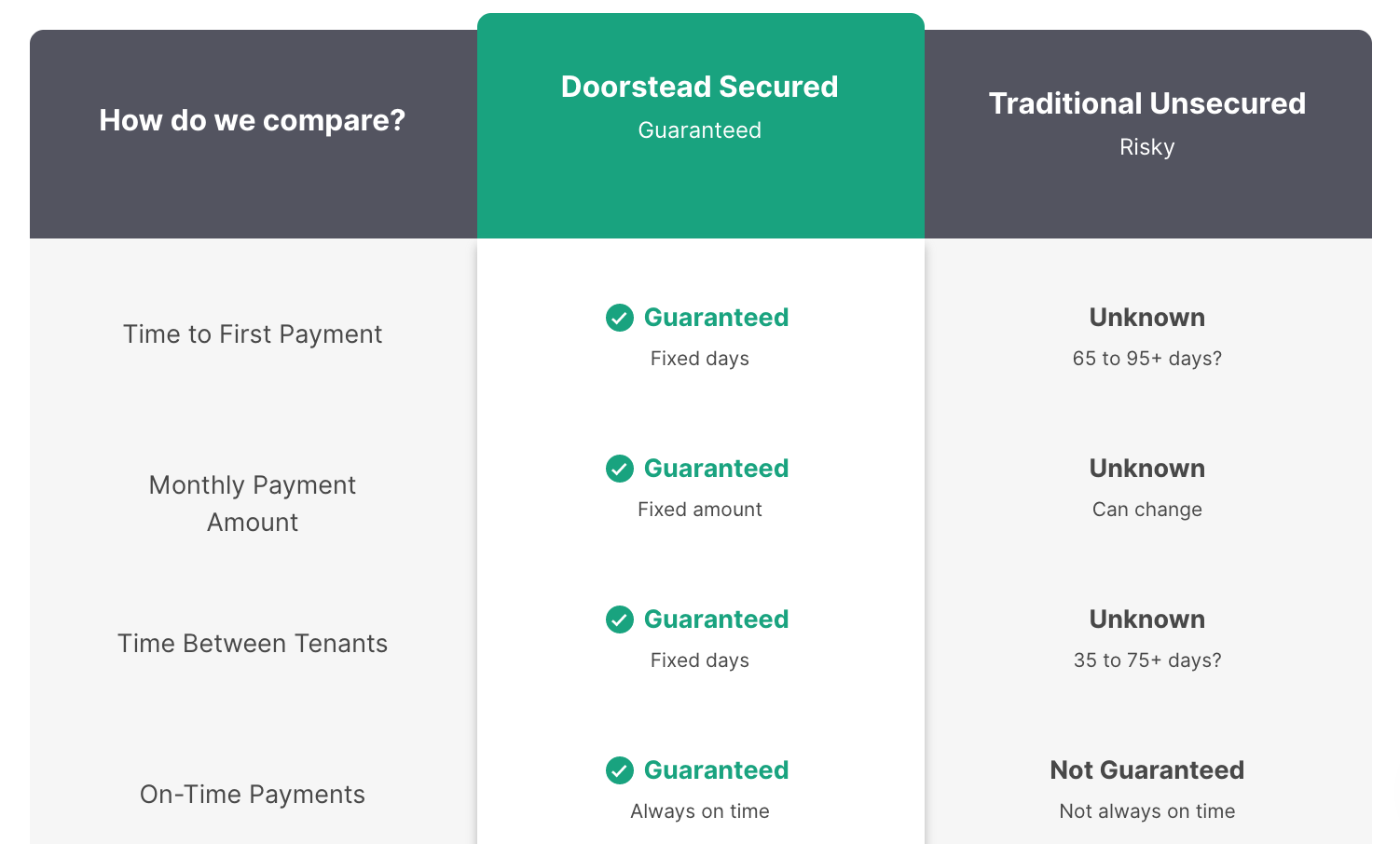


From there, the starutp does approved maintenance and cleaning as necessary, and then methodically lists the home on all the top rental platforms. It handles open house walk-throughs and runs background checks on potential tenants to find who will most reliably pay rent. Doorstead prepares a lease and gets it signed by a tenant, but even if it doesn’t, owners still get their guaranteed payments. Rent is collected online, and if a move-out or eviction is necessary, Doorstead takes care of the transition to finding a new tenant.

There’s plenty of margin for Doorstead to earn if can consistently fill homes faster. Most property managers charge at least 50% of the first months rent, but instead Doorstead keeps all the rent of any extra days if it fills the spot before the guaranteed due date. From there, it charges 8% of monthly rent with no tenant placement fee, which is close to or under the common 10% fee on single-family home property management. And if it manages to secure a higher rate from tenants than its guarantee, it gives 70% to the owner.

How Doorstead Works

Doorstead claims to be less risky than alternatives

“Property management incumbents have a 43-day vacancy average which leads to $86 billion in economic waste in the U.S. alone” Waliany tells TechCrunch. “This means that landlords could earn the same money and lower rents by 12% for tenants with an efficient market.”

The Rise Of iRenting

With Doorstead, even if the owner lives far away, the turn-key service lets them efficiently rent their home. That’s not only important to them, but to overcrowded cities like San Francisco that often see apartments left vacant by overseas owners because they’re too much effort to rent out. To date, Doorstead’s algorithm has allowed it to recoup 100% of its guarantees and it’s shooting to stay above 90%, while maintaining its NPS of 80.

apartment building code overlay

But if the startup is working that well, it’s only a matter of time until incumbents try to barge in.

“It would be a no brainer for Airbnb to enter this market and Zillow to open this” Waliany admits, given their existing pricing algorithms and popularity as rental destinations. But Bronzo says “the biggest barrier is the operations piece that an Airbnb and Zillow haven’t stepped into.” It would be a big departure from their lean software-based marketplaces. Other property management startups like Mynd, OneRent, and BelongHome only offer guaranteed rent once tenants are found, absolving themselves of most of the risk. They’d have to take on a more precarious business model.

What about Zeus, Sonder, and Lyric, which offer property management of homes they then use for corporate housing or as boutique hotels? “An owner of ours considered Zeus vs Doorstead and went with Doorstead because: 1) our offer was ~12% higher, and 2) they didn’t want the wear-and-tear that comes with having people move in and out of the property every few days or few months” Waliany explains. “Sonder and Lyric have 300 move-in and move outs over a 6-year period. Doorstead has ~4 move ins/outs and that results in significantly less wear-and-tear and a much easier operations to manage. Not only that, the long-term rental market is 42x larger and has 12x more addressable revenue.” Doorstead will have to build a brand and product moat to defend against inevitable direct competition.

Doorstead Rentals

iRenting is still a fresh concept so Waliany warns that “with any new business model, there will inevitably be ‘unknown unknowns’ that we cannot predict, black swan events, and things that we might only be able to learn through calculated bets.” Luckily, since it doesn’t hold the leases for very long, and home rentals typically increase in an economic downturn, Doorstead’s liability is manageable in the event of a recession or other crisis.

There are three large trillion-dollar industries – food, transportation, and housing. At Doorstead, we have an opportunity to completely redefine the housing value chain by creating a new class of property management that eliminates unnecessary vacancies. In the end, this redefinition of the value chain allows ourselves to become the Blackstone of the future” Waliany concludes. “It seems like we’re giving everyone free money.” That will prove either the startup’s downfall or a powerful growth tactic.


https://ift.tt/35hqpjx Get guaranteed rent for your home from new startup Doorstead https://ift.tt/2OyV06B

Checking in on the state of ISAs

Income share agreements (ISAs) rose to public awareness this year — if measured in press articles and discussion on “VC Twitter” — after several years of niche experimentation among a small community of education advocates. An ISA in a financing model where the student participates in an education program without paying tuition, then pays a certain percentage of their income for a set time term in return.

As I mentioned in my analysis of ISAs back in April, there is rapid growth in ISA pilots by traditional universities in the US and by vocational training programs but there’s also a lot of regulatory uncertainty. All stakeholders in the US want the federal government to provide a regulatory framework for the ISA market since the current lack of policy creates market uncertainty and opportunities for unethical actors.

I asked several of the entrepreneurs, investors, and policy experts at the forefront of ISAs to share their perspectives on the current state of the ISA movement:

  • Tonio DeSorrento, Vemo Education
  • Ethan Pollack, Aspen Institute
  • Shaan Hathiramani, Flockjay
  • Austen Allred, Lambda School
  • Alison Griffin, Whiteboard Advisors
  • Sam Lessin, Slow Capital
  • Terri Burns, GV
  • Kristen Sharp, Entangled Solutions
  • Leo Polovets, Susa Ventures
  • Jan Lynn-Matern, Emerge Education

Here’s what they had to say…

GettyImages 960803498

Image via Getty Images / manopjk

Tonio DeSorrento, Founder & CEO of Vemo Education

“What’s been really fascinating, in recent years, is the innovation that is occurring at colleges and universities that are using ISAs to support and improve student success.


https://ift.tt/2VlQpWx Checking in on the state of ISAs https://ift.tt/2LRFr85

Week in Review: Tech’s trashiest merger

Hey everyone. Thank you for welcoming me into you inbox yet again.

Last week, I talked about Juul’s unraveling mission statement and the highly valued startup’s new Big Tobacco CEO. I got some great email responses and plenty of a pro-Juul DMs.

If you’re reading this on the TechCrunch site, you can get this in your inbox here, and follow my tweets here.


The big story

This section might slowly turn into my grievance of the week, but this week the tale isn’t a screed against Juul, it’s a prolonged eye roll after the merger of two adtech companies responsible for pumping the internet full of garbage.

Taboola and Outbrain have merged, forming a $2 billion adtech giant. Those startup names likely don’t mean much to you, but they’re both responsible for a lot of the publishing world’s junkiest ad units.

You’ve seen them. You’ve tried not to see them.

These startups grew their networks by sending traffic from one partner to another and incentivizing the flow of more traffic through them.

By adding a bit of JavaScript, publications were able to bring in traffic and, more importantly, effortless cash. It’s been an irresistible sell to plenty of publishers, but it’s also been an eyesore for many of them and a race to the bottom in terms of selling the most salacious headlines. This has brought in revenues to publications that aren’t afraid to sell a bit of

Being an adtech “giant” is pretty relative these days. Taking on Google and Facebook’s overwhelming ad duopoly is an incredibly noble goal — I would love for a true competitor to emerge — but I have very little faith that a Frankensteined fusion of these two crap ad companies is going to do much to halt a war path. I hope someone else can find a path.

Send me feedback
on Twitter @lucasmtny or email
lucas@techcrunch.com

On to the rest of the week’s news.

Surface Duo Screen Shot 2019 10 02 at 8.27.54 AM

Trends of the week

Here are a few big news items from big companies, with green links to all the sweet, sweet added context:

  • Microsoft’s dual screen unveil
    Microsoft dove headfirst into dual-screen folding displays at its hardware event this week. Take a peek at the Neo and Duo. Read more here.
  • Tesla buys a startup
    Tesla has been arranging its efforts around robo taxis and now is making some acquisitions to bolster its presence. See them all here.

GAFA Gaffes

How did the top tech companies screw up this week? This clearly needs its own section, in order of badness:

  1. Facebook news can’t be trusted:
    [Facebook leads in news consumption among social feeds, but most don’t trust it]

Sign up for more newsletters in your inbox (including this one) here.


https://ift.tt/2oQVLwR Week in Review: Tech’s trashiest merger https://ift.tt/2pPO7n0

Spotify gains Siri support on iOS 13, arrives on Apple TV

{rss:content:encoded} Spotify gains Siri support on iOS 13, arrives on Apple TV https://ift.tt/30UfqcC https://ift.tt/2IwfusH October 07, 2019 at 05:16PM

In a long-awaited move, Spotify announced this morning its iOS 13 app would now offer Siri support and its streaming music service would also become available on Apple TV. That means you can now request your favorite music or podcasts using Siri voice commands, by preferencing the command with “Hey Siri, play…,” followed by the audio you want, and concluding the command with “on Spotify.”

The Siri support had been spotted earlier while in beta testing, but the company hadn’t confirmed when it would be publicly available.

According to Spotify, the Siri support will also work over Apple AirPods, on CarPlay, and via AirPlay on Apple HomePod.

In addition, the Spotify iOS app update will include support for iPhone’s new data-saver mode, which aids when bandwidth is an issue.

Spotify is also today launching on Apple TV, joining other Spotify apps for TV platforms, including Roku, Android TV, Samsung Tizen, and Amazon Fire TV.

The app updates are still rolling out, so you may need to wait to take advantage of the Apple TV support and other new features.

The lack of Siri support for Spotify was not the streaming music service’s fault — it wasn’t until iOS 13 that such support even became an option. With the new mobile operating system launched in September, Apple finally opened up its SiriKit framework to third-party apps, allowing end-users to better control their apps using voice commands. That includes audio playback on music services like Spotify, as well as the ability to like and dislike tracks, skip or go to the next song, and get track information.

Pandora, Google Maps and Waze were among the first to adopt Siri integration when it became available in iOS 13 — a clear indication that some of Apple’s chief rivals have been ready and willing to launch Siri support as soon as it was possible.

Though the integration with Siri will be useful for end-users and beneficial to Spotify’s business, it may also weaken the streaming company’s antitrust claims against Apple.

Spotify has long stated that Apple engages in anti-competitive business practices when it comes to its app platform, which is designed to favor its own apps and services, like Apple Music, it says. Among its chief complaints was the inability of third-party apps to work with Siri, which gave Apple’s own apps a favored position. Spotify also strongly believes the 30% revenue share required by the App Store hampers its growth potential.

The streamer filed an antitrust complaint against Apple in the European Union in March. And now, U.S. lawmakers have reached out to Spotify to request information as a part of an antitrust probe here in the states, reports claim. 

Despite its new ability to integrate with Siri in iOS 13, Spotify could argue that it’s still not enough. Users will have to say “on Spotify” to take advantage of the new functionality, instead of being able to set their default music app to Spotify, which would be easier. It could also point out that the support is only available to iOS 13 devices, not the entire iOS market.

Along with the Apple-related news, Spotify today also announced support for Google Nest Home Max, Sonos Move, Sonos One SL, Samsung Galaxy Fold, and preinstallation on Michael Kors Acess, Diesel and Emporio Armani Wear OS smartwatches.


Report: WeWork co-founder Adam Neumann may have to unload property to pay off a giant loan

Adam Neumann may be out of the daily flow of WeWork, but he seemingly remains top of mind to some of the company’s bankers.

According to a new Business Insider piece, Neumann is working with JPMorgan, UBS and Credit Suisse to consider new terms for a $500 million loan that he took out before WeWork filed to go public, and from which Neumann has already drawn down $380 million. Because he can no longer pay the loan with proceeds from selling WeWork shares publicly (it yanked its S-1 filing earlier this week), he may have to put up some of his properties or other assets as collateral for the loan, according to one of BI’s sources.

“No terms have been set,” a spokeswoman for Neumann tells the outlet.

Per earlier reports, Neumann has plenty to offload if it comes to it, having acquired numerous residential and commercial properties over the years.

Among his reported investments is a $10.5 million Greenwich Village townhouse; a farm in Westchester, New York; a home in the Hamptons, where he reportedly weathered the storm with his family ahead of resigning as CEO last week; and a $21 million, 13,000-square-foot house in the Bay Area with a guitar-shaped room.

According to an earlier WSJ report, Neumann also bought several commercial properties through investor groups that he leased back, in some cases, to WeWork.

WeWork and Neumann have both enjoyed a close relationship with JPMorgan in recent years. As recently reported in The New York Times, JPMorgan “lent Mr. Neumann money personally (with his inflated shares as collateral), provided equity and debt for the company, served as a corporate adviser for the I.P.O. and secured nearly $6 billion in financing as part of the now scotched offering.”


https://ift.tt/eA8V8J Report: WeWork co-founder Adam Neumann may have to unload property to pay off a giant loan https://ift.tt/2nnJxLW

5 days left to save on passes to Disrupt Berlin 2019

A show of hands, startuppers. Who’s ready to save some money on passes to Disrupt Berlin 2019, our premier tech conference that takes place on 11-12 December? Then listen up, because our super early bird pricing ends in just five days. Right now, passes start at €345 + VAT and, depending on which pass you choose, you can save up to €600. Ka-ching!

Save your euros. Buy your passes to Disrupt Berlin before the Friday, 11 October at 11:59 p.m. (CEST) deadline. Then plan your strategy to make sure you take full advantage of Disrupt. Let’s look at what’s in store.

We’re talking two full days of programming. A roster of world-class speakers and panelists — founders, investors and icons. These are folks who have done the hard work in the trenches. They know how to succeed, and they’ll share their experiences, insights and advice.

We’re thrilled that our roster includes the likes of Julian Stiefel, co-founder/co-CEO of Tourlane. The company’s ongoing mission? Using a recent round of funding ($47 million) to address the challenging problems associated with booking group travel.

You’ll also hear from Jen Rubio, co-founder and chief brand officer of Away, one of the most successful consumer brands in years. How successful? The company, which launched in 2015, has sold more than 1 million suitcases, raised a $100 million round at a $1.4 billion valuation earlier this year and turned profitable in 2018. We’re guessing she might have just one or two tips for aspiring direct-to-consumer entrepreneurs.

Don’t miss the legendary entrepreneurial showdown that is Startup Battlefield. This epic pitch competition has, since its inception, launched 857 companies that have gone on to collective raise $8.9 billion and produce 113 exits. Be in the room and cheer on some of the world’s top early-stage startups as they compete for the $50,000 equity-free prize, investor love and global media attention.

Ready to network? There’s no better place to start than Startup Alley, the Disrupt expo floor. You’ll find hundreds of innovative early-stage startups exhibiting their tech products, services and platforms. Make connecting with the people who can help move your business forward by using CrunchMatch.

Our business-matching platform makes it easier to find and connect with people who share your business interests. You create a profile listing your specific criteria and goals. The CrunchMatch algorithm suggests matches and, subject to your approval, proposes meeting times and sends meeting requests.

When you’re in Startup Alley, be sure to keep an eye out for our TC Top Picks. These companies, curated and selected by TechCrunch editors, represent the best early-stage startups in these categories: AI/Machine Learning, Biotech/Healthtech, Blockchain, Fintech, Mobility, Privacy/Security, Retail/E-commerce, Robotics/IoT/Hardware, CRM/Enterprise and Education.

An amazing slate of speakers, a world-class pitch competition, hundreds of exhibitors and full-tilt networking. That’s just a small taste of what’s waiting for you at Disrupt Berlin 2019  on 11-12 December. Why pay more than necessary? The super early bird pricing disappears on Friday, 11 October at 11:59 p.m. (CEST) deadline. Buy your passes here today.

Is your company interested in sponsoring or exhibiting at Disrupt Berlin 2019? Contact our sponsorship sales team by filling out this form.


https://ift.tt/eA8V8J 5 days left to save on passes to Disrupt Berlin 2019 https://ift.tt/33bs48F

Sunday, October 6, 2019

Why we’re still waiting on the Postmates S-1

In a wide-ranging conversation at TechCrunch Disrupt San Francisco last week, Postmates co-founder and chief executive officer Bastian Lehmann made light of the company’s lack of IPO documents.

The San Francisco-based on-demand delivery business was expected to publicly file its IPO prospectus in September in preparation for a fall exit, sources familiar with the matter told TechCrunch this summer. September, however, has come and gone and we’re still waiting on Postmates to release the critical document.

“The reality is that we will IPO when we believe we find the right time for the business and the right time for the markets,” Lehmann told TechCrunch. “And if you look at the markets right now, I believe they are a little choppy. They are a little choppy when it comes to growth companies specifically … We are hopeful that we find a good window to get out there.”

Lehmann made reference to Uber and other companies to recently float, citing market conditions as an IPO deterrent. Uber, Lyft, Slack and other fast-growing unicorns have struggled since entering the public markets earlier this year despite sky-high private market valuations. WeWork, a money-losing endeavor, recently decided to delay its IPO after demand from Wall Street devalued the business by the billions. Whether Postmates will complete its debut by the end of the year is unclear.

Postmates confidentially filed with the U.S. Securities and Exchange Commission for an IPO in February. Shortly after, Postmates held M&A talks with DoorDash, another food delivery unicorn, according to people familiar with the matter, but failed to come to mutually favorable terms. DoorDash has previously declined to comment on these reports. On stage last week, Lehmann declined to confirm the reports.

“I don’t think it does any good to speculate on M&A,” he said. “I think you have four well-funded players here in the U.S. in this space. I think everyone is well aware of the strengths and the weaknesses of each other and you know at some point down the line, if we take Europe for example, you will see consolidation in the market. People have conversations all the time but I wouldn’t read too much into it.”

Postmates operates its on-demand delivery platform, powered by a network of local gig economy workers, in more than 3,500 cities across all 50 states. The company does not yet operate in any international markets aside from Mexico City, however, Lehmann’s comments suggest the business could be plotting a foray into Europe, where Deliveroo, Just Eat and others dominate the market.

Postmates has raised about $900 million to date, including a $225 million round announced last month that valued the company at $2.4 billion. DoorDash, on the other hand, reached a $12.6 billion valuation in May with a $600 million Series G and has raised more than double that of Postmates. When asked why DoorDash, a similar and competing business, needed that much more capital, Lehmann joked “Maybe [DoorDash CEO Tony Xu] needs a jet, I don’t know.”

Postmates, founded in 2011 by Lehmann, is backed by Spark Capital, Founders Fund, Uncork Capital, Slow Ventures, Tiger Global, Blackrock and others. In our interview with Lehmann, the long-time CEO discussed the ‘choppy’ public markets, competitors, the company’s autonomous robotics delivery efforts and more.

https://ift.tt/2O6UpZz


https://ift.tt/eA8V8J Why we’re still waiting on the Postmates S-1 https://ift.tt/2AM9jfJ

Miss out on Startup Battlefield? Apply to TC Top Picks at Disrupt Berlin 2019

Did you miss the deadline to apply for Startup Battlefield at Disrupt Berlin 2019? Well don’t despair, founders. There’s more than one way to place your early-stage startup in front of thousands of influential technologists, investors and global media. Apply to be considered for our TC Top Picks program and the opportunity to exhibit in Startup Alley for free.

Deadline alert: You must apply to be a TC Top Pick by 18 October at 12 p.m. (PT). It’s simple to do and it’s free. Don’t let this opportunity slip through your time-strapped fingers.

TC Top Picks is a pre-conference competition. To be considered, your early-stage startup must fall within one of the following categories: AI/Machine Learning, Biotech/Healthtech, Blockchain, Fintech, Mobility, Privacy/Security, Retail/E-commerce, Robotics/IoT/Hardware, CRM/Enterprise and Education.

Our TechCrunch editors — always on the hunt for the best early-stage startups — will vet each application and select up to five startups in each category. If you’re named a TC Top Pick, you’ll receive a free Startup Alley Exhibitor Package and a VIP experience at Disrupt Berlin.

What sort of startup catches TechCrunch’s discerning editorial eyes? Great question. Take a look at the list of TC Top Picks from Disrupt Berlin 2018.

The exclusive TC Top Pick cadre will exhibit in a prime location within Startup Alley and — thanks to plenty of pre-conference marketing — be on the receiving end of intense investor and media interest. One of the best perks is the live Showcase Stage interview. TechCrunch editors interview each Top Pick to showcase their company and product. We record the interview and promote the video across our social media platforms.

If you’re still kicking yourself for missing the Startup Battlefield deadline, here’s more good news. There’s always the possibility that you’ll compete as a Wild Card. Say what, now?

Out of all the startups exhibiting in Startup Alley, TechCrunch editors will choose one — the Wild Card — to compete in the Startup Battlefield. At Disrupt Berlin 2018, TC editors chose Legacy, and the feisty startup went on to win the Startup Battlefield and the $50,000 prize.

Disrupt Berlin 2019 takes place on 11-12 December, and TC Top Picks is your chance to place your extraordinary startup in front of the people who can move your business forward. If you want to exhibit in Startup Alley for free, do not miss this deadline. Apply to be a TC Top Pick before 18 October at 12 p.m. (PT). We’ll see you in Berlin!

Is your company interested in sponsoring or exhibiting at Disrupt Berlin 2019? Contact our sponsorship sales team by filling out this form.


https://ift.tt/eA8V8J Miss out on Startup Battlefield? Apply to TC Top Picks at Disrupt Berlin 2019 https://ift.tt/2AOAHcZ

blogger better Headline Animator