Curabitur et lectus vitae purus tincidunt laoreet sit amet ac ipsum. Proin tincidunt mattis nisi a scelerisque. Aliquam placerat dapibus eros non ullamcorper. Integer interdum ullamcorper venenatis. Pellentesque habitant morbi tristique senectus et netus et malesuada fames ac turpis egestas.
Curabitur et lectus vitae purus tincidunt laoreet sit amet ac ipsum. Proin tincidunt mattis nisi a scelerisque. Aliquam placerat dapibus eros non ullamcorper. Integer interdum ullamcorper venenatis. Pellentesque habitant morbi tristique senectus et netus et malesuada fames ac turpis egestas.
Curabitur et lectus vitae purus tincidunt laoreet sit amet ac ipsum. Proin tincidunt mattis nisi a scelerisque. Aliquam placerat dapibus eros non ullamcorper. Integer interdum ullamcorper venenatis. Pellentesque habitant morbi tristique senectus et netus et malesuada fames ac turpis egestas.
Curabitur et lectus vitae purus tincidunt laoreet sit amet ac ipsum. Proin tincidunt mattis nisi a scelerisque. Aliquam placerat dapibus eros non ullamcorper. Integer interdum ullamcorper venenatis. Pellentesque habitant morbi tristique senectus et netus et malesuada fames ac turpis egestas.
Curabitur et lectus vitae purus tincidunt laoreet sit amet ac ipsum. Proin tincidunt mattis nisi a scelerisque. Aliquam placerat dapibus eros non ullamcorper. Integer interdum ullamcorper venenatis. Pellentesque habitant morbi tristique senectus et netus et malesuada fames ac turpis egestas.
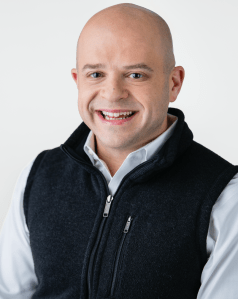
“Our real focus is on democratizing mental healthcare,” says SonderMind co-founder chief executive, Mark Frank.
His company, founded back in 2017, is having a moment. With the restrictions and economic stresses caused by the government’s efforts to mitigate the spread of the COVID-19 epidemic in the U.S., demand for mental health services is soaring. And it’s compounding what was already a mental health crisis in the U.S.
A 2019 article from Bloomberg Businessweek laid out the scope of the problem in stark terms. In 2017, 47,000 people died by suicide in the U.S. and there were 1.4 million suicide attempts — a suicide rate that’s the country’s highest since World War II, according to the Centers for Disease Control and Prevention. Drug overdoses, another measure of the nation’s anguish, killed 70,000 people in 2017. Another 7% of U.S. adults reported suffering at least one major depressive episode in 2018.
Taken together, the data points to a tremendous health problem. One that the current healthcare system is only now grappling with.
SonderMind’s chief executive sees his company as part of the solution.
Most mental health practitioners don’t operate within a healthcare network or take insurance, which means that the only folks with access to care are the ones that can afford the high price of therapy. SonderMind changes that equation by offering practitioners a toolkit and back office services so they can bill insurance providers and take care of the operational side of running a healthcare practice. It also acts as a funnel, gauging the needs of potential patients and connecting them to the therapists that are best suited to provide them the care they need. That lets practitioners focus on seeing patients, the company said.
The company currently counts 500 providers on its marketplace, which operates in Colorado, Arizona and Texas, and has raised $27 million in its latest round of financing to extend its services to other parts of the U.S.
The San Francisco-based investment firm General Catalyst led the financing, which also included additional new investors F-Prime Capital and participation from previous investors like the Kickstart Seed Fund, Diōko Ventures (managed by FCA Venture Partners) and Jonathan Bush.
“This financing provides the fuel to support our growth objectives and advance our mission to make behavioral health more accessible, approachable and utilized by building a modern marketplace that holds great appeal to both clinician and patient,” said Frank in a statement.
The investment extends General Catalyst’s funding into healthcare services in recent years and represents a continued emphasis on healthcare services for the firm. “Healthcare is obviously a really important thesis for GC as a whole,” says Holly Maloney, a managing director at General Catalyst. “This is going to be one of the largest value drivers for VC this decade.”
General Catalyst already had a robust portfolio of healthcare-focused companies — including Livongo, OM1 and Oscar Health.
For Maloney, the investment in SonderMind grew out of the firm’s exposure to mental health investment through another portfolio company, Mindstrong Health.“Mindstrong forced us to explore… access to care and finding care,” says Maloney.
The General Catalyst investor sees the investment in SonderMind as also helping to open doors for more people to join the profession.
“It helps people to start their business for sure. It helps more people pursue it as a career path,” she said. And that’s good for a country where more mental health professionals and better access to care are desperately needed.
https://ift.tt/eA8V8J As demand for mental health services soars, SonderMind raises $27 million to expand its services https://ift.tt/39PABkm
Airbnb said Monday that it has raised $1 billion in debt and equity from private equity firms Silver Lake and Sixth Street Partners, even as the online rental marketplace has seen its business plummet due to the COVID-19 pandemic.
Terms of the deal were not disclosed. It’s unclear how this funding might alter Airbnb’s previously shared plans to go public.
COVID-19, the disease caused by coronavirus, prompted governments throughout the world to issue stay-at-home orders, triggering a wave of cancellations in the travel and hospitality industries. Airbnb emphasized that the funds would support its ongoing work to invest over the long term, a statement aimed at couching this raise as strategic and not a bailout in troubled times.
“While the current environment is clearly a difficult one for the hospitality industry, the desire to travel and have authentic experiences is fundamental and enduring,” Silver Lake co-CEO and managing partner Egon Durban said in a statement. “Airbnb’s diverse, global, and resilient business model is particularly well suited to prosper as the world inevitably recovers and we all get back out to experience it.”
Airbnb CEO Brian Chesky acknowledged Monday that while the desire to connect and travel has been reinforced during this time, the “way it manifests will evolve as the world changes.”
Airbnb is betting how and where people work will evolve. As a result, the company said it will direct its attention and new funds toward three core products: hosts, long-term stays and Airbnb experiences.
Last month, Airbnb said it would direct $250 million to help hosts who have been impacted by COVID-19. The funds will be used to pay a host 25% of what they would normally receive through their cancellation policy if a guest cancels a reservation due to COVID-19 between March 14 and May 31. Airbnb said this policy applies retroactively to all cancellations during that period.
The move was an attempt by Airbnb to make amends to its hosts who complained that the company’s policy would allow guests to cancel reservations and receive a full refund. That policy, which is still active, lets guests who booked reservations on or before March 14 that begin anytime on or before May 31 to cancel and receive a standard refund or travel credit.
https://ift.tt/39TsSCL Airbnb turns to private equity to raise $1 billion https://ift.tt/3aJLLZk
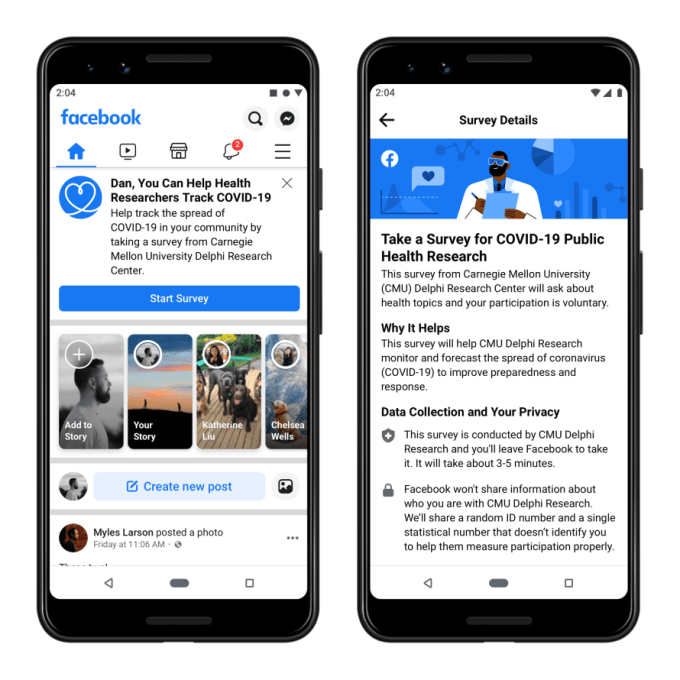
Starting today, some U.S. Facebook users will see a new pop-up on the app asking them to complete a survey about COVID-19. The survey, from Carnegie Mellon University’s Delphi epidemiological research center, is one of many new symptom mapping projects that seek to anticipate where the next wave of the virus will hit as COVID-19 sweeps through populations the world over.
As if often the case in research, the challenge for these symptom mapping efforts is attracting a large enough sample of respondents to paint a statistically meaningful picture. Carnegie Mellon’s research effort will get a big leg up from Facebook, which may promote similar surveys in different parts of the world if this one goes well.
While some other projects require users to download an app or find their way to an obscure web portal, Facebook’s promotion of the Carnegie Mellon survey means it can instantly reach a portion of users from the largest pool of online users any social network has ever collected. Facebook declined to provide details on how many users will be seeing the new prompt, but even a sub-section of Facebook’s U.S. users over the age of 18 would likely be massive from a data collection standpoint.
Many U.S. symptom tracking projects launched as the virus exploded over the last month, including a new app from Pinterest’s co-founder and others from research institutes like Harvard and New York’s Weill Cornell Medicine. The idea is that tracking self-reported symptoms could provide geographical insights that bolster the limited testing data available now.
While users might be understandably wary of a research effort promoted by Facebook, given its recently fairly notorious record on user privacy, the company’s knowledge of who you are won’t be linked to the university’s data, which will be examined in aggregate. According to Facebook’s announcement, the survey data collected will aid public health planning around resource allocation and eventually “when, where and how to reopen parts of society.”
The company announced the effort along with an expanded set of disease prevention maps, which the company will make available to researchers as part of its “Data for Good” initiative.
from Social – TechCrunch https://ift.tt/2UOprbB Facebook starts prompting US users to fill out a COVID-19 survey to help track the virus Taylor Hatmaker https://ift.tt/2ReFsVU
via IFTTT
Social distancing requirements amid the COVID-19 pandemic may have canceled kids’ birthday parties, but parents are finding new ways to take the celebrations online. While video chat apps like Zoom, Google Hangouts or FaceTime are an option for gathering kids together in the virtual space, there’s still the challenge of what to do once there. A few companies are working to solve this challenge for parents who are looking for ideas to make their child’s birthday special in the time of COVID-19.
Sky Zone
One business that’s been heavily impacted by government-mandated retail closures is Sky Zone, the indoor trampoline park that’s home to dozens of kids’ birthday parties per day. The company operates Sky Zone parks in more than 160 locations across the U.S. and Canada, mainly to franchisees, which have now temporarily closed due to the coronavirus outbreak.
To help give back to families who still want a party while staying at home, Sky Zone has shifted its current focus to virtual birthday parties. The move not only offers parents the benefit of the hassle-free party planning that a typical events space provides, it also gives Sky Zone a way to keep employees working during the business closures.
The party, however, is not a new source to replace the business’s lost revenue or a way to make payroll. Instead, Sky Zone is offering to host the party for free to parents for up to 10 guests. Parents will have the option to tip the party host at the end of the event to support Sky Zone team members.
To request a party, parents fill out an online form with their information, then wait to hear from the Sky Zone representative who will schedule the party and create a digital invitation with a link to join the party room. Parents forward the digital invite to their friends and family however they choose. Then, on the day of the event, everyone joins the virtual party, which is hosted via Zoom.
The party itself is a 20 to 25-minute experience with the party host leading the kids through games and activities to get kids moving, like Simon Says, Dance Battles, Trivia and even teaching the kids a TikTok dance. They’ll also lead the group in singing Happy Birthday to the Guest of Honor while parents bring in the cake.
The offering was first launched on March 26, 2020 and already Sky Zone has hosted 30 parties and has more than 100 others scheduled.
The benefit of this party over a DIY group chat is that the staff hosting the party are already used to working with kids. Plus, it’s an easy way for overworked parents to get the party handled when they don’t have time to organize more time-consuming events, like a drive-by birthday parade, in-home scavenger hunt or the other alternative birthday party options some parents have turned to in this time of crisis.
Roblox
Another company venturing into the virtual party space is gaming platform Roblox.
Already a huge online hangout for kids in the pre-COVID-19 era, Roblox usage has been booming in recent weeks as kids stuck at home look for ways to socialize with both online and real-life friends in the virtual world. Today, Roblox claims more than 120 million monthly active users and is now No. 35 on App Annie’s 2020 ranking of the top 52 mobile game publishers by revenue.
The company says it was inspired by the stories of friends, family and classmates connecting on its platform during the pandemic, including those who were hosting in-game birthday parties.
Together, with its developer community, Roblox on Friday launched the new “Play Together” game sort, which makes it easier for players to find those games where you socialize with others — like visiting a virtual shopping mall, going camping or riding virtual water slides, for example. The games in the Play Together game sort also offer VIP servers for 10 Robux (10 cents). That allow users to play with family, friends, classmates and others they choose in a private virtual space — like a virtual birthday party.
To create a VIP server, you first visit the individual game’s page on Roblox, then click on the “Servers” tab and then the button “Create VIP Server.” Give your server a name, then invite others using the link provided. (Note that this is opting you into a subscription, so you’ll need to cancel it after the party ends — unless you want to retain the option to have private playspaces like this going forward.)
If you can’t figure out this process, trust me that your child can show you the ropes here.
While Roblox is popular with both boys and girls alike, a private match on Fornite is an alternative for some parents. The majority of Fornite players (roughly 73%) are male, so this could be an option for non-coed parties, for instance.
Caribu
For younger children and toddlers whose virtual party may only involve gathering together extended family — like grandparents, aunts, uncles and cousins, for example — there’s Caribu.
The family-friendly video calling app helps little ones get over their awkwardness about chatting online by offering a variety of in-app activities. For birthday parties, Caribu’s paint and drawing feature could be a fun, mess-free activity. The app also includes other simple games like Tic-Tac-Toe, interactive word puzzles and word searches.
To help keep families connected during the COVID-19 pandemic, AT&T is sponsoring 60 days of free access and unlimited use of the Caribu app, which offers in-app subscriptions for its full content library, which includes kids’ e-books.
Houseparty
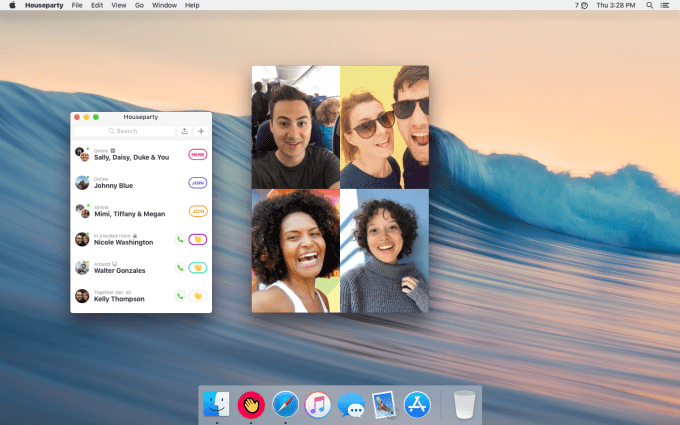
For tweens and teens, the group video chat app Houseparty is another option that works across mobile and desktop.
Houseparty has also seen significant growth due to coronavirus-related lockdowns and home quarantines, particularly in Europe. During the week of March 21, Houseparty downloads surged at 423 times the average weekly number of downloads in Q4 2019.
What makes Houseparty an option for a virtual party experience is that it’s not just another way to group chat — friends can play online games in the chat, including Heads Up!, Trivia, Chips and Guac and Quick Draw. These are free to play, though there is an option to purchase more decks through in-app purchases for some games.
Evites with built-in video chat
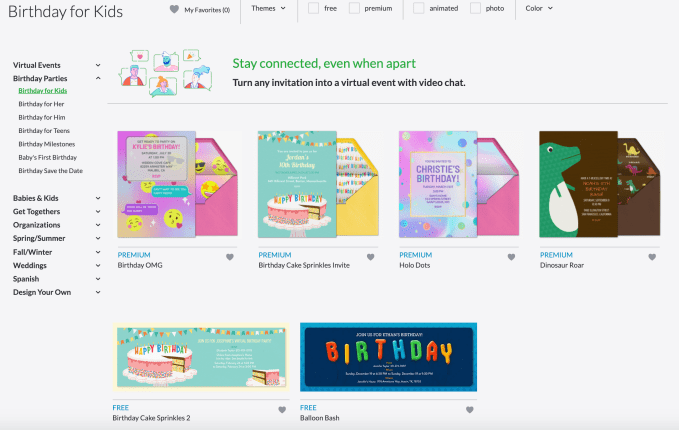
Even if you do choose to go the DIY route to host a simple FaceTime, Google Hangouts, Zoom or Skype video chat, there are ways to make the invite more special than just a text. For example, the digital invitations service Evite has updated its app and website to now allow party hosts to add a video chat link to their personalized invite.
The company is also beta testing its own Evite video chat, which is a more integrated option that allows up to eght guests to be able to join from a tab within the invite.
Hobnob’s digital invites app has also updated to make it easier for friends to send invitations for online-only events through Zoom, Facebook Live and YouTube Live.
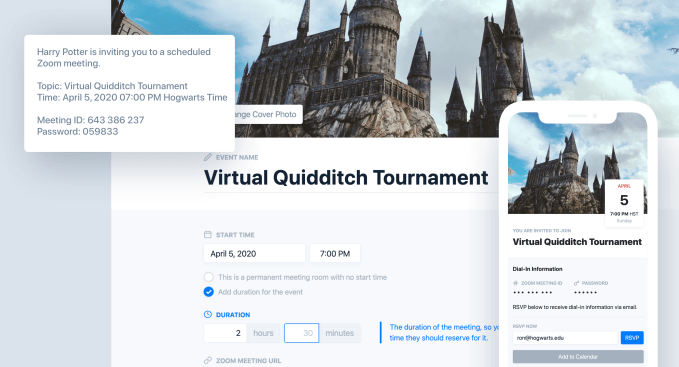
This free online tool lets you customize your Zoom video call invite URL with a title, explanation, image and RSVP requirement. This latter RSVP feature means that only those you’ve specifically invited via email will be able to access the provided link and join.
While a Facebook Live stream may not have a party host like Sky Zone, or built-in options to play games like Caribu or Houseparty, it does offer an easy way to share a celebration happening at home with others. Though children won’t have their own Facebook account (hopefully!), parents can send out invites to the parents of the child’s friends or family members through a Facebook Group invite, for instance, or by posting a message about the virtual party on their own profile. Participants can then watch the stream together as the child opens gifts left on the porch (and wiped down) and celebrates at home with family.
While technology can help to facilitate these virtual events, parents can take extra steps to make a virtual party special. Some local businesses that used to send characters — like superheroes or Disney princesses — to kids’ birthday parties are now offering to record video messages or even join a virtual party the parent is hosting. Neighbors and friends can decorate the yard or leave chalk messages. Surpriseballoon drops, car parades, scavenger hunts and other activities can make the party memorable for other reasons besides being the child’s first quarantine birthday.
from Social – TechCrunch https://ift.tt/39K2xGB Creative ways to host a virtual birthday party for kids Sarah Perez https://ift.tt/2UMl6p5
via IFTTT
{rss:content:encoded} Quibi had a launch day outage https://ift.tt/3dWlrgN https://ift.tt/34eXWuM April 06, 2020 at 10:18PM
Looks like things haven’t gone completely smoothly with Quibi‘s launch.
The issue appears to have been resolved, but the Quibi customer support account tweeted this afternoon that “some users may be experiencing problems with the Quibi app,” only to add an hour later that “Users should once again be able to use the Quibi app normally. Thank you for your patience.”
It’s not clear how widespread the outage was, but according to The Verge, one staffer saw an error screen and was unable to browse the app, while another was another to create an account. The app seems to be working normally as I write this shortly after 4pm Eastern.
A quick catch-up for those of you still wondering what Quibi even is: It’s a short-form video service founded by Hollywood executive Jeffrey Katzenberg and led by CEO Meg Whitman (previously CEO of Hewlett Packard Enterprise and eBay).
The app is launching with nearly 50 shows today, all of them created specifically for mobile, with episodes that are less than 10 minutes long. After a 90-day free trial, it’ll cost you $4.99 with ads or $7.99 per month without ads.
Looks like things haven’t gone completely smoothly with Quibi‘s launch.
The issue appears to have been resolved, but the Quibi customer support account tweeted this afternoon that “some users may be experiencing problems with the Quibi app,” only to add an hour later that “Users should once again be able to use the Quibi app normally. Thank you for your patience.”
It’s not clear how widespread the outage was, but according to The Verge, one staffer saw an error screen and was unable to browse the app, while another was another to create an account. The app seems to be working normally as I write this shortly after 4pm Eastern.
A quick catch-up for those of you still wondering what Quibi even is: It’s a short-form video service founded by Hollywood executive Jeffrey Katzenberg and led by CEO Meg Whitman (previously CEO of Hewlett Packard Enterprise and eBay).
The app is launching with nearly 50 shows today, all of them created specifically for mobile, with episodes that are less than 10 minutes long. After a 90-day free trial, it’ll cost you $4.99 with ads or $7.99 per month without ads.
While a number of startups have been hard hit by efforts to curb the spread of the COVID-19 virus, refurbishing firm Back Market is showing increased growth globally.
The Paris-based startup encourages customers to send in their old devices so they can be refurbished and resold into the e-commerce secondhand market. The growth achieved in the midst of the COVID-19 crisis is partly due to increased laptop sales as people seek better devices to work remotely.
For people who are unsure whether refurbished products are reliable, Back Market permits customers to send in old devices, exchange them for newer versions and pay the difference. CEO Thibaud Hug de Larauze said this payback service is currently possible only in France, but starting in Q2, it will be available in other markets.
Founded in 2014, Back Market has raised a total of €48 million in funding over two rounds, most recently a Series B in June 2018. The company is profitable and reportedly still has money to spend from its last funding round.
“We don’t release the gross merchandise volume, but it’s a three-digit growth rate,” Hug de Larauze told TechCrunch. “We saw an increase in demand for laptops, printers and other devices needed for working at home. Demand for refurbished phones is going down as people seek to get the first necessity items, like food for their situation.”
Over the past two weeks, Back Market saw skyrocketing demand from Italy, a nation with a high coronavirus death toll where citizens were warned they would be confined to their homes for four weeks.
Another factor that helped the platform’s growth: Smartphone brands like Apple and Samsung closed their retail stores, a move that turned Back Market into a major supply channel. While offline retailers and carriers are shut down in Europe, Hug de Larauze says Chinese offline retailers and refurbishing factories are starting to get back to work.
https://ift.tt/eA8V8J COVID-19 crisis spurs triple-digit growth for refurbishing startup Back Market https://ift.tt/39JVYDX
{rss:content:encoded} The U.S. is formalizing Team Telecom rules to restrict foreign ownership of internet and telecom assets https://ift.tt/2x0cGlc https://ift.tt/3aN3Mpz April 06, 2020 at 09:41PM
It has the simplest name but the sort of shadowy overtones that national security writers lust after.
Team Telecom, a mostly informal working committee of the Departments of Defense, Homeland Security, and Justice (along with affiliated agencies) has for years been quietly tasked with evaluating and maintaining the security of America telecom infrastructure in concert with the FCC. Its primary objective as far as we have been able to ascertain is to monitor the ownership of key telecom assets to ensure they don’t fall into the hands of suspect nations (think China, Russia, etc).
That informal arrangement is disappearing, as the administration over the weekend published a new executive order formally instantiating Team Telecom as a legal process for reviewing applications for telecom licenses, deals, and other requests made to the FCC.
Under a newly-christened “Committee for the Assessment of Foreign Participation in the United States Telecommunications Services Sector” (CAFPUSTSS?), the Committee will be charged with assisting “the FCC in its public interest review of national security and law enforcement concerns that may be raised by foreign participation in the United States telecommunications services sector.”
Like its Team Telecom forerunner, the Committee will be made up of the heads of Justice, Defense, and Homeland Security, with the Attorney General playing the role of chair. Applications to the Committee will be referred to the U.S. government’s highest-ranking intelligence officer, the Director of National Intelligence, for analysis.
Unlike in the past where the timeline for reviews was anything but standardized, the executive order provides for a 120-day adjudication process, with a 90-day extension if the Committee has additional concerns and goes through a secondary review.
In a brief press statement, FCC Chairman Ajit Pai said, “I applaud the President for formalizing Team Telecom review and establishing a process that will allow the Executive Branch to provide its expert input to the FCC in a timely manner.” The FCC intends to finish its own rulemaking around Team Telecom, a process which was first proposed at the tail end of the Obama administration and has been on-going ever since.
These reforms to Team Telecom are in line with similar reforms made to CFIUS, the Committee for Foreign Investment in the United States, which were finalized at the beginning of this year after Congress passed a reform bill in 2018.
While the new rules will provide some certainty to areas of telecom like fiber optic cable expansion and wireless services, expect the new rules to be used to put even more restrictions of countries like China hoping to get a slice of the U.S. infrastructure market. Indeed, in the FCC’s statement today, the agency said “As we demonstrated last year in rejecting the China Mobile application, this FCC will not hesitate to act to protect our networks from foreign threats.”
TechCrunch confirmed today that BounceX (the firm is rebranding this year) has executed layoffs and salary cuts in the wake of recent COVID-19-led economic disruptions.
Many startups are undergoing staff cuts as the domestic and global economies slow, making individual reductions less newsworthy as the layoff tally rises. However, as BounceX is a company we’ve recently highlighted for its growth and capital efficiency, its own cuts are worth noting.
Reductions
TechCrunch was tipped concerning the BounceX staff cuts and salary reductions earlier today, events that the company confirmed this afternoon. Our original tipster pegged the cuts at around 20% of staff, with pay cuts for the rest of its denizens.
The company confirmed the existence of salary cuts and layoffs, but did not affirm our figures. Here’s BounceX on its hard day; the firm confirmed pay cuts via a spokesperson separately from this comment:
COVID-19 has hit our client base really hard, especially if they had significant retail presence. In order to accommodate clients and help stabilize our business & their businesses, we made the immensely difficult decision to move forward with a reduction in force. While we expected over 30% growth this year and adding 150 new roles by year end, we were forced to consolidate roles in order to do everything we could to take care of as many of our people as possible and continue to help our clients get through this.
It is not a surprise that BounceX was planning revenue growth and 150 new roles; the company recently crossed the $100 million ARR threshold, an event that TechCrunch covered as part of our long-running series focused on companies that reach the revenue threshold.
Indeed, in February, when BounceX shared the milestone, the firm also announced a rebrand, stating that it would change its name to Wunderkind. As you can read from the name, BounceX was feeling good at the time, looking to the future, proud of its growth and track record of efficient capital use.
As TechCrunch wrote at the time:
Wunderkind has been super efficient to date, with [CEO Ryan] Urban telling TechCrunch that “the amount of equity [his company has] actually put to work is probably sub-$35 million,” with less than $50 million in equity capital raised. The company also has debt lines that it can use, the CEO noted.
Given its history of conservative capital management, it doesn’t seem likely that BounceX is in existential danger after its layoffs. The company’s debt line — though we don’t know anything about its covenants — could provide more cushion. But its quick turnaround in fortunes shows how fast things can change.
What’s it like to take a company with 3,000 employees distributed across 25 offices and make it fully remote with just a few weeks’ notice?
I hopped on a call with Twilio CEO Jeff Lawson to hear about how their transition has gone so far, and what he’s learned from the process.
Twilio CEO Jeff Lawson
Remote work isn’t brand-new for Twilio; as with a lot of software companies, many employees have worked remotely. But it’s still a massive shift: Prior to the coronavirus outbreak, Lawson says around 10% of the company worked remotely. Today, it’s everyone.
“For a company like us to go from partially virtual to fully virtual in a short period of time,” he says, “it’s not without its hiccups, but it has worked pretty well.”
Things are weird for everyone right now, so compassion is key
Shifting to remote work might make things feel different for a while — but those differences pale in comparison to the other changes people are coping with in the shadow of the COVID-19 pandemic.
“I think the fact that you are distributed is lesser than the fact that you’re like, not allowed to go outside,” says Lawson. “You’re worried about friends and family and you’re reading the news… those things are more impactful.”
https://ift.tt/2RhjHoo Twilio CEO Jeff Lawson on shifting a 3,000-person company to fully remote https://ift.tt/39KDrXR
Space startup Swarm emerged from stealth mode in an unusual way two years ago when it turned out that it had launched some of its satellites in contravention of an FCC order not to do so. The regulator had argued that their satellites, which are tiny spacecraft smaller even than most Cubesats, were in fact too small and couldn’t be reliably tracked using existing technology. Now, two years later, Swarm has announced that it has cleared all the regulatory hurdles it needed to in order to begin operating commercially in the U.S.
Already last year, Swarm got approval from the FCC to send up the 150 satellites it planned for its initial constellation, as well as up to a total of 600, and it gained approval to use the wireless spectrum that it requires to transmit from its satellites to Earth. On top of that, the company has now added regulatory approval to operate in the U.K., New Zealand, Germany, Sweden, Antartica and in international waters, and it gained approval for ground stations in the U.S., the U.K., Antartica, New Zealand and the Azores, with plans for more to come online through the remainder of this year, brining its total ground station network to 30 by end of summer if all goes to plan.
Swarm’s ultimate goal is to provide a worldwide, affordable satellite data network that will be suitable for use in IoT applications, including maritime and ground logistics tracking, and agriculture, as well as for basic communication services for areas that have inadequate ground infrastructure. It’s now at the point where it can begin turning on services using the nine satellites it already has on orbit, as it continues to work towards launching more and expanding its regulatory approvals to cover active operations across more countries.
https://ift.tt/eA8V8J Swarm gets all the approvals it needs to begin operating its satellite connectivity service in the U.S. https://ift.tt/3bTUbxs
Foursquare, the 10-year-old location platform based in New York City, has today announced its plan to merge with Factual.
The terms of the deal were not disclosed. The merged company will keep the Foursquare moniker, and Foursquare CEO David Shim will remain at the helm, with Factual’s founder and now-former CEO Gil Elbaz joining Foursquare cofounder Dennis Crowley as a member of the board and executive team.
Shim confirmed to TechCrunch that this merger was in the works before the coronavirus turned the world upside down.
A company spokesperson acknowledged that there are redundancies in the two teams — so there will be layoffs, although they declined to get specific about how many employees or which teams will be affected.
Foursquare is not the same company it was when it launched at SXSW in 2009. The location-based social network, which let people check-in to locations to share with their friends and earn badges, has evolved over time into an advertising and marketing platform focused on location as a differentiator.
In 2014, Foursquare split its main app into two separate apps, the Foursquare City Guide and Swarm. Swarm let users check in to locations and earn mayorships and other stickers, with an abruptly sunset feature set around social utility and meeting up with friends in the real world. Foursquare City Guide, on the other hand, used past check-in data and data from Swarm to power a Yelp competitor, giving users a way to find great restaurants and experiences in their area.
Since that split, Foursquare has built out a back-end platform for brands and publishers to leverage its data, including an API and SDK for developers to offer location-contextual experiences to their end users. For example, Uber started using Foursquare’s tools to allow users to type in the name of the restaurant or store where they wanted to be picked up, rather than having to hunt down the physical address.
The Pilgrim technology, according to Foursquare, is more accurate than your average location tech because of its 10 years of check-in data. The tech understands the difference between a fifth-story location and a ground-floor location. It knows the difference between the coffee shop and the bar next door in a densely packed city like New York.
Because of this, Foursquare is able to give brands the ability to serve these hyper-contextual experiences in the right place at the right time. And it’s been relatively successful doing so.
Foursquare reported more than $100 million in revenue last year.
Factual, for its part, also launched in 2009 as a repository for open data, but over time it has become increasingly focused on using its location data to improve advertising. The company offered brands the ability to track the success of their marketing campaigns, measuring whether a campaign actually got people to visit stores physically — so you can see why it might be a good fit with Foursquare.
Factual’s Elbaz argued that there’s not only a huge opportunity in the location data space, but also a need to combat the threat posed by the digital ad “duopoly” of Google and Facebook. This is a sentiment that has been echoed by Foursquare, which says that a vertically integrated, solely location-focused company is better for data privacy than ad-first companies like Facebook and Google.
“Both companies have long maintained that there is a need for independent, neutral location data, available outside of the walled gardens, and we expect near-term that the walled gardens will relent and seek out an independent partner,” said David Shim. “Foursquare is primed to be that provider.”
Collectively, our biggest strength lies in trust,” added Gil Elbaz. “Marketers need an independent and neutral party they can trust, for measurement, for continuity, and for true innovation. This deal represents 30+ years of combined experience where we have been sought out as the independent, leading source for location.”
Prior to the merger, Factual raised a total of $104 million, most recently in a $42 million round from Upfront Ventures and Felicis Ventures.
The combined entity will represent some of the largest location data sets in the world, spanning more than 500 million devices, a panel of 25 million opted-in, always on users and over 14 billion user-confirmed check-ins. The company will also have data on more than 105 million points of interest across 190 countries and 50 territories.
That said, combining forces might be more than just a good idea — it might be a necessity. A recent IAB survey found that 74 percent of media planners and brands are expecting the COVID-19 pandemic and resulting economic downturn will have an even bigger impact on ad spend than the 2008 recession. Add to that the fact that most people are (or should be) staying home and it’s looking like a challenging year for any location-based ad company.
“Generally speaking, there’s no denying that the entire advertising/marketing industry at large has taken a hit from COVID-19,” said David Shim. “We started seeing some impact in late-March. At the same time, it’s opened up new conversations who are looking to us to help them understand the impact COVID on their business, and brands are already working with us to prepare for the “Great Reset” in offline consumer behavior.”
He added that there will be pent-up consumerism, making this “a historic opportunity to grab and defend market share.”
https://ift.tt/eA8V8J Foursquare merges with Factual https://ift.tt/2UOdiDe





 The party itself is a 20 to 25-minute experience with the party host leading the kids through games and activities to get kids moving, like Simon Says, Dance Battles, Trivia and even teaching the kids a TikTok dance. They’ll also lead the group in singing Happy Birthday to the Guest of Honor while parents bring in the cake.




 Posts
Posts


