l
l
blogger better. Powered by Blogger.

Search

Labels

blogger better

Followers

Blog Archive

Total Pageviews

Labels

Download

Blogroll

Featured 1

Curabitur et lectus vitae purus tincidunt laoreet sit amet ac ipsum. Proin tincidunt mattis nisi a scelerisque. Aliquam placerat dapibus eros non ullamcorper. Integer interdum ullamcorper venenatis. Pellentesque habitant morbi tristique senectus et netus et malesuada fames ac turpis egestas.

Featured 2

Curabitur et lectus vitae purus tincidunt laoreet sit amet ac ipsum. Proin tincidunt mattis nisi a scelerisque. Aliquam placerat dapibus eros non ullamcorper. Integer interdum ullamcorper venenatis. Pellentesque habitant morbi tristique senectus et netus et malesuada fames ac turpis egestas.

Featured 3

Curabitur et lectus vitae purus tincidunt laoreet sit amet ac ipsum. Proin tincidunt mattis nisi a scelerisque. Aliquam placerat dapibus eros non ullamcorper. Integer interdum ullamcorper venenatis. Pellentesque habitant morbi tristique senectus et netus et malesuada fames ac turpis egestas.

Featured 4

Curabitur et lectus vitae purus tincidunt laoreet sit amet ac ipsum. Proin tincidunt mattis nisi a scelerisque. Aliquam placerat dapibus eros non ullamcorper. Integer interdum ullamcorper venenatis. Pellentesque habitant morbi tristique senectus et netus et malesuada fames ac turpis egestas.

Featured 5

Curabitur et lectus vitae purus tincidunt laoreet sit amet ac ipsum. Proin tincidunt mattis nisi a scelerisque. Aliquam placerat dapibus eros non ullamcorper. Integer interdum ullamcorper venenatis. Pellentesque habitant morbi tristique senectus et netus et malesuada fames ac turpis egestas.

Monday, April 13, 2020

Mighty Jaxx raises $3.2 million for MightyVerse, its platform for tech-enabled collectible figures

Mighty Jaxx, which makes licensed collectibles, has raised 4.5 million Singapore dollars (about $3.2 million) in funding for MightyVerse, its platform for tech-enabled figures. Led by the investment arm of KB Financial Group, one of South Korea’s largest banks, the round also included participation from Greycroft Partners’ gaming fund GC VR Gaming Tracker Fund and returning investor SG Innovate.

This brings Mighty Jaxx’s total pre-Series A funding to about $4.7 million, with part of the new capital also earmarked to develop products from its new licensing deals with Hasbro and Nickelodeon.

Founded in 2012, Mighty Jaxx’s other licensing deals including partnerships with Cartoon Network, Warner Brothers, DC Comics, Looney Tunes and Sesame Street. It raised its first round of funding last July to develop MightyVerse. Products integrated with the platform have already launched, and Mighty Jaxx’s goal is to ship five million units this year, with its next big release, a collaboration with Toei Animation’s popular anime “One Piece,” to take place within the next two months.

The development of MightyVerse was incubated when Mighty Jaxx took part in Ubisoft’s Entrepreneurs’ Lab last year. Jackson Aw, founder and CEO of Mighty Jaxx, told TechCrunch that MightyVerse’s technology will help authenticate collectible figures, which can go for huge prices on the secondary market, by integrating technology during the manufacturing stage. The platform will also eventually include a social network for collectors.

MightyVerse collectibles are able to store information and digital assets, gamifying the collecting experience, Aw added. For example, when collectors buy a figure, “they will be able to unlock digital rewards hidden throughout the game, allowing us to create an incredibly immersive game experience in both the digital and physical worlds through the MightyVerse.”

Aw said the COVID-19 pandemic impacted Mighty Jaxx’s manufacturing and logistics, especially when factories closed in China, but partnerships with factories in other countries and companies like DHL have helped mitigate the impact, allowing its operations to return to “a level for optimum efficiency.”


https://ift.tt/34ARWgg Mighty Jaxx raises $3.2 million for MightyVerse, its platform for tech-enabled collectible figures https://ift.tt/2wCk2Lr

Layoffs are disproportionately impacting startup satellite offices

Layoffs have struck the startup world swiftly, hurting hospitality and travel startups, as well as recruitment and scooter companies. New data shows that some of those layoffs, brought on by COVID-19, might be disproportionately impacting satellite campuses.

By nature, satellite offices are secondary to a startup’s headquarters. Opening smaller offices is a strategic move when a company gets a fresh round of funding or wants to expand to a new market. We’ve seen satellite offices pop up in cities like Portland, Phoenix or Austin, which has satellite offices for Apple, Facebook and Oracle, for example.

While most layoffs are coming from companies whose headquarters are located in the main entrepreneurial hubs of the Bay area and New York, the actual staff members are located in the satellite cities, according to data from Layoffs.fyi, a tracker created by former Y Combinator grad Roger Lee.

EasyPost in San Francisco laid off 75 employees, nearly all in Salt Lake City and Louisville. U.K.-based Challenger bank Monzo laid off 165 customer support employees recently in Las Vegas.

Toast, based in Boston, laid off 1,300 employees, or 50% of its entire staff. Per Layoffs.fyi data, 12% of those layoffs were in Omaha, and another 10% were in Chicago.

KeepTruckin, based in San Francisco and last valued at $1.25 billion, laid off around 350 employees, and 33% of those employees were located in Nashville or Chicago.

These numbers are only a fraction of the total layoffs across the country, as Layoffs.fyi’s data set only includes publicly disclosed actions and tips. But even if the data is just serving as an anecdotal snapshot, it’s an important one to note.

What the data means

Once the economy does recover to a new normal, it’s unclear whether HQ cities or satellite cities will be in a better position to bounce back. We caught up with some investors in Boston, a top startup hub that has recently faced its own flurry of layoffs, to hear their thoughts.

According to Lily Lyman, a partner at Boston-based venture capital firm Underscore, satellite offices are often where a company might locate the sales, customer success and business development staff. Logistically, those roles are the most vulnerable as consumer activity slows. For a lot of businesses, there are no sales and deals to be done right now.

“[These roles are getting] disproportionately affected in [reduction of forces] as companies expect a slowdown on the commercial side,” Lyman said. “While a logical decision to extend the cash runway, it does come with the risk that this withdrawal can damage relationships with customers that may be hard to recover.”

Not everyone sees cuts hitting satellite offices the hardest. Michael Skok, another partner at Underscore, said that “in some cases, we’ve seen that satellite offices are established in emerging markets which come with cost savings, so these offices may actually be more protected in these times.” In other words, if you’re cutting costs, San Francisco employee expenses might be higher than Denver employee expenses by sheer nature of the former having exorbitantly high living costs. Revolution Ventures, which invests in startups in emerging tech scenes, said it has not heard about satellite office layoffs from its portfolio as of recently.

And finally, to put it crassly, layoffs in a non-HQ city might quell some of the negative signaling that founders and venture capitalists are trying so hard to avoid (well, most of them at least). Slimming down operations is becoming a proactive response, not a reactive strategy as the pandemic continues to evolve.

Today’s data reminds us that layoffs are rarely an isolated occurrence, and staff cuts appear to be landing harder on less robust tech ecosystems.


https://ift.tt/39TsSCL Layoffs are disproportionately impacting startup satellite offices https://ift.tt/2K5TdCc

Silicon Valley restructuring veteran says his firm is winding down up to 3 startups a day

Marty Pichinson gets called a lot of things: Silicon Valley’s undertaker, its terminator, a grave digger. These aren’t meant as slights; Pichinson is the founder of Sherwood Partners, a restructuring firm that Bay Area venture firms frequently turn to when they need someone to help sell off the assets of startups they have funded. The idea is to return at least some money to the company’s creditors and, if anything is left, to the VCs, too.

We last checked in with Pichinson almost exactly three years ago when the startup world was humming along. Even then, because of the sheer number of companies that get funded — and thus the number of startups that invariably don’t make it — Sherwood Partners was helping to wind down two to four companies a week.

Now, as he told us in conversation last week, it’s winding down two to three companies every day.

So who is shutting down, how does it all work and what can VCs expect to get in terms of a return in the age of the coronavirus?

Right now, Pichinson says the shutdowns are across verticals and across stages. “We’re in companies that raised $10 million to $25 million, to companies that raised up to $1.5 billion. It doesn’t matter what size they are; when they come to us, they’re all broke. If we’re closing it down to clean up and monetize what we can, they are basically in the same position, whether they raised $20 million or they were once a billion-dollar business.”


https://ift.tt/eA8V8J Silicon Valley restructuring veteran says his firm is winding down up to 3 startups a day https://ift.tt/2RzdSmi

Italians stuck at home are measuring light pollution for ‘science on the balcony’

{rss:content:encoded} Italians stuck at home are measuring light pollution for ‘science on the balcony’ https://ift.tt/2V4cMkM https://ift.tt/2yc7Jps April 14, 2020 at 12:21AM

The fact that so many people are stuck at home makes for strange opportunities. Italy’s confined populace has taken to singing from the balconies — and now researchers are asking them to use those same balconies to help accomplish a bit of citizen science.

The project, created by the Italian National Research Council, aims to take widespread samples of light pollution in the country. The question of “light trespass,” or how much light from outside our homes reaches inside them, isn’t a particularly easy one to test without access to those homes. So they’re asking people to collect that information themselves.

Lots of data points!

Using their phone and a special app, some 7,000 Italians participated in an initial run of the experiment two weeks ago. All they needed to do was turn off all the lights in their place, go to their window or balcony, and point their phone at the brightest light source they could see.

The resulting data showed that the average light trespass in Italian cities is nearly twice that of homes in the country — not exactly surprising, but it’s important for even supposedly obvious conclusions to be quantified and supported with evidence. Sure, it’s brighter in the city — but how much brighter? What type of light is it? More data means better understanding of even the most basic questions.

“With this experiment, we wanted to bring citizens closer to measurement techniques, to let them see the often complex process and allow them to participate in the scientific method,” Alessandro Farini, one of the organizers of the experiment, told Nature. (I contacted the researchers for more information but have not heard back.)

The experiment was so successful that #scienzasulbalcone, or “science on the balcony,” is having an encore — new measurements taken last week and a final one tomorrow night. The team issued revised instructions to its participants in order to better characterize the data they bring in.

Anyone interested in helping is asked to find a light bulb they can easily check the wattage on, then calibrate their phone by leaving only that light on and using their phone’s ambient light sensor to measure its output. This will help calibrate the system, since some phones are more sensitive to light than others. Once they’re done, they can make another measurement out their window or off the balcony, and submit that.

If you’re interested in taking part, you can find the instructions in Italian here; English instructions are here, but I don’t think it is intended to be a global effort just yet.

Frank raises $5M more in its quest to get students max financial aid

Frank, a New York-based student-facing startup, has raised $5 million in what the company described as an “interim strategic round” led by Chegg, a public edtech company. According to Frank founder and CEO Charlie Javice, previous investors Aleph and Marc Rowan took part in the round alongside new investor GingerBread Capital.

The education funding-focused startup last raised known capital in December of 2017, when it closed a $10 million Series A. Frank raised a seed round earlier that same year worth $5.5 million.

According to Javice, her firm closed its round in early March, before the recent market carnage. Bearing in mind that there is always lag between when a funding round is closed and when it is announced, the new Frank round is on the fresher side of things. Most rounds are a bit more like Shippo’s recent investment (closed in December, announced in April) than Podium’s recent deal, which it started raising in mid-February of this year.

Timing aside, what Frank is doing is interesting, so let’s talk about its business, how it approached 2019 and how it’s faring in today’s changed market.

Everyone’s broke

To help keep student debt low, Frank is a bit akin to TurboTax for college money, as TechCrunch wrote when covering its Series A, helping students get through a thicket of forms and aid to collect as much aid as possible while avoiding borrowing.

American higher education is too expensive, and applying for financial help is irksome and byzantine. I can safely report that sans quoting an expert, as I had to go through it as a student and only finished paying my student loans last July.

Frank wants to help make college more affordable, with the company noting in a call with TechCrunch that there’s been a good number of companies working to help students service debt in a less expensive way after they’ve hired the money; it wants to help students avoid taking on so much red ink in the first place.

According to Javice, lots of students fail to finish signing up for federal aid programs, and some students wind up dropping out of programs before finishing them, leaving them saddled with debt but no degree. That’s a hell of a trap to wind up in, as student loans are the barnacles of the financial world — incredibly hard to get rid of.

According to Javice, Frank was a little early to rethinking its own growth/profit trade-off than the rest of the startup world, which woke up when WeWork filed to go public and was quickly booed off Wall Street. In mid-2019, Frank slowed growth to get closer to the margins it wanted. (Thinking out loud, this is probably how the startup managed to survive so long off its December 2017 Series A.)

Indeed, according to Frank’s CEO, it was in a comfortable cash position before this round, which she described as more a vote of confidence than a round of necessity.

Which brings us to today, and the new, COVID-19 world. In an email to TechCrunch, Javice said that “like everyone else,” her company is “adjusting to the new realities.” She added that college and university attendance “has typically been countercyclical” and that her company is “seeing a large demand for higher education and specifically financial aid.”

If the new economy winds up creating a little tailwind for Frank, it won’t be the only startup to accrue help; Slack and Zoom and other remote work-friendly companies have also seen their fortunes turn for the better in recent weeks. And now with $5 million more on hand, it can certainly meet new demand.


https://ift.tt/eA8V8J Frank raises $5M more in its quest to get students max financial aid https://ift.tt/3bigPQ0

Driverless vehicles in the age of the novel coronavirus

The COVID-19 pandemic has led to different outcomes for different businesses. While some have stood to benefit (think Zoom, Facebook and bidet startup Tushy), others have been hit hard and laid off employees in order to survive. But there are some that fall somewhere in the middle. Autonomous driving startup Voyage believes it is not explicitly benefiting, but it’s not at risk of going under either, says CEO Oliver Cameron.

Cameron’s response to the pandemic centers around three areas: passenger operations, technology and company-building. While operations have halted, Voyage is moving forward with its technology and has shifted the company to a 100% remote work environment. With a post-pandemic world in mind, Cameron envisions more demand for autonomous vehicles.

Before COVID-19 was declared a pandemic, Voyage had already paused its consumer operations, which primarily serve seniors in retirement communities.

“We did that because, obviously, seniors are disproportionately impacted by this and it would be horrific for Voyage to be patient zero in the retirement community and this is something we were operating out of an abundance of caution,” says Cameron. “So we paused our operations from a consumer service perspective very early and we won’t open those up for quite some time. It’s tough to say at what particular point because it seems like the consensus is it will be a progressive opening up of the economy, meaning some populations will be fine to go back to work and there will be some that are significantly impacted, like seniors, that are effectively locked down for an extended period of time. So we’re not in a rush to get that back up and running until we hear from the community itself that it’s ok to do that.”

Despite the hiatus in operations, Voyage is still running simulations and using a variety of automated testing tools to determine if it is making progress. For example, Voyage uses automation to test for regressions in perception. A challenge in perception is false positives and false negatives — that is, seeing something that isn’t there or not seeing something that is there, Cameron explains.

“And we have this pretty cool tool that enables us to monitor with each perception release if we are seeing regressions based on perception performance in the past,” he says. “We don’t need to be there in the real world to see that. We can just tell instantaneously if that is the case.”

Voyage also has a way of testing different permutations of environments to see how its planning and prediction software can handle different scenarios. Then, of course, it uses more traditional simulation tools provided by Applied Intuition.

“But we don’t fool ourselves into thinking that simulation or automated testing makes up for all that real-world testing brought to the table,” Cameron says. “It doesn’t, and there’s definitely going to be some time that we have to spend once we do get back on the road, fixing issues that we just couldn’t find as a result of not being on the road.”

From a company and personnel standpoint, Voyage has also transitioned into a remote-working company. It hasn’t been a distraction, according to Cameron, since Voyage embraced remote work some time ago.

“We’re lucky that we are able to weather the storm,” Cameron says. “We’ve got a good chunk of cash in the bank and, luckily, we raised at a reasonable time — at the end of last year — so we’re going to be fine.”

Many companies in the tech ecosystem have been forced to lay off employees amid the COVID-19 pandemic. Voyage, however, will seemingly not be one of them. As Cameron noted, Voyage raised a $31 million round in September.

“There’s been a lot of discussion about great companies will weather this and the companies that were going to die anyway will die. I’m sure there is some truth to that but some of it is just luck. Some of it is that you raised at a time you didn’t know was important, but turned out to be quite important. And, you know, our burn has always been low compared to others in the space. For us, we’ve always been frugal and it turns out that’s quite important in a pandemic.”

Despite Voyage’s use of simulation, its automated testing and healthy bank account, the pandemic is still a major complication.

“I think it’s got to set everyone back,” Cameron says. “I think there is a spectrum and there are companies that stand to benefit from this. We’ve seen with Zoom they stand to benefit from this. Remote working tools, they stand to benefit from this. And then you go all the other way to the end of the spectrum — those that are actively impacted like airlines, ride-sharing, scooters and I believe we’re somewhere in the middle. The reason we’re in the middle is because in a post-virus world, I’m pretty sure behaviors change. It’s TBD on how long those behaviors last, but it’s clear that behaviors are going to change.”

In that world where behaviors change, Cameron bets that driverless cars will add more value than traditional ride-hailing services. In a world where people may still be hesitant to get into a car with strangers, a driverless car would mitigate those fears, he says.

“In the short term, everyone’s impacted,” he says. “There’s a slowdown in everything. in the medium and long term, we’ll be fine because I believe the demand is still there for driverless vehicles and even more so for those disproportionately impacted.”



https://ift.tt/39TsSCL Driverless vehicles in the age of the novel coronavirus https://ift.tt/3cgjlXj

Hallway creates a ‘virtual break room’ for remote workers using scheduled video chats

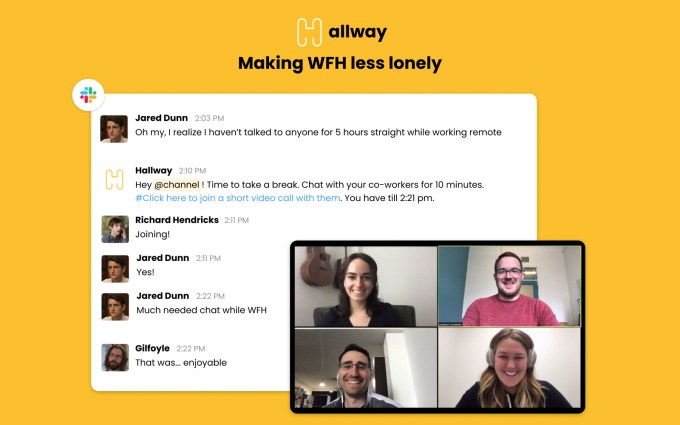
The coronavirus outbreak has forced millions of U.S. employees to work from home — many for the first time. But remote work can be lonely and isolating, as people feel disconnected from their team and co-workers due to the lack of face-to-face conversations. That’s where the new startup, Hallway, aims to help. The service re-creates the break-room experience and the serendipity of random hallway conversations with its new app aimed at Slack users.

The app allows companies to schedule 10-minute video chats within Slack channels, where colleagues can catch up with one another outside of more formal web meetings.

The startup was co-founded by Parthi Loganathan, a former product manager at Google who launched Google Chat and Google Go; and Kunal Jasty, a former associate at private equity firm Insight Partners.

The two were originally working on a product called Across that would help teams provide customer support in shared Slack channels. But when the shelter-in-place was brought into effect in San Francisco, things quickly changed.

“It forced a lot of companies that were unprepared for remote work to go remote overnight,” Loganathan explains. Meanwhile, his roommate complained he was going stir-crazy working from home and missed talking to his team.

“Hallway seemed like a simple and fun way to tackle that problem, so we built it in a couple of days,” Loganathan says.

The founders already had first-hand experience with the challenges involved in dealing with remote teams, as half their team was based in India. And they had experience building Slack apps, not only with Across but with others similar to Hallway, as well.

As a result, Hallway was built quickly, with only four days in between the idea and the first user, Loganathan says.

To use Hallway, you can either add it to Slack from the Hallway website or from the Slack app directory. (To install it, you may need admin approval if you don’t have permission to add apps to your Slack workspace.)

There’s no front-end for the app — everything is user-facing in Slack, including the login process, onboarding experience and the settings user interface. Once installed, you’re given the onboarding instructions over direct message within Slack. You can then invite the Hallway bot to any Slack channel by typing /invite @hallway. This kicks off the bot to start creating break rooms on a recurring basis automatically, which are announced by way of an @here message.

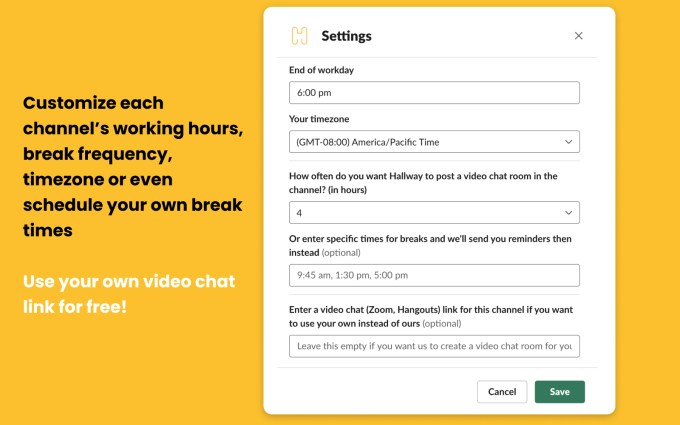
By default, Hallway’s break rooms are scheduled every two hours between 9 AM and 6 PM Monday through Friday, but users can adjust the timezone and adjust the frequency of the breaks by typing in /hallway in a Slack channel to customize the settings.

You can opt to use your own Zoom or Google Meet links with Hallway. But the experience works better with Hallway’s timed video chat rooms, which are powered by daily.co’s video infrastructure.

The service itself is free for up to two slack channels, but only offers 10 of its timed video chats before you have to either switch to using your own web meeting links or have to upgrade.

Hallway’s “team” pricing plan for larger companies supports up to five channels and offers an unlimited number of video chat rooms, as well as the customization options, for $30 per month. For more than five channels, enterprise pricing is available upon request.

Since launching just a few weeks ago, Hallway has quickly grown its customer base.

The service is now being used by more than 170 teams at companies like Nextdoor, Productboard, Bank Novo, Pivotal, Coursera and others. The majority of users are on the free plan for now. However, companies in need of an upgrade can access more flexible pricing if users are willing to share the service with friends.

For the time being, the co-founders want to focus on improving the Hallway experience in Slack, but they’re already thinking about what comes next.

“We’re solving the problem of keeping teams connected and reducing workplace loneliness while working remotely. Right now, we’re improving the core experience of spontaneous timed video chats and giving users more options to customize them,” says Loganathan. “We’re looking into specific use cases we can help companies with, like team building and employee onboarding for remote teams,” he notes.

The company may also consider a solution for Microsoft Teams in the future, he says.

Hallway has raised an undisclosed amount of pre-seed funding.


from Social – TechCrunch https://ift.tt/2yPh8DF Hallway creates a ‘virtual break room’ for remote workers using scheduled video chats Sarah Perez https://ift.tt/3b4iBo4
via IFTTT

Hallway creates a ‘virtual break room’ for remote workers using scheduled video chats

The coronavirus outbreak has forced millions of U.S. employees to work from home — many for the first time. But remote work can be lonely and isolating, as people feel disconnected from their team and co-workers due to the lack of face-to-face conversations. That’s where the new startup, Hallway, aims to help. The service re-creates the break room experience and the serendipity of random hallway conversations with its new app aimed at Slack users.

The app allows companies to schedule 10-minute long video chats within Slack channels where colleagues can catch up with one another outside of more formal web meetings.

The startup was co-founded by Parthi Loganathan, a former Product Manager at Google who launched Google Chat and Google Go; and Kunal Jasty, a former Associate at private equity firm Insight Partners.

The two were originally working on a product called Across that would help teams provide customer support in shared Slack channels. But when the shelter-in-place was brought into effect in San Francisco, things quickly changed.

“It forced a lot of companies that were unprepared for remote work to go remote overnight,” Loganathan explains. Meanwhile, his roommate complained he was going stir-crazy working from home and missed talking to his team.

“Hallway seemed like a simple and fun way to tackle that problem, so we built it in a couple of days,” Loganathan says.

The founders already had first-hand experience with the challenges involved in dealing with remote teams, as half their team was based in India. And they had experience building Slack apps, not only with Across but with others similar to Hallway, as well.

As a result, Hallway was built quickly, with only four days in between the idea and the first user, Loganathan says.

To use Hallway, you can either add it to Slack from the Hallway website or from the Slack app directory. (To install it, you may need admin approval if you don’t have permission to add apps to your Slack workspace.)

There’s no front-end for the app — everything is user-facing in Slack, including the login process, onboarding experience, and the settings user interface. Once installed, you’re given the onboarding instructions over direct message within Slack. You can then invite the Hallway bot to any Slack channel by typing /invite @hallway. This kicks off the bot to start creating break rooms on a recurring basis automatically which are announced by way of an @here message.

By default, Hallway’s break rooms are scheduled every 2 hours between 9 AM and 6 PM Monday through Friday, but users can adjust the timezone and adjust the frequency of the breaks by typing in /hallway in a Slack channel to customize the settings.

You can opt to use your own Zoom or Google Meet links with Hallway. But the experience works better with Hallway’s timed video chat rooms, which are powered by daily.co’s video infrastructure.

The service itself is free for up to 2 slack channels but only offers 10 of its timed video chats before you have to either switch to using your own web meeting links or have to upgrade.

Hallway’s “team” pricing plan for larger companies supports up to 5 channels and offers an unlimited number of video chat rooms as well as the customization options for $30 per month. For more than 5 channels, enterprise pricing is available upon request.

Since launching just a few weeks ago, Hallway has quickly grown its customer base.

The service is now being used by over 170 teams at companies like Nextdoor, Productboard, Bank Novo, Pivotal, Coursera, and others. The majority of users are on the free plan for now. However, companies in need of an upgrade can access more flexible pricing if users are willing to share the service with friends.

For the time being, the co-founders want to focus on improving the Hallway experience in Slack, but they’re already thinking about what comes next.

“We’re solving the problem of keeping teams connected and reducing workplace loneliness while working remotely. Right now, we’re improving the core experience of spontaneous timed video chats and giving users more options to customize them,” says Loganathan. “We’re looking into specific use cases we can help companies with like team building and employee onboarding for remote teams,” he notes.

The company may also consider a solution for Microsoft Teams in the future, he says.

Hallway has raised an undisclosed amount of pre-seed funding.


https://ift.tt/2yPh8DF Hallway creates a ‘virtual break room’ for remote workers using scheduled video chats https://ift.tt/3b4iBo4

Will podcast ad revenue bounce back after COVID-19?

There are early signs that media will be one of many industries to take a huge blow from the COVID-19 pandemic, with sharp declines in ad revenue and significant layoffs. Podcasting is unlikely to be an exception; Podtrac recently reported that downloads have fallen 10% since the beginning of March, while unique listeners fell by 20%.

A different picture emerged when I spoke to Ross Adams, CEO of podcast advertising company Acast, which works with both bedroom podcasters and large publishers like the BBC and PBS NewsHour.

Adams said listenership isn’t down — it’s just that audiences have changed when they’re listening and what they’re listening to, with Acast seeing its largest weekends ever in recent weeks. And plenty of people want to start new podcasts; signups for the Acast Open platform increased 49% month-over-month in March.

“What we’re seeing now is an opportunity for people to discover podcasting as a medium,” he said. “And once you discover it, you stick with it.”

Advertising may be a separate issue, with Adams admitting that the downturn is likely to affect “every business that has the majority of their revenue from ads.” But even then, he sees opportunity as marketing dollars move from traditional industries like radio and out-of-home advertising.

We also discussed Acast’s financials, the podcast discovery process and tips for new podcasters. Read a transcript of our conversation, edited for length and clarity, below.

TechCrunch: Let’s start with the good news. One of the prompts for this conversation is the fact that you guys announced some financial numbers — you doubled the revenue last year to $38 million. So first of all, congratulations.

Ross Adams: Thank you.

And secondly, there’s a lot of different factors at play and different conversations about podcasting breaking through in 2019. But when you look back, what do you see as the biggest factors that contributed to your growth?


https://ift.tt/2G1Xtna Will podcast ad revenue bounce back after COVID-19? https://ift.tt/2K2G6lm

Recap: Roblox, SuperAwesome and Fingerprint execs discuss kids’ media

Consumption of all types of kids-focused digital media has soared with a large portion of the world’s children home from school right now. At all times of day, children are playing games, watching shows and using edtech tools — often in a social context with friends online.
This only accelerates the normalization of virtual spaces as social hubs, and it makes protection of children’s data a more pressing concern for entertainment and communications platforms (like Zoom) that haven’t built a product specific to this demographic.
During last week’s TechCrunch Live session on the state of kids’ media, I had an engaging discussion with three industry leaders about how COVID-19 is impacting companies in the space and what long-term changes could result from it:

  • Craig Donato, chief business officer of Roblox, the $4 billion gaming platform that counts the majority of U.S. kids age 9-12 among its active users.
  • Nancy MacIntyre, co-founder and CEO of Fingerprint, the company behind Kidimo, a leading subscription video and gaming service for children.
  • Dylan Collins, co-founder and CEO of SuperAwesome, the London-based creator of “kid-safe” adtech and privacy tools.

Below is the recording of our conversation as well as the full transcript (with minor edits for clarity):

TechCrunch: The COVID-19 crisis has put families all at home together and changed a lot for your businesses. I want to set context first by looking at the couple years leading up to this. What have been the two biggest changes in the kids’ media space from your perspectives?

Craig Donato: One huge shift that we’ve seen over the last five years is the evolution of games into social places — experiences where kids hang out with their friends, do things with them versus these narrow competitive environments. We really see Roblox as a medium of shared experience. That’s a pretty significant shift, and it’s really benefited platforms like Roblox, but also Minecraft and Fortnite.


https://ift.tt/eA8V8J Recap: Roblox, SuperAwesome and Fingerprint execs discuss kids’ media https://ift.tt/34vXU1C

Checking on Utah’s startup scene as the economy slips

Hello and welcome back to our regular morning look at private companies, public markets and the gray space in between.

TechCrunch is taking a closer look at a few markets as the world changes. Following our dive into Boston late last week, we’re widening our scope and taking a peek at the state of Utah.

Utah’s startup scene has been in the news lately, with one of its better-known successes Podium raising $125 million, for example. The round valued Podium at around $1.5 billion, a healthy valuation for the company which recently reached $100 million ARR.

To get a handle on what’s going on in Utah, TechCrunch spoke with Qualtrics’ CEO and co-founder Ryan Smith about his home state. We’ve also snagged some recent news and venture data and taken a look at what the tech companies of Silicon Slopes are doing as a group. Let’s explore.


https://ift.tt/eA8V8J Checking on Utah’s startup scene as the economy slips https://ift.tt/2K2zZO4

Equity Monday: Two early-stage rounds, grocery delivery and SoftBank’s bill

Good morning friends, and welcome back to TechCrunch’s Equity Monday, a short-form audio hit to kickstart your week.

Before we jump into today’s show, don’t forget that the long-form Equity that started in the unicorn era and continue in today’s changed world still drops on Friday. We had a blast last week, so make sure to catch up.

That said, there was a lot to go over this morning, so let’s get into what we had to discuss:

  • Global spend patterns are changing, helping some startups and slowing others. But notable in the mix is how well grocery delivery is doing; if the change will be enough to turn uncertain bets like Instacart into sure things, however, is not yet clear.
  • Earnings are finally nearly here. We’ll see the big names start to disclose results next week. In the next three weeks or so we’ll hear from Apple, Microsoft, Facebook, Netflix and Spotify. The results will help us understand how the market is doing; and, by proxy, how startups are performing.
  • Quoting from our script this morning: “Would it be great to know how startups are doing without resorting to our chronic use of public proxies? Yes. Any startup who wants to kick off that trend can send in reports of how their Q1 went and what they expect in Q2 and the other two quarters of 2020 to EquityPod@TechCrunch.com. That’s probably the easiest way to get your company on the show, so, please do write in with specifics.”
  • We took a look at the latest rounds from Kargo and Pangea.app.
  • Finally, SoftBank’s huge Vision Fund bill is coming due. I almost can’t believe these numbers. What a mess.

And that’s the show for today. Stay safe, and we’ll be back Friday morning to cap off whatever this week winds up becoming.

Equity drops every Monday at 7:00 AM PT and Friday at 6:00 am PT, so subscribe to us on Apple PodcastsOvercastSpotify and all the casts.


https://ift.tt/eA8V8J Equity Monday: Two early-stage rounds, grocery delivery and SoftBank’s bill https://ift.tt/2RwDTTo

blogger better Headline Animator