l
l
blogger better. Powered by Blogger.

Search

Labels

blogger better

Followers

Blog Archive

Total Pageviews

Labels

Download

Blogroll

Featured 1

Curabitur et lectus vitae purus tincidunt laoreet sit amet ac ipsum. Proin tincidunt mattis nisi a scelerisque. Aliquam placerat dapibus eros non ullamcorper. Integer interdum ullamcorper venenatis. Pellentesque habitant morbi tristique senectus et netus et malesuada fames ac turpis egestas.

Featured 2

Curabitur et lectus vitae purus tincidunt laoreet sit amet ac ipsum. Proin tincidunt mattis nisi a scelerisque. Aliquam placerat dapibus eros non ullamcorper. Integer interdum ullamcorper venenatis. Pellentesque habitant morbi tristique senectus et netus et malesuada fames ac turpis egestas.

Featured 3

Curabitur et lectus vitae purus tincidunt laoreet sit amet ac ipsum. Proin tincidunt mattis nisi a scelerisque. Aliquam placerat dapibus eros non ullamcorper. Integer interdum ullamcorper venenatis. Pellentesque habitant morbi tristique senectus et netus et malesuada fames ac turpis egestas.

Featured 4

Curabitur et lectus vitae purus tincidunt laoreet sit amet ac ipsum. Proin tincidunt mattis nisi a scelerisque. Aliquam placerat dapibus eros non ullamcorper. Integer interdum ullamcorper venenatis. Pellentesque habitant morbi tristique senectus et netus et malesuada fames ac turpis egestas.

Featured 5

Curabitur et lectus vitae purus tincidunt laoreet sit amet ac ipsum. Proin tincidunt mattis nisi a scelerisque. Aliquam placerat dapibus eros non ullamcorper. Integer interdum ullamcorper venenatis. Pellentesque habitant morbi tristique senectus et netus et malesuada fames ac turpis egestas.

Monday, May 4, 2020

NWU researchers develop a throat-worn wearable that could offer early warnings for COVID-19 patients

The ongoing COVID-19 pandemic is resulting in big shifts across industries, but the development of more long-term solutions that address a future in which what we need to do is mitigate the impact of the new coronavirus seems like a worthwhile place to invest time and effort. Projects like a new one from Northwestern University researchers working with the Shirley Ryan AbilityLab in Chicago that resulted in a wearable to potentially provide early warnings to COVID-19 patients are a prime example of that kind of work.

The wearable is designed to be worn on the throat, and it’s already in use by around 25 individuals, who are providing early data via at-home and in-clinic monitoring about its effectiveness. The hardware involve monitors coughs and respiratory activity, and then feeds that into a set of algorithms developed by the research team that can identify what might be early symptoms of COVID-19, and potential signs that the infection is progressing in a dangerous way that could require more advanced care.

The gadget is designed to be worn around the clock, and provides a continuous data stream. This has the advantage of providing insight as it becomes available, instantly, instead of relying on regular check-ins, or waiting for when symptoms are clearly bad enough that someone needs additional help, at which point it’s usually past the stage of early intervention. The wearable essentially looks like a thin bandage the size of a postage stamp, and it can monitor not only cough sounds and frequency, but also chest movements, heart rate, body temperature and respiratory rate.

It’s tuned specifically to what health experts have generally tagged as the most common early symptoms of COVID-19, which include fever, coughing and problem breathing. The ‘suprasternal notch,’ which the technical name for the site on the throat where the wearable rests, is “where airflow occurs near the surface of the skin” through the respiratory pathways of the body, according to Northwestern researcher John A. Rogers who led the device’s development team.

This hardware can potentially be useful in a number of ways: First, it’s a valuable tool for frontline healthcare workers, offering them what will hopefully be an early warning sign of any oncoming illness, so that they can avoid infecting their colleagues and get the treatment they need as efficiently as possible. Second, it could be used by those already diagnosed with COVID-19, to potentially provide valuable insight into the course of the infection, and when it might be getting worse. Third, it could eventually also be used to tell scientists working on therapies what is working, how, and how well with live information from test subjects both in-clinic and at home.

The device is also relatively easy to produce, with the team saying they can do-so at a rate of around hundreds per week, without even needing to lean very heavily on outside suppliers. That’s a considerable advantage for any hardware that might need to be leveraged in volume to address the crisis. Plus, people can wear it almost unnoticed, and it’s very easy to use both for clinicians and patients.

There are other projects in the works to see how devices that monitor biometrics, including the Oura ring, and the Kinsa thermometer, can help contain the epidemic. The researchers behind this wearable have spun up an engineering company called Sonica to manage their device’s development, and will now be working with various agencies (including through funding by BARDA) to deploy it in more places, and see about potentially productizing the wearable for wide scale use.


https://ift.tt/eA8V8J NWU researchers develop a throat-worn wearable that could offer early warnings for COVID-19 patients https://ift.tt/2yuyFRI

Facebook to add gift cards, jobs and donation tools to its COVID-19 Community Help hub

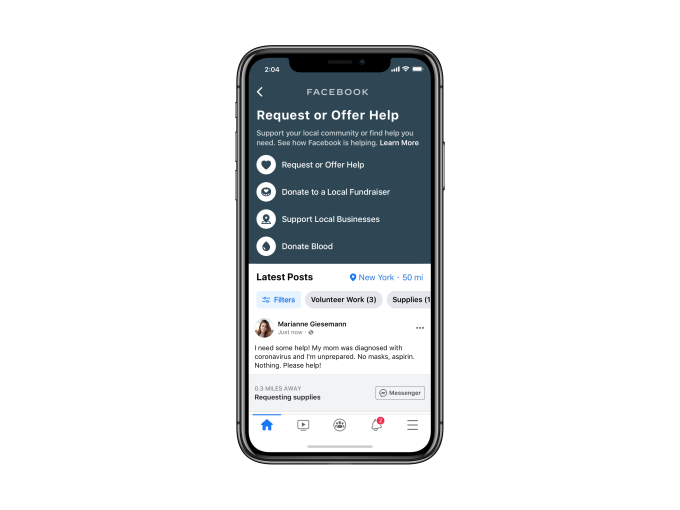
Facebook is expanding its Community Help hub to better serve local communities amid the COVID-19 pandemic. The hub has already seen significant usage by those requesting food, supplies and information about local resources, as well as use by volunteers and groups willing to lend a hand. Now, Facebook is adding more features to the hub to allow people to support local businesses, blood banks, nonprofits, and more.

As part of Facebook’s efforts with GivingTuesday, it will roll out these new additions on May 5th, it says.

Typically, the GivingTuesday charitable giving event is held on the Tuesday after Thanksgiving in the U.S. — after Black Friday and Cyber Monday sales wrap. But in response to the unprecedented need caused by the pandemic, GivingTuesday announced an emergency day of giving, called Giving Tuesday Now.

This new event happens tomorrow, May 5th, and already has a number of partners and supporters, including Facebook, as well as PayPal, America’s Food Fund, Ford, Bill & Melinda Gates Foundation, CDC Foundation, LinkedIn, United Way, GoFundMe, and many others.

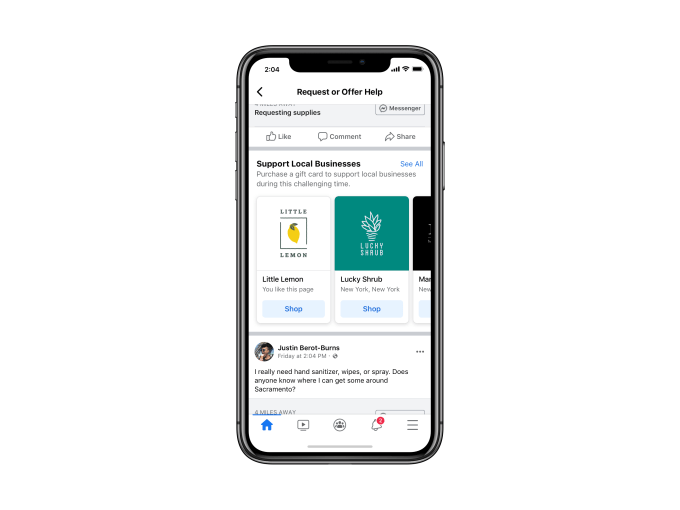
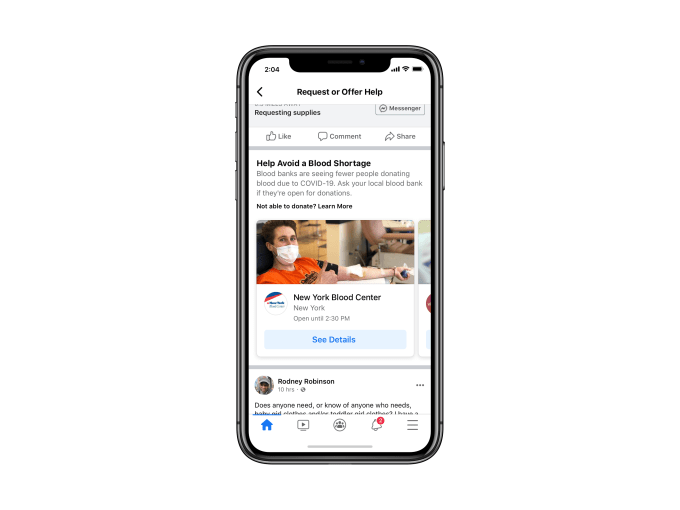
Starting tomorrow, Facebook users will be able to go to Community Help at Facebook.com/covidsupport in order to buy gift cards to local businesses, sign up to donate to local nonprofits and fundraisers, sign up to be a donor at local blood banks, and find local job opportunities.

In some cases, Facebook already had built the technology and formed partnerships needed to launch these features. For example, Facebook began its work to connect Facebook users with blood banks back in 2017, then expanded the blood donations feature to the U.S. last June.

It also offers a fundraising platform of its own and announced last month it was working on tools that would allow businesses to offer gift cards to their customers via its platform. It’s been working on its jobs portal since 2018, too.

On Tuesday, these efforts are being centralized in the Community Help hub, which will give them increased visibility.

Facebook is not the only platform helping local businesses and nonprofits by rolling out new features.

Neighborhood social network Nextdoor also recently launched tools to allow businesses to promote their fundraisers and gift cards; Yelp just added a way for businesses to promote their virtual services; Instagram has introduced a range of tools for businesses, including those for connecting customers to Facebook’s gift cards or stickers for food ordering and more.

The revamped Community Help section will be live tomorrow, May 5, 2020.


from Social – TechCrunch https://ift.tt/2xCbLro Facebook to add gift cards, jobs and donation tools to its COVID-19 Community Help hub Sarah Perez https://ift.tt/2z4VgVd
via IFTTT

A turbulent stock market is a boon to investing-focused fintech startups

Hello and welcome back to our regular morning look at private companies, public markets and the gray space in between.

A few weeks back we dug into the boom that savings and investing apps and services were enjoying. Companies like Acorns, M1 Finance, Robinhood and others were seeing rapid growth in their assets under management (AUM) and downloads. New data out today underscores how well finance apps are faring in the new, chaotic COVID-19 era.

You can run a simple test on yourself in this case. Since, say, January of this year, have you paid more or less attention to your banking and investing related apps and, more broadly, your financial life? Perhaps you are trying to put a bit more away? Or make sure your 401k isn’t invested in something silly?

If so, you are far from alone. To detail just how much more activity this slice of the startup world is enjoying, this morning we’re taking another look at the growth that this slice of the fintech world is undergoing. We’ll lean on some new data from a mobile app analytics provider (AppAnnie) and a report from a brokerage-infra startup (DriveWealth) to get a clearer picture of where investing and savings apps are growing and just how well they are performing.

Investing in a downturn


https://ift.tt/eA8V8J A turbulent stock market is a boon to investing-focused fintech startups https://ift.tt/3c3HUHi

In conversation with Icebreaker, Finland’s most active pre-seed VC

Icebreaker claims to be Finland’s most active pre-seed VC. The firm, which also invests in Estonia and Sweden, has backed 38 companies in the last three years out of its first fund, with a 65% success rate so far for companies that have been able to raise follow-on funding.

Two weeks ago, Icebreaker announced the launch of Fund II, with an initial close of €50 million. That’s more than twice the size of its first fund, which topped out at €20 million.

Its remit remains largely the same, however. The company typically invests between €150k and €800k in teams that have “deep domain expertise” and are building globally competitive tech companies according to Icebreaker co-founder and partner Riku Seppälä.

Noteworthy, this goes right to the top of the funnel and includes backing and helping to connect “pre-founders,” defined as individuals with over 5 years of work experience in their domain who are aiming to start or join a tech company. As part of this effort, Icebreaker operates an online and offline community to act as a catalyst for new companies to be founded.

Meanwhile, I’m told that Fund II was signed just as the coronavirus crisis began to take hold and includes the majority of LPs from Fund I in addition to new investors. Lead LPs are Tesi, KRR III, Varma Mutual Pension Insurance Company and Elo Mutual Pension Insurance Company, together with 41 other entities consisting of institutional investors, family offices and founders.

To find out more about Fund II and what’s it’s like to launch a new pre-seed fund at a time of such uncertainty, and to understand how Icebreaker thinks about startup life during and after lockdown, I put questions to Icebreaker co-founder and Partner Riku Seppälä.

TechCrunch: What does it feel like to close a new fund right at the start of a pandemic?

Riku Seppälä: Of course, we have been distracted by the mounting health crisis and how the world economy will recover, so the feelings are mixed.


https://ift.tt/eA8V8J In conversation with Icebreaker, Finland’s most active pre-seed VC https://ift.tt/2WtK9x7

Decrypted: Chegg’s third time unlucky, Okta’s new CSO Rapid7 beefs up cloud security

Ransomware is getting sneakier and smarter.

The latest example comes from ExecuPharm, a little-known but major outsourced pharmaceutical company that confirmed it was hit by a new type of ransomware last month. The incursion not only encrypted the company’s network and files, hackers also exfiltrated vast amounts of data from the network. The company was handed a two-for-one threat: pay the ransom and get your files back or don’t pay and the hackers will post the files to the internet.

This new tactic is shifting how organizations think of ransomware attacks: it’s no longer just a data-recovery mission; it’s also now a data breach. Now companies are torn between taking the FBI’s advice of not paying the ransom or the fear their intellectual property (or other sensitive internal files) are published online.

Because millions are now working from home, the surface area for attackers to get in is far greater than it was, making the threat of ransomware higher than ever before.

That’s just one of the stories from the week. Here’s what else you need to know.

THE BIG PICTURE


Chegg hacked for the third time in three years

Education giant Chegg confirmed its third data breach in as many years. The latest break-in affected past and present staff after a hacker made off with 700 names and Social Security numbers. It’s a drop in the ocean when compared to the 40 million records stolen in 2018 and an undisclosed number of passwords taken in a breach at Thinkful, which Chegg had just acquired in 2019.

Those 700 names account for about half of its 1,400 full-time employees, per a filing with the Securities and Exchange Commission. But Chegg’s refusal to disclose further details about the breach — beyond a state-mandated notice to the California attorney general’s office — makes it tough to know exactly went wrong this time.


https://ift.tt/eA8V8J Decrypted: Chegg’s third time unlucky, Okta’s new CSO Rapid7 beefs up cloud security https://ift.tt/2zY8qUj

Tech stocks open lower ahead of another busy earnings week

The optimism that confounded many in April may be slipping in May, as stocks fell during Friday’s trading session and are down again this morning.

The tech-heavy Nasdaq Composite is off 0.55% this morning, putting it 13% off its record highs set this year, but also up 29% from its 52-week lows it set directly following those highs. Niching down to SaaS and cloud stocks, the Bessemer-Nasdaq cloud index is off 0.85% today, after shedding nearly 3% in last week’s final trading session.

SaaS and cloud stocks rebounded mightily in April, making their slow start in May a disappointment. As last month came to a close, strong results from giants like Alphabet and Microsoft lowered some market concerns about the economy’s health towards the end of Q1.

However, the week ahead is full of earnings so we shouldn’t place too much stock in any particular trading session. To prepare you for the news onslaught, TechCrunch has prepared a list of companies expected to report Q1 results this week, along with the startup sector that they will help detail with their own numbers.

Please enjoy:

  • Monday: Appfolio (vertical SaaS), Chegg (edtech), Despegar.com (travel-focused tech), Five9 (cloud).
  • Tuesday: Blizzard (gaming), EA (gaming), Arista Networks (networking), Beyond Meat (meat substitutes), Groupon (ecommerce), TripAdvisor (travel tech), Pinterest (consumer demand, marketplaces).
  • Wednesday: Alteryx (SaaS), Square (fintech), PayPal (fintech), Hubspot (SaaS), GrubHub (food delivery), Fastly (infra), FitBit (consumer tech), Etsy (consumer goods, ecommerce), Upwork (marketplaces), Sprout Social (SaaS), Sonos (consumer tech), Shopify (ecommerce, SaaS), Zynga (gaming), Lyft (on-demand mobility), Twilio (SaaS, telecom).
  • Thursday: Bill.com (SaaS), CarGurus (consumer demand, ecommerce), Care.com (health-tech), Castlight Health (SaaS), Cloudflare (infra), Dropbox (SaaS), The Trade Desk (martech), HP, GoPro (consumer hardware), Fiverr (consumer marketplaces), Rapid7 (cybersec), Yelp (advertising), Uber (on-demand mobility),
  • Friday: Riot Blockchain (lol)

So it’s going to be busy. No matter what sort of startup you care about the most, there’s going to be an earnings report for you coming out shortly. Of course, news from Pinterest, Uber and Lyft will dominate, but there’s a lot of smaller reports that may prove even more interesting.

TechCrunch will cover a handful. The rest will be covered in a summary fashion as needed to explain new trends that are impacting startups. And then, like a wave after its crest, things should start to slow on the earnings front for another few months as Q2 rolls along.

Monday! Let’s go!


https://ift.tt/eA8V8J Tech stocks open lower ahead of another busy earnings week https://ift.tt/35uRsIM

Equity Monday: Intel covets Moovit, two early stage rounds, and Uber’s earnings

Good morning and welcome back to TechCrunch’s Equity Monday, a jumpstart for your week.

Equity had a busy last few days, so to help you catch up: Friday’s episode was a lot of fun (Duolingo, Figma, OMERS, and aquafaba), and we also dropped an Equity Shot on Saturday, digging into the first major technology earnings week.

But this morning we were busy digging through what’s happened over the last few days, and what’s to come. Here’s the rundown:

We wrapped asking that’s going to come for companies that were still speculative businesses before the slowdown. They’re going to vaporize, right?

Equity drops every Monday at 7:00 AM PT and Friday at 6:00 am PT, so subscribe to us on Apple PodcastsOvercastSpotify and all the casts.


https://ift.tt/eA8V8J Equity Monday: Intel covets Moovit, two early stage rounds, and Uber’s earnings https://ift.tt/2zX7UpC

Customer journey hijacking prevention tool Namogoo acquires Personali for its behavioural analytics

Namogoo, the Israel-based company that has developed a solution for e-commerce and other online enterprises to prevent “customer journey hijacking,” has acquired behavioural analytics company Personali. Terms of the deal remain undisclosed, although we understand the Personali is joining Namogoo.

Described as a “strategic acquisition,” Personali — which was founded in 2011 and had raised $15 million to date from backers such as Norwest Venture Partners, Cedar Fund, and Gemini Partners — provides “AI-powered” behavioural analytics tools for personalising in-site incentives and therefore helping to increase sales.

Specifically, it claims that by optimising and personalising discounts at strategic moments along the customer journey, brands using Personali’s various solutions have seen conversions increase by 32% while reducing the cost of promotions by 30%. That dovetails nicely with Namogoo’s proposition.

Founded by Chemi Katz and Ohad Greenshpan in 2014, Namogoo’s platform gives online businesses more control over the customer journey by preventing unauthorised ad injections that attempt to divert customers to competitors. It also helps uncover privacy and compliance risks that can come from the use of third and fourth-party ad vendors.

In October, Namogoo raised $40 million in Series C funding, in a round led by Oak HC/FT, with participation from existing backers GreatPoint Ventures, Blumberg Capital and Hanaco Ventures.

At the time, the company told TechCrunch that retailers using its technology see conversion rates increase between 2-5%, which in the first half of 2019 totalled more than $575 million in revenue for Namogoo customers. It is used by more than 150 global brands in over 38 countries, including Tumi, Asics, Argos, Dollar Shave Club, Tailored Brands, Upwork and others.

Meanwhile, Namogoo says the acquisition will enable it to offer a more robust set of services to both new and existing e-commerce clients, spanning solutions to help increase customer engagement, loyalty, and conversions.

“We are very excited to integrate Personali’s advanced solutions and extraordinary team into our company,” said Chemi Katz, Namogoo CEO and co-founder, in a statement. “Our goal has always been to help brands provide their customers with the best possible shopping experience and increase sales, which fits perfectly with the Personali solution”.


https://ift.tt/eA8V8J Customer journey hijacking prevention tool Namogoo acquires Personali for its behavioural analytics https://ift.tt/2KU2A8K

Poynter Institute’s International Fact-Checking Network launches chatbot on WhatsApp to debunk thousands of coronavirus-related hoaxes

You can now debunk thousands of coronavirus-related hoaxes with a few texts on WhatsApp.

Poynter Institute, a nonprofit organization that supports journalism, today launched a bot on WhatsApp to help people across the globe debunk over 4,000 hoaxes, including whether the infection originated in a lab in Wuhan, China. (No conclusive evidence yet.)

The chatbot relies on information supplied by over 100 independent fact-checkers in more than 70 countries. It’s the largest database of debunked falsehoods related to COVID-19, said Poynter Institute. The service is currently available in English, but support for other languages including Hindi, Spanish, and Portuguese will be rolled out soon.

Users can test the chatbot by either saving +1 (727) 2912606 as a contact number and texting the word ‘hi’. Alternatively, they can click on http://poy.nu/ifcnbot that does not require them to save the chatbot’s number to their phonebook.

Once they have texted ‘hi’ to the bot, sending ‘1’ (and then waiting for the chatbot to respond, which can take 2-3 seconds) prompts a new message from the bot, which asks them to enter the keyword of their query. Here you can type “origin,” “garlic” (to know if there is any evidence that this herb helps in fighting with coronavirus; there isn’t), or any other keyword.

The chatbot identifies a user’s country (by checking their mobile country code), and provides them with information that has been fact-checked by their closest organization. The chatbot also shares general tips to fight the coronavirus outbreak, and offers transparency on the nearest fact-checkers a person has.

The chatbot says on WhatsApp that it may aggregate and share anonymous results of user queries and other interactions with the research community and program partners. But that, “your personal information, however, will never be shared.”

In a statement, Baybars Orsek, IFCN’s Director, commented: “Billions of users rely on WhatsApp to stay in touch with their friends and families every month. Since bad actors use every single platform to disseminate falsehoods, to mislead others during such troubling times, fact-checkers’ work is more important than ever.”

The new chatbot is the latest effort from WhatsApp, used by more than 2 billion people, to curb the spread of misinformation on its platform. In recent months WhatsApp has also collaborated with the WHO to launch an information service that reached more than 10 million users within days. The Facebook-owned service is also working with federal and state governments in many markets to help them deliver authoritative information about the infectious disease in many countries.

WhatsApp, which recently introduced new limit on forwarding messages on its app that has significantly cut down the number of forwards it sees on the platform, donated $1 million to Poynter Institute’s International Fact-Checking Network (IFCN) in March.

More to follow…


from Social – TechCrunch https://ift.tt/eA8V8J Poynter Institute’s International Fact-Checking Network launches chatbot on WhatsApp to debunk thousands of coronavirus-related hoaxes Manish Singh https://ift.tt/2SxOn5C
via IFTTT

Oxwash bags $1.7M for a cleaner spin on laundry

Oxwash, a UK-based laundry startup that’s aiming to disrupt traditional but environmentally costly washing and dry-cleaning processes by using ozone to sterilize fabrics at lower temperatures, along with electric cargo bikes for hyper local pick ups and deliveries, has bagged a £1.4 million (~$1.7M) seed.

Backers in the funding round include TrueSight Ventures, Biz Stone (co-founder of Twitter), Paul Forster (founder of Indeed.com), Founders Factory and other unnamed angel investors.

Prior to this, Oxwash was working with a £300k pre-seed round — which it used to fund building its first washing hubs (which it calls “Lagoons”) and to test its reengineered washing process.

The startup’s pitch is that its applying “space age” technology to clean dirty laundry, burnished by the claim that its co-founder and CEO, Kyle Grant, is a former NASA engineer — having spent two years as a systems engineer where he researched the use and effect of microorganisms for extended space travel.

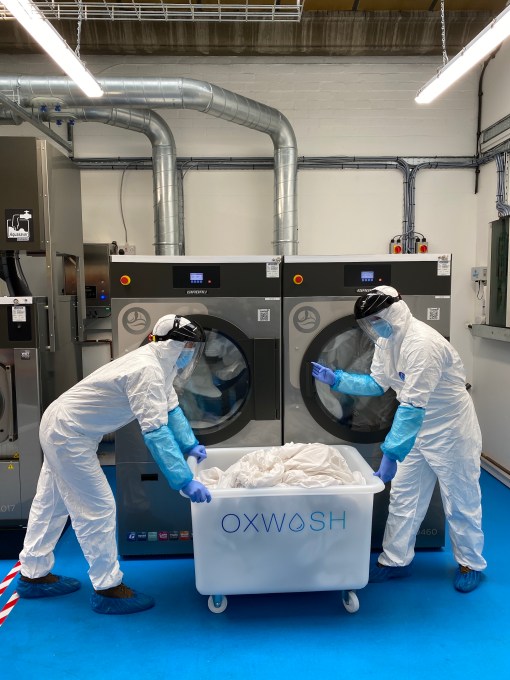
That said, it’s packing its reengineered cleaning system into standard (but “massively” modified) industrial washing machines. Just add coronavirus-safe ‘space suits’ (er, PPE)….

“Washing still has crazy carbon emissions, pollution and collection/delivery services cause large amounts of congestion. We saw a way to re-engineer the laundry process from the ground up and to be the first truly sustainable, space-age laundry company in the world,” says Grant, discussing the opportunity he and his co-founder spied to rethink laundry.

“We’re developing processes to have zero net carbon emissions for the whole laundry process — from collection to washing and back to delivery.”

The team is developing “chemistry that works at 20˚C better than at 40˚C or higher, integrating ozone disinfection to remove microorganisms by oxidation rather than using heat and developing water recycling and filtration systems to reduce water consumption and remove microfibre pollution at the same time”, per Grant.

It’s also structuring business operations to locate washing hubs in city centres, where its customers are based, so it can make use of electric bikes for moving the laundry around — allowing for a next day service with 30 minute collection and delivery windows.

“Traditional washing processes use huge amounts of water, energy to heat said water, harsh chemicals and normal petrol/diesel vans for the collections and deliveries. These process warehouses are usually located outside of cities and there are large lags in when items are returned to the customers (up to two weeks),” he further claims.

While ozone itself is a pollutant that degrades air quality, and can even be dangerous if released, Grant says the ozone used in its cleaning machines — which is produced from oxygen in the atmosphere — degrades back to oxygen “within minutes and is therefore inert and safe”.

“After extensive analysis ozone is far safer to use in commercial laundry processes than heat and harsh chemicals such as peroxides (bleach),” he suggests.

On safety, he also says their washing machines are modified to be sealed whilst “washing and disinfecting”, and can only be opened after the ozone has degraded. “Our lagoons are also fitted with ozone sensors that will cut off our generators if the ozone concentration in the air ever goes over the safe limit,” he adds. “Thankfully this has never occurred. The risks to our staff are far lower than when working with boiling water tanks, harsh chemicals and manual handling, the usual work flow in commercial laundries.”

Oxwash launched in the UK in early 2018 and now has more than 4,000 individual customers, per Grant, along with “several hundred” business customers — including the Marriott Hotel Chain, NHS GP practices, London Marathon and Universities of Oxford and Cambridge.

It’s executed a slight pivot of focus over the past two months — spying an opportunity to target risks related to the coronavirus. “We’ve developed a service in the last 2 months that is available to provide coronavirus disinfection,” he says in a statement. “We are working closely with [the UK’s National Health Service] NHS and vulnerable groups to provide support when needed.”

“We have adopted laboratory-grade PPE [personal protective equipment] processes, heavily inspired and adapted from my time working at NASA but also from guidelines from the NHS and HSE England,” Grant adds. “For example, we now perform contactless collections and deliveries whereby the customers pre-bag their items in supplied dissolvable bags. Our rider then has gloves, goggles and a respirator to perform the transfer back to the lagoon where a member of our team in full hazmat gear will load and unload the machines where disinfection is performed.”

Before the COVID-19 pandemic, he says the startup was getting traction from customers wanting to remove allergens that caused them allergic reactions.

“We were confident of moving into the healthcare market in the years to come but usually the tender process for such contracts is not conducive to a startup,” says Grant. “However since the advent of COVID-19 and our ongoing healthcare certification, we have seen a huge increase in the value of proper hygiene to both the individuals and businesses we serve. The Marriott Hotel chain and Airbnb have both expressed serious intent to work on a non-healthcare hygiene rating much like that of the Food Standards Authority. We are working with CINET (the international textile committee) to bring this to market with our technology and processes.”

The seed funding will be used to expand to more cities within the UK and Europe — with London and other European hubs, such as Paris and Amsterdam, in its sights. Its initial two locations are Oxford and Cambridge.

It’s also going to spin up on the hiring front, planning to add a head of growth and head of tech, as well as new operational roles in London.

Ploughing more resource into software dev is another focus, with funding going to expand the tech stack and the software systems which run its logistics and integrate with its digitised washing process. More work on its app is also planned. 

Asked what makes Oxwash a scalable business, Grant points to the development of this proprietary software alongside the reengineered washing service. “This iteration of technology and service allows us to develop our washing technology rapidly and get real-time feedback on the end-product and service from our customers,” he says. “The scalable technology element is the proprietary washing process driven by our bespoke software stack and process algorithms.”

On the labor side, Grant says Oxwash is “working towards a B Corp accreditation”.

“[We] have long held that our team should be properly reimbursed for their work but also as ambassadors for our brand out on our bikes. To that end all of our riders (couriers) are fully employed and like the rest of the team they are paid in excess of the national living wage,” he adds.


https://ift.tt/3fhsvFj Oxwash bags $1.7M for a cleaner spin on laundry https://ift.tt/35smXTX

Friday, May 1, 2020

Otonomo raises $46 million to expand its automotive data marketplace

New vehicles today can produce a treasure trove of data. Without the proper tools, that data will sit undisturbed, rendering it worthless.

A number of companies have sprung up to help automakers manage and use data generated from connected cars. Israeli startup Otonomo is one such player that jumped on the scene in 2015 with a cloud-based software platform that captures and anonymizes vehicle data so it can then be used to create apps to provide services such as electric vehicle management, subscription-based fueling, parking, mapping, usage-based insurance and emergency service.

The startup announced this week it has raised $46 million to take its automotive data platform further. The capital was raised in a Series C funding round that included investments from SK Holdings, Avis Budget Group and Alliance Ventures. Existing investors Bessemer Venture Partners also participated. Otonomo has raised $82 million, to date.

The funds will be used to help Otonomo scale its business, improve its products and help it remain competitive, according to the company. Otonomo is also aiming to expand into new markets, particularly South Korea and Japan.

“We now have the expanded resources needed to deliver on our vision of making car data as valuable as possible for the entire transportation ecosystem, while adhering to the strictest privacy and security standards,” Otonomo CEO and founder Ben Volkow said in a statement.

Otonomo’s pitch focuses on creating opportunities to monetize connected car data while keeping it safe from the moment it is captured. Once the data is securely collected, the platform modifies it so companies can use it to develop apps and services for fleets, smart cities and individual customers. The platform also enables GDPR, CCPA and other privacy regulation-compliant solutions using both personal and aggregate data.

Today, Otonomo’s platform takes in 2.6 billion data points a day from more than 20 million vehicles through partnerships with more than automakers, fleets and farm and construction manufacturers. Otonomo has more than 25 partnerships, a list that includes Daimler, BMW, Mitsubishi Motor Company and Avis Budget Group. The company said it’s preparing to bring on seven more customers.

That opportunity for Otonomo is growing based on forecasts, including one from SBD Automotive that predicts connected cars will account for more than 70% of cars sold in North American and European markets in 2020.


https://ift.tt/eA8V8J Otonomo raises $46 million to expand its automotive data marketplace https://ift.tt/2YoxGgA

Introducing the term-sheet grader

When we launched in 2016, we took the unusual approach of saying we’d buy common stock in startups. We believed then, and still do, that alignment with founders was more important than covering our downside in investments that didn’t work as planned. Said differently, we wanted to enhance our upside through alignment, rather than maximizing our downside through terms.

The world has changed a lot since that time. While we are actively making investments, and still buying common stock, we know that many entrepreneurs may be trying to raise money now — and it is very hard.

Fred Destin wrote a great piece about the ugly terms that can creep into term sheets during difficult times. If you have a choice between a good term sheet and a bad one, of course, you’ll take the good one. But what if you have no choice? And how can you compare term sheets in the first place?

To this end, we developed the term-sheet grader, a simple way to compare different term sheets or help characterize whether a term sheet is good or evil.

Let me first point out that none of this has anything to do with the valuation of the round (share price), the amount of capital, the likelihood of reaching a closing, the quality of the firm or the trust you have with the individual leading the investment, all absolutely critical pieces of the puzzle. Here, we are just looking at the terms and conditions, the legal structure of the investment.

We’ve listed nine key terms below — five that have to do with economics and four that relate to control and decision-making:

  • Each key term can earn +1 for being friendly and -1 for being tough.
  • There are a few really friendly terms that have a score of +2 each.
  • Likewise, there are a few really tough ones that earn a -2.
  • The best a term sheet could score is a +11, the worst is a -11.
  • The “Industry Standard” deal scores a 0.

FWIW, the Pillar common stock standard deal earns a +8 (shown below).


https://ift.tt/eA8V8J Introducing the term-sheet grader https://ift.tt/2Wcq5iw

blogger better Headline Animator