l
l
blogger better. Powered by Blogger.

Search

Labels

blogger better

Followers

Blog Archive

Total Pageviews

Labels

Download

Blogroll

Featured 1

Curabitur et lectus vitae purus tincidunt laoreet sit amet ac ipsum. Proin tincidunt mattis nisi a scelerisque. Aliquam placerat dapibus eros non ullamcorper. Integer interdum ullamcorper venenatis. Pellentesque habitant morbi tristique senectus et netus et malesuada fames ac turpis egestas.

Featured 2

Curabitur et lectus vitae purus tincidunt laoreet sit amet ac ipsum. Proin tincidunt mattis nisi a scelerisque. Aliquam placerat dapibus eros non ullamcorper. Integer interdum ullamcorper venenatis. Pellentesque habitant morbi tristique senectus et netus et malesuada fames ac turpis egestas.

Featured 3

Curabitur et lectus vitae purus tincidunt laoreet sit amet ac ipsum. Proin tincidunt mattis nisi a scelerisque. Aliquam placerat dapibus eros non ullamcorper. Integer interdum ullamcorper venenatis. Pellentesque habitant morbi tristique senectus et netus et malesuada fames ac turpis egestas.

Featured 4

Curabitur et lectus vitae purus tincidunt laoreet sit amet ac ipsum. Proin tincidunt mattis nisi a scelerisque. Aliquam placerat dapibus eros non ullamcorper. Integer interdum ullamcorper venenatis. Pellentesque habitant morbi tristique senectus et netus et malesuada fames ac turpis egestas.

Featured 5

Curabitur et lectus vitae purus tincidunt laoreet sit amet ac ipsum. Proin tincidunt mattis nisi a scelerisque. Aliquam placerat dapibus eros non ullamcorper. Integer interdum ullamcorper venenatis. Pellentesque habitant morbi tristique senectus et netus et malesuada fames ac turpis egestas.

Friday, April 20, 2018

Twitter doesn’t care that someone is building a bot army in Southeast Asia

Facebook’s lack of attention to how third parties are using its service to reach users ended up with CEO Mark Zuckerberg taking questions from Congressional committees. With that in mind, you’d think that others in the social media space might be more attentive than usual to potentially malicious actors on their platforms.

Twitter, however, is turning the other way and insisting all is normal in Southeast Asia, despite the emergence of thousands of bot-like accounts that have followed prominent users in the region en masse over the past month.

Scores of reporters and Twitter users with large followers — yours truly included — have noticed swarms of accounts with generic names, no profile photo, no bio and no tweets have followed them over the past month.

These accounts might be evidence of a new ‘bot farm’ — the creation of large numbers of accounts for sale or usage on-demand which Twitter has cracked down on — or the groundwork for more nefarious activities, it’s too early to tell.

In what appears to be the first regional Twitter bot campaign, a flood of suspicious new followers has been reported by users across Southeast Asia and beyond, including Thailand, Myanmar Cambodia, Hong Kong, China, Taiwan, Sri Lanka among other places.

While it is true that the new accounts have done nothing yet, the fact that a large number of newly-created accounts have popped up out of nowhere with the aim of following the region’s most influential voices should be enough to concern Twitter. Especially since this is Southeast Asia, a region where Facebook is beset with controversies — from its role inciting ethnic hatred in Myanmar, to allegedly assisting censors in Vietnam, witnessing users jailed for violating lese majeste in Thailand, and aiding the election of controversial Philippines leader Duterte.

Then there are governments themselves. Vietnam has pledged to build a cyber army to combat “wrongful views,” while other regimes in Southeast Asia have clamped down on social media users.

Despite that, Twitter isn’t commenting.

The U.S. company issued a no comment to TechCrunch when we asked for further information about this rush of new accounts, and what action Twitter will take.

A source close to the company suggested that the sudden accumulation of new followers is “a pretty standard sign-up, or onboarding, issue” that is down to new accounts selecting to follow the suggested accounts that Twitter proposes during the new account creation process.

Twitter is more than 10 years old, and since this is the first example of this happening in Southeast Asia that explanation already seems inadequate at face value. More generally, the dismissive approach seems particularly naive. Twitter should be looking into the issue more closely, even if for now the apparent bot army isn’t being put to use yet.

Facebook is considered to be the internet by many in Southeast Asia, and the social network is considerably more popular than Twitter in the region, but there remains a cause for concern here.

“If we’ve learned anything from the Facebook scandal, it’s that what can at first seem innocuous can be leveraged to quite insidious and invasive effect down the line,” Francis Wade, who recently published a book on violence in Myanmar, told the Financial Times this week. “That makes Twitter’s casual dismissal of concerns around this all the more unsettling.”


from Social – TechCrunch https://ift.tt/eA8V8J Twitter doesn’t care that someone is building a bot army in Southeast Asia Jon Russell https://ift.tt/2qMdaot
via IFTTT


Thursday, April 19, 2018

Technique to beam HD video with 99 percent less power could sharpen the eyes of smart homes

{rss:content:encoded} Technique to beam HD video with 99 percent less power could sharpen the eyes of smart homes https://ift.tt/2vyYYEk https://ift.tt/2HhQsPC April 20, 2018 at 01:13AM

Everyone seems to be insisting on installing cameras all over their homes these days, which seems incongruous with the ongoing privacy crisis — but that’s a post for another time. Today, we’re talking about enabling those cameras to send high-definition video signals wirelessly without killing their little batteries. A new technique makes beaming video out more than 99 percent more efficient, possibly making batteries unnecessary altogether.

Cameras found in smart homes or wearables need to transmit HD video, but it takes a lot of power to process that video and then transmit the encoded data over wi-fi. Small devices leave little room for batteries, and they’ll have to be recharged frequently if they’re constantly streaming. Who’s got time for that?

The idea behind this new system, created by a University of Washington team led by prolific researcher Shyam Gollakota, isn’t fundamentally different from some others that are out there right now. Devices with low data rates, like a digital thermometer or motion sensor, can something called backscatter to send a low-power signal consisting of a couple bytes.

Backscatter is a way of sending a signal that requires very little power, because what’s actually transmitting the power is not the device that’s transmitting the data. A signal is sent out from one source, say a router or phone, and another antenna essentially reflects that signal, but modifies it. By having it blink on and off you could indicate 1s and 0s, for instance.

UW’s system attaches the camera’s output directly to the output of the antenna, so the brightness of a pixel directly correlates to the length of the signal reflected. A short pulse means a dark pixel, a longer one is lighter, and the longest length indicates white.

Some clever manipulation of the video data by the team reduced the number of pulses necessary to send a full video frame, from sharing some data between pixels to using a “zigzag” scan (left to right, then right to left) scan pattern. To get color, each pixel needs to have its color channels sent in succession, but this too can be optimized.

Assembly and rendering of the video is accomplished on the receiving end, for example on a phone or monitor, where power is more plentiful.

In the end, a full-color HD signal at 60FPS can be with less than a watt of power, and a more modest but still very useful signal — say, 720p at 10FPS — can be sent for under 80 microwatts. That’s a huge reduction in power draw, mainly achieved by eliminating the entire analog to digital converter and on-chip compression. At those levels, you can essentially pull all the power you need straight out of the air.

They put together a demonstration device with off-the-shelf components, though without custom chips it won’t reach those

A frame sent during one of the tests. This transmission was going at about 10FPS.

microwatt power levels; still, the technique works as described. The prototype helped them determine what type of sensor and chip package would be necessary in a dedicated device.

Of course, it would be a bad idea to just blast video frames into the ether without any compression; luckily, the way the data is coded and transmitted can easily be modified to be meaningless to an observer. Essentially you’d just add an interfering signal known to both devices before transmission, and the receiver can subtract it.

Video is the first application the team thought of, but there’s no reason their technique for efficient, quick backscatter transmission couldn’t be used for non-video data.

The tech is already licensed to Jeeva Wireless, a startup founded by UW researchers (including Gollakota) a while back that’s already working on commercializing another low-power wireless device. You can read the details about the new system in their paper, presented last week at the Symposium on Networked Systems Design and Implementation.

Reddit hires former Time Inc. exec Jen Wong as COO

Reddit, one of the internet’s largest hubs for both traffic and controversy, announced today that it has hired former Time Inc. President of Digital Jen Wong to take on the role of COO.

She will be tasked with managing Reddit’s business strategy, working out of the company’s New York office. Wong left Time Inc. earlier this year when the company was acquired by Meredith Corp for $1.84 billion.

In a blog post, the company detailed the scope of her role as COO. A major focus will be building the company’s advertising strategy:

Her goals as COO will align closely with her past experience at Time, PopSugar, and AOL: using her media, publisher, advertising, and operations expertise to help us build out our offerings for users, advertisers, and partners; applying her experience building successful digital advertising offerings for internet media giants to our own ads platform; and, through it all, working to grow our business while staying true to the things that make Reddit unique.

Despite claiming 330 million monthly active users, Reddit is still a relatively small operation by Silicon Valley standards. A major part of that is that they’ve been slow to build out a sophisticated advertising product, though in recent months they’ve begun rolling out native ads in the company’s mobile apps.

“Jen is a seasoned digital veteran and successful executive at some of the biggest media companies in the world, her experience and vision will help carry Reddit’s momentum forward in the years to come,” Reddit CEO Steve Huffman said in a statement.


from Social – TechCrunch https://ift.tt/eA8V8J Reddit hires former Time Inc. exec Jen Wong as COO Lucas Matney https://ift.tt/2JZkjtu
via IFTTT

Square acquires corporate catering startup Zesty

Square has acquired elements of corporate catering startup Zesty. Square, which already owns on-demand food delivery service Caviar, plans to use Zesty’s assets to strengthen Caviar’s corporate ordering business, Caviar for Teams.

Neither company disclosed financial terms of the deal, but the plan is for Caviar and Zesty to operate independently in the short term.

“Restaurants turn to Caviar to reach more diners and grow their businesses,” Square Caviar Lead Gokul Rajaram said in a press release. “Expanding our corporate catering product with Zesty enables us to offer our restaurant partners another way to boost sales through higher-margin, large-format catering orders,” said Gokul Rajaram, Caviar Lead at Square. “Caviar is thriving, and we’re excited to supercharge its success with Zesty and double down on an area with great opportunity to drive more growth for our business.”

Since its acquisition of Caviar in 2014, Square has acquired OrderAhead’s pickup business to launch Caviar Pickup and Entrees On-Trays to expand its footprint in the Dallas-Fort Worth, Texas area.

Zesty currently partners with about 150 restaurants in San Francisco, which is the only operate in which it operates. Some of Zesty’s customers include Snap, Splunk and TechCrunch. Zesty, which first launched in 2013 under a different name, had previously raised $20.7 million in venture funding.

“Adding Zesty’s offerings, like sophisticated menu-planning tools and algorithms, white-glove catering services, and nutrition and allergen customization, will help us expand our catering offering and even better serve companies of all sizes,” the Caviar team wrote on Medium. “Plus, it provides our restaurant partners with more opportunities to reach new corporate customers.”


https://ift.tt/eA8V8J Square acquires corporate catering startup Zesty https://ift.tt/2HMbpPx

Russia’s game of Telegram whack-a-mole grows to 19M blocked IPs, hitting Twitch, Spotify and more

As the messaging app Telegram continues to try to evade Russian authorities by switching up its IP addresses, Russia’s regulator Roskomnadzor (RKN) has continued its game of whack-a-mole to try to lock it down by knocking out complete swathes of IP address. The resulting chase how now ballooned to nearly 19 million IP addresses at the time of writing, as tracked by unofficial RKN observer RKNSHOWTIME (updated on a Telegram channel with stats accessible on the web via Phil Kulin’s site).

As a result, there have been a number of high-profile services also knocked oput in the crossfire, with people in Russia reporting dozens of sites affected including Twitch, Slack, Soundcloud, Viber, Spotify, Fifa, Nintendo, as well as Amazon and Google. (A full list of nearly forty addresses is listed below.)

What’s notable is that Google and Amazon themselves seem still not to be buckling under pressure. As we reported earlier this week, a similar — but far smaller — instance happened in the case of Zello, which had also devised a technique to hop around IP addresses when its own IP addresses were shut down by Russian regulators.

Zello’s circumventing lasted for nearly a year, until it seemed the regulator started to use a more blanket approach of blocking entire subnets — a move that ultimately led to Google and Amazon asking Zello to cease its activities.

After that, Zello’s main access point for its Russian users was via VPN proxies — one of the key ways that users in one country can effectively appear as if they are in another, allowing them to circumvent geoblocking and geofencing, either by the companies themselves, or those that have been banned by a state.

It’s important to note that the domain fronting that Google is in the process of shutting down is not the same as IP hopping — although, more generally, it will mean that there is now one less route for those globally whose traffic is getting blocked through censorship to wiggle around that. The IP hopping that has led to 19 million addresses getting blocked in Russia is another kind of circumvention. (I’m pointing this out because several people I’ve spoken to assumed they were the same.)

Pavel Durov, Telegram’s founder and CEO, has made several public calls on Telegram and also third-party sites like Twitter to praise how steadfast the big internet companies have been. And others like the ACLU have also waded into the story to call on Amazon, Apple, Google and Microsoft to hold strong and continue to allow Telegram to IP hop.

But what could happen next?

I’ve contacted Google, Amazon and Telegram now several times to ask this question and for more details on what is going on. As of yet I’ve had no replies. However, Alexey Gavrilov, the CTO and founder of Zello, provided a little more potential insight:

He said that ultimately they might ask Telegram to stop — something that might become increasingly hard not to do as more services get affected — and if that doesn’t work they can suspend Telegram’s account.

“Each cloud provider has provisions, which let them do it if your use interferes with other customers using their service,” Gavrilov notes. “The interpretation of this rule may be not trivial in case when the harm is caused by third party (i.e RKN in this case) so I think there are some legal risks for Amazon / Google. Plus that would likely cause a PR issue for them.”

Another question is whether there are bigger fish to fry in this story. Some have floated the idea that just as Zello preceded Telegram, RKN’s battles with the latter might lead to how it negotiates with Facebook.

As we have reported before, Facebook notably has never moved to house Russian Facebook data in Russia. Local hosting has been one of the key requirements that the regulator has enforced against a number of other companies as part of its “data protection” rules, and over the last couple of years while some high-profile companies have run afoul of the these regulations, others (including Apple and Google) have reportedly complied.

Regardless, there’s been one ironic silver lining in this story. Since RKN shifted its focus to waging a war on Telegram, Gavrilov tells me that Zello service has been restored in Russia. Here’s to weathering the storm. 

We’ll update this post as and when we get responses from the big players. A more complete list of sites that people have reported as affected by the 19 million address block is below, via Telegram channel Нецифровая экономика (“Non-digital economy”). Some of these have been disputed, so take this with a grain of salt:

1. Sberbank (disputed)
2. Alfa Bank (disputed)
3. VTB
4. Mastercard
5. Some Microsoft services
6. Video agency RT Ruptly
7. Games like Fortnite, PUBG, Guild Wars 2, Vainglory, Guns of Boom, World of Warships Blitz, Lineage 2 Mobile and Total War: Arena
8. Twitch
9. Google
10. Amazon
11. Russian food retailer Dixy (disupted)
12. Odnoklassniki (the social network, ok,ru)
13. Viber
14. Дилеры Volvo
15. Gett Taxi
16. BattleNet
17. SoundCloud
18. DevianArt
19. Coursera
20. Realtimeboard
21. Trello
22. Slack
23. Evernote
24. Skyeng (online English language school)
25. Part of the Playstation Network
26. Ivideon
27. ResearchGate
28. Gitter
29. eLama
30. Behance
31. Nintendo
32. Codeacademy
33. Lifehacker
34. Spotify
35. FIFA
36. And it seems like some of RKN’s site itself


from Social – TechCrunch https://ift.tt/eA8V8J Russia’s game of Telegram whack-a-mole grows to 19M blocked IPs, hitting Twitch, Spotify and more Ingrid Lunden https://ift.tt/2vpclGQ
via IFTTT

Russia’s game of Telegram whack-a-mole grows to 19M blocked IPs, hitting Twitch, Spotify and more

{rss:content:encoded} Russia’s game of Telegram whack-a-mole grows to 19M blocked IPs, hitting Twitch, Spotify and more https://ift.tt/2vpclGQ https://ift.tt/2F19FPs April 19, 2018 at 09:50PM

As the messaging app Telegram continues to try to evade Russian authorities by switching up its IP addresses, Russia’s regulator Roskomnadzor (RKN) has continued its game of whack-a-mole to try to lock it down by knocking out complete swathes of IP address. The resulting chase how now ballooned to nearly 19 million IP addresses at the time of writing, as tracked by unofficial RKN observer RKNSHOWTIME (updated on a Telegram channel with stats accessible on the web via Phil Kulin’s site).

As a result, there have been a number of high-profile services also knocked oput in the crossfire, with people in Russia reporting dozens of sites affected including Twitch, Slack, Soundcloud, Viber, Spotify, Fifa, Nintendo, as well as Amazon and Google. (A full list of nearly forty addresses is listed below.)

What’s notable is that Google and Amazon themselves seem still not to be buckling under pressure. As we reported earlier this week, a similar — but far smaller — instance happened in the case of Zello, which had also devised a technique to hop around IP addresses when its own IP addresses were shut down by Russian regulators.

Zello’s circumventing lasted for nearly a year, until it seemed the regulator started to use a more blanket approach of blocking entire subnets — a move that ultimately led to Google and Amazon asking Zello to cease its activities.

After that, Zello’s main access point for its Russian users was via VPN proxies — one of the key ways that users in one country can effectively appear as if they are in another, allowing them to circumvent geoblocking and geofencing, either by the companies themselves, or those that have been banned by a state.

It’s important to note that the domain fronting that Google is in the process of shutting down is not the same as IP hopping — although, more generally, it will mean that there is now one less route for those globally whose traffic is getting blocked through censorship to wiggle around that. The IP hopping that has led to 19 million addresses getting blocked in Russia is another kind of circumvention. (I’m pointing this out because several people I’ve spoken to assumed they were the same.)

Pavel Durov, Telegram’s founder and CEO, has made several public calls on Telegram and also third-party sites like Twitter to praise how steadfast the big internet companies have been. And others like the ACLU have also waded into the story to call on Amazon, Apple, Google and Microsoft to hold strong and continue to allow Telegram to IP hop.

But what could happen next?

I’ve contacted Google, Amazon and Telegram now several times to ask this question and for more details on what is going on. As of yet I’ve had no replies. However, Alexey Gavrilov, the CTO and founder of Zello, provided a little more potential insight:

He said that ultimately they might ask Telegram to stop — something that might become increasingly hard not to do as more services get affected — and if that doesn’t work they can suspend Telegram’s account.

“Each cloud provider has provisions, which let them do it if your use interferes with other customers using their service,” Gavrilov notes. “The interpretation of this rule may be not trivial in case when the harm is caused by third party (i.e RKN in this case) so I think there are some legal risks for Amazon / Google. Plus that would likely cause a PR issue for them.”

Another question is whether there are bigger fish to fry in this story. Some have floated the idea that just as Zello preceded Telegram, RKN’s battles with the latter might lead to how it negotiates with Facebook.

As we have reported before, Facebook notably has never moved to house Russian Facebook data in Russia. Local hosting has been one of the key requirements that the regulator has enforced against a number of other companies as part of its “data protection” rules, and over the last couple of years while some high-profile companies have run afoul of the these regulations, others (including Apple and Google) have reportedly complied.

Regardless, there’s been one ironic silver lining in this story. Since RKN shifted its focus to waging a war on Telegram, Gavrilov tells me that Zello service has been restored in Russia. Here’s to weathering the storm. 

We’ll update this post as and when we get responses from the big players. A more complete list of sites that people have reported as affected by the 19 million address block is below, via Telegram channel Нецифровая экономика (“Non-digital economy”). Some of these have been disputed, so take this with a grain of salt:

1. Sberbank (disputed)
2. Alfa Bank (disputed)
3. VTB
4. Mastercard
5. Some Microsoft services
6. Video agency RT Ruptly
7. Games like Fortnite, PUBG, Guild Wars 2, Vainglory, Guns of Boom, World of Warships Blitz, Lineage 2 Mobile and Total War: Arena
8. Twitch
9. Google
10. Amazon
11. Russian food retailer Dixy (disupted)
12. Odnoklassniki (the social network, ok,ru)
13. Viber
14. Дилеры Volvo
15. Gett Taxi
16. BattleNet
17. SoundCloud
18. DevianArt
19. Coursera
20. Realtimeboard
21. Trello
22. Slack
23. Evernote
24. Skyeng (online English language school)
25. Part of the Playstation Network
26. Ivideon
27. ResearchGate
28. Gitter
29. eLama
30. Behance
31. Nintendo
32. Codeacademy
33. Lifehacker
34. Spotify
35. FIFA
36. And it seems like some of RKN’s site itself

eBay’s mobile app can now fill out your listings for you

{rss:content:encoded} eBay’s mobile app can now fill out your listings for you https://ift.tt/2HdKlvC https://ift.tt/2vtnJl1 April 19, 2018 at 04:16PM

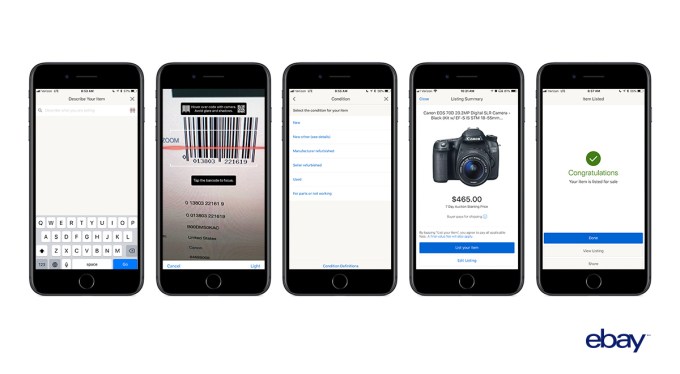
Ebay is rolling out an app update designed to make it easier to list items for sale on its online marketplace. Instead of filling out detailed forms on your mobile phone’s small screen, you can now scan the barcode on the item in question or type a description, choose the item’s condition, then click “list your item” to make the listing go live on eBay’s site.

After scanning or entering the description, eBay’s app will do a one-to-one match to its catalog to help to fill in the necessary information for that product. It will also offer sellers a pre-populated stock photo, eBay’s price recommendation and its shipping recommendations,

The change is meant to reduce to a matter of seconds the number of steps it takes to list. And if the process is less cumbersome, eBay hopes more people will choose to sell on eBay as opposed to the growing number of resale apps like OfferUp or LetGo, which are currently ranking higher than eBay on Apple’s App Store.

Facebook’s Marketplace has also likely had some impact on eBay’s sales, especially in terms of local sales.

Despite the increased competition, eBay is still seeing more than 13.4 million listings added to its site every week from the eBay mobile app alone.

The app’s newfound ability to quickly list the item uses technology like structured data and predictive analytics to pre-populate listings with the information required, instead of relying on sellers to type it in themselves.

This use of technology is something the company believes is a competitive advantage over newcomers to the space, in addition to its ability to provide access to millions of shoppers around the world.

“At eBay, we’re dedicated to delivering a seamless and efficient selling experience for both first-time and seasoned sellers alike,” says Kelly Vincent, eBay’s VP of Consumer Selling Product & Engineering, in a statement about the app’s revamp.

“This latest update continues to leverage eBay’s structured data, which helps catalogue the 1.1+ billion items on the platform, to instantaneously populate product details, pricing and shipping information in the listing flow. Not only does the catalogue facilitate a superior listing experience, it enables buyers to easily find the great deals offered by our sellers,” she added.

Vincent also noted that eBay’s use of structured data and other new technology will make its way to other products and features this year, but didn’t say what those may be. However, the focus for now seems to be enabling sellers.

Ebay’s updated app with the barcode scanning feature for listings is rolling out now on both iOS and Android.

Crypto-collectibles and Kitties marketplace Rare Bits raises $6M

Rare Bits wants to be eBay for the blockchain, where you buy, sell, and trade non-fungible crypto-goods. After CryptoKitties raised $12 million from Andreessen Horowitz last month for its digital collectibles game, there’s been an explosion of interest in the space. But without a popular marketplace, it’s hard to find the goods you want at the right price. Now a team of former Zynga staffers is building out its crypto-collectible auction and commerce site with a $6 million round led by Nabeel Hyatt at Spark Capital, and joined by First Round Capital, David Sacks’ Craft Ventures, and SVAngel.

“Because of the Ethereum ledger, for the first time, users can truly own their digital items” says co-founder Amitt Mahajan. “Previously in mobile or social games, virtual items earned through play or by spending money were actually owned by the company operating the game. If they shut down their servers, the items would go away and users would be out of luck. We believe this new asset class represents a paradigm shift in digital property whereby centralized assets will be moved onto decentralized systems” For now, Rare Bits isn’t slapping any extra fees on its marketplace, compared to paying 1 percent to 4 percent on other marketplaces like Open Sea and Wyvern Exchange. Instead, if a crypto-item developer charges a fee on secondary sales, say 5 percent, they’ll split that with Rare Bits for arranging the transaction.

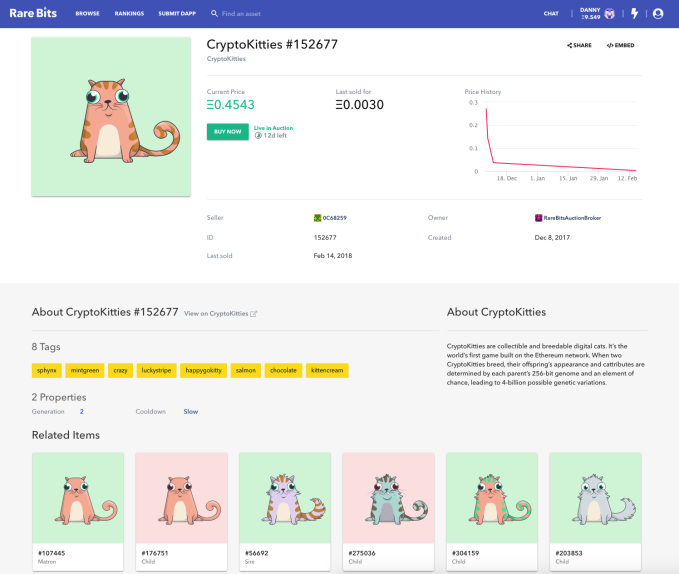
Users get the benefit of having all their crypto-collectibles in a single wallet. They can see historical pricing before they buy anything thanks to the transparency of the Ethereum ledger, whether they want to “Buy Now” or win an auction. They collectors can also see related items rather than transacting in a vacuum.

Rare Bits founders from left: Danny Lee, Payom Dousti, Dave Pekar, and Amitt Mahajan.

Mahajan, Danny Le, and Dave Pekar all met after selling their gaming startups to Zynga. [Disclosure: I know Pekar from college] Their fourth co-founder Payom Dousti worked at crypto VC fund 1/0 Capital and sold his sports analytics startup numberFire to FanDuel. With experience across the gaming, virtual good, and crypto space, Mahajan tells me “We thought long and hard about potentially building blockchain-based games ourselves but ultimately decided that there was a larger opportunity in focusing on crypto-based property as a whole.” The Rare Bits exchange launched in February and did over $100,000 in transactions in its first month.

With some CryptoKitties selling elsewhere for as much as $200,000, investors liked the idea of taking a cut of everyone’s transactions rather than just launching another digital trading card. That led Rare Bits to raise a $1 million seed from Macro Ventures and angels like Steve Jang and Robin Chan. As scaling issues threaten to prevent the Bitcoin and Ethereum blockchains from supporting micropayments and mainstream commerce, new use cases like crypto-collectibles are taking the spotlight.

Now with the $6 million Series A, Rare Bits is bringing in some heavyweight angels from the world of gaming. That includes Emmet Shear and Justin Kan, the co-founders of Twitch. Former Dropbox execs and married couple Ruchi Sanghvi and Aditya Agrawal are also in the round, alongside Greenoaks Captial MD Neil Mehta and Channel Factory CEO Tony Chen.

The team hopes the runway will help it secure partnerships with developers and creatives to publish new collectibles for the blockchain that have a home on Rare Bits. “While today most of these items are items from games and collectibles, we envision that we will see licenses, tickets, rights, even tokenized physical goods represented as digital assets” Mahajan tells us.

Rare Bits will have to deal with the inherent scaling troubles of the Ethereum blockchain it operates on. For now, it’s refunding users the “gas” it costs to execute purchases and sales on its marketplace in a timely manner. Thos range from a few cents to a few dollars depending on network congestion. But Rare Bits could be looking at a steep bill or be forced to push those fees onto users if it gets popular enough.

There’s always the danger that CryptoKitties and the like are just the new Beanie Babies — valued today, but worthless when the fad dies. Rare Bits benefits from getting to follow the trend to whatever crypto-collectible is in vogue, and just has to hope the whole concept doesn’t fade.

“Our ultimate goal is to convince millions of new people to begin owning and transacting crypto-based property” says Mahajan. But the founders will probably be okay regardless. “Like anyone crazy enough to start a crypto app company this early, we started buying and HODLing BTC and ETH years ago.”


from Social – TechCrunch https://ift.tt/2J7Lh0U Crypto-collectibles and Kitties marketplace Rare Bits raises $6M Josh Constine https://ift.tt/2qHekRo
via IFTTT

Crypto-collectibles and Kitties marketplace Rare Bits raises $6M

Rare Bits wants to be eBay for the blockchain, where you buy, sell, and trade non-fungible crypto-goods. After CryptoKitties raised $12 million from Andreessen Horowitz last month for its digital collectibles game, there’s been an explosion of interest in the space. But without a popular marketplace, it’s hard to find the goods you want at the right price. Now a team of former Zynga staffers is building out its crypto-collectible auction and commerce site with a $6 million round led by Nabeel Hyatt at Spark Capital, and joined by First Rount Capital, David Sacks’ Craft Ventures, and SVAngel.

“Because of the Ethereum ledger, for the first time, users can truly own their digital items” says co-founder Amitt Mahajan. “Previously in mobile or social games, virtual items earned through play or by spending money were actually owned by the company operating the game. If they shut down their servers, the items would go away and users would be out of luck. We believe this new asset class represents a paradigm shift in digital property whereby centralized assets will be moved onto decentralized systems” For now, Rare Bits isn’t slapping any extra fees on its marketplace, compared to paying 1 percent to 4 percent on other marketplaces like Open Sea and Wyvern Exchange. Instead, if a crypto-item developer charges a fee on secondary sales, say 5 percent, they’ll split that with Rare Bits for arranging the transaction.

Users get the benefit of having all their crypto-collectibles in a single wallet. They can see historical pricing before they buy anything thanks to the transparency of the Ethereum ledger, whether they want to “Buy Now” or win an auction. They collectors can also see related items rather than transacting in a vacuum.

Rare Bits founders from left: Danny Lee, Payom Dousti, Dave Pekar, and Amitt Mahajan.

Mahajan, Danny Le, and Dave Pekar all met after selling their gaming startups to Zynga. [Disclosure: I know Pekar from college] Their fourth co-founder Payom Dousti worked at crypto VC fund 1/0 Capital and sold his sports analytics startup numberFire to FanDuel. With experience across the gaming, virtual good, and crypto space, Mahajan tells me “We thought long and hard about potentially building blockchain-based games ourselves but ultimately decided that there was a larger opportunity in focusing on crypto-based property as a whole.” The Rare Bits exchange launched in February and did over $100,000 in transactions in its first month.

With some CryptoKitties selling elsewhere for as much as $200,000, investors liked the idea of taking a cut of everyone’s transactions rather than just launching another digital trading card. That led Rare Bits to raise a $1 million seed from Macro Ventures and angels like Steve Jang and Robin Chan. As scaling issues threaten to prevent the Bitcoin and Ethereum blockchains from supporting micropayments and mainstream commerce, new use cases like crypto-collectibles are taking the spotlight.


https://ift.tt/2J7Lh0U Crypto-collectibles and Kitties marketplace Rare Bits raises $6M https://ift.tt/2qHekRo

3D printing marketplace Shapeways raises a $30 million Series E

Investors, it seems, aren’t entirely soured on the world of 3D printing. The technology is still making progress in the enterprise sector, and Shapeways is certainly continuing to make a case for it in the world of online marketplaces. This morning, the New York-based company announced the closing of a $30 million Series E. 

The round, led by  Lux Capital, puts its total funding north of $100 million. That’s no small chunk of change, particularly as 3D printing has lost much of its luster in the consumer world over the past several years. But the company has been a bit of a quiet success in 3D printing, selling the technology as a service along with an Etsy-like online marketplace, rather than attempting to convince early adopters to spend $500-$1,000 on a desktop machine.

After a long search, the company appointed Gregory Kress its new CEO, back in February. At the time, he explained his vision of playing a stronger role in the world of hardware prototyping/startup incubation. “We can help them to market it and develop and sustain a small business,” said Kress. “I see Shapeways shifting from delivering one niche of that customer experience to truly helping our creators from almost a platform perspective and allowing us to become a one-stop shop.”

Now flush with extra cash, Shapeways is going to take that expansion further. “The capital will be used to accelerate company growth and launch additional services to support Shapeways’ overall vision to become the complete end-to-end platform helping creators ‘design, make, and sell,’ regardless of 3D modeling experience,” the company writes in a press release tied to the funding announcement.

That starts with the introduction of the new Design With Shapeways tool, which is designed to walk creators through the 3D printing process, starting with a 3D file, 2D drawing, or even just an idea. The new Spring & Wonder line, meanwhile, offers a hands-on approach to creating personalized jewelry through the service.


https://ift.tt/eA8V8J 3D printing marketplace Shapeways raises a $30 million Series E https://ift.tt/2HNtZ9V

MoviePass’s parent company is getting crushed after offering new stock

{rss:content:encoded} MoviePass’s parent company is getting crushed after offering new stock https://ift.tt/2HdNHPd https://ift.tt/2J7GL2n April 19, 2018 at 04:56PM

Helios and Matheson Analytics is looking to push additional capital into its prime and wildly popular asset, MoviePass, by raising money in a new stock sale that appears to be giving Wall Street fits.

Looking to raise additional capital, Helios and Matheson said it would sell up to $150 million in a stock sale that essentially seems geared to fund MoviePass’s expansion. Helios and Matheson is the largest shareholder of MoviePass, which is an increasingly popular service for going to watch movies. MoviePass’s parent company saw a sharp decline in its stock price today, with its value dropping around 40% as a result of the announcement.

“Helios and Matheson may use the net proceeds from this offering to increase the Company’s ownership stake in MoviePass or to support the operations of MoviePass and MoviePass Ventures; to satisfy a portion or all of any amounts payable in connection with previously issued convertible notes; and for general corporate purposes and transaction expenses,” the company said in the release. “The Company may also use the proceeds to make other acquisitions.”

Helios and Matheson recorded a net loss of around $150 million in 2017 (attributed to its acquisition of the majority stake in MoviePass). The company acquired a majority stake in MoviePass toward the end of last year. At the end of 2017, the company had around $25 million in cash and cash equivalents, according to their last annual report.

MoviePass allows users to spend around $10 per month to get one ticket to a movie every day, albeit with some strings attached. But it offers a way for theaters to fill seats and still acquire revenue from concessions and other products while allowing viewers to actually get in the door without paying a steep ticket price that might come with that movie.

mParticle hires Adobe’s John Sedlak as chief revenue officer

mParticle, which helps companies like Airbnb and Spotify manage their customer data, has hired four new executives — including John Sedlak, most recently a vice president at Adobe, who’s joining the company as chief revenue officer.

In addition, Kiran Hebbar (formerly CFO of Social Tables) is joining as chief financial officer, Will Rogers (previously an engineer at Etsy) has been named chief information security officer and Aurélie Pols (who worked as data governance and privacy advocate at Krux Digital) is the new data protection officer.

Sedlak told me that in his roles at Adobe and Oracle (which he joined through the acquisition of BlueKai), he saw how the big marketing software players are trying to build comprehensive marketing clouds, often created through multiple startup acquisitions.

“They would constantly go to market and tout the benefits of the end-to-end stack, when I began to notice that there were many best-of-breed point solutions out there,” he said. “I got to see the power of standalone companies who are innovating ahead of what the big guys were doing. I’d put mParticle on that list.”

In the years since I first wrote about mParticle in 2014, a handy acronym has emerged to describe what the company does — CDP, short for customer data platform. Basically, CDPs like mParticle allow companies to unify all their first party data, creating a single view of the customer.

Sedlak contrasted mParticle’s approach with older data management platforms, which he said weren’t built to connect customer data across all their interactions on different devices.

“They were originally built to ingest first party cookie data coupled with third party data,” he said. “They never fully contemplated the notion of a true cross-device world and I think [co-founders Michael Katz and Andrew Katz] knew that in 2013 and said, ‘You know we’re going to start solving for that now.'”

As for what hiring Sedlak will do for the company, he said one of his goals is to bring on even bigger customers: “I think mParticle can drive incremental or discrete value … to Fortune 50 marketers who I personally have done business with in the past, where I see an opportunity for us to significantly augment their current investments in the marketing cloud platforms.”

CEO Michael Katz, meanwhile, pointed out that that two of these hires are focused on security. With the recent Facebook scandals discussions and Europe’s adoption of GDPR protections, there’s “a really healthy conversation around the importance of data control and governance,” and he said these hires will help mParticle build the tools that allow businesses to “put customer privacy and data security at the forefront of their business practice.”


https://ift.tt/eA8V8J mParticle hires Adobe’s John Sedlak as chief revenue officer https://ift.tt/2qJ67wO

blogger better Headline Animator