l
l
blogger better. Powered by Blogger.

Search

Labels

blogger better

Followers

Blog Archive

Total Pageviews

Labels

Download

Blogroll

Featured 1

Curabitur et lectus vitae purus tincidunt laoreet sit amet ac ipsum. Proin tincidunt mattis nisi a scelerisque. Aliquam placerat dapibus eros non ullamcorper. Integer interdum ullamcorper venenatis. Pellentesque habitant morbi tristique senectus et netus et malesuada fames ac turpis egestas.

Featured 2

Curabitur et lectus vitae purus tincidunt laoreet sit amet ac ipsum. Proin tincidunt mattis nisi a scelerisque. Aliquam placerat dapibus eros non ullamcorper. Integer interdum ullamcorper venenatis. Pellentesque habitant morbi tristique senectus et netus et malesuada fames ac turpis egestas.

Featured 3

Curabitur et lectus vitae purus tincidunt laoreet sit amet ac ipsum. Proin tincidunt mattis nisi a scelerisque. Aliquam placerat dapibus eros non ullamcorper. Integer interdum ullamcorper venenatis. Pellentesque habitant morbi tristique senectus et netus et malesuada fames ac turpis egestas.

Featured 4

Curabitur et lectus vitae purus tincidunt laoreet sit amet ac ipsum. Proin tincidunt mattis nisi a scelerisque. Aliquam placerat dapibus eros non ullamcorper. Integer interdum ullamcorper venenatis. Pellentesque habitant morbi tristique senectus et netus et malesuada fames ac turpis egestas.

Featured 5

Curabitur et lectus vitae purus tincidunt laoreet sit amet ac ipsum. Proin tincidunt mattis nisi a scelerisque. Aliquam placerat dapibus eros non ullamcorper. Integer interdum ullamcorper venenatis. Pellentesque habitant morbi tristique senectus et netus et malesuada fames ac turpis egestas.

Thursday, May 24, 2018

Instapaper on pause in Europe to fix GDPR compliance “issue”

Remember Instapaper? The Pinterest-owned, read-it-later bookmarking service is taking a break in Europe — apparently while it works on achieving compliance with the region’s updated privacy framework, GDPR, which will start being applied from tomorrow.

Instapaper’s notification does not say how long the self-imposed outage will last.

The European Union’s General Data Protection Regulation updates the bloc’s privacy framework, most notably by bringing in supersized fines for data violations, which in the most serious cases can scale up to 4% of a company’s global annual turnover.

So it significantly ramps up the risk of, for example, having sloppy security, or consent flows that aren’t clear and specific enough (if indeed consent is the legal basis you’re relying on for processing people’s personal information).

That said, EU regulators are clearly going to tread softly on the enforcement front in the short term. And any major fines are only going to hit the most serious violations and violators — and only down the line when data protection authorities have received complaints and conducted thorough investigations.

So it’s not clear exactly why Instapaper believes it needs to pause its service to European users. It’s also had plenty of time to prepare to be compliant — given the new framework was agreed at the back end of 2015. We’ve reached out to Pinterest with questions and will update this story with any response.

In an exchange on Twitter, Pinterest product engineering manager Brian Donohue — who, prior to acquisition was Instapaper’s CEO — flagged that the product’s privacy policy “hasn’t been changed in several years”. But he declined to specify exactly what it feels its compliance issue is — saying only: “We’re actively working to resolve the issue.”

In a customer support email that we reviewed, the company also told one European user: “We’ve been advised to undergo an assessment of the Instapaper service to determine what, if any, changes may be appropriate but to restrict access to IP addresses in the EU as the best course of action.”

“We’re really sorry for any inconvenience, and we are actively working on bringing the service back online for residents in Europe,” it added.

The product’s privacy policy is one of the clearer T&Cs we’ve seen. It also states that users can already access “all your personally identifiable information that we collect online and maintain”, as well as saying people can “correct factual errors in your personally identifiable information by changing or deleting the erroneous information” — which, assuming those statements are true, looks pretty good for complying with portions of GDPR that are intended to give consumers more control over their personal data.

Instapaper also already lets users delete their accounts. And if they do that it specifies that “all account information and saved page data is deleted from the Instapaper service immediately” (though it also cautions that “deleted data may persist in backups and logs until they are deleted”).

In terms of what Instapaper does with users’ data, its privacy policy claims it does not share the information “with outside parties except to the extent necessary to accomplish Instapaper’s functionality”.

But it’s also not explicitly clear from the policy whether or not it’s passing information to its parent company Pinterest, for example, so perhaps it feels it needs to add more detail there.

Another possibility is Instapaper is working on compliance with GDPR’s data portability requirement. Though the service has offered exports options for years. But perhaps it feels these need to be more comprehensive.

As is inevitable ahead of a major regulatory change there’s a good deal of confusion about what exactly must be done to comply with the new rules. And that’s perhaps the best explanation for what’s going on with Instapaper’s pause.

Though, again, there’s plenty of official and detailed guidance from data protection agencies to help.

Unfortunately it’s also true that there’s a lot of unofficial and dubious quality advice from a cottage industry of self-styled ‘GDPR consultants’ that have sprung up with the intention of profiting off of the uncertainty. So — as ever — do your due diligence when it comes to the ‘experts’ you choose.


from Social – TechCrunch https://ift.tt/eA8V8J Instapaper on pause in Europe to fix GDPR compliance “issue” Natasha Lomas https://ift.tt/2x3GRHc
via IFTTT

Klevio launches its smart intercom and app that lets you open doors remotely

Klevio, a smart home startup out of the U.K., is officially launching its first product: a smart intercom system that lets you control your front door lock via an iOS and Android app on your phone and remotely.

Dubbed “Klevio One,” the device is designed to be retrofitted to existing electric strike-enabled locks, and also interfaces with intercom systems found on the communal doors of apartment blocks. This, say its makers, means that it is better suited to flats than smart locks already on the market.

In a call with Klevio co-founder and CEO Aleš Špetič, he explained that the approach the London-based company has taken is different to smart locks that typically use a motor to turn the lock and require tearing out and replacing your existing lock. In contrast, if you already have an electric strike as part of your lock — which a lot of apartments do — the Klevio One can simply be wired to interface with it. If you don’t, a Klevio installer can fit one to your existing lock for you.

This major upside of this approach is that Klevio isn’t re-inventing the whole wheel, but taking years old, tried and tested electric strike technology, and simply adding smart connectivity to it.

It means the Klevio One works with multiple doors and there’s no need to modify the communal area of apartment buildings when installing it, since the device is located within an individual apartment. You can also still use your old physical keys as a backup, and the company says the use of Klevio won’t be obvious to anyone outside the building.

And as you’d expect, the Klevio system is cloud-connected so that you can control your lock remotely, and issue virtual and one-time use keys. It comes in a WiFi only version, and a subscription version with added 4G.

The startup’s back story is noteworthy, too. The Klevio’s original concept and eureka moment came at Onefinestay, the ‘upscale Airbnb’ acquired by Accor in 2016. After the exit, Onefinestay co-founder Demetrios Zoppos teamed up with CubeSensors’ Aleš Špetič and Marko Mrdjenovič to start the new company, including purchasing the needed patents from Onefinestay.

In addition, Onefinestay co-founder Greg Marsh is an investor in Klevio, alongside LocalGlobe’s partner Robin Klein (who I’m told has invested in a personal capacity). To date Klevio has raised £1.2 million in funding.

Meanwhile, Špetič tells me that prior to today’s wider launch — where it can be ordered via the Klevio website — the Klevio One has been piloted with 1,000 users across London.


https://ift.tt/eA8V8J Klevio launches its smart intercom and app that lets you open doors remotely https://ift.tt/2kkhqrD

Announcing the 15 companies competing in Startup Battlefield Europe

TechCrunch scoured all of Europe to find the most innovative and disruptive early-stage startups to launch at TechCrunch Startup Battlefield Europe 2018 at VivaTech. And today starting at 9:05 am CET on the TechCrunch homepage you can watch the pitches from the latest 15 Startup Battlefield companies. 

Each company will pitch for six minutes on the Pitch B stage at VivaTech, followed by a rigorous six-minute Q&A with esteemed judges from all over Europe. Five companies will be selected to pitch in the finals this evening at 6:15 pm on the VivaTech Main Stage in front of a fresh crop of judges.

Our teams come from a diverse set of industries and are using a range of technologies, from insurance tech to biotech, and from blockchain technology to the latest in bioluminescent capture. Some are first-time founders and others have already negotiated $60 million financing rounds and developed tokens with over a billion-dollar market cap. These founders are challenging industry norms, and replacing the status quo of today’s businesses with technologies that support circular economy, optimized IoT design, GDPR-compliant data innovation and so much more.

Many of the problems these startups attempt to solve are rooted in personal experiences: One entrepreneur is building an insole to help Parkinson’s patients, like her father, regain their ability to sense the ground beneath them. Another entrepreneur grew up in a port city watching the dysfunction of shipments and became fixated on making them more seamless. And there’s an entrepreneur participating who built a flight marketplace, realizing first-hand that hobby pilots’ empty seats were a market opportunity waiting to be unlocked.

Here are the 15 Startup Battlefield Europe companies and the order in which they will pitch:

Session 1 at 9:05 am CET: Statice, Anorak, Tapoly, Wakeo, BIMlosophy

Session 2 at 10:30 am CET: Glowee, Mapify, DROVA, Walk With Path, StatusToday

Session 3 at 12:00 pm CET: Wingly, Varanida, Solely Original Shoes, Wisebatt, IOV

Over the last two months, these 15 startups refined their business models, demos and messaging with TechCrunch’s Startup Battlefield team and editors. Today, it will culminate onstage as they share their business with the world and answer the judges’ questions about the viability of their businesses.

Battlefield alumni have raised more than $8.2 million with over 105 successful exits, so investors, get your checkbooks ready. One of these 15 startups will receive the TechCrunch Startup Battlefield Top European startup award along with €25,000 in equity-free money.

TechCrunch Editor-in-Chief Matthew Panzarino and I will kick off Startup Battlefield Europe at 9:05 am CET. You can find more information about Startup Battlefield Europe here.


https://ift.tt/eA8V8J Announcing the 15 companies competing in Startup Battlefield Europe https://ift.tt/2KN7IJO

Wednesday, May 23, 2018

It’s unconstitutional for Trump to block people on Twitter

A uniquely 21st-century constitutional question received a satisfying answer today from a federal judge: President Trump cannot block people on Twitter, as it constitutes a violation of their First Amendment rights. The court also ruled he must unblock all previously blocked users. “No government official is above the law,” the judge concluded.

The question was brought as part of a suit brought by the Knight First Amendment Institute, which alleged that the official Presidential Twitter feed amounts to a public forum, and that the government barring individuals from participating in it amounted to limiting their right to free speech.

After consideration, New York Southern District Judge Naomi Reice Buchwald determined that this is indeed that case:

We hold that portions of the @realDonaldTrump account — the “interactive space” where Twitter users may directly engage with the content of the President’s tweets — are properly analyzed under the “public forum” doctrines set forth by the Supreme Court, that such space is a designated public forum, and that the blocking of the plaintiffs based on their political speech constitutes viewpoint discrimination that violates the First Amendment.

The President’s side argued that Trump has his own rights, and that in this case the choice not to engage with certain people on Twitter is among them. These are both true, Judge Buchwald found, but that doesn’t mean blocking is okay.

There is nothing wrong with a government official exercising their First Amendment rights by ignoring someone. And indeed that is what the “mute” function on Twitter is equivalent to. No harm is done to either party by the President choosing not to respond, and so he is free to do so.

But to block someone both prevents that person from seeing tweets and from responding to them, preventing them from even accessing a public forum. As the decision puts it:

We reject the defendants’ contentions that the First Amendment does not apply in this case and that the President’s personal First Amendment interests supersede those of plaintiffs…

While we must recognize, and are sensitive to, the President’s personal First Amendment rights, he cannot exercise those rights in a way that infringes the corresponding First Amendment rights of those who have criticized him.

The court also examined the evidence and found that despite the Executive’s arguments that his Twitter accounts are, for various reasons, in part private and not subject to rules limiting government spaces, the President’s Twitter is definitively a public forum, meeting the criteria set out some time back by the Supreme Court.

At this point in time President Trump has by definition performed unconstitutional acts, but the court was not convinced that any serious legal remedy needs to be applied. And not because the Executive side of the case said it was monstrous of the Judicial to dare to tell it what to do:

While we find entirely unpersuasive the Government’s parade of horribles regarding the judicial interference in executive affairs presented by an injunction directing the President to comply with constitutional restrictions… declaratory relief is likely to achieve the same purpose.

By this the judge means that while the court would be legally in the clear if it issued an official order binding the Executive, but that there’s no reason to do so. Instead, merely declaring that the President is has violated the rules of the Constitution should be more than enough to compel his team to take the appropriate action.

Specifically, Trump and (it is implied but not stated specifically) all public officials are to unblock any blocked users on Twitter and never hit that block button again:

No government official is above the law and because all government officials are presumed to follow the law once the judiciary has said what the law is, we must assume that the President and Scavino will remedy the blocking we have held to be unconstitutional.

No timeline is set but it’s clear that the Executive is on warning. You can read the full decision here.

This also sets an interesting precedent as regarding other social networks, but the repercussions thereof are impossible to predict at this time. Legal scholars and political agents will almost certainly weigh in on the issue heavily over the coming weeks.


from Social – TechCrunch https://ift.tt/eA8V8J It’s unconstitutional for Trump to block people on Twitter Devin Coldewey https://ift.tt/2s88vwY
via IFTTT

Samsung adds ‘The Incredibles’ to its AR Emojis

{rss:content:encoded} Samsung adds ‘The Incredibles’ to its AR Emojis https://ift.tt/2khMicj https://ift.tt/2J0hUkW May 23, 2018 at 07:40PM

Samsung’s AR Emojis were met with a…lukewarm reception when they launched alongside the Galaxy S9. The augmented reality avatars were regarded as a me-too response to Apple’s Animojis — and more to the point, were downright creepy.

But at launch, the company brought one key element to the offering that Apple hasn’t: a content partnership. And not just any content partnership, mind. A Disney content partnership. So far, it’s rolled out the iconic likes of Mickey, Minnie and Donald, and now, just in time for the latest Pixar sequel, it’s offering up the cast of The Incredibles 2.

Starting today, Galaxy S9 and S9+ owners can download  Mr. Incredible, Elastigirl, Violet, Dash, Jack-Jack and new character Frozone, for all of their AR Emoji-related needs. So users can send a birthday greeting, reach out to a loved one or break up with an ex as their favorite super baby.

The new content pack is available directly through the camera software’s built-in AR Emoji mode. The tech uses in excess of 100 facial features to map the user’s movements.

Apple offers a $50 credit for some out-of-warranty iPhone battery purchases

{rss:content:encoded} Apple offers a $50 credit for some out-of-warranty iPhone battery purchases https://ift.tt/2GIh3ji https://ift.tt/2kiEiYB May 23, 2018 at 07:18PM

If you bought a battery replacement for an out-of-warranty iPhone last year, you may be eligible for a $50 credit from Apple. The company issued a new support page post this week, announcing the rebate policy, which applies to purchases made at authorized locations.

The move is part of on-going restitution in the wake of an admission that the company was throttling processing speeds on older model phones, in order to save on battery life. Late last year, Apple apologized for not informing users about the issue, promising to be more transparent in the future.

Soon after, the company began offering $29 battery replacements — a $50 discount on out-of-warranty battery replacements. This credit covers those who purchased a battery out-of-warranty any point in 2017, leading up to that new offer.

The company has promised to send an email to all eligible users with instructions on how to get the credit transferred to their account between now and July 27. Those who don’t get a notification, but still believe themselves to be eligible, can contact Apple directly between now and the end of the year.

Ring’s Jamie Siminoff and Clinc’s Jason Mars to join us at Disrupt SF

Disrupt SF is set to be the biggest tech conference that TechCrunch has ever hosted. So it only makes sense that we plan an agenda fit for the occasion.

That’s why we’re absolutely thrilled to announce that Ring’s Jamie Siminoff will join us on stage for a fireside chat and Jason Mars from Clinc will be demo-ing first-of-its-kind technology on the Disrupt SF stage.

Jamie Siminoff – Ring

Earlier this year, Ring became Amazon’s second largest acquisition ever, selling to the behemoth for a reported $1 billion.

But the story begins long ago, with Jamie Siminoff building a WiFi-connected video doorbell in his garage in 2011. Back then it was called DoorBot. Now, it’s called Ring, and it’s an essential piece of the overall evolution of e-commerce.

As giants like Amazon move to make purchasing and receiving goods as simple as ever, safe and reliable entry into the home becomes critical to the mission. Ring, which has made neighborhood safety and home security its main priority since inception, is a capable partner in that mission.

Of course, one doesn’t often build a successful company and sell for $1 billion on their first go. Prior to Ring, Siminoff founded PhoneTag, the world’s first voicemail-to-text company and Unsubscribe.com. Both of those companies were sold. Based on his founding portfolio alone, it’s clear that part of Siminoff’s success can be attributed to understanding what consumers need and executing on a solution.

Dr. Jason Mars – Clinc

AI has the potential to change everything, but there is a fundamental disconnect between what AI is capable of and how we interface with it. Clinc has tried to close that gap with its conversational AI, emulating human intelligence to interpret unstructured, unconstrained speech.

Clinc is currently targeting the financial market, letting users converse with their bank account using natural language without any pre-defined templates or hierarchical voice menus.

But there are far more applications for this kind of conversational tech. As voice interfaces like Alexa and Google Assistant pick up steam, there is clearly an opportunity to bring this kind of technology to all facets of our lives.

At Disrupt SF, Clinc’s founder and CEO Dr. Jason Mars plans to do just that, debuting other ways that Clinc’s conversational AI can be applied. Without ruining the surprise, let me just say that this is going to be a demo you won’t want to miss.

Tickets to Disrupt are available here.


https://ift.tt/eA8V8J Ring’s Jamie Siminoff and Clinc’s Jason Mars to join us at Disrupt SF https://ift.tt/2GJZW0K

Facebook launches new tools for Group admins, including free customer service

Facebook’s Groups are one of the social network’s most popular products, with more than 1.4 billion monthly users across tens of millions of active groups. Today, the company is rolling out a series of new features aimed at those who create and manage these groups, including customer support with answers and help provided by a real person, not a machine or automated responses. Admins are also getting a dedicated online education portal and more tools to manage their groups’ posts.

Unfortunately, the customer support service is not available to all groups at this time.

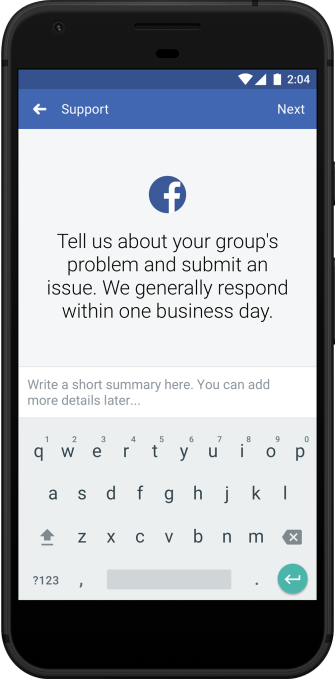
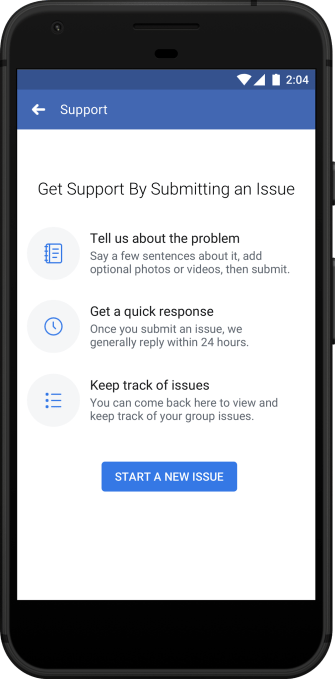
Facebook instead is beginning a pilot program for admin support that’s only available to a limited number of group admins on iOS and Android at this time, initially in English and Spanish.

“We spend a lot of time speaking with admins, and we listen to their feedback quite a lot,” explains Alex Deve, Product Management Director for Groups. “And the first thing we heard from them – very loud and clear – is that they want to be able to reach out to us and get a very quick response,” he says.

The free service will allow admins to send any issues they have to Facebook, and the company will respond within one business day. This is made possible by the additional hires the company made to expand its moderation team, as CEO Mark Zuckerberg had previously announced, Deve notes.

The idea with the admin support isn’t just about helping admins out directly – it’s also about figuring out what their needs are, what troubles they have, and what features they want. This will help Facebook roll out new features for admins that they’ll find useful, but it also ties into another new product being announced today: an online educational center for admins.

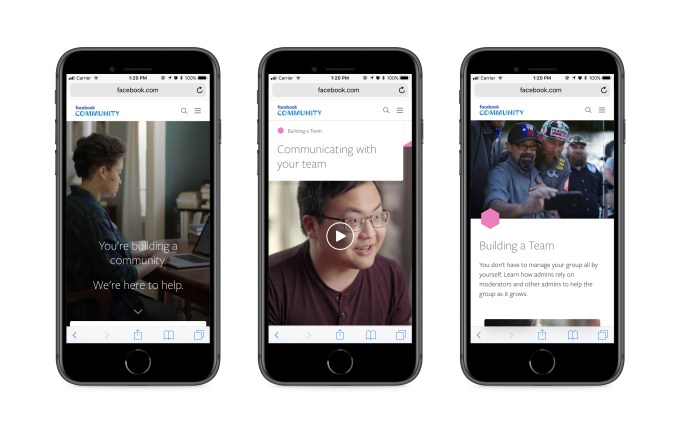
At facebook.com/community, Facebook has collected best practices, tutorials, product demos, and case studies based on the experiences and expertise from the admin community, and is sharing it with others in the form of audio and video content. There are tips on things like growing groups, setting the rules, building a team, using group tools, managing conflicts, and more.

“Going forward, the support work is going to feed into this. [Facebook will learn] what other themes are very common that people want to hear about from other admins. So we’ll create more videos in the future,” says Deve.

Additionally, Facebook is rolling out two new admins tools today, created in response to user feedback.

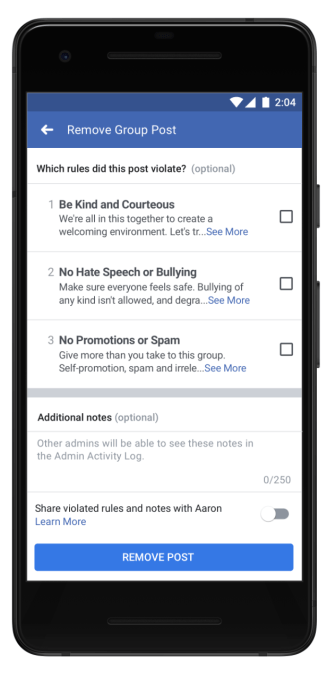
The first will allow admins and moderators to notify a member whose post gets pulled down which group rule they broke that caused its removal. They’ll also be able to collaborate with other admins and moderators by adding notes in an activity log when they remove a post.

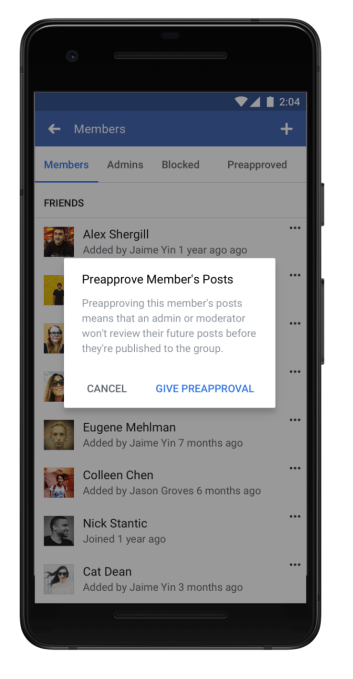
The other new feature, “pre-approved members,” will allow admins and moderators to select members whose content will automatically be approved whenever they post. This will save admins time by not having to moderate content from trusted people.

Groups have been a particular interest for Facebook in recent months, especially as the trend towards private networking and sharing continues to grow. At the company’s F8 Developer Conference in May, Facebook announced other features that will make Groups a more prominent part of the Facebook experience, as a result. This includes a new tab for Groups, where your groups are better organized and you can find others to join – similar to Facebook’s now-defunct standalone Groups app. And it introduced a new Groups plugin that admins could use on their websites or emails to solicit people to join their group.

All the new Groups features are rolling out starting today to about 20 percent of supported users, and will continue to roll out to the rest of the world in the weeks ahead. The online educational portal is live now in English, but will launch in Spanish in June.


from Social – TechCrunch https://ift.tt/2KOWjsU Facebook launches new tools for Group admins, including free customer service Sarah Perez https://ift.tt/2x5pIwW
via IFTTT

Vivo’s all-screen phone with a flip-up camera could arrive in June

{rss:content:encoded} Vivo’s all-screen phone with a flip-up camera could arrive in June https://ift.tt/2IJNcNG https://ift.tt/2GL197V May 23, 2018 at 06:12PM

The all-screen smartphone is an inevitability. The question at this point, really, is who will get there first and how they’ll accomplish that feat. I spoke to a LG rep at the G7 launch, who suggested that the notch is going to be fact of life for the next couple of years, but a number of manufacturers are pushing to get there a heck of a lot quicker.

Back at MWC in Febrary, Vivo’s Apex handset seemed like little more than a concept, but a couple of new teasers suggest otherwise. A new video demonstrates the handset’s flip-up selfie camera in action, along with a “Save the Date” notice for a June 12 event in Shanghai. The handset appears to be, at the very least, a close relative of the concept phone. 

A February press release highlights the concept in a bit more detail.

“In keeping with the promise to continuously support user habits,” the company notes, “Apex also features an 8MP Elevating Front Camera. The camera seamlessly rises in 0.8 seconds when it is required and retracts after use. Together with the hidden proximity sensor and ambient light sensor, this eliminates the space taken up by conventional front cameras, while offering the same selfie experience to users.”

Vivo’s just one of a number of companies who think they’ve got the answer here. When we met with Doogee back in February, the company showed off a number of prototypes aimed at circumventing the notch, including a similar pop up model and a version that slides to reveal a camera inside.

And then, of course, there’s the Lenovo Z5, which a VP for the company showed off via social media earlier this month. Though that presently seems to amount to little more than a sketch. For the moment, all of this feels like a bunch of companies showing off concepts aimed at demonstrating that they “thought of it first.”

Perhaps next month, however, Vivo will be ready to put its money where its mouth is.

Hugging Face raises $4 million for its artificial BFF

Chatbot startup Hugging Face has raised a $4 million seed round led by Ronny Conway from a_capital. Existing investors Betaworks, SV Angel and Kevin Durant are also participating.

I already reviewed Hugging Face so I won’t write the same thing again. But the startup has been building a chatbot app with a strong personality for bored teenagers. Instead of focusing on customer support or convenience, Hugging Face is focusing on emotions and entertainment.

It’s been available in the App Store as a standalone app and on Kik. Today, the company is also launching Hugging Face on Messenger. It should help bring new users.

Even without Messenger, Hugging Face now handles 1 million messages per day. In total, Hugging Face has received over 100 million messages.

It’s also worth noting that Hugging Face accepts text messages, photos, emojis, everything. So you can take a selfie, send a sad emoji, and the chatbot will know how you feel.

And it’s clear that Hugging Face is betting on surprise and enjoyment. The app doesn’t have to be perfect to be entertaining.

Beyond the consumer app, the team behind Hugging Face has written a couple of research papers about artificial intelligence. It’s clear that the startup plans on building a great team of engineers when it comes to natural language conversations. The team will double over the coming months.


https://ift.tt/eA8V8J Hugging Face raises $4 million for its artificial BFF https://ift.tt/2J2LXs1

Tempow raises $4 million to improve Bluetooth

French startup Tempow has raised a $4 million funding round. Balderton Capital led the round, with C4 Ventures also participating. The company has been working on improving the Bluetooth protocol to make it more versatile.

Smartphones, speakers and connected devices all use Bluetooth in one way or another. There are only a handful of Bluetooth chipset manufacturers in the world, such as Qualcomm and Broadcom. While Bluetooth chips have become incredibly efficient as they use much less power than they used to, it’s been stagnant on the software front.

Tempow is a software company that wants to rewrite the Bluetooth stack from scratch. The company started with an audio profile.

Thanks to Tempow’s technology, you can connect a phone to multiple Bluetooth speakers at once. This is just a software improvement — it works with standard Bluetooth chipsets and all Bluetooth audio devices out there.

Lenovo liked this idea and licensed the technology for its Moto X4 handset. More than 5 million devices with Tempow’s Bluetooth stack have been sold.

With today’s funding round, the startup wants to tackle more use cases. For instance, Tempow wants to optimize the pairing process, enhance the security of the protocol and work on battery consumption. “Maybe you could pay using Bluetooth instead of NFC,” co-founder and CEO Vincent Nallatamby told me.

At the same time, the startup is negotiating with multiple manufacturers. You can expect to see Tempow’s technology in more devices in the future.

The company currently has 7 patents pending and just got its first patent last week. Eventually, Tempow thinks it can build a team of Bluetooth experts who push the protocol forward.


https://ift.tt/eA8V8J Tempow raises $4 million to improve Bluetooth https://ift.tt/2s7w3lF

Platform.sh raises $34 million to simplify cloud deployment

French startup Platform.sh has raised a $34 million funding round. The company wants to help you manage your cloud infrastructure by handling the most tedious part of the job.

When you use Platform.sh for your application, the startup is going to handle testing and deployment to your cloud infrastructure. Every time you want to iterate and update your application to a new version, deployment is as easy as a git commit.

Partech is leading the round, with Idinvest Partners, Benhamou Global Ventures, SNCF Digital Ventures and existing investor Hi Inov also participating.

Platform.sh targets big clients. The company is currently working with 650 enterprise clients, such as Magento, Gap Inc. and The Financial Times. In 2018, revenue has more than doubled compared to the same period last year.

Platform.sh can create new instances and deploy clones of your web applications in less than 60 seconds. That’s how you can deploy with confidence and save time.

The idea is that Platform.sh helps you deploy 10 times or 20 times per day. Your users won’t see a difference as your website will remain available during the entire day.

Behind the scene, Platform.sh uses multiple cloud vendors for its infrastructure, including Amazon Web Services, Microsoft Azure and Orange Business Services.

Platform.sh isn’t the only continuous deployment solution out there. And many tech companies are going to build their own continuous deployment process on top of open source technologies.

But many companies don’t have a big tech team and can outsource this part of their infrastructure. If you’re building a media or e-commerce website, you might want to focus on other parts of your business. In that case, Platform.sh provides a one-stop shop for your cloud hosting needs.


https://ift.tt/eA8V8J Platform.sh raises $34 million to simplify cloud deployment https://ift.tt/2IZ8FRX

blogger better Headline Animator