l
l
blogger better. Powered by Blogger.

Search

Labels

blogger better

Followers

Blog Archive

Total Pageviews

Labels

Download

Blogroll

Featured 1

Curabitur et lectus vitae purus tincidunt laoreet sit amet ac ipsum. Proin tincidunt mattis nisi a scelerisque. Aliquam placerat dapibus eros non ullamcorper. Integer interdum ullamcorper venenatis. Pellentesque habitant morbi tristique senectus et netus et malesuada fames ac turpis egestas.

Featured 2

Curabitur et lectus vitae purus tincidunt laoreet sit amet ac ipsum. Proin tincidunt mattis nisi a scelerisque. Aliquam placerat dapibus eros non ullamcorper. Integer interdum ullamcorper venenatis. Pellentesque habitant morbi tristique senectus et netus et malesuada fames ac turpis egestas.

Featured 3

Curabitur et lectus vitae purus tincidunt laoreet sit amet ac ipsum. Proin tincidunt mattis nisi a scelerisque. Aliquam placerat dapibus eros non ullamcorper. Integer interdum ullamcorper venenatis. Pellentesque habitant morbi tristique senectus et netus et malesuada fames ac turpis egestas.

Featured 4

Curabitur et lectus vitae purus tincidunt laoreet sit amet ac ipsum. Proin tincidunt mattis nisi a scelerisque. Aliquam placerat dapibus eros non ullamcorper. Integer interdum ullamcorper venenatis. Pellentesque habitant morbi tristique senectus et netus et malesuada fames ac turpis egestas.

Featured 5

Curabitur et lectus vitae purus tincidunt laoreet sit amet ac ipsum. Proin tincidunt mattis nisi a scelerisque. Aliquam placerat dapibus eros non ullamcorper. Integer interdum ullamcorper venenatis. Pellentesque habitant morbi tristique senectus et netus et malesuada fames ac turpis egestas.

Thursday, September 20, 2018

Cluep, a Canadian startup that raised just $500k, acquired for $40M

Everyone loves a tale of a bootstrapped startup founder’s journey to an eight-figure exit.

The team at Toronto-based Cluep have a good one.

The founders of the adtech startup raised less than $500,000 from angel investors before selling their company to Impact Group for $40 million ($53 milllion CAD) this week.

Founded in 2012, Karan Walia, Sobi Walia and Anton Mamonov were just 21, 17 and 16 years old, respectively, when they started the digital advertising platform, which uses artificial intelligence to help brands connect and engage with people based on what they are sharing, how they are feeling and the places they’ve been.

They, being teenagers, struggled initially to get the company off the ground. At one point, the trio hacked into computers at a university in Toronto to train the neural networks on large amounts of data sets because they didn’t have enough money to buy their own tech. On a shoe-string budget, they would split meals at Popeyes to get by.

“No one wanted to give us money at that time so we had to live off of my student loans,” Walia told TechCrunch. “We did pretty much everything, whether it was programming and building the product, or going out and selling. I was our first sales rep and I was pretty bad early on but I learned.”

Ultimately, Cluep was able to raise enough from angels to pay themselves a salary, hire a few engineers and sales representatives, and move into an actual office. From that point, their revenue began growing significantly YoY.

  • 2015: $2 million CAD in revenue
  • 2016: $6 million CAD in revenue
  • 2017: $14.5 million CAD in revenue
  • 2018: On track to bring in ~$30 million CAD

They fielded offers from VCs toward the end of 2015 and considered raising a proper Series A round of capital, but ultimately decided staying independent would lead to the best exit.

“This way allowed us to basically maintain control and exit on our terms,” Walia said.

Impact Group, a Boise, Idaho-based grocery sales and marketing agency, will operate Cluep independently.


https://ift.tt/eA8V8J Cluep, a Canadian startup that raised just $500k, acquired for $40M https://ift.tt/2ODmp4g

Meet the startups in the latest Alchemist class

Alchemist is the Valley’s premiere enterprise accelerator and every season they feature a group of promising startups. They are also trying something new this year: they’re putting a reserve button next to each company, allowing angels to express their interest in investing immediately. It’s a clever addition to the demo day model.

You can watch the livestream at 3pm PST here.

Videoflow – Videoflow allows broadcasters to personalize live TV. The founding team is a duo of brothers — one from the creative side of TV as a designer, the other a computer scientist. Their SaaS product delivers personalized and targeted content on top of live video streams to viewers. Completely bootstrapped to date, they’ve landed NBC, ABC, and CBS Sports as paying customers and appear to be growing fast, having booked over $300k in revenue this year.

Redbird Health Tech – Redbird is a lab-in-a-box for convenient health monitoring in emerging market pharmacies, starting with Africa. Africa has the fastest growing middle class in the world — but also the fastest growing rate of diabetes (double North America’s). Redbird supplies local pharmacies with software and rapid tests to transform them into health monitoring points – for anything from blood sugar to malaria to cholesterol. The founding team includes a Princeton Chemical Engineer, 2 Peace Corps alums, and a Pharmacist from Ghana’s top engineering school. They have 20 customers, and are growing 36% week over week.

ShuttleShuttle is getting a head start on the future of space travel by building a commercial spaceflight booking platform. Space tourism may be coming sooner than you think. Shuttle wants to democratize access to the heavens above. Founded by a Stanford Computer Science alum active in Stanford’s Student Space Society, Shuttle has partnerships with the leading spaceflight operators, including Virgin Galactic, Space Adventures, and Zero-G. Tickets to space today will set you back a cool $250K, but Shuttle believes that prices will drop exponentially as reusable rockets and landing pads become pervasive. They have $1.6m in reservations and growing.

Birdnest – Threading the needle between communal and private, Birdnest is the Goldilocks of office space for startups. Communal coworking spaces are accessible but have too many distractions. Traditional office spaces are private but inflexible on their terms. Birdnest brings the best of each without the drawbacks: finding, leasing, and operating a network of underutilized spaces inside of private offices. The cofounders, a duo of Duke and Kellogg MBA grads, are at $300K ARR with a fast-growing 50+ client waitlist.

Tag.bio – Tag.bio wants to make data science actionable in healthtech. The founding team is comprised of a former Ayasdi bioinformatician and a former Honda Racing engineer with a Stanford MBA. They’ve developed a next-generation data science platform that makes it easy and fast to build data apps for end users, or as they say, “WordPress for data science.” The result they claim is lightning-fast analysis apps that can be run by end users, dramatically accelerating insight discovery. They count the UCSF Medical Center and a “large Swiss pharma company” as early customers.

nCorium – They’ve built a new server architecture to handle the onslaught of AI to come with what they claim is the world’s first AI accelerator on memory to deliver 30x greater performance than the status quo. The quad founding team is intimidatingly technical — including a UCSD Professor, and former engineers from Qualcomm and Intel with 40 patents among them. They have $300K in pilots.

Spiio – Software eats landscaping with Spiio, which combines cloud-driven AI with physical sensors to monitor watering and landscaping for big companies. Their smart system knows when to water and when not to. This reduces water consumption by 50%, which means their system pays for itself in less than 30 days for big companies. They want to connect every plant to the internet, and look like they are off to a good start — $100K in orders from brand name Valley tech firms, and they are doubling monthly.

Element42 – Fraud is a major problem — For example, if you buy a Rolex on eBay, you run the risk of winding up with a counterfeit. Started by ex-VPs from Citibank, the founders are using risk models and technologies that banks use to help brands combat fraud and counterfeiting. Designed with token economics, they also incentivize customers to buy genuine products by serving exclusive content and promotions only to genuine product holders. Built on blockchain at the core, they claim to be the world’s first peer-to-peer authentication platform for physical assets. They have 45 customers across two industry verticals, 800K in ARR and are a member of World Economic Forum’s global initiatives against corruption.

My90 – Distrust between the public and the police has rarely been more strained than it is today. My90 wants to solve that by collecting data about interactions between the police and the public—think traffic stops, service calls, etc.—and turn these into actionable intelligence via an online analytics dashboard. Users text My90 anonymously about their interactions, and My90’s dashboard analyzes the results using natural language processing. Customers include major city police departments like the San Jose Police Department and the world’s largest community policing program. They have booked $150K in pilots and are expanding aggressively across the US.

Nunetz – A Stanford Computer Science grad and UCSF Neurosurgeon have come together to try to build a single unifying interface to replace the deluge of monitors and data sources in today’s clinical health environment. The goal is to prepare a daily “battle map” for physicians, nurses, and other providers, with an initial focus on the Intensive Care Unit (ICU). They have closed 3 paid pilots with hospitals through grants.

When Labs – If you hate managing people, When Labs wants to unburden you. Using an AI-powered assistant that texts with employees to negotiate assignments for hourly work, WhenLabs is trying to free customers like Hilton from spending money on managers who would normally do this manually. As the system gets smarter, they claim employees will prefer interfacing with their AI bot more than a human. AI and HR is a crowded space, but this might be the team to separate from the pack: the founding team’s previous company had a 9 figure exit to IBM.

FirstCut – FirstCut helps businesses put video content out at scale. Video dominates social media — it creates 10x more comments than text — and is emerging as a necessity for B2B media. But putting video out if you are a B2B marketer normally requires using agencies that charge hefty fees. FirstCut wants to disrupt the agencies with software and marketplaces. They use software automation and an on-demand talent marketplace to offer a fixed price product for video content. They are at $180k revenue, and most of it is moving to recurring subscriptions.

LynxCare – LynxCare claims that 90% of healthcare data goes untapped when doctors make critical decisions about your life. Further, they claim the average person’s life could be extended by 4 years if that data can be converted into insights. Their team of clinicians and data scientists aims to do just that — building a data platform that aggregates disparate data sets and drive insight for better clinical outcomes. And it looks like their platform has fans: they are active in 9 hospitals, count Pharma companies like Pfizer as Partners, and grew 4x over the past year and now are at $800K ARR.

ADIAN – Adian is a B2B SaaS product that digitizes the complex agrochemical supply chain in order to improve the sales process between manufacturers and distributors. The company claims manufacturers reduce costs by 20% and increase sales by 4% by using their online framework. $1.5 Billion and 70,000 orders have gone through the platform to date.

Hardin Scientific – Hardin is building IoT-enabled, Smart Lab Equipment. The hardware becomes a gateway to become the hub for monitoring, controlling, and sharing scientific data across teams. They’ve closed over $1.5m in revenue, and raised $15m in equity and debt financing. One of their smart devices is being used to 3D print bio-tissues and human organs in space.

ZaiNar – This team of 5 Stanford grads — 3 PhD’s and 2 MBAs — joined up with the Co-Founder of BlueKai to build the world’s best time synchronization technology. ZaiNar claims their ability to wirelessly synchronize and distribute time between networked devices is a thousand times better than existing technologies. This enables them to locate RF-emitting devices (i.e. phones, cars, drones, & RFID) at long distances with sub-meter accuracy. Beyond location, this technology has applications across data transmission, 5G communications, and energy grids. ZaiNar has raised a $1.7M seed from AME Cloud and Softbank, and has built an extensive patent portfolio.

SMART Brain Aging – This startup claims to reduce the onset of dementia by 2.25 years with software. They are the only company approved by Medicare to get reimbursed on a preventative basis for the treatment of dementia. In conjunction with Harvard University, they have developed 20,000 exercises that are clinically proven to reduce the onset of dementia and, they claim, help build neurotransmitters. The company works with 300 patients per week ($2.2m annual revenue) and is building to a goal of helping 22,000 people in 24 months.

Phoneic – Phoneic believes the data trapped in voice calls from cellphones is a gold mine waiting to be unleashed. Their app records and transcribes cell phones conversations, and the company has built an integration layer to enterprise AI and CRM systems that traditionally didn’t have access to voice data. The team is led by the co-founder of 3jam, one of the first group SMS and virtual number companies, which was acquired by Skype in 2011. He is keenly aware of the power of virality — and like Skype, the use of Phoneic spreads its adoption. The company has already raised $800,000 in seed funding.

Arkose Labs – Whether or not you think Russia interfered with the 2016 election, it’s no secret that bots are having significant impact on society. Arkose Labs wants to fight fraud, without adding friction to legit users. Most fraud prevention platforms today focus on gathering info from the user and providing a probability score that the traffic is good or bad. This leaves companies with a difficult decision where they may be blocking revenue generating users. Arkose has a different approach, and uses a bilateral approach that doesn’t force this tradeoff. They claim to be the only solution to offer a 100% SLA on fraud prevention. Big companies like Singapore Airlines and Electronic Arts are customers. USVP led a $6m investment into the company.


https://ift.tt/eA8V8J Meet the startups in the latest Alchemist class https://ift.tt/2xD7pMv

Instagram may divide hashtags from captions to end overhashing

Geofenced sharing, Quiz stickers, Stories Highlight stickers, and a separate interface for adding hashtags to posts are amongst a slew of new features Instagram has prototyped or is now testing. The last one could finally #cure #the #hashtag #madness that’s infected many of Instagram’s 1 billion users, causing them desperately fill up their captions with tagged words that make the feed tough to read in hopes of scoring a few extra views or followers.

The pace of iteration at Instagram is staggering, and helping it to leave Snapchat in the dust. With Facebook’s deep pockets funding its product, design, and engineering teams, Instagram is able to keep its app full of fresh toys to play with. Here’s a look at three prototypes, one test, and one confirmed roll out from Instagram

Hashtag Selector

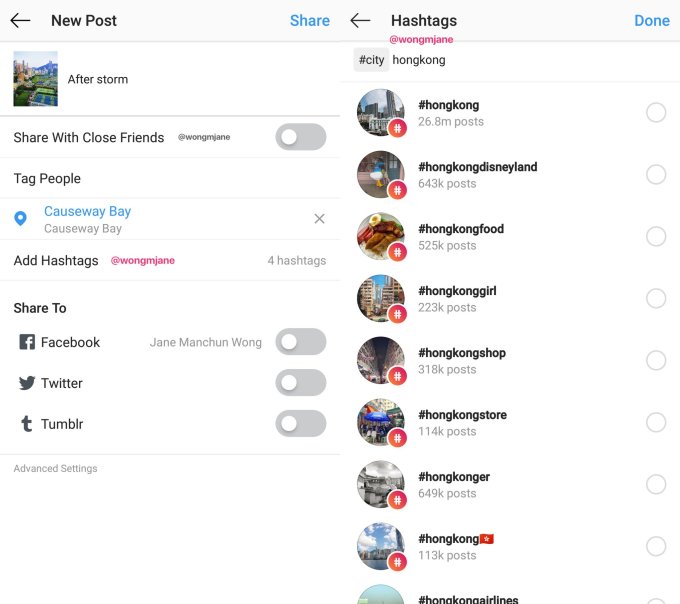
The feature isn’t released or even necessarily testing yet, and Instagram refused to comment on it. But frequent TechCrunch tipster and mobile researcher Jane Manchun Wong was able to dig the designated hashtag selector prototype out of the Instagram Android app’s code. It shows a dedicated “Add Hashtags” option underneath the caption composer and people tagger. Similar past discoveries by Wong have led to TechCrunch scoops about the eventual release of Instagram video calling, name tags, music stickers, and more, though there’s always a chance Instagram scraps this feature before it ever launches.

Disambiguating hashtags from captions could make adding them to posts less invasive and distracting, and thereby get more users doing it. That could in turn help Instagram tune its feed algorithm to show you more posts with hashtags you seem to care about, get more users following hashtags, allow it to better sort the Explore page with its new topic channels like Sports, Beauty, and Shopping. But perhaps most importantly, it could just make Instagram less annoying. Everyone has that friend that slaps on so many hashtags that their captions become an incoherent mess.

Geofenced Posts

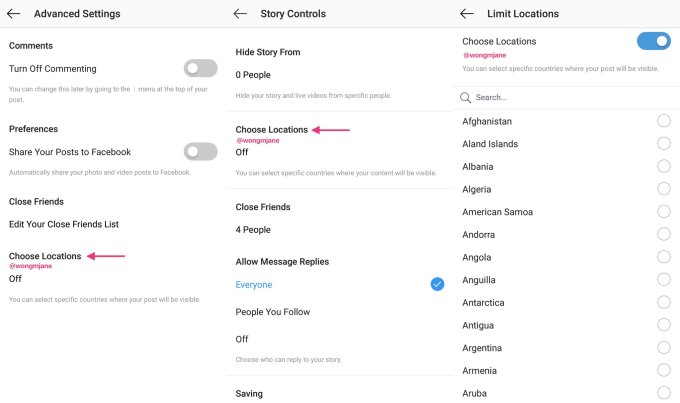
Wong also dug out a powerful new feature that could help social media managers, businesses, and pro creators reach the right audience. Instagram has prototyped a “Choose Locations” option for posts that lets you select from a list of countries where you want your post to be visible. Instagram declined to comment.

The geofencing feature might enable Instagrammers to design different content and captions for different countries and languages. Facebook has offered geofencing for posts for many years, and Instagram already offers ad targeting down to the zip code or mile radius. But if this location chooser launches for everyone’s posts, it could let people and professional accounts express their prismatic identity differently across the globe.

Stories Highlight Stickers

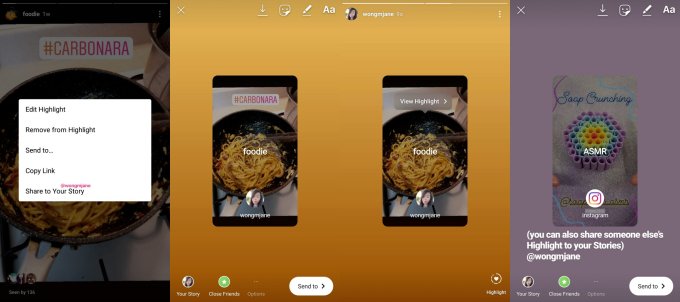
Instagram gave me a confirmation that this final find by Wong is officially in testing. It allows users to turn someone else’s Stories Highlight from their profile into a sticker to overlay on their own Story. It’s an extension of the Quote-tweet style feature Instagram started testing in March that lets you turn people’s public feed posts into Stories stickers so you can add your commentary — or dunk on someone dumb. Stories Highlight Stickers could create a new path to virality for start creators who could convince their followers to re-share their Highlights and turn their friends into fellow fans.

Quiz Stickers

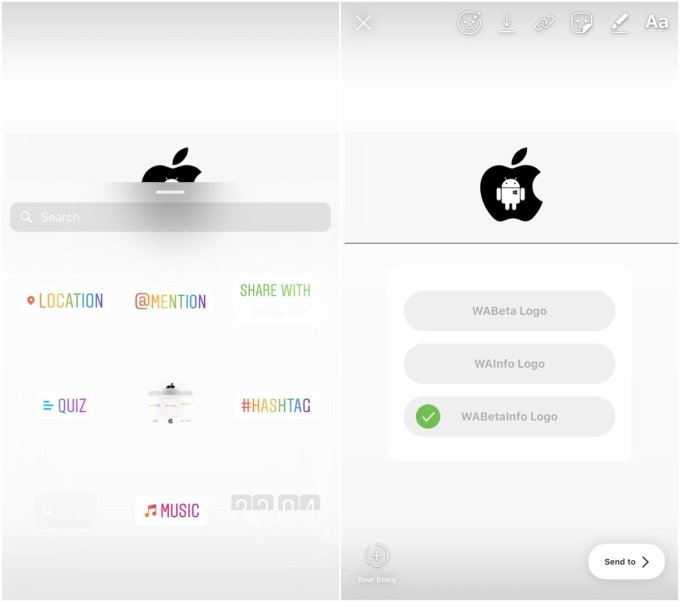
This prototype discovered by WABetaInfo‘s Twitter account allows users to ask a question in their Story and designate a correct answer. The Quiz sticker functions similarly to Instagram’s recently added Poll and Question stickers, but instead of tallying the results or letting you re-post someone’s answer, they’ll immediately see whether they guessed the right answer to your test. This ties into Instagram’s strategy to crush Snapchat by making its own Stories more interactive and turning the connection between fans and followers into a two-way street.

Video Tagging

Instagram did confirm the launch of one new feature, tagging people in videos. TechCrunch spotted thIS last week and Instagram said it was testing, but upon our inquiry told us that it’s now fully rolled out. Video tagging could generate extra visits for Instagram as few people have the willpower to ignore a notification that they were named in a new piece of content. The feature could also help Instagram figure out who to show the videos too by allowing it to place them high in the feed of the best friends of people tagged.

Combined, this flurry of new and potential features proves Instagram isn’t allowing its dominance to diminish its shipping schedule. It also demonstrates that Instagram VP of product Kevin Weil’s move to Facebook’s blockchain team his replacement by former News Feed VP Adam Mosseri hasn’t disrupted the app’s brisk pace of innovation.

The jury is still out about whether Instagram’s biggest new initiatives will take off. IGTV is off to a slow start, but will need time to build a long-form video archive to rival YouTube. And we’ll have to wait and see if users grow addicted to Instagram Explore’s new Shopping channel. But constantly updating the app takes pressure off of any one feature to carry the weight of a billion people’s eyes. Who wants to build a direct competitor to something evolving this fast?


from Social – TechCrunch https://ift.tt/2xxxCMu Instagram may divide hashtags from captions to end overhashing Josh Constine https://ift.tt/2Nu0uju
via IFTTT

Instagram may divide hashtags from captions to end overhashing

{rss:content:encoded} Instagram may divide hashtags from captions to end overhashing https://ift.tt/2Nu0uju https://ift.tt/2xxxCMu September 20, 2018 at 05:47PM

Geofenced sharing, Quiz stickers, Stories Highlight stickers, and a separate interface for adding hashtags to posts are amongst a slew of new features Instagram has prototyped or is now testing. The last one could finally #cure #the #hashtag #madness that’s infected many of Instagram’s 1 billion users, causing them desperately fill up their captions with tagged words that make the feed tough to read in hopes of scoring a few extra views or followers.

The pace of iteration at Instagram is staggering, and helping it to leave Snapchat in the dust. With Facebook’s deep pockets funding its product, design, and engineering teams, Instagram is able to keep its app full of fresh toys to play with. Here’s a look at three prototypes, one test, and one confirmed roll out from Instagram

Hashtag Selector

The feature isn’t released or even necessarily testing yet, and Instagram refused to comment on it. But frequent TechCrunch tipster and mobile researcher Jane Manchun Wong was able to dig the designated hashtag selector prototype out of the Instagram Android app’s code. It shows a dedicated “Add Hashtags” option underneath the caption composer and people tagger. Similar past discoveries by Wong have led to TechCrunch scoops about the eventual launch of Instagram video calling, name tags, music stickers, and more.

Disambiguating hashtags from captions could make adding them to posts less invasive and distracting, and thereby get more users doing it. That could in turn help Instagram tune its feed algorithm to show you more posts with hashtags you seem to care about, get more users following hashtags, allow it to better sort the Explore page with its new topic channels like Sports, Beauty, and Shopping. But perhaps most importantly, it could just make Instagram less annoying. Everyone has that friend that slaps on so many hashtags that their captions become an incoherent mess.

Geofenced Posts

Wong also dug out a powerful new feature that could help social media managers, businesses, and pro creators reach the right audience. Instagram has prototyped a “Choose Locations” option for posts that lets you select from a list of countries where you want your post to be visible. Instagram declined to comment.

The geofencing feature might enable Instagrammers to design different content and captions for different countries and languages. Facebook has offered geofencing for posts for many years, and Instagram already offers ad targeting down to the zip code or mile radius. But if this location chooser launches for everyone’s posts, it could let people and professional accounts express their prismatic identity differently across the globe.

Stories Highlight Stickers

Instagram gave me a confirmation that this final find by Wong is officially in testing. It allows users to turn someone else’s Stories Highlight from their profile into a sticker to overlay on their own Story. It’s an extension of the Quote-tweet style feature Instagram started testing in March that lets you turn people’s public feed posts into Stories stickers so you can add your commentary — or dunk on someone dumb. Stories Highlight Stickers could create a new path to virality for start creators who could convince their followers to re-share their Highlights and turn their friends into fellow fans.

Quiz Stickers

This prototype discovered by WABetaInfo‘s Twitter account allows users to ask a question in their Story and designate a correct answer. The Quiz sticker functions similarly to Instagram’s recently added Poll and Question stickers, but instead of tallying the results or letting you re-post someone’s answer, they’ll immediately see whether they guessed the right answer to your test. This ties into Instagram’s strategy to crush Snapchat by making its own Stories more interactive and turning the connection between fans and followers into a two-way street.

Video Tagging

Instagram did confirm the launch of one new feature, tagging people in videos. TechCrunch spotted thIS last week and Instagram said it was testing, but upon our inquiry told us that it’s now fully rolled out. Video tagging could generate extra visits for Instagram as few people have the willpower to ignore a notification that they were named in a new piece of content. The feature could also help Instagram figure out who to show the videos too by allowing it to place them high in the feed of the best friends of people tagged.

Combined, this flurry of new and potential features proves Instagram isn’t allowing its dominance to diminish its shipping schedule. It also demonstrates that Instagram VP of product Kevin Weil’s move to Facebook’s blockchain team his replacement by former News Feed VP Adam Mosseri hasn’t disrupted the app’s brisk pace of innovation.

The jury is still out about whether Instagram’s biggest new initiatives will take off. IGTV is off to a slow start, but will need time to build a long-form video archive to rival YouTube. And we’ll have to wait and see if users grow addicted to Instagram Explore’s new Shopping channel. But constantly updating the app takes pressure off of any one feature to carry the weight of a billion people’s eyes. Who wants to build a direct competitor to something evolving this fast?

Bird hits 10 million scooter rides

Bird just announced 10 million scooter rides since launching about one year ago. If this story sounds familiar to you, it’s probably because Bird competitor Lime earlier today announced it surpassed 11.5 million rides across its shared bikes and scooters.

Bird, which launched last September in Santa Monica, Calif., currently operates in 100 cities and has over two million unique riders, Bird founder and CEO Travis VanderZanden told TechCrunch. But Bird’s first year of operations has been full of ups and downs.

Many of the downs have been around regulatory issues. Bird faced, and overcame them, in Santa Monica but failed in San Francisco.

“I think anytime you’re doing something new that the cities haven’t contemplated before, there always seems to be gray area on where you fit in in the regulatory environment,” VanderZanden said. “Cities hadn’t thought about electric scooters and electric scooter sharing. We collaborated very closely with the cities we’re in now.”

Although San Francisco did not grant an operating permit to Bird — the city gave them to Scoot and Skip — VanderZanden stressed that “San Francisco is one city. We’re in 100 cities.”

He also said Bird is not looking to appeal the decision in San Francisco. Lime, however, is in engaging in the appeals process.

As Bird enters its second year of operations, the name of the game is to double down on its efforts with cities and building out its government tech platform. Bird is also looking into manufacturing its own scooters to provide more durability to its customers and differentiate itself from other scooters on the market.

“We’ve been investing heavily in that area,” VanderZanden said. “You’ll start to see new vehicles coming from us soon.”

He added, “we want to keep building vehicles that are more ruggedized but also vehicles that have new features for the riders as well.”

And Bird definitely has the funds to do that. To date, Bird has raised $415 million in funding for shared electric scooters.


https://ift.tt/eA8V8J Bird hits 10 million scooter rides https://ift.tt/2OFAmij

MariaDB acquires Clusterix

MariaDB, the company behind the eponymous MySQL drop-in replacement database, today announced that it has acquired Clusterix, which itself is a MySQL drop-in replacement database, but with a focus on scalability. MariaDB will integrate Clusterix’s technology into its own database, which will allow it to offer its users a more scalable database service in the long run.

That by itself would be an interesting development for the popular open source database company. But there’s another angle to this story, too. In addition to the acquisition, MariaDB also today announced that cloud computing company ServiceNow is investing in MariaDB, an investment that helped it get to today’s acquisition. ServiceNow doesn’t typically make investments, though it has made a few acquisitions. It is a very large MariaDB user, though, and it’s exactly the kind of customer that will benefit from the Clusterix acquisition.

MariaDB CEO Michael Howard tells me that ServiceNow current supports about 80,000 instances of MariaDB. With this investment (which is actually an add-on to MariaDB’s 2017 Series C round), ServiceNow’s SVP of Development and Operations Pat Casey will join MariaDB’s board.

Why would MariaDB acquire a company like Clusterix, though? When I asked Howard about the motivation, he noted that he’s now seeing more companies like ServiceNow that are looking at a more scalable way to run MariaDB. Howard noted that it would take years to build a new database engine from the ground up.

“You can hire a lot of smart people individually, but not necessarily have that experience built into their profile,” he said. “So that was important and then to have a jumpstart in relation to this market opportunity — this mandate from our market. It typically takes about nine years, to get a brand new, thorough database technology off the ground. It’s not like a SaaS application where you can get a front-end going in about a year or so.

Howard also stressed that the fact that the teams at Clusterix and MariaDB share the same vocabulary, given that they both work on similar problems and aim to be compatible with MySQL, made this a good fit.

While integrating the Clusterix database technology into MariaDB won’t be trivial, Howard stressed that the database was always built to accommodate external database storage engines. MariaDB will have to make some changes to its APIs to be ready for the clustering features of Clusterix. “It’s not going to be a 1-2-3 effort,” he said. “It’s going to be a heavy-duty effort for us to do this right. But everyone on the team wants to do it because it’s good for the company and our customers.

MariaDB did not disclose the price of the acquisition. Since it was founded in 2006, though, the Y Combinator-incubated Clusterix had raised just under $72 million, though. MariaDB has raised just under $100 million so far, so it’s probably a fair guess that Clusterix didn’t necessarily sell for a large multiple of that.


https://ift.tt/eA8V8J MariaDB acquires Clusterix https://ift.tt/2MODt5v

Facebook and Airbnb told to change their ToS to fix EU consumer rights issues by year’s end

Facebook has been singled out for censure by the European Commission’s head of consumer affairs who has warned she’s running out of patience and said the company needs to make additional changes to its terms of service before the end of the year to bring them into line with the bloc’s consumer rules.

The Commission also said today that Airbnb has agreed to make additional changes to its ToS by December.

The EU’s executive body has been sounding off about tech and social media platforms’ terms of service impinging on citizens’ consumer rights for almost two years.

In February it warned a raft of companies they needed to do more to respect consumer rights. In July the Commission joined with EU consumer authorities to push Airbnb to make changes.

At the same time the Commission is pushing for an update to modernise EU consumer rules — and is hoping to get the backing of the European Parliament and member states, via the European Council, which is needed to reform EU law.

“I have respect for the work of national consumer authorities but sometimes the powers they have on national level are not sufficient for companies to co-operate efficient with them,” tweeted commissioner Vera Jourova today. “Hence the #NewDealForConsumers we propose strengthening their power and having persuasive sanctions.”

Reuters reports that Twitter was also warned by the Commission today that it must make ToS changes to come into compliance with EU consumer law.

The EC’s public denouncement of tech giants inexorably has a strategic political dimension, as it seeks to garner attention for its reform cause and drum up support for reworking the rules.

Though it clearly also feels that social media giants haven’t yet done enough to comply with existing EU consumer rules.

Giving an update on its efforts “to ensure fair treatment for consumers in the EU in the online world” at a press conference today, Jourova said that Airbnb’s current terms still mislead consumers because they are not clear enough about costs, while Facebook’s terms are not clear about how user data is passed to third parties.

She warned Facebook she’s “running out of patience”, having been engaged in negotiations on the matter for almost two years now. 

On Airbnb she said the company has agreed to make additional changes before the end of the year to make it clearer to consumers what the total cost of a stay with a host will be before they hit ‘buy’.

“Following our call in July Airbnb informed us that it accepted to improve transparency of prices — so the consumers can know up front about the final price or additional costs, like cleaning fees or local taxes. Airbnb will also make changes to terms and conditions for instance to be clear that consumers can use all the legal remedies available and in particular their right to sue a host in case of personal harm or other damages,” she said. 

“EU consumers must have guaranteed the same rights in selling and purchasing offline and online,” Jourova added. “We didn’t come with a specific legislation for online selling but we always said offline rules must apply also for the online world. So this is what we are now doing with Airbnb and Facebook where we still see some gaps in their contracts which they use for providing their services to EU consumers.”

Responding to her remarks today in a statement, an Airbnb spokesperson told us: “Airbnb is a community build on trust and transparency is a key part of that. Guests have always been aware of all fees, including service charges and taxes, before booking listings, and we are pleased to work with the CPC to make this even clearer for guests.”

In Facebook’s case the Commission wants to see greater transparency in its ToS on the key characteristics of its services and relations with third parties with whom the company shares consumers’ data — saying a clearer link needs to be made between the actual provision of the service; the fact that consumers’ data constitute the consideration for receiving that service; and the commercial exploitation of the data and user generated content (by providing targeted advertising services to third parties).

It is also not happy about Facebook’s terms granting the company a perpetual licence on user generated content even after a user quits Facebook, saying this is unfair.

It also believes the rights Facebook grants itself over the content users upload is not made sufficiently prominent to consumers when they sign up.

Additionally it criticises Facebook’s terms for not being clear on its obligations to remove user generated content and/or suspend or terminate an account, saying its ToS include vague phrases and do not clarify whether the consumer will be notified in advance.

The Commission also flags the lack of an appeal option for consumers in some cases.

It’s also not happy about Facebook granting itself the power to unilaterally change its terms of service, saying this is contrary to EU consumer legislation which identifies as unfair terms that enable: “the seller or supplier to alter the terms of the contract unilaterally without a valid reason which is specified in the contract”.

Jourova said both Facebook and Airbnb have a deadline of October 18 to propose additional changes — which will then be assessed by the Commission and the Consumer Protection Cooperation Network of EU consumer rights bodies that it’s working with on this issue — with the aim of having an acceptable (“fully functional”) final implementation by December, and new compliant contracts definitely in place by January.

In further remarks about Facebook Jourova said her latest meeting with the company had been “constructive” but pointed to the Cambridge Analytica scandal as a “stark reminder that not many people have clarity on how Facebook uses personal data of its users and how it works with third parties like apps, games or quiz creators”.

“Not many people know that Facebook has made available their data to third parties or that, for instance, it holds full copyright about any picture or content you put on it even after you delete your account,” she continued, saying she had spoken to many Facebook users who were “very surprised” to learn the rights its ToS grant it over user data.

“So we want Facebook to be absolutely clear to its users about how the service operates and makes money. Facebook has almost 380M users in Europe and I expect Facebook to take more responsibility for them.”

“I expect also Facebook to be honest with those that go and try to understand all the consequences of using their services,” she added. “I will not hide that I am becoming rather impatient because we have been in dialogue with Facebook almost two years and I really want to see not a progress, it’s not enough for me, I want to see the results.”

Responding to Jourova’s remarks today, a Facebook spokesperson emailed us the following statement:

People share their most valued moments on Facebook, and we want to make our terms clear and accessible to everyone. We updated Facebook’s Terms of Service in May and included the vast majority of changes the Consumer Protection Cooperation Network and the European Commission had proposed at that point. Our terms are now much clearer on what is and what isn’t allowed on Facebook and on the options people have. We are grateful to the CPC and the Commission for their feedback and will continue our close cooperation to understand any further concerns and make appropriate updates.

At today’s press conference Jourova also raised the spectre of a regime of co-ordinated penalties for consumer rights violations coming down the pipe to strengthen enforcement, saying there’s a need for the EU to have “unified sanctions” (something it does now has for data protection violations, thanks to the GDPR).

Unified sanctions are included in the Commission’s new deal for consumers, which it adopted in April — and which is now on the table as a proposal for the other two EU institutions to consider and (the Commission hopes) support.

She said the proposal is “the package which should improve the enforcement of consumer rights in a very big scope”, adding: “I do hope that the European Parliament and the Member States will adopt the legislation or the position quickly so that we have this done as soon as possible in Spring next year.”


from Social – TechCrunch https://ift.tt/eA8V8J Facebook and Airbnb told to change their ToS to fix EU consumer rights issues by year’s end Natasha Lomas https://ift.tt/2MNUoFq
via IFTTT

Inside Facebook Dating, launching today first in Colombia

Does deeper data produce perfect matches? Facebook is finally ready to find out, starting today with a country-wide test in Colombia of its Dating feature. It’s centered around an algorithm-powered homescreen of Suggested romantic matches based on everything Facebook knows about you that other apps don’t. There’s no swiping and it’s not trying to look cool, but Facebook Dating is familiar and non-threatening enough to feel accessible to Facebook’s broad array of single users.

Originally announced at F8 in May, Facebook has hammered out details like limiting users to expressing interest in a maximum of 100 people per day, spotlighting personal questions as well as photos, and defaulting to show you friends-of-friends as well as strangers unless you only want to see people with no mutual connections. If the test goes well, expect Facebook to roll Dating out to more countries shortly as the social network pushes its mission to create meaningful connections and the perception that it can be a force of good.

“The goal of the team is to make Facebook simply the best place to start a relationship online” Facebook Dating’s product manager Nathan Sharp told me during an expansive interview about the company’s strategy and how it chose to diverge from the top dating apps. For starters, it’s not trying to compete with Tinder for where you find hookups by swiping through infinite options, but instead beat eHarmony, Hinge, or OKCupid at finding you a life partner. And it’s all about privacy, from its opt-in nature to how it’s almost entirely siloed from Facebook though lives within the same app.
“We wanted to make a product that encouraged people to remember that there are people behind the profiles and the cards that they’re seeing. We wanted a system that emphasizes consideration over impulse, We want you to consider more than that person’s profile photo.”

There are no plans to monetize Facebook Dating with ads or premium subscriptions to bonus features. But as Facebook strives to stay relevant beyond the aging News Feed and combat its branding crisis, there are plenty of incentives for it to find us a significant other.

How Facebook Dating Works…

“Dating is something we’ve seen on the platform since the earliest days. We know there are 200 million people who list themselves as single” says Sharp. He’s married himself but says with a laugh that Facebook Dating “is definitely a young and single team.” Back in 2004, online dating still had a sleazy reputation. But now that over a third of U.S. marriages start online, and Facebook has had time to identify the pitfalls stumbled into by other dating apps, it’s ready to pucker up.

The basic flow is that users 18 and up (or the local ‘Adult’ equivalent) will see a notice atop their News Feed inviting them to try Facebook Dating when it comes to their country, and they’ll see a shortcut in their bookmarks menu.
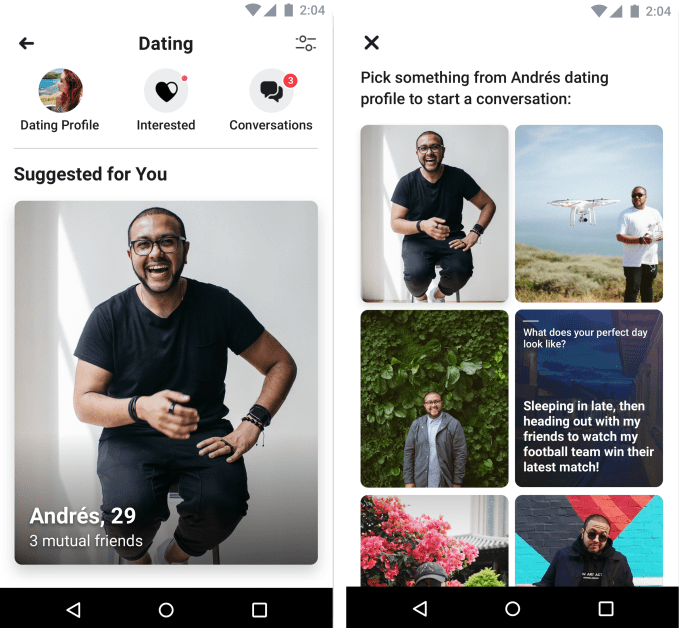
They’ll opt in, verify their city using their phone’s location services, and decide whether to add details like a free-form bio, workplace, education, religion, height, and if they have children. Facebook offers non-binary genders and sexual orientations. To fill out their profile, they’ll choose up to a dozen photos they upload, are tagged in, previously posted to Facebook, or cross-posted from Instagram as well as answer up to 20 questions about their personality such as “What does your perfect day look like?”

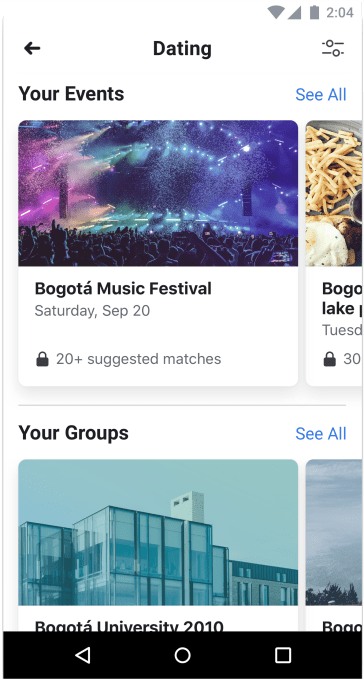
Users can select to filter their matches by distance (up to a maximum radius of 100 kilometers), if they have children, religion, height and age. They may then browse through the homescreen’s Suggested matches list, or they can choose to ‘Unlock’ Events and Groups they’re part of to see people from those who’ve done the same. Anyone you’ve blocked on Facebook won’t show up, though unfriended exs might. To see the next person, they either have to say they’re not interested, or choose a photo or question from the person’s profile and send them a message related to it (or at least they’re supposed to), and the sender can’t see the recipient any more.

The text and emoji-only messages go through a special Facebook Dating chat section, not Messenger, and land in the recipient’s Interested tab with no read receipts. If they reply, the chat moves to both people’s Conversations tab. From there they can decide to connect elsewhere online or meet up in person.

Sharp admits that “The moment you try to control the system you may have some unexpected behaviors occur there”. Facebook thought ahead so you can’t message photos (dick pics), you’re supposed to tie your message to a piece of their content (fewer generic pick-up lines), and you can’t follow up with people who don’t respond to you (stalking). But the company plans to stay vigilant in case unexpected forms of abuse or privacy issues emerge.

…And Why

Starting today users in Colombia will be able to create a Facebook Dating profile, but the company won’t start serving matches until there are enough sign ups. Sharp tells me “we don’t expect it to take months.” But why Colombia? He says it’s because much of South America has culturally accepted online dating, it has a sizeable population of 30 million monthly active Facebook users, and the social network can track data out of a few discrete metropolitan areas.

But there are a lot of other ‘whys’ to how Facebook Dating was built. Sharp ran me through the decision making process his team undertook to turn Facebook Dating from a concept into a concrete product. Here I’ll run through its rules and features while explaining the philosophy behind them.

  1. Meaningful relationships not one-night-stands, because “meaningful” is Facebook’s new watchword as it enters the ‘Time Well Spent’ era, and Facebook has the deep biographical and interest data to find you matches you’ll want to wake up next to each day, not just go to bed with.
  2. Opt-in not automatic enrollment, because “not everyone who’s single wants to date, not everyone who wants to date wants to date online, not everyone who dates online wants to date on Facebook” says Sharp.
  3. Within Facebook not a new app, because it lowers the barrier to behavior that’s already hard enough for some people, and it can only achieve its mission if people actually use it.
  4. Friends-of-friends and strangers not friends, because many people’s biggest fear is “are my friends and family going to see this” says Sharp, and people who are already friends don’t need help meeting and may already know if they want to date each other.
  5. A new profile not your same one, because some people might want to share a different side of themselves or might not publicly disclose their sexual orientation. The only info ported into Facebook Dating is your first name and age.
  6. Message and response not both people swiped right, because since Facebook wants you to be deliberate about who you show interest in, you have to send one message and hope to hear back. There’s no infinite right-swiping and then waiting get matched or messaged. “It puts the power in the responder” Sharp says.
  7. Profiles and chat are separate not part of Facebook, because it doesn’t want to scare users about privacy slip-ups, and doesn’t want people to pollute the main Facebook experience soliciting dates
  8. Real age and location not self-described, because Facebook wants to prevent catfishing as well as users contacting matches in distant cities who they’ll never meet.
  9. Matches through Events and Groups not randos, because a photo isn’t enough for choosing a life partner, interest overlaps are key to compatability, and they give people ready-mate happenings to use as dates.

A prototype of Facebook Dating’s onboarding flow

The end result is an online dating product that maximizes convenience, both in where it’s available and how much hunting you have to do by yourself. The big question remains how far Facebook will go to making Dating a hit. The feature could live or die by how much Facebook is willing to constantly nag its single users to sign-up.

Facebook’s in a precarious time for its brand, and may have trouble getting people to trust it with an even more sensitive part of their lives. “As all the events of the past year have unfolded, it’s only underscored the importance of privacy” Sharp concludes. No one wants their dating profile ending up Cambridge Analytica’d. But if analyzing your every Like and link gives Facebook uncanny matching accuracy, word could travel fast if it’s how people find their soul-mates.


from Social – TechCrunch https://ift.tt/2OBFRyj Inside Facebook Dating, launching today first in Colombia Josh Constine https://ift.tt/2xls1tt
via IFTTT

Inside Facebook Dating, launching today first in Colombia

{rss:content:encoded} Inside Facebook Dating, launching today first in Colombia https://ift.tt/2xls1tt https://ift.tt/2OBFRyj September 20, 2018 at 12:00PM

Does deeper data produce perfect matches? Facebook is finally ready to find out, starting today with a country-wide test in Colombia of its Dating feature. It’s centered around an algorithm-powered homescreen of Suggested romantic matches based on everything Facebook knows about you that other apps don’t. There’s no swiping and it’s not trying to look cool, but Facebook Dating is familiar and non-threatening enough to feel accessible to Facebook’s broad array of single users.

Originally announced at F8 in May, Facebook has hammered out details like limiting users to expressing interest in a maximum of 100 people per day, spotlighting personal questions as well as photos, and defaulting to show you friends-of-friends as well as strangers unless you only want to see people with no mutual connections. If the test goes well, expect Facebook to roll Dating out to more countries shortly as the social network pushes its mission to create meaningful connections and the perception that it can be a force of good.

“The goal of the team is to make Facebook simply the best place to start a relationship online” Facebook Dating’s product manager Nathan Sharp told me during an expansive interview about the company’s strategy and how it chose to diverge from the top dating apps. For starters, it’s not trying to compete with Tinder for where you find hookups by swiping through infinite options, but instead beat eHarmony, Hinge, or OKCupid at finding you a life partner. And it’s all about privacy, from its opt-in nature to how it’s almost entirely siloed from Facebook though lives within the same app.

“We wanted to make a product that encouraged people to remember that there are people behind the profiles and the cards that they’re seeing. We wanted a system that emphasizes consideration over impulse, We want you to consider more than that person’s profile photo.”

There are no plans to monetize Facebook Dating with ads or premium subscriptions to bonus features. But as Facebook strives to stay relevant beyond the aging News Feed and combat its branding crisis, there are plenty of incentives for it to find us a significant other.

How Facebook Dating Works…

“Dating is something we’ve seen on the platform since the earliest days. We know there are 200 million people who list themselves as single” says Sharp. He’s married himself but says with a laugh that Facebook Dating “is definitely a young and single team.” Back in 2004, online dating still had a sleazy reputation. But now that over a third of U.S. marriages start online, and Facebook has had time to identify the pitfalls stumbled into by other dating apps, it’s ready to pucker up.

The basic flow is that users 18 and up (or the local ‘Adult’ equivalent) will see a notice atop their News Feed inviting them to try Facebook Dating when it comes to their country, and they’ll see a shortcut in their bookmarks menu.

They’ll opt in, verify their city using their phone’s location services, and decide whether to add details like a free-form bio, workplace, education, religion, height, and if they have children. Facebook offers non-binary genders and sexual orientations. To fill out their profile, they’ll choose up to a dozen photos they upload, are tagged in, previously posted to Facebook, or cross-posted from Instagram as well as answer up to 20 questions about their personality such as “What does your perfect day look like?”

Users can select to filter their matches by distance (up to a maximum radius of 100 kilometers), if they have children, religion, height and age. They may then browse through the homescreen’s Suggested matches list, or they can choose to ‘Unlock’ Events and Groups they’re part of to see people from those who’ve done the same. Anyone you’ve blocked on Facebook won’t show up, though unfriended exs might. To see the next person, they either have to say they’re not interested, or choose a photo or question from the person’s profile and send them a message related to it (or at least they’re supposed to), and the sender can’t see the recipient any more.

The text and emoji-only messages go through a special Facebook Dating chat section, not Messenger, and land in the recipient’s Interested tab with no read receipts. If they reply, the chat moves to both people’s Conversations tab. From there they can decide to connect elsewhere online or meet up in person.

Sharp admits that “The moment you try to control the system you may have some unexpected behaviors occur there”. That’s why you can’t message photos (dick pics), and you can’t follow up with people who don’t respond to you (stalking). But Facebook plans to stay vigilant in case unexpected forms of abuse or privacy issues emerge.

…And Why

Starting today users in Colombia will be able to create a Facebook Dating profile, but the company won’t start serving matches until there are enough sign ups. Sharp tells me “we don’t expect it to take months.” But why Colombia? He says it’s because much of South America has culturally accepted online dating, it has a sizeable population of 30 million monthly active Facebook users, and the social network can track data out of a few discrete metropolitan areas.

But there are a lot of other ‘whys’ to how Facebook Dating was built. Sharp ran me through the decision making process his team undertook to turn Facebook Dating from a concept into a concrete product. Here I’ll run through its rules and features while explaining the philosophy behind them.

  1. Meaningful relationships not one-night-stands, because “meaningful” is Facebook’s new watchword as it enters the ‘Time Well Spent’ era, and Facebook has the deep biographical and interest data to find you matches you’ll want to wake up next to each day, not just go to bed with.
  2. Opt-in not automatic enrollment, because “not everyone who’s single wants to date, not everyone who wants to date wants to date online, not everyone who dates online wants to date on Facebook” says Sharp.
  3. Within Facebook not a new app, because it lowers the barrier to behavior that’s already hard enough for some people, and it can only achieve its mission if people actually use it.
  4. Friends-of-friends and strangers not friends, because many people’s biggest fear is “are my friends and family going to see this” says Sharp, and people who are already friends don’t need help meeting and may already know if they want to date each other.
  5. A new profile not your same one, because some people might want to share a different side of themselves or might not publicly disclose their sexual orientation. The only info ported into Facebook Dating is your first name and age.
  6. Message and response not both people swiped right, because since Facebook wants you to be deliberate about who you show interest in, you have to send one message and hope to hear back. There’s no infinite right-swiping and then waiting get matched or messaged. “It puts the power in the responder” Sharp says.
  7. Profiles and chat are separate not part of Facebook, because it doesn’t want to scare users about privacy slip-ups, and doesn’t want people to pollute the main Facebook experience soliciting dates
  8. Real age and location not self-described, because Facebook wants to prevent catfishing as well as users contacting matches in distant cities who they’ll never meet.
  9. Matches through Events and Groups not randos, because a photo isn’t enough for choosing a life partner, interest overlaps are key to compatability, and they give people ready-mate happenings to use as dates.

A prototype of Facebook Dating’s onboarding flow

The end result is an online dating product that maximizes convenience, both in where it’s available and how much hunting you have to do by yourself. The big question remains how far Facebook will go to making Dating a hit. The feature could live or die by how much Facebook is willing to constantly nag its single users to sign-up.

Facebook’s in a precarious time for its brand, and may have trouble getting people to trust it with an even more sensitive part of their lives. “As all the events of the past year have unfolded, it’s only underscored the importance of privacy” Sharp concludes. No one wants their dating profile ending up Cambridge Analytica’d. But if analyzing your every Like and link gives Facebook uncanny matching accuracy, word could travel fast if it’s how people find their soul-mates.

Hear about the keys to local investing at Startup Battlefield Africa with Omobola Johnson and Lexi Novitske

Omobola Johnson (Image: Flickr/World Economic Forum under a CC BY-NC-SA 2.0

TechCrunch Startup Battlefield is returning to Africa in December, this time in Lagos, Nigeria. We will have a day-long program full of our flagship Battlefield competition highlighting the best startups that Africa has to offer.

Not only that, we’ll have panel discussions designed to explore the continent’s rapidly developing technological infrastructure on the continent. To wit, I’m excited to announce the first two speakers who will don our stage with direct knowledge about investing Silicon Valley money in the local ecosystem.

Omobola Johnson is a senior partner at TLcom Capital and the former minister of communication technology for Nigeria. Her vast knowledge about the startup investing landscape comes from her 25-year tenure at Accenture where she served as the managing director.

As ICT minister, she focused on the execution of the National Broadband Plan, as well as promoting government interest in local venture capital through the development of a fund and a network of startup incubators. And at Accenture, she advised numerous startups in various industries on how to become competitive and help to strengthen the tech landscape.

Lexi Novitske

Lexi Novitske is the principal investment officer for Singularity Investments where she is responsible for managing investments in the firm’s Africa portfolio.

Novitske moved to Africa from the United States, having identified a unique approach to providing African startups with the capital necessary to thrive. Big surprise: It’s not just about writing a check and hoping for returns. It’s about understanding the complexities of the environment, modifying Western attitudes about business and working hard with your companies to ensure the best outcomes.

Johnson and Novitske are just the beginning of what we have to offer at Battlefield Africa technology. Stay tuned for more announcements of great speakers and get your tickets before they sell out.


https://ift.tt/2NrzeCm Hear about the keys to local investing at Startup Battlefield Africa with Omobola Johnson and Lexi Novitske https://ift.tt/2DevPBY

Lime hits 11.5 million bike and scooter rides

Bike and scooter company Lime recently hit 11.5 million rides, a couple of months after it surpassed six million rides. This milestone comes just 14 months after Lime deployed its first bikes.

Today, Lime is in more than 100 markets throughout the U.S. and Europe. Last December, Lime brought its bikes to a number of European cities and in June, Lime brought its scooters to Paris. By the end of this year, Lime plans to launch in an additional 50 cities.

The rise of shared personal electric vehicles has also led to a new type of side hustle for some people. Through Lime’s Juicer program, which enables anyone to make money from charging scooters overnight, the company has paid out millions of dollars to those workers.

Lime has raised $467 million in funding, with its most recent round coming in at $335 million. The round, led by GV, included participation from Uber.


https://ift.tt/2xoMe1o Lime hits 11.5 million bike and scooter rides https://ift.tt/2MQwcSW

Curve, the all-your-cards-in-one app, adds ‘zero fees’ when spending abroad

Curve, the London fintech that lets you consolidate all of your bank cards into a single Curve card and app to make it easier to manage your spending, has always faced a slight awareness problem. Even though nobody else does what Curve does — the product is innovative on a multiple fronts, such as its “financial time travel” feature — it is also the kind of proposition that not everybody gets until they’ve signed up and started using it. Once they do, however, they tend to stick around. I’m told retention rates are way above industry average at 70 percent.

Three years since launch and much further along in the roadmap, the sum of its parts is beginning to make Curve a much easier sell. Not least because any company that wants to create “one card to rule them all” needs to have multiple bases covered if it is going to convince you to leave your other debit and credit cards at home. One of those, of course, is low FX fees when spending abroad. Or, better still, zero fees.

Enter the latest update from Curve, which introduces the “real exchange rate, with no hidden fees”. Up until now, Curve offered a better exchange rate and fee structure than most high street banks (around 1-2 percent on top of MasterCard’s competitive exchange rate), but it wasn’t up there with the very best on the market, such as the likes of Revolut, Starling, TransferWise, Monzo or Tandem, depending on use case and your penchant for convenience over price.

To that end, the fintech startup has spent the last six months re-engineering the platform’s money exchange piping to be able to compete much harder in currency conversion and at the point of purchase.

“Our zero FX proposition is built on the foundations of the innovative technology at the heart of Curve, enabling us to perform FX swaps on top of any card that you have loaded into your Curve wallet without the user needing to do anything special and with the transaction showing in the underlying cards native currency,” Curve CTO Matt Collinge tells me. “We are essentially adding a wrapper of convenient ‘fintechness’ to existing bank and credit cards”.

The new “zero fee” pricing is fairly straight-forward but there are some caps and different limitations depending on if you have the blue free Curve card or the black paid-for one. The pricing changes slightly from November, too.

The company broke down the terms as follows:

Blue Curve card users:

– Spend Abroad: 0% fee and access to the Real Exchange Rate on spend in over 150+ supported foreign currencies worldwide. Initial cap of up to £500 per rolling month, and 1% fee thereafter (in November this will become 2% thereafter).
– ATM Extractions Abroad: £200 at 0% fee, 2% or £2 per transaction thereafter (whichever is greater).
– Weekend Spend Abroad: as the currency market is closed, we need to charge a 0.5% markup on Euros and US Dollars and 1% markup for all other supported currencies (in November this becomes 0.5% fee for Euros and US dollars, 1.5% fee for all other currencies).

Black Curve card users:

– Spend Abroad: 0% fee and access to the Real Exchange Rate on spend in over 150+ supported foreign currencies worldwide, for an unlimited amount per rolling year – subject to a generous Fair Use Policy of £15,000 and 1% fee thereafter (in November this will become 2% thereafter).
– ATM Extractions Abroad: £400 ATM at 0 fee, 2% or £2 per transaction thereafter (whichever is greater).
– Weekend Spend Abroad: as the currency market is closed, we need to charge a 0.5% markup on Euros and US Dollars and 1% markup for all other supported currencies (in November this becomes 0.5% fee for Euros and US dollars, 1.5% fee for all other currencies).

In a call, Curve founder and CEO Shachar Bialick explained that the £500 per month zero fee cap for blue Curve card users is informed by research the startup did that showed that over 80 percent of traveling customers spend less than £500 abroad per month. The extra fees also kick in after to ensure Curve doesn’t lose money — there is in-built currency risk when attempting to give customers the real exchange rate in real-time — and is able to build a sustainable business in the long run. Likewise, the weekend bump is pretty standard and is a strategy also employed by Revolut, for example. With that said, for more frequent travellers, Bialick’s advice was that they should apply for the paid-for black Curve card, which also brings increased cash-back.

Aside from “zero fees,” there are other advantages to using Curve when spending abroad or in a foreign currency, according to the Curve founder. Since the Curve card acts as a conduit to your other bank cards (similar to the way mobile wallets like Apple Pay work), you are effectively turning all of your debit and credit cards into zero fee currency exchange. And you don’t need to top up or decide in advance how much foreign currency to convert or worry about transferring it back if you under spend on your trip. In addition, Curve supports 150 global currencies (as a comparison, Revolut supports 24 currencies).

But more than anything, Bialick hopes the headline of “zero fees” will shut down one potential reason not to go ‘full Curve’ for all of your everyday spending. His feeling is that once prospective users realise it competes very aggressively on FX, which is how a lot of challenger banks have attracted customers, they’ll want to give Curve a try and ditch their other cards in the process. Only then will they appreciate Curve’s fintech convergence proposition.


https://ift.tt/eA8V8J Curve, the all-your-cards-in-one app, adds ‘zero fees’ when spending abroad https://ift.tt/2QKODLO

blogger better Headline Animator