l
l
blogger better. Powered by Blogger.

Search

Labels

blogger better

Followers

Blog Archive

Total Pageviews

Labels

Download

Blogroll

Featured 1

Curabitur et lectus vitae purus tincidunt laoreet sit amet ac ipsum. Proin tincidunt mattis nisi a scelerisque. Aliquam placerat dapibus eros non ullamcorper. Integer interdum ullamcorper venenatis. Pellentesque habitant morbi tristique senectus et netus et malesuada fames ac turpis egestas.

Featured 2

Curabitur et lectus vitae purus tincidunt laoreet sit amet ac ipsum. Proin tincidunt mattis nisi a scelerisque. Aliquam placerat dapibus eros non ullamcorper. Integer interdum ullamcorper venenatis. Pellentesque habitant morbi tristique senectus et netus et malesuada fames ac turpis egestas.

Featured 3

Curabitur et lectus vitae purus tincidunt laoreet sit amet ac ipsum. Proin tincidunt mattis nisi a scelerisque. Aliquam placerat dapibus eros non ullamcorper. Integer interdum ullamcorper venenatis. Pellentesque habitant morbi tristique senectus et netus et malesuada fames ac turpis egestas.

Featured 4

Curabitur et lectus vitae purus tincidunt laoreet sit amet ac ipsum. Proin tincidunt mattis nisi a scelerisque. Aliquam placerat dapibus eros non ullamcorper. Integer interdum ullamcorper venenatis. Pellentesque habitant morbi tristique senectus et netus et malesuada fames ac turpis egestas.

Featured 5

Curabitur et lectus vitae purus tincidunt laoreet sit amet ac ipsum. Proin tincidunt mattis nisi a scelerisque. Aliquam placerat dapibus eros non ullamcorper. Integer interdum ullamcorper venenatis. Pellentesque habitant morbi tristique senectus et netus et malesuada fames ac turpis egestas.

Thursday, September 27, 2018

May Mobility puts autonomous shuttles on the streets of Columbus, Ohio

This December a set of autonomous vehicles will start roaming the streets of Columbus, Ohio in an effort to turn this bustling midwestern community into the first smart city. The project, which is part of the Smart Columbus and DriveOhio initiatives, is the first step in launching a fully autonomous shuttle route in the city.

“We’re proud to have the first self-driving shuttle in Ohio being tested on the streets of Columbus,” said Mayor Andrew J. Ginther. “This pilot will shape future uses of this emerging technology in Columbus and the nation. Residents win when we add more mobility options to our transportation ecosystem – making it easier to get to work, school or local attractions.”

Michigan-based May Mobility provided the shuttles and the team is training the autonomous vehicles to navigate Columbus streets. May Mobility already launched their vehicles in Detroit and this is the second full implementation of the tech.

The six-seater electric shuttles will follow a 3 mile route through downtown Columbus and the vehicles will start picking up passengers on December 1. Rides are free. May Mobility has already performed over 10,000 successful trips in Detroit. In Columbus the shuttles will drive the Scioto Mile loop, a scenic route through the city and by the Ohio River. A large digital display will show system information and there will be a single operator to oversee the trip and take control in case of emergency.

Founder Edwin Olson is a robotics professor at the University of Michigan and his team won the original DARPA challenge in 2007.

“Cities are seeking cost-effective transportation services that will improve congestion in urban cores, and self-driving shuttles can offer a huge relief,” he said. “As we work toward a future where people can drive less and live more, we’re thrilled to be working with partners from Columbus to provide a new transportation experience that will make traveling through Columbus safe, reliable and personal.”

Columbus won the $40 million Smart City Challenge in June 2016 to test and implement smart city tech.


https://ift.tt/2DxNqFj May Mobility puts autonomous shuttles on the streets of Columbus, Ohio https://ift.tt/2N0yO0F

Compound launches easy way to short cryptocurrencies

Think Ethereum and other crypto coins are overvalued? Now you can make money when their prices fall via Compound, which is launching its money market protocol for shorting cryptocurrencies today. The Coinbase and Andreessen Horowitz-funded startup today opens its simple web interface allowing users to borrow and short Ethereum, 0x’s ZRX, Brave’s BAT, and Augur’s REP token, or lend them through Compound to earn interest.

“If/when Compound scales, this will lead to some really interesting improvements in market structure, namely, fairer prices” Compound CEO Robert Leshner tells me. The startup spent the summer completing a security audit by Trail Of Bits and adding 26 hedge fund partners who will trade with Compound, offering liquidity to independent investors looking to be matched with borrowers or lenders. Next, the startup wants to offer a stablecoin on its protocol, bring in big financial institutions to add even more liquidity, and partner with a wallet provider to make signup faster.

Compound users visit its site through a Web3 browser such as MetaMask or Coinbase Wallet and enter their Ethereum price. They can then view the interest rates for borrowing and shorting or lending and earning interest for each of the supported tokens. Compound’s secret sauce is that those interest rates are set algorithmically based on demand, though eventually it wants a community governance body to oversee this process.

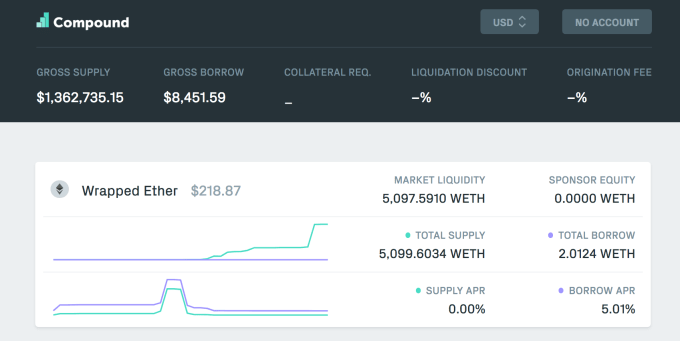
To make sure no one thinks they’re getting scammed, Compound is also releasing a transparency dashboard users can view to check up on all the assets moving through the protocol and see what Compound is earning. It charges 10 percent of what borrowers pay in interest, with the rest going to the lender. That margin is what attracted the $8.2 seed round for Compound that also included Polychain Capital and Bain Capital Ventures.

Compound’s protocol isn’t just useful for crypto haters, or HODLers who want to generate interest instead of just having their coins gathering dust in a wallet. It could also make crypto exchanges like Coinbase or Robinhood less attractive to users because leaving their coins there comes with the opportunity cost of not lending them for profit. Meanwhile, shorts could pop the volatile crypto bubble and push prices to more sensible and stable levels. That’s market health is a critical precursor to big banks and traditional investors diving into crypto.

[Disclosure: The author owns small positions in Bitcoin and Ethereum, but has no financial motive for writing this article, did not make trades in the week prior to this article, and doesn not plan to make trades in the 72 hours following publication.]


https://ift.tt/2DJyjc6 Compound launches easy way to short cryptocurrencies https://ift.tt/2Qdan1Q

The Infatuation raises $30M from Jeffrey Katzenberg’s WndrCo to bring Zagat into the digital age

WndrCo, the consumer tech investment and holding company founded by longtime Hollywood executive Jeffrey Katzenberg, has invested $30 million in The Infatuation, a restaurant discovery platform.

The Infatuation made waves earlier this year when it purchased Zagat from Google, which had paid $151 million for the 40-year-old company in 2011. Despite efforts to makeover the Zagat app, the search giant ultimately decided to unload the perennial restaurant review and recommendation service and focus on expanding its database of restaurant recommendations organically.

New York-based The Infatuation was founded by music industry vets Chris Stang and Andrew Steinthal in 2009. It has previously raised $3.5 million for its mobile app, events, newsletter and personalized SMS-based recommendation tool.

Stang told TechCrunch this morning that they plan to use a good chunk of the funds to develop the new Zagat platform, which will be kept separate from The Infatuation.

“The first thing we want to do before we build anything is spend a lot of time researching how people have used Zagat in the past, how they want to use it in the future, what a community-driven platform could look like and how to apply community reviews and ratings to the brand,” said Stang, The Infatuation’s chief executive officer. “Zagat’s roots are in user-generated content. … What we are doing now is thinking through what that looks like with new tech applied to it. What it looks like in the digital age. How [we can] take our domain expertise and that legendary brand and make something new with it.”

The Infatuation will also expand to new cities beginning this fall with launches in Boston and Philadelphia. It’s already active in a dozen or so U.S. cities including Los Angeles, Seattle and San Francisco. The startup’s first and only international location is London.

Katzenberg, who began his Hollywood career at Paramount Pictures, began raising up to $2 billion for WndrCo about a year ago. Since then, he’s unveiled WndrCo’s new mobile video startup NewTV, which has raised $1 billion and hired Meg Whitman, the former president and CEO of Hewlett Packard, as CEO.

On top of that, WndrCo has invested in MixcloudAxiosNodeFlowspace, Whistle Sports, TYT Network and others.

Given The Infatuation founders’ experience in the entertainment industry, a partnership with Katzenberg was natural.

“We really felt like between content and technology they had … expertise on both sides,” Stang said. “The Infatuation is at its best when great content intersects with great technology, to find a fund that was perfectly suited to that was exciting.”


https://ift.tt/eA8V8J The Infatuation raises $30M from Jeffrey Katzenberg’s WndrCo to bring Zagat into the digital age https://ift.tt/2OWeFdS

China’s secret startup advantage: liquidity

This year’s rush of IPOs from Chinese tech companies has dominated headlines, but what’s more interesting is how quickly they got there.

Traditionally, “going public” represented the gratifying culmination of sleepless nights and missed birthdays that went into building a company. The peak of a lengthy climb, where founders and VCs would finally see the fruits of their labor. 

However, Chinese companies appear to be reaching that peak much quicker than their American peers, heading to the public markets only a few years after initial venture investments, and often with little operating history. 

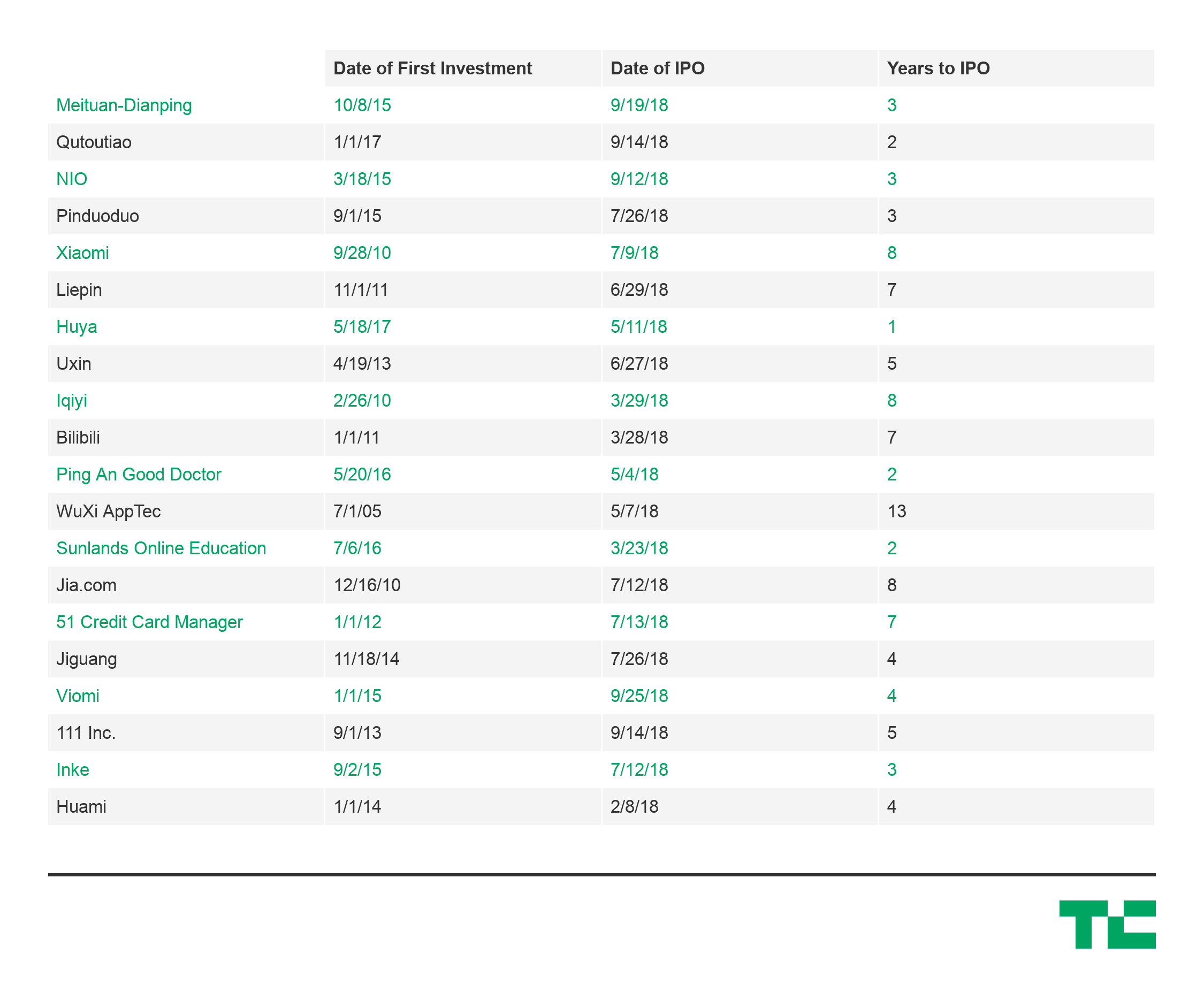
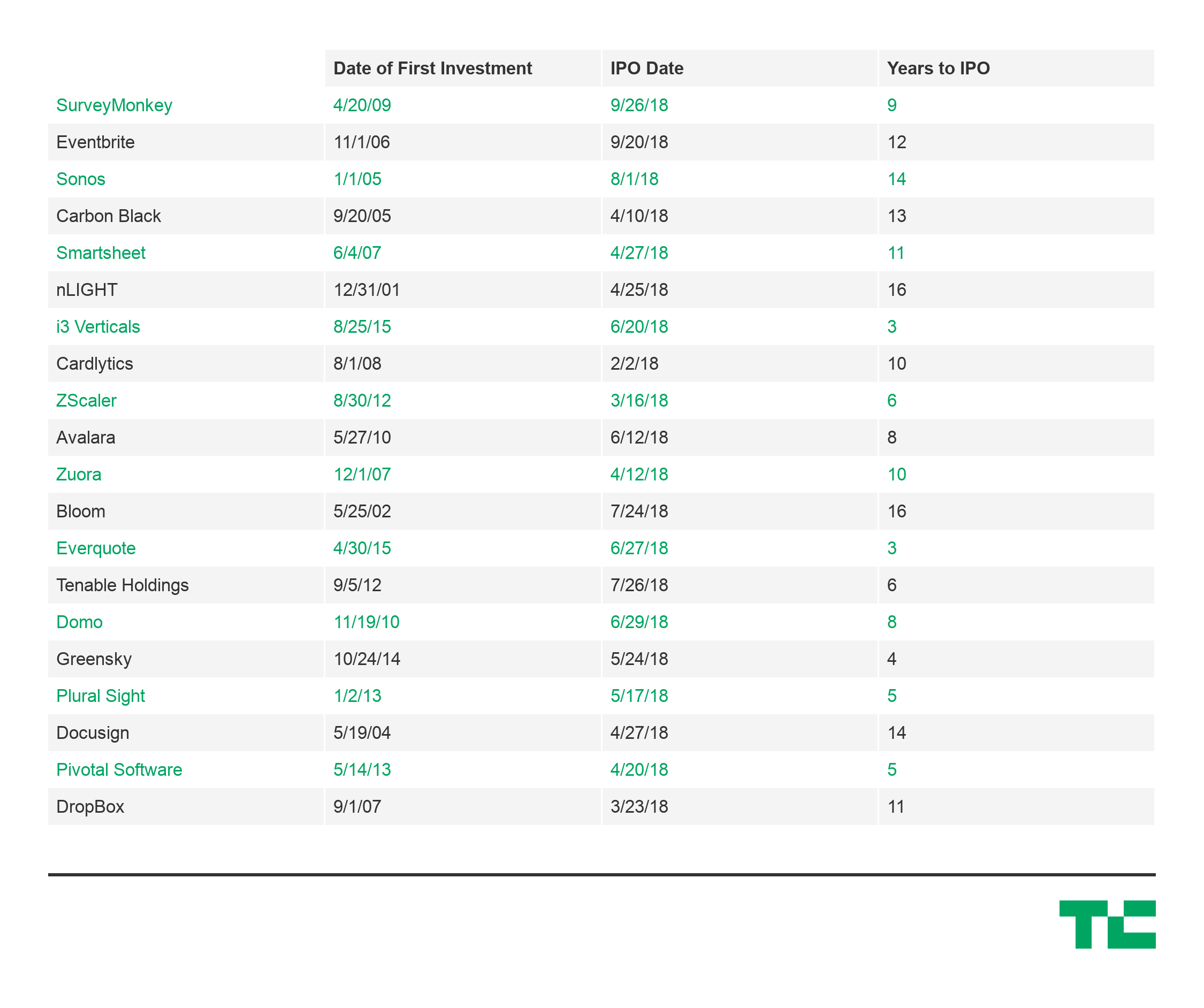
Analyzing twenty of the most high profile Chinese tech IPOs this year, the average time from first venture investment to IPO was only around three to five years. Take e-commerce platform Pinduoduo, which pulled in $1.6 billion less than three years after its Series A.  Or the recent IPO of EV-manufacturer NIO, which raised a billion dollars just three-and-a-half years after its Series A and having just delivered its first car in June.

China IPO data for 2018 compiled from NASDAQ, Pitchbook, and Crunchbase

That’s less than half the average 10-year timeline for venture-backed US tech companies that went public in 2018, including Dropbox, Eventbrite, and DocuSign, which all IPO’d more than a decade after their initial investments.

Differences in market maturity, government involvement, and support from large tech incumbents all undoubtedly play a factor, but the speed to liquidity for the Chinese companies is still astounding.

Faster liquidity can push cycle of returns, fundraising, reinvestment

Speed to liquidity is a critical metric for the health of a startup ecosystem. It creates a positive cycle where faster liquidity can drive faster fundraising, faster reinvestment, faster startup building, and faster public liquidity again.  An accelerated cycle could be especially appealing for funds with LPs that require faster returns due to cash commitments or otherwise.

It’s important to note that venture returns are a function of capital and time, so quicker exits will also drive higher returns for the same amount invested.  For example, a $1 million investment with a $5 million exit after ten years would generate an Internal Rate of Return (a commonly used metric to evaluate VC performance) of 20%.  If the same exit occurred after five years, the IRR would be 50%. 

Liquidity is a key consideration as China’s influence on the flow of global venture capital intensifies. As China’s tech ecosystem sees more of its darlings mature and more consistently deliver smashing exits, investments in China will have to be a more serious consideration for VCs, even if only to minimize the sheer amount of time, resources, and painstaking energy needed to build a company in the U.S.


https://ift.tt/2Dz02f9 China’s secret startup advantage: liquidity https://ift.tt/2NKmbfb

Facebook poisons the acquisition well

Who should you sell your startup to? Facebook and the founders of its former acquisitions are making a strong case against getting bought by Mark Zuckerberg and Co. After a half-decade of being seen as one of the most respectful and desired acquirers, a series of scandals has destroyed the image of Facebook’s M&A division. That could make it tougher to convince entrepreneurs to sell to Facebook, or force it to pay higher prices and put contractual guarantees of autonomy into the deals.

WhatsApp’s founders left amidst aggressive pushes to monetize. Instagram’s founders left as their independence was threatened. Oculus’ founders were demoted. And over the past few years, Facebook has also shut down acquisitions, including viral teen Q&A app TBH (though its founder says he recommended shutting it down), fitness tracker Moves, video advertising system LiveRail, voice control developer toolkit Wit.ai and still-popular mobile app developer platform Parse.

Facebook’s users might not know or care about much of this. But it could be a sticking point the next time Facebook tries to buy out a burgeoning competitor or complementary service.

Broken promises with WhatsApp

The real trouble started with WhatsApp co-founder Brian Acton’s departure from Facebook a year ago before he was fully vested from the $22 billion acquisition in 2014. He’d been adamant that Facebook not stick the targeted ads he hated inside WhatsApp, and Zuckerberg conceded not to. Acton even got a clause added to the deal that the co-founders’ remaining stock would vest instantly if Facebook implemented monetization schemes without their consent. Google was also interested in buying WhatsApp, but Facebook’s assurances of independence sealed the deal.

WhatsApp’s other co-founder, Jan Koum, left Facebook in April following tension about how Facebook would monetize his app and the impact of that on privacy. Acton’s departure saw him leave $850 million on the table. Captivity must have been pretty rough for freedom to be worth that much. Today in an interview with Forbes’s Parmy Olson, he detailed how Facebook got him to promise it wouldn’t integrate WhatsApp’s user data to get the deal approved by EU regulators. Facebook then broke that promise, paid the $122 million fine that amounted to a tiny speed bump for the money-printing corporation, and kept on hacking.

When Acton tried to enact the instant-vesting clause upon his departure, Facebook claimed it was still exploring, not “implementing,” monetization. Acton declined a legal fight and walked away, eventually tweeting “Delete Facebook.” Koum stayed to vest a little longer. But soon after they departed, WhatsApp started charging businesses for slow replies, and it will inject ads into the WhatsApp’s Stories product Status next year. With user growth slowing, users shifting to Stories, and News Feed out of ad space, Facebook’s revenue problem became WhatsApp’s monetization mandate.

The message was that Facebook would eventually break its agreements with acquired founders to prioritize its own needs.

Diminished autonomy for Instagram

Instagram’s co-founders Kevin Systrom and Mike Krieger announced they were resigning this week, which sources tell TechCrunch was because of mounting tensions with Zuckerberg over product direction. Zuckerberg himself negotiated the 2012 acquisition for $1 billion ($715 million when the deal closed with Facebook’s share price down, but later $4 billion as it massively climbed). That price was stipulated on Instagram remaining independent in both brand and product roadmap.

Zuckerberg upheld his end of the bargain for five years, and the Instagram co-founders stayed on past their original vesting dates — uncommon in Silicon Valley. Facebook pointed to Instagram’s autonomy when it was trying to secure the WhatsApp acquisition. And with the help of Facebook’s engineering, sales, recruiting, internationalization and anti-spam teams, Instagram grew into a 1 billion-user juggernaut.

But again, Facebook’s growth and financial woes led to a change of heart for Zuckerberg. Facebook’s popularity amongst teens was plummeting while Instagram remained cool. Facebook pushed to show its alerts and links back to the parent company inside of Instagram’s notifications and settings tabs. Meanwhile, it stripped out the Instagram attribution from cross-posted photos and deleted a shortcut to Instagram from the Facebook bookmarks menu.

Zuckerberg then installed a loyalist, his close friend and former News Feed VP Adam Mosseri, as Instagram’s new VP of Product mid-way through this year. The reorganization also saw Systrom start reporting to Facebook CPO Chris Cox. Previously the Instagram CEO had more direct contact with Zuckerberg despite technically reporting to CTO Mike Schroepfer, and the insertion of a layer of management between them frayed their connection. Six years after being acquired, Facebook started breaking its promises, Instagram felt less autonomous and the founders exited.

The message again was that Facebook expected to be able to exploit its acquisitions regardless of their previous agreements.

Reduced visibility for Oculus

Zuckerberg declared Oculus was the next great computing platform when Facebook acquired the virtual reality company in 2014. Adoption ended up slower than many expected, forcing Oculus to fund VR content creators since it’s still an unsustainable business. Oculus has likely been a major cash sink for Facebook it will have to hope pays off later.

But in the meantime, the co-founders of Oculus have faded into the background. Brendan Iribe and Nate Mitchell have gone from leading the company to focusing on the nerdiest part of its growing product lineup as VPs running the PC VR and Rift hardware teams, respectively. Former Xiaomi hardware leader Hugo Barra was brought in as VP of VR to oversee Oculus, and he reports to former Facebook VP of Ads Andrew “Boz” Bosworth — a longtime Zuckerberg confidant who TA’d one of his classes at Harvard who now runs all of Facebook’s hardware efforts.

Oculus’ original visionary inventor Palmer Luckey left Facebook last year following a schism with the company over him funding anti-Hillary Clinton memes and “sh*tposters.” He was pressed to apologize, saying “I am deeply sorry that my actions are negatively impacting the perception of Oculus and its partners.”

Lesser-known co-founder Jack McCauley left Facebook just a year after the acquisition to start his own VR lab. Sadly, Oculus co-founder Andrew Reisse died in 2013 when he was struck by a vehicle in a police chase just two months after the acquisition was announced. The final co-founder Michael Antonov was the chief software architect, but Facebook just confirmed to me he recently left the division to work on artificial intelligence infrastructure at Facebook.

Today for the first time, none of the Oculus co-founders appeared onstage at its annual Connect conference. Obviously the skills needed to scale and monetize a product are different from those needed to create. Still, going from running the company to being stuck in the audience doesn’t send a great signal about how Facebook treats acquired founders.

Course correction

Facebook needs to take action if it wants to reassure prospective acquisitions that it can be a good home for their startups. I think Zuckerberg or Mosseri (likely to be named Instagram’s new leader) should issue a statement that they understand people’s fears about what will happen to Instagram and WhatsApp since they’re such important parts of users’ lives, and establishing core tenets of the product’s identity they don’t want to change. Again, 15-year-old Instagrammers and WhatsAppers probably won’t care, but potential acquisitions would.

So far, Facebook has only managed to further inflame the founders versus Facebook divide. Today former VP of Messenger and now head of Facebook’s blockchain team David Marcus wrote a scathing note criticizing Acton for his Forbes interview and claiming that Zuckerberg tried to protect WhatsApp’s autonomy. “Call me old fashioned. But I find attacking the people and company that made you a billionaire, and went to an unprecedented extent to shield and accommodate you for years, low-class. It’s actually a whole new standard of low-class,” he wrote.

Posted by David Marcus on Wednesday, September 26, 2018

But this was a wasted opportunity for Facebook to discuss all the advantages it brings to its acquisitions. Marcus wrote, “As far as I’m concerned, and as a former lifelong entrepreneur and founder, there’s no other large company I’d work at, and no other leader I’d work for,” and noted the opportunity for impact and the relatively long amount of time acquired founders have stayed in the past. Still, it would have been more productive to focus on why’s it’s where he wants to work, how founders actually get to touch the lives of billions and how other acquirers like Twitter and Google frequently dissolve the companies they buy and often see their founders leave even sooner.

Acquisitions have protected Facebook from disruption. Now that strategy is in danger if it can’t change this narrative. Lots of zeros on a check might not be enough to convince the next great entrepreneur to sell Facebook their startup if they suspect they or their project will be steamrolled.


https://ift.tt/eA8V8J Facebook poisons the acquisition well https://ift.tt/2NK2UdO

Pew: A majority of U.S. teens are bullied online

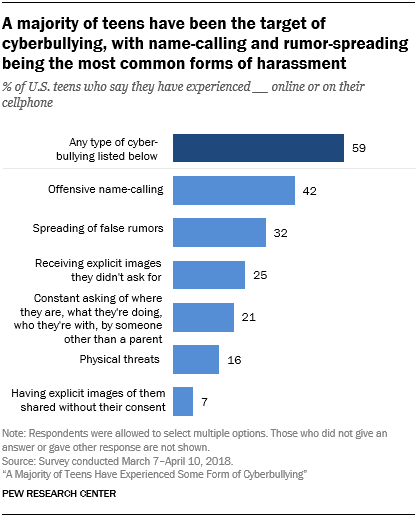
A majority of U.S. teens have been subject to online abuse, according to a new study from Pew Research Center, out this morning. Specifically, that means they’ve experienced at least one of a half-dozen types of online cyberbullying, including name-calling, being subject to false rumors, receiving explicit images they didn’t ask for, having explicit images of themselves shared without their consent, physical threats, or being constantly asked about their location and activities in a stalker-ish fashion by someone who is not their parents.

Of these, name-calling and being subject to false rumors were the top two categories of abuse teens were subject to, with 42% and 32% of teens reporting it had happened to them.


Pew says that texting and digital messaging has paved the way for these types of interactions, and parents and teens alike are both aware of the dangers and concerned.

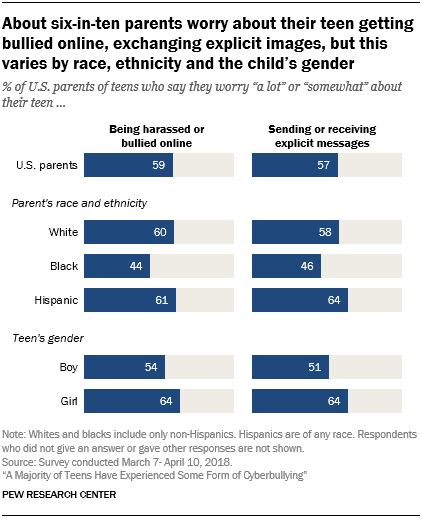
Parents, in particular, are worried about teens sending and receiving explicit images, with 57% saying that’s a concern, and a quarter who worry about this “a lot.” And parents of girls worry more. (64% do.)
Meanwhile, a large majority – 90% – of teens now believe that online harassment is a problem and 63% say it’s what they consider a “major” problem.

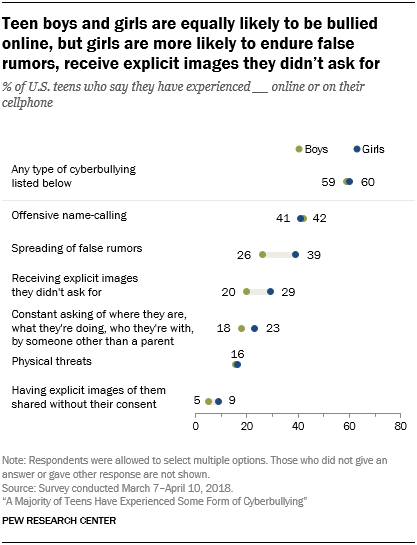
Pew also found that girls and boys are both harassed online in fairly equal measure, with 60% of girls and 59% of boys reporting having experienced some sort of online abuse. That’s a figure that may surprise some. However, it’s important to clarify that this finding is about whether or not the teen had ever had experienced online abuse – not how often or how much.

Not surprisingly, Pew found that girls are more likely than boys to have experienced two or more types of abuse, and 15% of girls have been the target of at least 4 types of abuse, compared with 6% of boys.

Girls are also more likely to be the recipient of explicit images they didn’t ask for, as 29% of teens girls reported this happened to them, versus 20% of boys.

And as the teen girls got older, they receive even more of these types of images, with 35% of girls ages 15 to 17 saying they received them, compared with only 1 out of 5 boys.
Several factors seem to play no role in how often the teens experience abuse, including race, ethnicity, or parents’ educational attainment, Pew noted. But having money does seem to matter somehow – as 24% of teens whose household income was less than $30K per year said they received online threats, compared with only 12% of those whose household incomes was greater than $75K per year. (Pew’s report doesn’t attempt to explain this finding.)

Beyond that factor, receiving or avoiding abuse is directly tied to how much screen time teens put in.

That is, the more teens go online, the more abuse they’ll receive.

45% of teens say they’re online almost constantly, and they are more likely to be harassed, as a result. 67% of them say they’ve been cyberbullied, compared with 53% who use the internet several times a day or less. And half the constantly online teens have been called offensive names, compared with just about a third (36%) who use the internet less often.

Major tech companies, including Apple, Google, and Facebook, have begun to address the issues around device addiction and screen time with software updates and parental controls.

Apple, in iOS 12, rolled out Screen Time controls that allows Apple device users to measure, monitor and restrict how often they’re on their phones, when, what type of content is blocked, and which apps they can use. In adults, the software can nudge them in the right direction, but parents also have the option of locking down their children’s phones using Screen Time controls. (Of course, savvy kids have already found the loopholes to avoid this, according to new reports.)

Google also introduced time management controls in the new version of Android, and offers parental controls around screen time through its Family Link software.

And both Google and Facebook have begun to introduce screen time reminders and settings for addictive apps like YouTube, Facebook and Instagram.

Teens seem to respect parents’ involvement in their digital lives, the report also found.
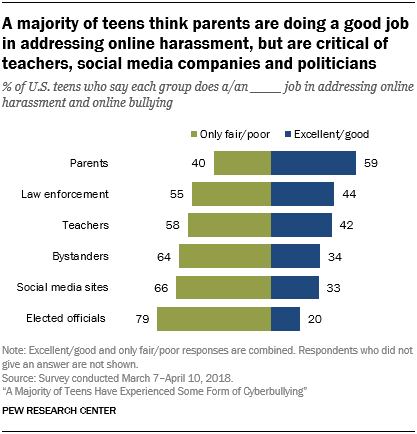
A majority – 59% – of U.S. teens say their parents are doing a good job with regard to addressing online harassment. However, 79% say elected officials are failing to protect them through legislation, 66% say social media sites are doing a poor job at stamping down abuse, and 58% of teachers are doing a poor job at handling abuse, as well.

Many of the top media sites were largely built by young people when they were first founded, and those people were often men. The sites were created in an almost naive fashion, with regard to online abuse. Protections – like muting, filters, blocking, and reporting, were generally introduced in a reactive fashion, not as proactive controls.

Instagram, for example – one of teens’ most-used apps – only introduced comment filters, blocklists, and comment blocking in 2016, and just four months ago added account muting. The app was launched in October 2010.

Pew’s findings indicate that parents would do well by their kids by using screen time management and control systems – not simply to stop their teenagers from being bullied and abused as often, but also to help the teens practice how to interact with the web in a less addictive fashion as they grow into adults.

After all, device addiction resulting in increased exposure to online abuse is not a plague that only affects teens.

Pew’s full study involves surveys of 743 teens and 1,058 parents living in the U.S. conducted March 7 to April 10, 2018. It counted “teens” as those ages 13 to 17, and “parents of teens” are those who are the parent or guardian of someone in that age range. The full report is here.


from Social – TechCrunch https://ift.tt/2NHnSKB Pew: A majority of U.S. teens are bullied online Sarah Perez https://ift.tt/2Qc4It2
via IFTTT

Facebook poisons the acquisition well

Who should you sell your startup to? Facebook and the founders of its former acquisitions are making a strong case against getting bought by Mark Zuckerberg and Co. After a half-decade of being seen as one of the most respectful and desired acquirers, a series of scandals has destroyed the image of Facebook’s M&A division. That could make it tougher to convince entrepreneurs to sell to Facebook, or force it to pay higher prices and put contractual guarantees of autonomy into the deals.

WhatsApp’s founders left amidst aggressive pushes to monetize. Instagram’s founders left as their independence was threatened. Oculus’ founders were demoted. And over the past few years, Facebook has also shut down acquisitions, including viral teen Q&A app TBH (though its founder says he recommended shutting it down), fitness tracker Moves, video advertising system LiveRail, voice control developer toolkit Wit.ai and still-popular mobile app developer platform Parse.

Facebook’s users might not know or care about much of this. But it could be a sticking point the next time Facebook tries to buy out a burgeoning competitor or complementary service.

Broken promises with WhatsApp

The real trouble started with WhatsApp co-founder Brian Acton’s departure from Facebook a year ago before he was fully vested from the $22 billion acquisition in 2014. He’d been adamant that Facebook not stick the targeted ads he hated inside WhatsApp, and Zuckerberg conceded not to. Acton even got a clause added to the deal that the co-founders’ remaining stock would vest instantly if Facebook implemented monetization schemes without their consent. Google was also interested in buying WhatsApp, but Facebook’s assurances of independence sealed the deal.

WhatsApp’s other co-founder, Jan Koum, left Facebook in April following tension about how Facebook would monetize his app and the impact of that on privacy. Acton’s departure saw him leave $850 million on the table. Captivity must have been pretty rough for freedom to be worth that much. Today in an interview with Forbes’s Parmy Olson, he detailed how Facebook got him to promise it wouldn’t integrate WhatsApp’s user data to get the deal approved by EU regulators. Facebook then broke that promise, paid the $122 million fine that amounted to a tiny speed bump for the money-printing corporation, and kept on hacking.

When Acton tried to enact the instant-vesting clause upon his departure, Facebook claimed it was still exploring, not “implementing,” monetization. Acton declined a legal fight and walked away, eventually tweeting “Delete Facebook.” Koum stayed to vest a little longer. But soon after they departed, WhatsApp started charging businesses for slow replies, and it will inject ads into the WhatsApp’s Stories product Status next year. With user growth slowing, users shifting to Stories, and News Feed out of ad space, Facebook’s revenue problem became WhatsApp’s monetization mandate.

The message was that Facebook would eventually break its agreements with acquired founders to prioritize its own needs.

Diminished autonomy for Instagram

Instagram’s co-founders Kevin Systrom and Mike Krieger announced they were resigning this week, which sources tell TechCrunch was because of mounting tensions with Zuckerberg over product direction. Zuckerberg himself negotiated the 2012 acquisition for $1 billion ($715 million when the deal closed with Facebook’s share price down, but later $4 billion as it massively climbed). That price was stipulated on Instagram remaining independent in both brand and product roadmap.

Zuckerberg upheld his end of the bargain for five years, and the Instagram co-founders stayed on past their original vesting dates — uncommon in Silicon Valley. Facebook pointed to Instagram’s autonomy when it was trying to secure the WhatsApp acquisition. And with the help of Facebook’s engineering, sales, recruiting, internationalization and anti-spam teams, Instagram grew into a 1 billion-user juggernaut.

But again, Facebook’s growth and financial woes led to a change of heart for Zuckerberg. Facebook’s popularity amongst teens was plummeting while Instagram remained cool. Facebook pushed to show its alerts and links back to the parent company inside of Instagram’s notifications and settings tabs. Meanwhile, it stripped out the Instagram attribution from cross-posted photos and deleted a shortcut to Instagram from the Facebook bookmarks menu.

Zuckerberg then installed a loyalist, his close friend and former News Feed VP Adam Mosseri, as Instagram’s new VP of Product mid-way through this year. The reorganization also saw Systrom start reporting to Facebook CPO Chris Cox. Previously the Instagram CEO had more direct contact with Zuckerberg despite technically reporting to CTO Mike Schroepfer, and the insertion of a layer of management between them frayed their connection. Six years after being acquired, Facebook started breaking its promises, Instagram felt less autonomous and the founders exited.

The message again was that Facebook expected to be able to exploit its acquisitions regardless of their previous agreements.

Reduced visibility for Oculus

Zuckerberg declared Oculus was the next great computing platform when Facebook acquired the virtual reality company in 2014. Adoption ended up slower than many expected, forcing Oculus to fund VR content creators since it’s still an unsustainable business. Oculus has likely been a major cash sink for Facebook it will have to hope pays off later.

But in the meantime, the co-founders of Oculus have faded into the background. Brendan Iribe and Nate Mitchell have gone from leading the company to focusing on the nerdiest part of its growing product lineup as VPs running the PC VR and Rift hardware teams, respectively. Former Xiaomi hardware leader Hugo Barra was brought in as VP of VR to oversee Oculus, and he reports to former Facebook VP of Ads Andrew “Boz” Bosworth — a longtime Zuckerberg confidant who TA’d one of his classes at Harvard who now runs all of Facebook’s hardware efforts.

Oculus’ original visionary inventor Palmer Luckey left Facebook last year following a schism with the company over him funding anti-Hillary Clinton memes and “sh*tposters.” He was pressed to apologize, saying “I am deeply sorry that my actions are negatively impacting the perception of Oculus and its partners.”

Lesser-known co-founder Jack McCauley left Facebook just a year after the acquisition to start his own VR lab. Sadly, Oculus co-founder Andrew Reisse died in 2013 when he was struck by a vehicle in a police chase just two months after the acquisition was announced. The final co-founder Michael Antonov was the chief software architect, but Facebook just confirmed to me he recently left the division to work on artificial intelligence infrastructure at Facebook.

Today for the first time, none of the Oculus co-founders appeared onstage at its annual Connect conference. Obviously the skills needed to scale and monetize a product are different from those needed to create. Still, going from running the company to being stuck in the audience doesn’t send a great signal about how Facebook treats acquired founders.

Course correction

Facebook needs to take action if it wants to reassure prospective acquisitions that it can be a good home for their startups. I think Zuckerberg or Mosseri (likely to be named Instagram’s new leader) should issue a statement that they understand people’s fears about what will happen to Instagram and WhatsApp since they’re such important parts of users’ lives, and establishing core tenets of the product’s identity they don’t want to change. Again, 15-year-old Instagrammers and WhatsAppers probably won’t care, but potential acquisitions would.

So far, Facebook has only managed to further inflame the founders versus Facebook divide. Today former VP of Messenger and now head of Facebook’s blockchain team David Marcus wrote a scathing note criticizing Acton for his Forbes interview and claiming that Zuckerberg tried to protect WhatsApp’s autonomy. “Call me old fashioned. But I find attacking the people and company that made you a billionaire, and went to an unprecedented extent to shield and accommodate you for years, low-class. It’s actually a whole new standard of low-class,” he wrote.

Posted by David Marcus on Wednesday, September 26, 2018

But this was a wasted opportunity for Facebook to discuss all the advantages it brings to its acquisitions. Marcus wrote, “As far as I’m concerned, and as a former lifelong entrepreneur and founder, there’s no other large company I’d work at, and no other leader I’d work for,” and noted the opportunity for impact and the relatively long amount of time acquired founders have stayed in the past. Still, it would have been more productive to focus on why’s it’s where he wants to work, how founders actually get to touch the lives of billions and how other acquirers like Twitter and Google frequently dissolve the companies they buy and often see their founders leave even sooner.

Acquisitions have protected Facebook from disruption. Now that strategy is in danger if it can’t change this narrative. Lots of zeros on a check might not be enough to convince the next great entrepreneur to sell Facebook their startup if they suspect they or their project will be steamrolled.


from Social – TechCrunch https://ift.tt/eA8V8J Facebook poisons the acquisition well Josh Constine https://ift.tt/2NK2UdO
via IFTTT

Yes Facebook is using your 2FA phone number to target you with ads

Facebook has confirmed it does in fact use phone numbers that users provided it for security purposes to also target them with ads.

Specifically a phone number handed over for two factor authentication (2FA) — a security technique that adds a second layer of authentication to help keep accounts secure.

Facebook’s confession follows a story Gizmodo ran a story yesterday, related to research work carried out by academics at two U.S. universities who ran a study in which they say they were able to demonstrate the company uses pieces of personal information that individuals did not explicitly provide it to, nonetheless, target them with ads.

While it’s been — if not clear, then at least evident — for a number of years that Facebook uses contact details of individuals who never personally provided their information for ad targeting purposes (harvesting people’s personal data by other means, such as other users’ mobile phone contact books which the Facebook app uploads), the revelation that numbers provided to Facebook by users in good faith, for the purpose of 2FA, are also, in its view, fair game for ads has not been so explicitly ‘fessed up to before.

Some months ago Facebook did say that users who were getting spammed with Facebook notifications to the number they provided for 2FA was a bug. “The last thing we want is for people to avoid helpful security features because they fear they will receive unrelated notifications,” Facebook then-CSO Alex Stamos wrote in a blog post at the time.

Apparently not thinking to mention the rather pertinent additional side-detail that it’s nonetheless happy to repurpose the same security feature for ad targeting.

Because $$$s, presumably.

We asked Facebook to confirm this is indeed what it’s doing — to make doubly doubly sure. Because, srsly wtaf. And it sent us a statement confirming that it repurposes digits handed to it by people wanting to secure their accounts to target them with marketing.

Here’s the statement, attributed to a Facebook spokesperson: “We use the information people provide to offer a better, more personalized experience on Facebook, including ads. We are clear about how we use the information we collect, including the contact information that people upload or add to their own accounts. You can manage and delete the contact information you’ve uploaded at any time.”

A spokesman also told us that users can opt out of this ad-based repurposing of their security digits by not using phone number based 2FA. (Albeit, the company only added the ability to do non-mobile phone based 2FA back in May, so anyone before then was all outta luck.)

On the ‘shadow profiles’ front — aka Facebook maintaining profiles of non-users based on the data it has been able to scrape about them from users and other data sources — the company has also been less than transparent.

Founder Mark Zuckerberg feigned confusion when questioned about the practice by US lawmakers earlier this year — claiming it only gathers data on non-users for “security purposes”.

Well it seems Facebook is also using the (valid) security concerns of actual users to extend its ability to target individuals with ads — by using numbers provided for 2FA to also carry out ad targeting.

Safe to say criticism of the company has been swift and sharp.

Soon Facebook will also be using behind-the-scenes tech means to target ads at WhatsApp users — despite also providing a robust encrypted security wrapper around their actual messages.

Stamos — now Facebook’s ex-CSO — has also defended its actions on that front.


from Social – TechCrunch https://ift.tt/eA8V8J Yes Facebook is using your 2FA phone number to target you with ads Natasha Lomas https://ift.tt/2xGsnL8
via IFTTT

Meet the startups that pitched at EF’s 10th Demo Day in London

Entrepreneur First (EF), the company builder and “talent first” investor, held its tenth London Demo Day this afternoon. This time around the even had a decidedly more international bent as it combined pitches from the London and recently launched Berlin programmes.

Once again, the pitches took place in front of a nearly overcapacity crowd at King’s Place in London’s King Cross area, and saw a 24 startups pitch their wares to investors, press and other actors in the European tech scene.

EF stands out from the many other demo days that the U.K. capital city hosts because of the way the investor backs individuals “pre-team, pre-idea” — meaning that the companies pitching only came into existence over the last 6 months and perhaps may never have done so without the founders bashing heads during the programme.

Unusually, aside from the upstarts presenting on stage, there were no other EF announcements today, which is in stark contrast to most previous demo days. However, I’m hearing there could be some big EF news coming quite shortly and this is likely a case of EF lining up its PR ducks in a row and choosing to shoot them down one news opportunity at a time. Besides, the company builder has had more than its fair share of announcements over the last twelve months.

In addition to existing programmes in London and Singapore, this year saw EF expand to Hong Kong and Paris, as well as Berlin. And almost exactly a year ago, EF announced a $12.4 million funding round led by Silicon Valley’s Greylock Partners, and that Greylock’s Reid Hoffman had joined the company builder’s board. The capital — to be used for operational purposes and separate from EF’s multiple investment funds — was raised to enable EF to scale its program in multiple tech startup/academic hubs around the world, and where it deemed the EF “secret sauce” can bring the most value.

Meanwhile, the themes for EF’s tenth London Demo Day continued to reflect the company builder’s focus on recruiting the best technical and domain expert talent — both recent graduates and also people already working at tech companies. They spanned AR headsets, “massive simulations,” genome sequencing, machine intelligence, and cryptocurrencies.

After tuning in to the live stream and enduring 24 rounds of ‘pitchlash’, my cursory 3 picks this time around are follows:

MyLevels

With a mission to “empower people to build a new relationship with food, myLevels uses data from Continuous Glucose Monitors combined with its own Bayesian-based machine learning models to measure the impact that food has on an individual’s body and metabolism. This is because the effect different food has on a person’s blood sugar levels — and the sometimes horrible spike followed by craving — varies person by person, and until now it has been difficult to build a personalised understanding of this. Once you have that understanding it becomes easier to lose weight and increase higher energy levels and even concentration.

Juno Bio

There’s gold in those microbiome, apparently. Juno Bio is “unlocking the potential of the microbiome” (bacteria that lives in our guts and other places, such as animals and soil), which the startup says has unprecedented potential to disrupt various industries such as the $195 billion fertiliser industry. More broadly, Juno Bio says there is an arms race for understanding and harnessing the information
that microbiome hold. To that end, Juno Bio uses machine learning and state of the art bioinformatics to analyse and predict how
best to manipulate microbiomes, significantly reducing the time and resources needed to improve their functionality.

Circuit Mind

Circuit Mind wants to use AI to automate the design of electronic circuits. The startup reckons that every year £40bn and 1.5bn hours are spent globally in “tedious and repetitive circuit board design” work, making building hardware even harder than it needs to be. To fix this, the company is building artificial intelligence that takes in the requirements for a circuit board and outputs the circuit board final design, ready for manufacture. “This means better circuits, designed orders of magnitude faster, at a fraction of the cost,” says Circuit Mind. Chalk this one up as another industry 4.0 play, of which EF already has a promising track record.

The full list of presenting teams (in their own words)

Nodes & Links is taming the complexity of modern projects.
CodeREG makes regulatory change in finance as simple as a software update.
QFlow enables construction teams to track, analyse and respond to environmental
risks.
Moonsift is the first platform for shoppers to create their own digital twin for product
discovery.
Homewards is the next generation of home ownership.
Popsure gives personalised insurance advice.
Metomic is data privacy made simple.
Teamflow unlocks the power of human intelligence in organisations to improve
productivity
myLevels empowers people to build a new relationship with food.
Phantasma Labs is helping self-driving cars understand humans better.
Juno Bio is unlocking the potential of the microbiome.
Magic Sandbox produces world class software engineers at scale.
Faultless AI eliminates human error in manufacturing.
Janus Genomics builds AI tools to enable biomedical data sharing while preserving
data privacy.
Lumenora is the world’s first compact, high field-of-view Augmented Reality
headset.
Donut enables increased crypto adoption through personalised portfolios. Fully
regulated.
Juniper uses hybrid deep learning to empower oncologists.
WILD AI empowers humans to reach their personal best through datalogy.
Holotron unleashes the true potential of VR & humanoid robots.
Data Hygge helps companies spot, prioritise and solve experience issues.
Yo-Da is the personal data management platform making consumer data protection
quick, easy, and profitable.
Insurami is removing friction in office space onboarding.
Atlas ML is a development platform for machine learning.
Circuit Mind is using AI to completely automate the design of electronic circuits.


https://ift.tt/eA8V8J Meet the startups that pitched at EF’s 10th Demo Day in London https://ift.tt/2Qcv79Y

India’s new technology infrastructure has created a platform to build domestic tech giants

In the two years since Indian social media app ShareChat raised $4 million in funding from Lightspeed Ventures the converging trends of increasing smartphone use, wireless internet connectivity, and cashless banking have combined to create a new social media juggernaut.

Now Lightspeed has confirmed that the company has raised an additional $100 million in financing at roughly a half billion dollar valuation alongside investment partners including India Quotient, Jesmond Holdings, Morningside, SAIF Partners, Shunwei Ventures, Venture Highway and Xiaomi. 

In the years since that first Lightspeed investment, ShareChat has gone from a company with 1 million monthly active users to 25 million monthly active users — and while the company lags behind the messaging giant WhatsApp (whose app is used by more than 200 million people in India) its growth in India is remarkable.

“ShareChat is really looking to tap into the next billion users in India,” says Ravi Mhatre, a partner at Lightspeed, whose investment dollars helped architect the ShareChat rise.

What’s giving this startup the ability to connect to those next billion users is one strategy of a 9-year-old plan to develop what’s been called the “India Stack” — an entirely new digital infrastructure for a country with a population of 1.32 billion spread across an area of nearly 1.3 million square miles.

The push began in 2009 with the launch of Aadhaar, India’s (recently amended) national biometric recording scheme. Seven years later it took a huge leap forward with the implementation of the nation’s massive demonetization plan and the near-simultaneous rollout of a 4G high speed mobile network across the country.

While the demonetization strategy ate into growth rates across the country, and likely didn’t reduce the amount of money in circulation, according to Indian financial publication LiveMint, the 4G rollout was a huge success.

Since Jio, the telecommunications arm of the giant industrial conglomerate Reliance Group, launched its 4G service in September 2016, adoption rates across the country have skyrocketed.

According to a report from the telecommunications analysis firm, OpenSignal, Jio’s contribution to networking India has been massive.

During the quarter ending June 2017, total data usage stood at over 4.2 million terabytes, out of which 4G data accounted for 3.9 million TBs, according to TRAI. The growth is most visible when checking the numbers from a year ago, when 4G data usage stood at a mere 8,050 TBs; that’s a 500-fold increase… [And] LTE availability in India is remarkable: users were able to connect to an LTE signal over 84% of the time, a rise of over 10 percentage points from a year earlier. This places India ahead of more established countries in the 4G landscape such as Sweden, Taiwan, Switzerland or the U.K.

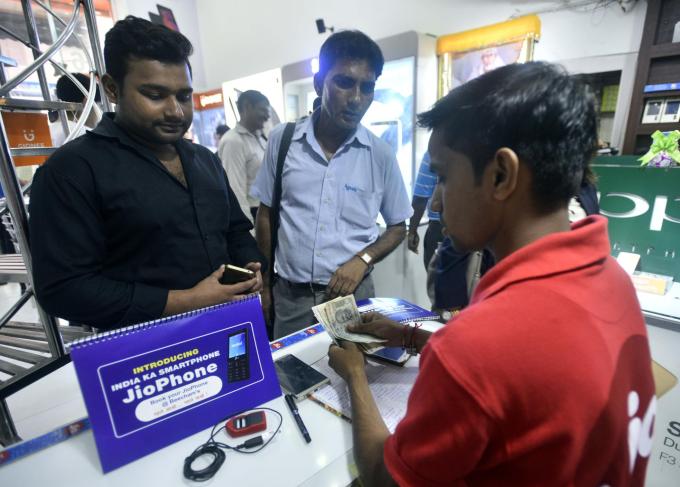
Disrupt telco Reliance Jio laid the foundation for India’s phone owners to switch to using mobile data packages (Photo by Arun Sharma/Hindustan Times via Getty Images)

For a startup like ShareChat that means tens of millions of daily active users, according to Mhatre.

Those users are drawn to ShareChat’s broadcast chat feature, which allows users on mobile phones to broadcast conversations and commentary about any topic they wish. “It’s a platform where content that is relevant to you is surfaced to you and you engage with it,” Mhatre says.

The company was founded by three Bangalore-based developers. Farid Ahsan, 26, Ankush Sachdeva, 25, and Bhanu Pratap Singh, also 26 — all graduates from India’s famous IIT Kanpur University — had worked up 17 different prototypes for a product before they finally settled on the version that would become ShareChat.

The company’s founders are also taking a page from the popular Chinese app WeChat and hope to turn their broadcast chat service into a platform for micropayments, education, and other types of entertainment.

What started as a niche site for people to communicate in their local dialects could now become the first true domestic social media giant in India.

There are other Chinese corollaries to ShareChat’s business that may be informative. Toutiao, the news aggregation service owned by Bytedance, is perhaps the closest in kind to ShareChat at the moment, but even that is only accurate to a point.

China’s infrastructure is still somewhat based on personal computers and landlines, whereas India’s is wholly mobile-first. For Mhatre, it’s the first country to make the leap to a digital economy based entirely on mobile computing.

At Lightspeed the opportunity that presents is similar to the mid-90s birth of the Internet in the U.S. and the late 2000 technology boom that created billions of dollars in value for companies like Alibaba, Baidu, and Tencent.

ShareChat is built to support India’s plethora of local languages, as opposed to English-first services like WhatsApp

What makes this feat even more impressive was that until two or three years ago, it looked like India wouldn’t be living up to the expectations that had been set for it and emerging market countries like Russia and Brazil that comprise three-fourths of the BRICs that were supposed to be the foundational building blocks of the 21st century global economy.

“If you look at China — the GDP in China is $12 to $13 trillion… India is about $2.5 trillion [but] infrastructure got developed there earlier than in India,” Mhatre said. India is at the same inflection point now, where the infrastructure boom is contributing to the development of new business models. 

The constraints of that infrastructure have also informed the business ShareChat has built as well. Because while digital penetration rates in the country are high, the download speeds are exceptionally low (due in part to overwhelming demand).

Again, the OpenSignal report is informative.

While LTE availability saw a meteoric rise, the same cannot be said of 4G speeds. In our latest State of LTE report, India occupied the lowest spot among the 77 countries we examined, with average download speeds of 6.1 Mbps, over 10 Mbps lower than the global average.

ShareChat’s focus on messaging and sharing data light images is a platform that’s suited to the current strengths and limitations of India’s infrastructure. “You have half a billion people with a high speed internet terminal in their hand and they want to do things with it,” Mhatre said. And ShareChat isn’t just localized in its tech stack. The company also is localized by language. 

As the investors at Lightspeed noted in their thoughts on the deal.

The “next billion” users in India speak 22 different languages and are spread out over an area the size of Europe. ShareChat’s founders Ankush, Bhanu and Farid blew us away with their insight into this new user base. Their first brush with this user base came in 2015 when they noticed that sharing of photos, videos, poetry, jokes and even good morning messages was at epidemic levels on WhatsApp. Yet there was no easy one-stop shop for finding this content.  ShareChat was born to solve this problem. As they developed the idea, they also saw that this audience hungered for connection and content about their cities and villages of origin. They noticed emergent behavior around users wanting to “look cool” to their friends by finding the best content, solving for loneliness by finding friends in their own language, and even wanting to drive fame and celebrity in their own geographies.  


from Social – TechCrunch https://ift.tt/2zzQZH8 India’s new technology infrastructure has created a platform to build domestic tech giants Jonathan Shieber https://ift.tt/2xPMHsW
via IFTTT

Berkanan is a Bluetooth-powered group messaging app

A new messaging app is looking to give folks a way to communicate in situations with poor or no cellular connectivity.

Berkanan, founded by Zsombor Szabó, is a group messaging app that uses Bluetooth to send and receive messages. This means that Berkanan works in a plane, at a festival, camping, or anywhere else where cellular coverage is disappointing.

Imagine people on a plane asking each other for top movie recommendations from the in-flight entertainment system, or folks at a festival figuring out a rally point to meet up between sets. Public messages auto-delete after 24 hours.

Alongside group messaging, Berkanan also allows private one-to-one messaging, as well as audio calls placed over Bluetooth. The range for these calls and messages is about 50 meters, but if there are people between you and your intended recipient with the app installed, Berkanan can send messages further by going through other users devices.

Berkanan will also show users if they are getting closer or further away from the user they’re messaging with, without ever showing either person’s exact location.

Group chatting with strangers in your location might seem a bit icky at first glance, but group chatting with strangers is essentially the basis of Twitter. With Berkanan, however, a common location replaces the #topic.

Berkanan is entirely bootstrapped, but Szabo has implemented a somewhat unconventional method of generating revenue.

Inspired by games like Fortnite, which make money off of custom skins, dances, and other virtual items, Berkanan will charge users to edit their profile. When a user logs on, their profile will consist of the name they assigned to their iPhone and their profile picture will be their initials, similar to the iOS Contacts interface.

Users can pay to add their own profile picture and add a short bio to their profile.

To be clear, it’s already possible to send SMS via Bluetooth. But Berkanan offers a way to broadcast that message to everyone (with the app) in your location. Of course, user acquisition is critical for the app, which is why Szabó is considering ways for the enterprise to take advantage of the app.


from Social – TechCrunch https://ift.tt/2Ij12mp Berkanan is a Bluetooth-powered group messaging app Jordan Crook https://ift.tt/2zzrq99
via IFTTT

Berkanan is a Bluetooth-powered group messaging app

A new messaging app is looking to give folks a way to communicate in situations with poor or no cellular connectivity.

Berkanan, founded by Zsombor Szabó, is a group messaging app that uses Bluetooth to send and receive messages. This means that Berkanan works in a plane, at a festival, camping, or anywhere else where cellular coverage is disappointing.

Imagine people on a plane asking each other for top movie recommendations from the in-flight entertainment system, or folks at a festival figuring out a rally point to meet up between sets. Public messages auto-delete after 24 hours.

Alongside group messaging, Berkanan also allows private one-to-one messaging, as well as audio calls placed over Bluetooth. The range for these calls and messages is about 50 meters, but if there are people between you and your intended recipient with the app installed, Berkanan can send messages further by going through other users devices.

Berkanan will also show users if they are getting closer or further away from the user they’re messaging with, without ever showing either person’s exact location.

Group chatting with strangers in your location might seem a bit icky at first glance, but group chatting with strangers is essentially the basis of Twitter. With Berkanan, however, a common location replaces the #topic.

Berkanan is entirely bootstrapped, but Szabo has implemented a somewhat unconventional method of generating revenue.

Inspired by games like Fortnite, which make money off of custom skins, dances, and other virtual items, Berkanan will charge users to edit their profile. When a user logs on, their profile will consist of the name they assigned to their iPhone and their profile picture will be their initials, similar to the iOS Contacts interface.

Users can pay to add their own profile picture and add a short bio to their profile.

To be clear, it’s already possible to send SMS via Bluetooth. But Berkanan offers a way to broadcast that message to everyone (with the app) in your location. Of course, user acquisition is critical for the app, which is why Szabó is considering ways for the enterprise to take advantage of the app.


https://ift.tt/2Ij12mp Berkanan is a Bluetooth-powered group messaging app https://ift.tt/2zzrq99

blogger better Headline Animator