l
l
blogger better. Powered by Blogger.

Search

Labels

blogger better

Followers

Blog Archive

Total Pageviews

Labels

Download

Blogroll

Featured 1

Curabitur et lectus vitae purus tincidunt laoreet sit amet ac ipsum. Proin tincidunt mattis nisi a scelerisque. Aliquam placerat dapibus eros non ullamcorper. Integer interdum ullamcorper venenatis. Pellentesque habitant morbi tristique senectus et netus et malesuada fames ac turpis egestas.

Featured 2

Curabitur et lectus vitae purus tincidunt laoreet sit amet ac ipsum. Proin tincidunt mattis nisi a scelerisque. Aliquam placerat dapibus eros non ullamcorper. Integer interdum ullamcorper venenatis. Pellentesque habitant morbi tristique senectus et netus et malesuada fames ac turpis egestas.

Featured 3

Curabitur et lectus vitae purus tincidunt laoreet sit amet ac ipsum. Proin tincidunt mattis nisi a scelerisque. Aliquam placerat dapibus eros non ullamcorper. Integer interdum ullamcorper venenatis. Pellentesque habitant morbi tristique senectus et netus et malesuada fames ac turpis egestas.

Featured 4

Curabitur et lectus vitae purus tincidunt laoreet sit amet ac ipsum. Proin tincidunt mattis nisi a scelerisque. Aliquam placerat dapibus eros non ullamcorper. Integer interdum ullamcorper venenatis. Pellentesque habitant morbi tristique senectus et netus et malesuada fames ac turpis egestas.

Featured 5

Curabitur et lectus vitae purus tincidunt laoreet sit amet ac ipsum. Proin tincidunt mattis nisi a scelerisque. Aliquam placerat dapibus eros non ullamcorper. Integer interdum ullamcorper venenatis. Pellentesque habitant morbi tristique senectus et netus et malesuada fames ac turpis egestas.

Tuesday, November 20, 2018

Zuckerberg won’t step down as Facebook chairman

In a short but amply-hyped interview with CNN, Facebook’s founder and chief executive again responded to criticism over the company’s most recent crisis.

The interview, excerpted from a longer Q&A for a CNN series called “Human Code,” hit most of the main questions that critics have raised about Facebook’s failings and Zuckerberg’s unilateral control over the company.

While we didn’t learn much new, we do know the company’s latest posture about a few leadership issues, the first of which being if Sheryl Sandberg remains secure in her position as COO.

“Sheryl is a really important part of this company… She’s been an important partner with me for 10 years,” Zuckerberg told CNN. “I’m really proud of the work we’ve done together and I hope that we work together for decades to come.”

That answers that, for now anyway.

The second big leadership issue: Will Zuckerberg retain all of the control he currently exercises as the chairman of Facebook’s board.

When asked if he plans to step down as chairman in the midst of his company’s latest crisis, Zuckerberg answered firmly enough to put that question to rest for now.

“That’s not the plan… I’m not currently thinking that that makes sense,” Zuckerberg told CNN.


from Social – TechCrunch https://ift.tt/eA8V8J Zuckerberg won’t step down as Facebook chairman Taylor Hatmaker https://ift.tt/2qWpzG5
via IFTTT

Our 3 favorite startups from Morgan Stanley’s 2nd Multicultural Innovation Lab Demo Day 

The Morgan Stanley Multicultural Innovation Lab, Morgan Stanley’s in-house accelerator focused on companies founded by multicultural and female entrepreneurs, hosted its second Annual Showcase and Demo Day.  The event also featured companies from accelerators HearstLab, Newark Venture Partner Labs and PS27 Ventures.  (Note: I was formerly employed by Morgan Stanley and have no financial ties.)

The showcase represented the culmination of the program’s second year, which followed an initial five company class that has already seen two acquisitions.  Through the six-month program, Morgan Stanley provides early-stage companies with a wide range of benefits including an equity investment from Morgan Stanley, office space at Morgan Stanley headquarters, access to Morgan Stanley’s extensive network, and others.  Applications are now open for its third cohort of companies with the application window closing on January 19th, 2018.

The 16 presenting startups, all led by a female or multicultural founder, offered solutions to structural inefficiencies across a wide array of categories including fintech, developer tools, and health.  Though all of the companies offered impressive presentations and strong value propositions, here are three of the companies that stood out to us.

Hatch Apps

In hopes of democratizing software and app development, Hatch Apps provides a platform that allows users and companies to build iOS, Android and web applications without any code through pre-built templates and custom plug-and-play functions.  In essence, Hatch Apps provides a solution for application building similar to what Squarespace or Wix provide for websites.

In the modern economy, every company is in one way or another a tech or tech-enabled company.  Now the demand for strong engineers has made the fight for talent increasingly competitive and has made engineering quite costly, even when only needed for simple tasks. 

For an implementation and subscription fee, Hatch Apps allows companies with less sophisticated engineering DNA to reduce entering costs by launch native apps on their own, across platforms, and often on faster timelines than those seen through third-party developers.  Once an app is launched, Hatch Apps provides customers with detailed analytics and allows them to send targeted push notifications, export data and make in-app changes that can automatically go live in app stores.

The company initially took a bootstrapping approach to financing and raised funds by selling a 2016 election-themed “Cards Against Humanity”-style game created on the platform.  Since then, Hatch Apps has already received funding from the Y Combinator Fellowship, Morgan Stanley, and a number of other investors.

FreeWill

While estate planning is a topic many don’t like to think about, it’s a critical issue for managing cross-generational wealth. But will drafting can often be very complex, time-consuming, and costly, requiring hours of legal consultation and coordination between various parties.

Founded by two former classmates at Stanford Business School, FreeWill looks to simplify the estate planning process by providing a free online platform that automates will drafting, in a similar function to what TurboTax does for taxes.  Using FreeWill, users can quickly set allocations for their estate and select personal recipients, charitable donations, executor specifications, and other ancillary requests.  The platform then creates a finalized legal document that is legally valid in all 50 states, which users can also quickly make changes to and replace without incurring expensive legal costs.

FreeWill is able to provide the platform to consumers for free due to the proceeds it receives from its non-profit customers, who pay to be featured on the platform as a partner organization.  FreeWill offers a compelling value proposition for partnering companies.  By acting as a channel to funnel user donations to listed organizations, FreeWill has been able to drive a 600% increase in charitable giving to partner organizations on average.  FreeWill also provides partner organizations with backing analytics that allow non-profits to track bequests and donors through monthly reports. 

FreeWill currently boasts an impressive roster of 75 paying non-profit partners that include American Red Cross, Amnesty International and many others.  In the long-run hopes to be the go-to solution financial and legal end of life planning for investment advisors, life insurance and employee benefits providers.

Shoobs

Shoobs is looking to be the go-to platform for local “urban” events, which the company defined as events centered on local nightlife, comedy and concerts in the hip-hop, R&B, and reggae genres to name a few.  But unlike the genre-agnostic, transaction-focused event management platforms that can make the space seem pretty crowded, Shoobs focused on providing genre-specific even discovery.  Shoobs matches urban event goers with artists of their choice and related smaller scale events that can be harder to discover, acting as a form of curation, quality control and discovery.

For event organizers, Shoobs helps provide digital ticketing and promotion services, with event recommendation capabilities that target the most promising potential customers.  Through its offering to event organizers, Shoobs is able to monetize its services through ticket sale commission, advertising and brand partnerships.

Since its initial launch in London, Shoobs notes it has become one of the top urban events platforms in the city, with an extensive base of recurring registered users and event organizers.  After previously working with AEG for its London launch, Shoobs is looking to expand stateside with the help of organizers like Live Nation.  Shoobs joins a long list of promising Y Combinator alumni companies with YC also acting as one of Shows initial investors

Other presenting companies included:

Morgan Stanley Multicultural Innovation Lab

  • BeautyLynk “is an on-demand hair and makeup service provider, specializing in customizable services for women.”
  • Broadway Roulette “is an events marketplace that pairs consumers with surprise cultural events, beginning with Broadway theater.”
  • CariClub “is an enterprise software platform to connect young professionals with nonprofit opportunities.”
  • COI Energy Services “is an integrated platform for electric utilities and business users to optimize and manage energy usage.”
  • CoSign “is an API and application that allows anyone to create, distribute and monetize visual content.”
  • Goalsetter “is a goals-based gifting, savings, and investing platform designed for children.”
  • myLAB Box “offers customizable at home health-test kits and relevant telemedicine consultations / prescription services.”

Hearst Labs

  • Priori “is a global legal marketplace changing the way in-house teams find, hire, and manage outside counsel.”
  • TRENCH “is an online fashion marketplace that makes use of the unworn items in every woman’s closet.”

Newark Venture Partners Labs

  • Floss Bar “is a new type of preventive brand for oral health care. The company offers high-quality, routine dental care across flexible locations at thoughtful prices.”
  • Upsider “is a software solution allowing recruiters to leverage AI technology to identify a comprehensive set of candidates who align with their business and role requirements, resulting in a more strategic understanding of the best possible talent for the job.”

PS27 Ventures

  • BlueWave Technologies “is a cleantech company and the creators of the BlueWave™ Cleaning System — a water free, detergent free, and chemical free plasma device that cleans items that are extremely hard or impossible to clean with a washer and dryer.”
  • OnPay Solutions “focuses exclusively on business-to-business payments. They create payment software and offer payment web services to enhance efficiency and productivity for Accounts Payable and Accounts Receivable.”


https://ift.tt/2nc26iu Our 3 favorite startups from Morgan Stanley’s 2nd Multicultural Innovation Lab Demo Day  https://ift.tt/2TymCsD

Piano teams up with True[x] to combine advertising and paywalls

Nearly every online publisher has launched or announced a paywall — but of course, even the ones who are successful won’t convince every reader, or even the majority of readers, to sign up. Now Piano and True[x] say they’ve found more effective way to monetize the rest of the audience, without threatening crucial subscription revenue.

Piano is a company that’s built a range of publisher tools, including paywall and subscription management. True[X], meanwhile, is an adtech company that was acquired by 21st Century Fox a few years ago.

Piano’s global head of business development Jonas Rideout said the collaboration will allow publishers to present different messages to different audience members. This is something that Piano has been working on already, but by working with True[x] specifically, it can present readers with the option to (temporarily) circumvent the paywall by watching a premium video ad.

According to Rideout, this takes advantage of Piano’s “out of the box segmentation,” which assesses reader loyalty based on things like how often they visit a site, where they’re coming from and how many pages they visit. It probably makes more sense to ask the most loyal readers to subscribe (since they’re the most likely to convert), but there’s another subset of readers who may be interested in the content, but aren’t actually going to pay — at least, not yet.

Those are the ones who will have the option to see an ad, so the publisher is still making money, and they’re also keeping the reader engaged in case they want to subscribe down the road.

“Maybe 1 to 3 percent of that audience is going to subscribe, but you’re worried about cooking your golden goose [by giving them a way to get around the paywall],” said Chris Shively, True[x]’s director of global business development. “Now you can actually provide that other 97 percent of the audience with a different experience. They’re getting to enjoy the product while you’re getting a significantly higher CPM.”

Ad Age Piano

Shively declined to specify how well these ads monetize, except to say that they’re priced “significantly higher” than a standard display or video ad. He also said, “It’s very important to us that the user has a choice” — so even if you’re given the ad option, you can still choose to subscribe instead.

And to be clear, these ads aren’t an indefinite free pass. It’s a metered system, where the publisher can let the reader through the paywall a set number of times before they really do have to pay.

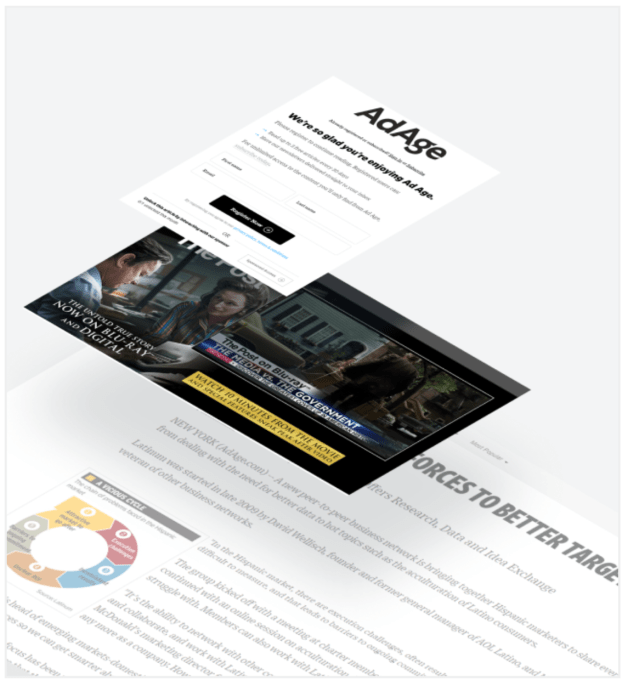
Piano and True[x] have already been testing this out with Ad Age, where they found that the visitors asked to view a video ad were significantly more likely to register later on. Among readers who watched the ad, there was a 17x increase in the current conversion rate, but even if you look at readers who were given the option and didn’t watch it, they were 3x more likely to register than those who were only presented with the registration option.

Rideout also noted that not every Piano publisher makes money through subscriptions (in fact, TechCrunch is a publisher that uses Piano for non-paywall purposes). So he said the team has been talking about “how else this could be applicable,” like helping publishers drive readers to signup for giveaways or to provide some of their data.

“It’s not just paid content sites — there are opportunities for other types of content,” he said.


https://ift.tt/2S2Qfk4 Piano teams up with True[x] to combine advertising and paywalls https://ift.tt/2DPLqaW

How a small French privacy ruling could remake adtech for good

A ruling in late October against a little known French adtech firm that popped up on the national data watchdog’s website earlier this month, is causing ripples of excitement to run through privacy watchers in Europe who believe it signals the beginning of the end for creepy online ads.

The excitement is palpable.

Impressively so, given the dry CNIL decision against mobile ‘demand side platform’, Vectaury, was only published in the regulator’s native dense French legalese.

Digital advertising trade press AdExchanger picked up on the decision yesterday.

Here’s the killer paragraph from CNIL’s ruling — translated into “rough English” by my TC colleague Romain Dillet:

The requirement based on the article 7 above-mentioned isn’t fulfilled with a contractual clause that guarantees validly collected initial consent. The company VECTAURY should be able to show, for all data that it is processing, the validity of the expressed consent.

In plainer English this is being interpreted by data experts as the regulator stating that consent to processing personal data cannot be gained through a framework arrangement which bundles a number of uses behind a single ‘I agree’ button that, when clicked, passes consent to partners via a contractual relationship.

CNIL’s decision suggests that bundling consent to partner processing in a contract is not, in and of itself, valid consent under the European Union’s General Data Protection Regulation (GDPR) framework.

Consent under this regime must be specific, informed and freely given. It says as much in the text of GDPR.

But now, on top of that, the CNIL’s ruling suggests a data controller has to be able to demonstrate the validity of the consent — so cannot simply tuck consent inside a contractual ‘carpet bag’ that gets passed around to everyone else in their chain as soon as the user clicks ‘I agree’.

This is important because many widely used digital advertising consent frameworks rolled out to websites in Europe this year — in claimed compliance with GDPR — are using a contractual route to obtain consent, and bundling partner processing behind often hideously labyrinthine consent flows.

The experience for web users in the EU right now is not great. But it could be leading to a much better Internet down the road.

Where’s the consent for partner processing?

Even on a surface level the current crop of confusing consent mazes look problematic.

But the CNIL ruling suggests there are deeper and more structural problems lurking and embedded within. And as regulators dig in and start to unpick adtech contradictions it could force a change of mindset across the entire ecosystem.

As ever, when talking about consent and online ads the overarching point to remember is that no consumer given a genuine full disclosure about what’s being done with their personal data in the name of behavioral advertising would freely consent to personal details being hawked and traded across the web just so a bunch of third parties can bag a profit share.

This is why, despite GDPR being in force (since May 25), there is still so many tortuously confusing ‘consent flows’ in play.

The long-standing online T&Cs trick of obfuscating and socially engineering consent remains an unfortunately standard playbook. But, less than six months into GDPR we’re still very much in a ‘phoney war’ phase. More regulatory rulings are needed to lay down the rules by actually enforcing the law.

And CNIL’s recent activity suggests more to come.

In the Vectaury case, the mobile ad firm used a template framework for its consent flow that had been created by industry trade association and standards body, IAB Europe.

It did make some of its own choices, using its own wording on an initial consent screen and pre-ticking the purposes (another big GDPR no-no). But the bundling of data purposes behind a single opt in/out button is the core IAB Europe design. So CNIL’s ruling suggests there could be trouble ahead for other users of the template.

IAB Europe’s CEO, Townsend Feehan, told us it’s working on a statement reaction to the CNIL decision but suggested Vectaury fell foul of the regulator because it may not have implemented the “Transparency & Consent Framework-compliant” consent management platform (CMP) framework — as it’s tortuously known — correctly.

So either “the ‘CMP’ that they implemented did not align to our Policies, or choices they could have made in the implementation of their CMP that would have facilitated compliance with the GDPR were not made”, she suggested to us via email.

Though that sidesteps the contractual crux point that’s really exciting privacy advocates — and making them point to the CNIL as having slammed the first of many unbolted doors.

The French watchdog has made a handful of other decisions in recent months also involving geolocation-harvesting adtech firms, and also for processing data without consent.

So regulatory activity on the GDPR+adtech front has been ticking up.

Its decision to publish these rulings suggests it has wider concerns about the scale and privacy risks of current programmatic ad practices in the mobile space than can be attached to any single player.

So the suggestion is that just publishing the rulings looks intended to put the industry on notice…

Meanwhile adtech giant Google has also made itself unpopular with publisher ‘partners’ over its approach to GDPR by forcing them to collect consent on its behalf. And in May a group of European and international publishers complained that Google was imposing unfair terms on them.

The CNIL decision could sharpen that complaint too — raising questions over whether audits of publishers that Google said it would carry out will be enough for the arrangement to pass regulatory muster.

For a demand-side platform like Vectaury, which was acting on behalf of more than 32,000 partner mobile apps with user eyeballs to trade for ad cash, achieving GDPR compliance would mean either asking users for genuine consent and/or having a very large number of contracts that it’s doing actual due diligence on.

Yet Google is orders of magnitude more massive of course.

The Vectaury file gives us a fascinating little glimpse into adtech ‘business as usual’. Business which also wasn’t, in the regulator’s view, legal.

The firm was harvesting a bunch of personal data (including people’s location and device IDs) on its partners’ mobile users via an SDK embedded in their apps, and receiving bids for these users’ eyeballs via another standard piece of the programmatic advertising pipe — ad exchanges and supply side platforms — which also get passed personal data so they can broadcast it widely via the online ad world’s real time bidding (RTB) system. That’s to solicit potential advertisers’ bids for the attention of the individual app user… The wider the personal data gets spread, the more potential ad bids.

That scale is how programmatic works. It also looks horrible from a GDPR ‘privacy by design and default’ standpoint.

The sprawling process of programmatic explains the very long list of ‘partners’ nested non-transparently behind the average publisher’s online consent flow. The industry, as it is shaped now, literally trades on personal data.

So if the consent rug it’s been squatting on for years suddenly gets ripped out from underneath it there would need to be radical reshaping of ad targeting practices to avoid trampling on EU citizens’ fundamental right.

GDPR’s really big change was supersized fines. So ignoring the law would get very expensive.

Oh hai real time bidding!

In Vectaury’s case CNIL discovered the company was holding the personal data of a staggering 67.6 million people when it conducted an on-site inspection of the company in April 2018.

That already sounds like A LOT of data for a small mobile adtech player. Yet it might actually have been a tiny fraction of the personal data the company was routinely handling — given that Vectaury’s own website claims 70% of collected data is not stored.

In the decision there was no fine but CNIL ordered the firm to delete all data it had not already deleted (having judged collection illegal given consent was not valid); and to stop processing data without consent.

But given the personal-data-based hinge of current-gen programmatic adtech that essentially looks like an order to go out of business. (Or at least out of that business.)

And now we come to another interesting GDPR adtech complaint that’s not yet been ruled on by the two DPAs in question (Ireland and the UK) — but which looks even more compelling in light of the CNIL Vectaury decision because it picks at the adtech scab even more daringly.

Filed last month with the Irish Data Protection Commission and the UK’s ICO, this adtech complaint — the work of three individuals, Johnny Ryan of private web browser Brave; Jim Killock, exec director of digital and civil rights group, the Open Rights Group; and University College London data protection researcher, Michael Veale — targets the RTB system itself.

Here’s how Ryan, Killock and Veale summarized the complaint when they announced it last month:

Every time a person visits a website and is shown a “behavioural” ad on a website, intimate personal data that describes each visitor, and what they are watching online, is broadcast to tens or hundreds of companies. Advertising technology companies broadcast these data widely in order to solicit potential advertisers’ bids for the attention of the specific individual visiting the website.

A data breach occurs because this broadcast, known as an “bid request” in the online industry, fails to protect these intimate data against unauthorized access. Under the GDPR this is unlawful.

The GDPR, Article 5, paragraph 1, point f, requires that personal data be “processed in a manner that ensures appropriate security of the personal data, including protection against unauthorised or unlawful processing and against accidental loss.” If you can not protect data in this way, then the GDPR says you can not process the data.

Ryan tells TechCrunch that the crux of the complaint is not related to the legal basis of the data sharing but rather focuses on the processing itself — arguing “that it itself is not adequately secure… that they’re aren’t adequate controls”.

Though he says there’s a consent element too, and so sees the CNIL ruling bolstering the RTB complaint. (On that keep in mind that CNIL judged Vectaury should not have been holding the RTB data of 67.6M people because it did not have valid consent.)

“We do pick up on the issue of consent in the complaint. And this particular CNIL decision has a bearing on both of those issues,” he argues. “It demonstrates in a concrete example that involved investigators going into physical premises and checking the machines — it demonstrates that even one small company was receiving tens of millions of people’s personal data in this illegal way.

“So the breach is very real. And it demonstrates that it’s not unreasonable to suggest that the consent is meaningless in any case.”

Reaching for a handy visual explainer, he continues: “If I leave a briefcase full of personal data in the middle of Charing Cross station at 11am and it’s really busy that’s a breach. That would have been a breach back in the 1970s. If my business model is to drive up to Charing Cross station with a dump-truck and dump briefcases onto the street at 11am in the full knowledge that my business partners will all scramble around and try and grab them — and then to turn up at 11.01am and do the same thing. And then 11.02am. And every microsecond in between. That’s still a fucking data breach!

“It doesn’t matter if you think you’ve consent or anything else. You have to [comply with GDPR Article 5, paragraph 1, point f] in order to even be able to ask for a legal basis. There are plenty of other problems but that’s the biggest one that we highlighted. That’s our reason for saying this is a breach.”

“Now what CNIL has said is this company, Vectaury, was processing personal data that it did not lawfully have — and it got them through RTB,” he adds, spelling the point out. “So back to the GDPR — GDPR is saying you can’t process data in a way that doesn’t ensure protection against unauthorized or unlawful processing.”

In other words, RTB as a funnel for processing personal data looks to be on inherently shaky ground because it’s inherently putting all this personal data out there and at risk…

What’s bad for data brokers…

In another loop back, Ryan says the regulators have been in touch since their RTB complaint was filed to invite them to submit more information.

He says the CNIL Vectaury decision will be incorporated into further submissions, predicting: “This is going to be bounced around multiple regulators.”

The trio is keen to generate extra bounce by working with NGOs to enlist other individuals to file similar complaints in other EU Member States — to make the action a pan-European push, just like programmatic advertising itself.

“We now have the opportunity to connect our complaint with the excellent work that Privacy International has done, showing where these data end up, and with the excellent work that CNIL has done showing exactly how this actually applies. And this decision from CNIL takes, essentially my report that went with our complaint and shows exactly how that applies in the real world,” he continues.

“I was writing in the abstract — CNIL has now made a decision that is very much not in the abstract, it’s in the real world affecting millions of people… This will be a European-wide complaint.”

But what does programmatic advertising that doesn’t entail trading on people’s grubbily obtained personal data actually look like? If there were no personal data in bid requests Ryan believes quite a few things would happen. Such as, for e.g., the demise of clickbait.

“There would be no way to take your TechCrunch audience and buy it cheaper on some shitty website. There would be no more of that arbitrage stuff. Clickbait would die! All that nasty stuff would go away,” he suggests.

(And, well, full disclosure: We are TechCrunch — so we can confirm that does sound really great to us!)

He also reckons ad values would go up. Which would also be good news for publishers. (“Because the only place you could buy the TechCrunch audience would be on TechCrunch — that’s a really big deal!”)

He even suggests ad fraud might shrink because the incentives would shift. Or at least they could so long as the “worthy” publishers that are able to survive in the new ad world order don’t end up being complicit with bot fraud anyway.

As it stands, publishers are being screwed between the twin plates of the dominant adtech plaforms (Google and Facebook), where they are having to give up a majority of their ad revenue — leaving the media industry with a shrinking slice of ad revenues (that can be as lean as ~30%).

That then has a knock on impact on funding newsrooms and quality journalism. And, well, on the wider web too — given all the weird incentives that operate in today’s big tech social media platform dominated Internet.

While a privacy-sucking programmatic monster is something only shadowy background data brokers that lack any meaningful relationships with the people whose data they’re feeding the beast could truly love.

And, well, Google and Facebook.

Ryan’s view is that the reason an adtech duopoly exists boils down to the “audience leakage” being enabled by RTB. Leakage which, in his view, also isn’t compliant with EU privacy laws.

He reckons the fix for this problem is equally simple: Keep doing RTB but without any personal data.

A real-time ad bidding system that’s been stripped of personal data does not mean no targeted ads. It could still support ad targeting based on real-time factors such as an approximate location (say to a city region) and/or generic and aggregated data.

Crucially it would not use unique identifiers that enable linking ad bids to a individual’s entire digital footprint and bid request history — as is the case now. Which essentially translates into: RIP privacy rights.

Ryan argues that RTB without personal data would still offer plenty of “value” to advertisers — who could still reach people based on general locations and via real-time interests. (It’s a model that sounds much like what privacy search engine DuckDuckGo is doing, and also been growing.)

The really big problem, though, is turning the behavioral ad tanker around. Given that the ecosystem is embedded, even as the duopoly milks it.

That’s also why Ryan is so hopeful now, though, having parsed the CNIL decision.

His reading is regulators will play a decisive role in pushing the ad industry’s trigger — and force through much-needed change in their targeting behavior.

“Unless the entire industry moves together, no one can be the first to remove personal data from bid requests but if the regulators step in in a big way… and say you’re all going to go out of business if you keep putting personal data into bid requests then everyone will come together — like the music industry was forced to eventually, under Steve Jobs,” he argues. “Everyone can together decide on a new short term disadvantageous but long term highly advantageous change.”

Of course such a radical reshaping is not going to happen overnight. Regulatory triggers tend to be slow motion unfoldings at the best of times. You also have to factor in the inexorable legal challenges.

But look closely and you’ll see both momentum massing behind privacy — and regulatory writing on the wall.

“Are we going to see programmatic forced to be non-personal and therefore better for every single citizen of the world (except, say, if they work for a data broker),” adds Ryan, posing his own concluding question.”Will that massive change, which will help society and the web… will that change happen before Christmas? No. But it’s worth working on. And it’s going to take some time

“It could be two years from now that we have the finality. But a finality there will be. Detroit was only able to fight against regulation for so long. It does come.”

Who’d have though ‘taking back control’ could ever sound so good?


from Social – TechCrunch https://ift.tt/eA8V8J How a small French privacy ruling could remake adtech for good Natasha Lomas https://ift.tt/2Bmt1zN
via IFTTT

LinkedIn launches its own Snapchat Stories: “Student Voices”

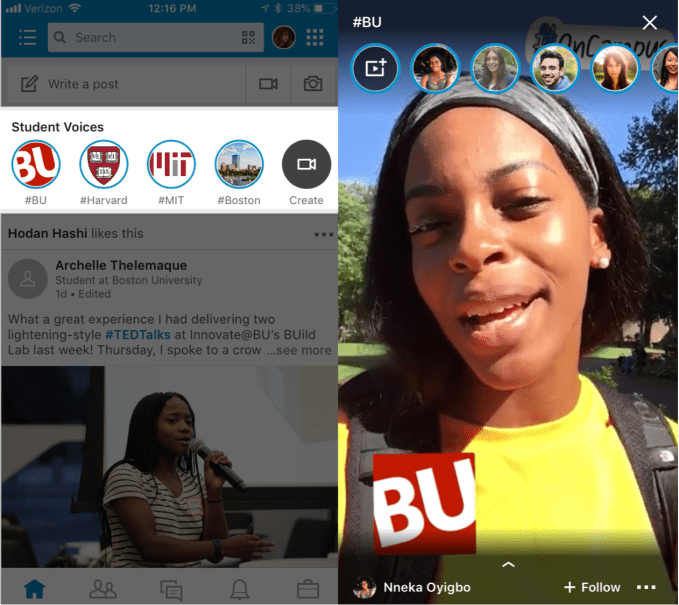
The social media singularity continues with the arrival of Snapchat Stories-style slideshows on LinkedIn as the app grasps for relevance with a younger audience. LinkedIn confirms to TechCrunch that it plans to build Stories for more sets of users, but first it’s launching “Student Voices” just for university students in the US. The feature appears atop the LinkedIn home screen and lets students post short videos to their Campus Playlist. The videos (no photos allowed) disappear from the playlist after a week while staying permanently visible on a user’s own profile in the Recent Activity section. Students can tap through their school’s own slideshow and watch the Campus Playlists of nearby universities.

LinkedIn now confirms the feature is in testing, with product manager Isha Patel telling TechCrunch “Campus playlists are a new video feature that we’re currently rolling out to college students in the US. As we know, students love to use video to capture moments so we’ve created this new product to help them connect with one another around shared experiences on campus to help create a sense of community.” Student Voices was first spotted by social consultant Carlos Gil, and tipped by Socially Contented’s Cathy Wassell to Matt Navarra.

A LinkedIn spokesperson tells us the motive behind the feature is to get students sharing their academic experiences like internships, career fairs, and class projects that they’d want to show off to recruiters as part of their personal brand. “It’s a great way for students to build out their profile and have this authentic content that shows who they are and what their academic and professional experiences have been. Having these videos live on their profile can help students grow their network, prepare for life after graduation, and help potential employers learn more about them” Patel says.

But unfortunately that ignores the fact that Stories were originally invented for broadcasting off-the-cuff moments that disappear so you DON’T have to worry about their impact on your reputation. That dissonance might confuse users, discourage them from posting to Student Voices, or lead them to assume their clips will disappear from their profile too — which could leave embarrassing content exposed to hirers. “Authenticity” might not necessarily paint users in the best light to recruiters, so it seems more likely that students would post polished clips promoting their achievements…if they use it at all.

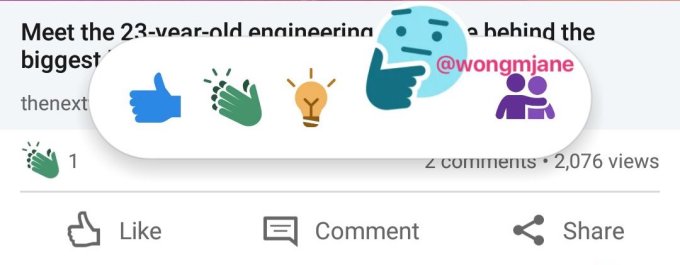
LinkedIn seems to be desperate to appeal to the next generation. Social app investigator and TechCrunch’s favorite tipster Jane Manchun Wong today spotted 10 minor new features LinkedIn is prototyping that include youth-centric options like GIF comments, location sharing in messages, and Facebook Reactions-style buttons beyond “Like” such as “Clap”, “Insightful”, “Hmm”, and “Support”.

When users post to Student Stories, they’ll have their university’s logo overlaid as a sticker they can move around. LinkedIn will generate this plus a set of suggested hashtags like #OnCampus based on a user’s profile including what school they say they attend, though users can also overlay their own text captions. Typically, users in the test phase were sharing videos of around 30 to 45 seconds. “Students are taking us to their school hackathons, showing us their group projects, sharing their student group activities and teaching us about causes they care about” Patel explains. You can see an example video here, and watch a sizzle reel about the feature below.

For now, LinkedIn tells me it has no plans to insert ads between clips in Student Voices. But if the Stories content assists with discovering and vetting job candidates, it could make LinkedIn more unique and indispensable to recruiters who do pay for premium access. And if these Stories get a ton of views simply by being emblazoned atop the LinkedIn feed, users might return to the app more frequently to share them. As we’ve seen with the steady increase in popularity of Facebook Stories, if you give people a stage for narcissism, they will fill it.

LinkedIn’s start as a dry web tool for seeking jobs has made for a rocky transition as it tries to become a daily habit for users. Some tactical advice in its feed can be helpful, but much of LinkedIn’s content feels blatantly self-promotional, boring, or transactional. Meanwhile, it’s encountering new competition as Facebook integrates career listings and job applications for blue-collar work into its social network that already sees over a billion people visit each day. It’s understandable why LinkedIn would try to latch on to the visual communication trend, as Facebook estimates Stories sharing will surpass feed sharing across all apps in 2019. But Student Voices nonetheless feels unabashedly “how do you do, fellow kids?”


from Social – TechCrunch https://ift.tt/2qYxYcg LinkedIn launches its own Snapchat Stories: “Student Voices” Josh Constine https://ift.tt/2R3PEPb
via IFTTT

LinkedIn launches its own Snapchat Stories: “Student Voices”

{rss:content:encoded} LinkedIn launches its own Snapchat Stories: “Student Voices” https://ift.tt/2R3PEPb https://ift.tt/2qYxYcg November 20, 2018 at 08:37PM

The social media singularity continues with the arrival of Snapchat Stories-style slideshows on LinkedIn as the app grasps for relevance with a younger audience. LinkedIn confirms to TechCrunch that it plans to build Stories for more sets of users, but first it’s launching “Student Voices” just for university students in the US. The feature appears atop the LinkedIn home screen and lets students post short videos to their Campus Playlist. The videos (no photos allowed) disappear from the playlist after a week while staying permanently visible on a user’s own profile in the Recent Activity section. Students can tap through their school’s own slideshow and watch the Campus Playlists of nearby universities.

LinkedIn now confirms the feature is in testing, with product manager Isha Patel telling TechCrunch “Campus playlists are a new video feature that we’re currently rolling out to college students in the US. As we know, students love to use video to capture moments so we’ve created this new product to help them connect with one another around shared experiences on campus to help create a sense of community.” Student Voices was first spotted by social consultant Carlos Gil, and tipped by Socially Contented’s Cathy Wassell to Matt Navarra.

A LinkedIn spokesperson tells us the motive behind the feature is to get students sharing their academic experiences like internships, career fairs, and class projects that they’d want to show off to recruiters as part of their personal brand. “It’s a great way for students to build out their profile and have this authentic content that shows who they are and what their academic and professional experiences have been. Having these videos live on their profile can help students grow their network, prepare for life after graduation, and help potential employers learn more about them” Patel says.

But unfortunately that ignores the fact that Stories were originally invented for broadcasting off-the-cuff moments that disappear so you DON’T have to worry about their impact on your reputation. That dissonance might confuse users, discourage them from posting to Student Voices, or lead them to assume their clips will disappear from their profile too — which could leave embarrassing content exposed to hirers. “Authenticity” might not necessarily paint users in the best light to recruiters, so it seems more likely that students would post polished clips promoting their achievements…if they use it at all.

LinkedIn seems to be desperate to appeal to the next generation. Social app investigator and TechCrunch’s favorite tipster Jane Manchun Wong today spotted 10 minor new features LinkedIn is prototyping that include youth-centric options like GIF comments, location sharing in messages, and Facebook Reactions-style buttons beyond “Like” such as “Clap”, “Insightful”, “Hmm”, and “Support”.

When users post to Student Stories, they’ll have their university’s logo overlaid as a sticker they can move around. LinkedIn will generate this plus a set of suggested hashtags like #OnCampus based on a user’s profile including what school they say they attend, though users can also overlay their own text captions. Typically, users in the test phase were sharing videos of around 30 to 45 seconds. “Students are taking us to their school hackathons, showing us their group projects, sharing their student group activities and teaching us about causes they care about” Patel explains. You can see an example video here, and watch a sizzle reel about the feature below.

For now, LinkedIn tells me it has no plans to insert ads between clips in Student Voices. But if the Stories content assists with discovering and vetting job candidates, it could make LinkedIn more unique and indispensable to recruiters who do pay for premium access. And if these Stories get a ton of views simply by being emblazoned atop the LinkedIn feed, users might return to the app more frequently to share them. As we’ve seen with the steady increase in popularity of Facebook Stories, if you give people a stage for narcissism, they will fill it.

LinkedIn’s start as a dry web tool for seeking jobs has made for a rocky transition as it tries to become a daily habit for users. Some tactical advice in its feed can be helpful, but much of LinkedIn’s content feels blatantly self-promotional, boring, or transactional. Meanwhile, it’s encountering new competition as Facebook integrates career listings and job applications for blue-collar work into its social network that already sees over a billion people visit each day. It’s understandable why LinkedIn would try to latch on to the visual communication trend, as Facebook estimates Stories sharing will surpass feed sharing across all apps in 2019. But Student Voices nonetheless feels unabashedly “how do you do, fellow kids?”

Facebook is finally rolling out its “how long do I spend on Facebook” dashboard

15 weeks after Facebook announced its “Your Time On Facebook” tool that counts how many minutes you spend on the app, the feature is finally rolling out around the world. Designed to help you manage your social networking, the dashboard reveals how many minutes you’ve spent on Facebook’s app on that device each day for the past week and on average.

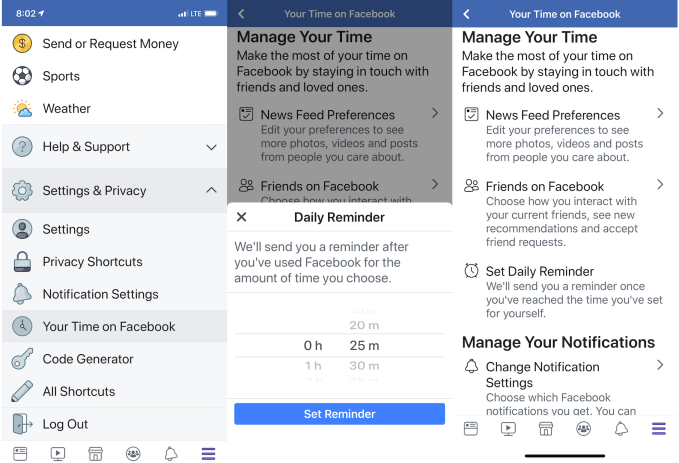
You can set a daily limit and receive a reminder to stop after that many minutes each day, plus access shortcuts to notification ,News Feed, and Friend Request settings. Those last two shortcuts are new, but otherwise the feature works the same as when it was previewed. You can access it by going to Facebook’s More tab -> Settings & Privacy -> Your Time On Facebook.
TechCrunch first broke the news that Facebook was working on the feature in June. Facebook gave some explanation for the delayed access to the feature, with spokespeople telling me “We typically rollout features slowly so we can catch bugs early and resolve them quickly. We slowed the rollout of the tools after launch so our teams could fix a few bugs before we expanded globally” and that “the tools will continue rolling out over the next few weeks.” Social consultant Matt Navarra had spotted the tool reaching more users today.

With the launches of similar tools as part of the latest versions of iOS and Android, plus the roll out of the similar Your Activity tab on Instagram last week, digital well-being features are becoming available to a wide swath of smart phone users. The question is whether simply burying these features in the Settings menus is enough to actually get people to shift towards healthier behavior.

Facebook and Instagram’s versions are particularly toothless. There are no options to force you to ease off your usage, just a quick daily limit notification to dismiss. iOS 12’s Screen Time at least delivery’s a weekly usage report by default so the feature finds you even if you don’t go looking for it. And Android’s new Digital Wellbeing dashboard is by far the most powerful, graying out app icons and requiring you to dig into your settings to unlock apps once you hit your daily limit. Facebook doesn’t necessarily need to force heavier restrictions on us, but it should at least provide more compelling optional tools to actually make us put our phones down and look up at the real world.

Facebook’s dashboard doesn’t integrate with Instagram’s, which would give people a more holistic sense of their activity on the social networks. You also won’t have your desktop Facebooking or time on secondary mobile devices like tablets tabulated here either.

But the biggest flaw remains that Your Time On Facebook treats all time the same. That seems to ignore the research Facebook itself has presented about digital well-being on social networks, as well as CEO Mark Zuckerberg’s comments on what constitutes healthy and unhealthy behavior. Zuckerberg said on the Q1 2018 earnings call “the well-being research that we’ve done . . . suggests that when people use the Internet for interacting with people and building relationships, that is correlated with all the positive measures of well-being that you’d expect — like longer term health and happiness, feeling more connected and less lonely – whereas just passively consuming content is not necessarily positive on those dimensions.”

Yet you can’t tell active and passive Facebooking apart from the dashboard. There’s no way to see a breakdown of how long you spend browsing the News Feed, watching Stories, or exploring photos on profiles versus creating posts or comments, messaging, or interacting in Groups. That segmentation would give users a much clearer view of where they’re spending or wasting hours, and what they could do to make their usage healthier. Hopefully with time, Facebook gives the dashboard more nuance so we can track not just time, but time well spent.


from Social – TechCrunch https://ift.tt/2qXXkXw Facebook is finally rolling out its “how long do I spend on Facebook” dashboard Josh Constine https://ift.tt/2zj3ztQ
via IFTTT

Facebook is finally rolling out its “how long do I spend on Facebook” dashboard

{rss:content:encoded} Facebook is finally rolling out its “how long do I spend on Facebook” dashboard https://ift.tt/2zj3ztQ https://ift.tt/2qXXkXw November 20, 2018 at 06:32PM

15 weeks after Facebook announced its “Your Time On Facebook” tool that counts how many minutes you spend on the app, the feature is finally rolling out around the world. Designed to help you manage your social networking, the dashboard reveals how many minutes you’ve spent on Facebook’s app on that device each day for the past week and on average.

You can set a daily limit and receive a reminder to stop after that many minutes each day, plus access shortcuts to notification ,News Feed, and Friend Request settings. Those last two shortcuts are new, but otherwise the feature works the same as when it was previewed. You can access it by going to Facebook’s More tab -> Settings & Privacy -> Your Time On Facebook.

TechCrunch first broke the news that Facebook was working on the feature in June. Facebook gave some explanation for the delayed access to the feature, with spokespeople telling me “We typically rollout features slowly so we can catch bugs early and resolve them quickly. We slowed the rollout of the tools after launch so our teams could fix a few bugs before we expanded globally” and that “the tools will continue rolling out over the next few weeks.” Social consultant Matt Navarra had spotted the tool reaching more users today.

With the launches of similar tools as part of the latest versions of iOS and Android, plus the roll out of the similar Your Activity tab on Instagram last week, digital well-being features are becoming available to a wide swath of smart phone users. The question is whether simply burying these features in the Settings menus is enough to actually get people to shift towards healthier behavior.

Facebook and Instagram’s versions are particularly toothless. There are no options to force you to ease off your usage, just a quick daily limit notification to dismiss. iOS 12’s Screen Time at least delivery’s a weekly usage report by default so the feature finds you even if you don’t go looking for it. And Android’s new Digital Wellbeing dashboard is by far the most powerful, graying out app icons and requiring you to dig into your settings to unlock apps once you hit your daily limit. Facebook doesn’t necessarily need to force heavier restrictions on us, but it should at least provide more compelling optional tools to actually make us put our phones down and look up at the real world.

Facebook’s dashboard doesn’t integrate with Instagram’s, which would give people a more holistic sense of their activity on the social networks. You also won’t have your desktop Facebooking or time on secondary mobile devices like tablets tabulated here either.

But the biggest flaw remains that Your Time On Facebook treats all time the same. That seems to ignore the research Facebook itself has presented about digital well-being on social networks, as well as CEO Mark Zuckerberg’s comments on what constitutes healthy and unhealthy behavior. Zuckerberg said on the Q1 2018 earnings call “the well-being research that we’ve done . . . suggests that when people use the Internet for interacting with people and building relationships, that is correlated with all the positive measures of well-being that you’d expect — like longer term health and happiness, feeling more connected and less lonely – whereas just passively consuming content is not necessarily positive on those dimensions.”

Yet you can’t tell active and passive Facebooking apart from the dashboard. There’s no way to see a breakdown of how long you spend browsing the News Feed, watching Stories, or exploring photos on profiles versus creating posts or comments, messaging, or interacting in Groups. That segmentation would give users a much clearer view of where they’re spending or wasting hours, and what they could do to make their usage healthier. Hopefully with time, Facebook gives the dashboard more nuance so we can track not just time, but time well spent.

Cloud communications platform Agora closes $70M Series C to create new developer tools

Part of Agora’s team. The cloud communications startup has offices in Santa Clara and Shanghai.

Agora, a developer of cloud communication APIs, will create products for new markets and verticals after raising a $70 million Series C led by Coatue Management. Existing investors SIG, Morningside Capital and Shunwei Capital also returned for the round, which brings Agora’s total funding so far to $125 million.

The startup’s APIs are used by customers, including The Meet Group, Xiaomi, Hike Messenger and Momo, to insert voice, video and group calling or broadcasting features into their apps. Agora claims it recently surpassed two billion installations of its SDKs and routes through its 200 distributed data centers around the world an average of 10 billion minutes of live communications each month.

The company is raising capital at a relatively fast pace to support its growth goals. Agora’s last funding announcement was made five months ago, when Agora said it had added a $30 million extension to its Series B, bringing that round to a total of $50 million.

The company was started in 2014 by CEO Tony Zhao, who was a founding engineer at online communication platform WebEx, acquired by Cisco in 2007, and former CTO of Chinese live-streaming video platform YY. Headquartered in Santa Clara, Calif., with offices in Shanghai, Agora is a relatively new entrant to a market that includes competitors like Twilio and Tokbox.

Agora’s core product is an SDK that enables developers to insert into their apps voice, video and group calling, as well as interactive broadcasting features, but it also recently added SDKs designed specifically for game developers and Facebook’s React Native framework.


https://ift.tt/2OTkIyY Cloud communications platform Agora closes $70M Series C to create new developer tools https://ift.tt/2RYAnyQ

With investors knocking, PlayVS opens the door to a $30M Series B

PlayVS, the company bringing esports infrastructure to high schools across the country, has today announced the close of a $30.5 million Series B financing. The round was led by Elysian Park Ventures, the investment arm of the L.A. Dodgers, with participation from five existing investors including New Enterprise Associates, Science Inc., Crosscut Ventures, Coatue Management and WndrCo.

New investors also joined in on the round, including Adidas (the company’s first esports investment), Samsung NEXT, Plexo Capital, as well as angel investors such as Sean “Diddy” Combs, David Drummond, DST Global partner Rahul Mehta, Michael Dubin and others.

It’s certainly worth noting that PlayVS raised a $15 million Series A just six short months ago. Founder and CEO Delane Parnell explained that this Series B was an opportunistic raise, as the company received a lot of inbound from investors to get a slice of the next round.

“This gives us much more stability and runway so that we can hire more senior employees and leadership,” said Parnell. “It also gives us a bit of a war chest to let the team go out and work their strategies.”

Alongside the raise, PlayVS also announced new game partnerships, bringing Rocket League and SMITE into the company’s portfolio. Rocket League and SMITE join League of Legends, which was added to the platform two months ago.

PlayVS launched early this year with a relatively novel approach to the esports world. Instead of focusing on the current esports space, PlayVS realized that there was a huge opportunity to bring infrastructure to the esports landscape in high school. As more and more esports careers are created through investment by colleges (via scholarships) and esports orgs, PlayVS gives students a place to show off their skills and get in front of recruiters.

The first step in the process was establishing a partnership between PlayVS and the NHFS, which is essentially the NCAA of high school sports. Through that partnership, PlayVS handles team schedules, district league schedules, coaching clinics, referees, and sets up an in-person live spectator event for the State Championship at the end of the year.

Right now, the company is in the midst of its Season Zero, testing out the platform with a small number of states — Connecticut, Georgia, Kentucky, Massachusetts, and Rhode Island — in preparation for the official Inaugural Season, which will begin in 2019. Today, PlayVS is adding Alabama (AHSAA), Mississippi (MISSHSAA), and parts of Texas (TCSAAL) to the program.

But the growth of the company is largely dependent on states and school districts, which is why PlayVS is announcing the launch of Club Leagues. Club Leagues is identical to the PlayVS sports league product, except there is no State Championship at the end. Still, students who do not yet have access to the official PlayVS sports league can create teams, join up, and play matches.

Eventually, Parnell says, the company will phase out Club Leagues as soon as official sport leagues are available to those players.


https://ift.tt/eA8V8J With investors knocking, PlayVS opens the door to a $30M Series B https://ift.tt/2ziktIZ

HyperSurfaces turns any surface into a user interface using vibration sensors and AI

Imagine any surface, such as a wooden table, car door or glass wall, could be turned into a user interface without the need for physical buttons or a touch screen. That’s the ambition of HyperSurfaces, the London startup originally behind the Mogees line of music devices and software, which today is unveiling what it claims is a major breakthrough in UI technology.

Dubbed “HyperSurfaces,” the new technology, for which the company has four related patents pending, combines vibration sensors and the latest developments in machine learning/AI to transform any object of any material, shape and size into an intelligent object able to recognise physical interactions.

Equally important is that once trained for a particular object, the HyperSurfaces neural network-trained algorithms are able to run on dedicated microchips that don’t require connection to the cloud for processing. This means that gestures can be instantly recognised and in turn trigger specific commands entirely locally and at much lower cost.

The idea, co-founder and CEO Bruno Zamborlin tells me, is to merge “the physical and the data worlds” in a more seamless way than has been previously possible, ridding us of unnecessary keyboards, buttons and touch screens.

“The HyperSurfaces algorithms belong to the current state of the art in deep learning research,” he explains. “On top of this, the computational power of microchips literally exploded over the last years allowing for machine learning algorithms to run locally in real-time whilst achieving a bill of material of just a few dollars. These applications are possible now and were not possible 3 or 5 years ago”.

Zamborlin says it is difficult to imagine what the applications of HyperSurfaces technology might end up being, in a similar way as it was difficult to imagine all of the applications a mobile phone could enable ten years ago. The most immediate ideas include the possibility of creating technological objects made of materials that until now haven’t been associated with technology at all, such as wood, glass, and different kinds of metal etc.

“Imagine a new wave of 3D wooden IoT devices,” he says, only half jokingly.

This could result in a wooden kitchen table becoming the controller for your living room smart lights and smart thermostat. Or perhaps your home’s floor becomes an advanced security system able to accurately distinguish the steps of a thief from those of your cat. HyperSurfaces has also already seen a lot of interest from car manufacturers.

“Other initial applications will probably include accommodating the desire of car manufactures to eliminate buttons and switches from their car doors and cockpits creating a brand new experience for the user,” adds Zamborlin. “We are used to flat plastic surfaces, but this won’t be a requirement anymore”.

HyperSurfaces team

To get this far — the video demos are very impressive and can’t help but fire your imagination — HyperSurfaces (then called Mogees) raised $1.1 million in seed funding about a year ago and has been head down ever since. This included Zamborlin recruiting a team of top AI scientists and completely re-focusing on research and development. “They are all from Goldsmiths [University of London], like myself, where we specialise in the niche of AI for real-time interaction,” he says.


https://ift.tt/2FyGk4x HyperSurfaces turns any surface into a user interface using vibration sensors and AI https://ift.tt/2Ki6BCN

‘Cloud canteen’ startup Feedr raises £1.5M to provide office workers with a healthier lunch

Feedr, a food tech startup that delivers healthy and personalised meals to office workers as an alternative to companies setting up their own canteens, has picked up just over £1.5 million in pre-Series A funding.

The round is led by London early-stage venture capital firm Episode 1. Also participating is Brent Hoberman’s Founders Factory, and angel investors Errol Damelin (Wonga founder and renowned fintech investor), Richard Glynn (former Ladbrokes CEO and Founder of Alinsky Partners), and David Pritchard (founder of OpenTable Europe).

Launched in 2016 by Riya Grover and Lyz Swanton, Feedr describes itself as an “intelligent lunch platform” or “cloud canteen”. The startup essentially operates a two-sided marketplace that connects healthy food suppliers with office workers at companies, in addition to arranging delivery.

To do this, Feedr publishes a “unique rotating menu” every day and asks workers to choose what they want to eat by 10.30am. It then pools those orders and sends them to the food suppliers it works with, who are mostly artisan and independent food producers, ready for delivery at lunch time.

The technology behind Feedr handles logistics planning, in terms of predicting and helping to manage demand for each meal on offer from specific suppliers. There is also a large emphasis on personalised recommendations based on the preferences of individual customers and their order history.

Food suppliers include Deliciously Ella, Farmstand, We Grill, Potage, and Maple & Fitz. Feedr works with a number of sub-contracted platforms to do the deliveries.

In a call, Feedr CEO Riya Grover told me the food tech startup has thus far mainly employed a B2B2C strategy by working directly with companies who want to offer their own “cloud canteen” as a perk provided to employees and as part of an employee wellness strategy. This sees each company that signs up with Feedr subsidise the cost of items on the menu so that workers can have a fresh healthy lunch daily for under £5, or cover the cost entirely.

To date, Feedr has fed employees at over 400 companies including AirBnB, Etsy, DHL, and PwC.

Grover also talked up Feedr’s tech that she says enables “dynamic menu building,” something she likened to a Netflix for food. When an employee selects a meal, Feedr feeds back these choices to its algorithm to create a more data-informed menu going forward. In other words, menu choices become more personalised the more employees use Feedr.

More broadly, Grover says Feedr is aiming to cater to three trends: on-demand food delivery, as pioneered by the likes of Deliveroo and Uber Eats; employee wellbeing as part of a company’s recruitment, retention and broader HR strategy; and the way consumers are becoming more accustomed to greater choice and healthier options.

Meanwhile, I’m told the funding round will be used by Feedr to invest in its technology to improve the online user experience, expand the choice of healthy meals and build out the machine learning that powers personalization. The company also plans to increase its sales force and expand outside of London.

Adds Damien Lane, Partner at Episode 1 Ventures: “Feedr’s strong brand values address the rise of the conscious consumer with a greater awareness of ingredient quality, artisanal producers, food provenance and the impact of food consumption on health. The team brings incredible execution skills with a passion for shaping healthier futures”.


https://ift.tt/eA8V8J ‘Cloud canteen’ startup Feedr raises £1.5M to provide office workers with a healthier lunch https://ift.tt/2qWdLDJ

blogger better Headline Animator