
Featured 1
Curabitur et lectus vitae purus tincidunt laoreet sit amet ac ipsum. Proin tincidunt mattis nisi a scelerisque. Aliquam placerat dapibus eros non ullamcorper. Integer interdum ullamcorper venenatis. Pellentesque habitant morbi tristique senectus et netus et malesuada fames ac turpis egestas.

Featured 2
Curabitur et lectus vitae purus tincidunt laoreet sit amet ac ipsum. Proin tincidunt mattis nisi a scelerisque. Aliquam placerat dapibus eros non ullamcorper. Integer interdum ullamcorper venenatis. Pellentesque habitant morbi tristique senectus et netus et malesuada fames ac turpis egestas.

Featured 3
Curabitur et lectus vitae purus tincidunt laoreet sit amet ac ipsum. Proin tincidunt mattis nisi a scelerisque. Aliquam placerat dapibus eros non ullamcorper. Integer interdum ullamcorper venenatis. Pellentesque habitant morbi tristique senectus et netus et malesuada fames ac turpis egestas.

Featured 4
Curabitur et lectus vitae purus tincidunt laoreet sit amet ac ipsum. Proin tincidunt mattis nisi a scelerisque. Aliquam placerat dapibus eros non ullamcorper. Integer interdum ullamcorper venenatis. Pellentesque habitant morbi tristique senectus et netus et malesuada fames ac turpis egestas.

Featured 5
Curabitur et lectus vitae purus tincidunt laoreet sit amet ac ipsum. Proin tincidunt mattis nisi a scelerisque. Aliquam placerat dapibus eros non ullamcorper. Integer interdum ullamcorper venenatis. Pellentesque habitant morbi tristique senectus et netus et malesuada fames ac turpis egestas.
Thursday, January 17, 2019
Innovaccer nabs $11 million from Microsoft’s VC arm to give doctors a better window into patient health
Cracking the silos of digital health records promises to bring better care to patients by better informing doctors, according to Abhinav Shashank, the chief executive officer of San Francisco-based startup Innovaccer.
Shashank’s company is just wrapping up a $35 million round of financing with a new $11 million commitment from Microsoft’s investment arm M12 (formerly known as Microsoft Ventures).
The corporate investor joins Westbridge and Lightspeed Partners, which previously committed to the Series B round last year.
Founded in 2014, Innovaccer has been working to roll up data from a number of different healthcare providers, including Hartford Healthcare, University of California, Mercy ACO Iowa, UniNet Healthcare Network of Nebraska, Inmediata Health Integrated Solutions of Puerto Rico and StratiFi Health Network.
Innovaccer estimates that it has saved its customers $400 million in expenses; the company said it will use the funds to build out its software services that connect to lab systems, electronic health records, claims management software and health information exchanges.
“Innovaccer’s approach to data aggregation and analytics fundamentally helps healthcare organizations implement value-based care models and improve care delivery,” said Rashmi Gopinath, partner at M12, in a statement. “We look to invest in startups addressing huge markets with best-in-class deep technology. We are excited to support Innovaccer as they continue to scale and grow in the global healthcare market.”
In addition to providing a unified view into all of the different records that a care provider touches, the company is also looking to layer in prompts to encourage treatment options for future care, according to Shashank.
According to the company’s chief executive, care providers are already incorporating suggestions from the company’s algorithmically based predictive tools in their treatment plans to ensure that patients are getting the best possible outcomes.
“It is rare to see this type of growth in the healthcare industry. Normally, this is only seen in the fastest of enterprise SaaS companies. We think there is tremendous potential to bring the speed and innovation normally associated with enterprise software to the world of healthcare IT,” says Sumir Chadha, managing director at Westbridge Capital.

https://ift.tt/eA8V8J Innovaccer nabs $11 million from Microsoft’s VC arm to give doctors a better window into patient health https://tcrn.ch/2DeHAqj
Labels:
startups

SeeTree raises $11.5M to help farmers manage their orchards
SeeTree, a Tel Aviv-based startup that uses drones and artificial intelligence to bring precision agriculture to their groves, today announced that it has raised an $11.5 million Series A funding round led by Hanaco Ventures, with participation from previous investors Canaan Partners Israel, Uri Levine and his investors group, iAngel and Mindset. This brings the company’s total funding to $15 million.
The idea behind the company, which also has offices in California and Brazil, is that in the past, drone-based precision agriculture hasn’t really lived up to its promise and didn’t work all that well for permanent crops like fruit trees. “In the past two decades, since the concept was born, the application of it, as well as measuring techniques, has seen limited success — especially in the permanent-crop sector,” said SeeTree CEO Israel Talpaz. “They failed to reach the full potential of precision agriculture as it is meant to be.”
He argues that the future of precision agriculture has to take a more holistic view of the entire farm. He also believes that past efforts didn’t quite offer the quality of data necessary to give permanent crop farmers the actionable recommendations they need to manage their groves.

SeeTree is obviously trying to tackle these issues and it does so by offering granular per-tree data based on the imagery gathered from drones and the company’s machine learning algorithms that then analyze this imagery. Using this data, farmers can then decide to replace trees that underperform, for example, or map out a plan to selectively harvest based on the size of a tree’s fruits and its development stages. They can then also correlate all of this data with their irrigation and fertilization infrastructure to determine the ROI of those efforts.
“Traditionally, farmers made large-scale business decisions based on intuitions that would come from limited (and often unreliable) small-scale testing done by the naked eye,” said Talpaz. “With SeeTree, farmers can now make critical decisions based on accurate and consistent small and large-scale data, connecting their actions to actual results in the field.”
SeeTree was founded by Talpaz, who like so many Israeli entrepreneurs previously worked for the country’s intelligence services, as well as Barak Hachamov (who you may remember from his early personalized news startup my6sense) and Guy Morgenstern, who has extensive experience as an R&D executive with a background in image processing and communications systems.

https://tcrn.ch/2Rzvzo3 SeeTree raises $11.5M to help farmers manage their orchards https://tcrn.ch/2VZx3q7
Labels:
startups
Ciitizen raises $17 million to give cancer patients better control over their health records
Labels:
startups
Spotify launches Car View on Android to make using its app less dangerous behind the wheel
{rss:content:encoded} Spotify launches Car View on Android to make using its app less dangerous behind the wheel https://tcrn.ch/2Hj0Pmm https://tcrn.ch/2MhuMSF January 17, 2019 at 06:10PM


Spotify is making it easier to use its streaming app in the car, when the phone is connected to the vehicle over Bluetooth. The company today confirmed the launch of a new feature called “Car View,” which is a simplified version of the service’s Now Playing screen that includes larger fonts, bigger buttons, and no distractions from album art. In Car View, you’re only shown the track title and artist, so you can read the screen with just a glance.
The site 9to5Google was the first to spot the feature’s appearance in Spotify’s settings. However, some users have had the option for weeks in what had appeared to be a slow rollout or possibly a test, pre-launch.
Spotify this morning formally announced the launch of Car View in a post to its Community Forums.
The company says the feature is currently available only on Android devices, and only when the device is connected over Bluetooth.
When the phone connects, Car View is automatically enabled when your music or podcast starts playing.

Above: Car View in action; credit: 9to5Google
While Spotify already offers several in-car experiences through integrations with other apps like Google Maps, Waze, as well as through Android Auto, using the music app while behind the wheel has been very distracting and difficult.
I’ve personally found Spotify so dangerous to navigate while in the car, that I just won’t use it unless I set it up to stream before I drive. Or, in some cases, I’ll hand the phone to a passenger to control instead.
Given the difficulty with Spotify in the car, Car View’s lack of support for those who use the app over an AUX cable is a little disappointing.There’s no good reason why users should not be allowed to manually enable Car View from the Settings, if they choose. After all, it’s just a change to the user interface of a single view – and it’s been built!
Of course, manually toggling Car View on might not feel as seamless as the Bluetooth experience, but a feature like this could prevent accidents caused by people fiddling with their phone in the car. Hopefully, Spotify will make Car View more broadly accessible in time.
According to Spotify, once Car View is enabled, you can access your Library, tap to Browse, or use Search. While listening, you can use the seek bar to skip to another part of the song.
In the case that a passenger is controlling the music on your phone, they can temporarily disable Car View by way of the three dots menu. And if, for some reason, you don’t want to use Car View, the feature can be disabled in the Settings. (But keep it on, OK?)
Spotify also noted Car View supports landscape view, and will arrive on iOS in the future. It didn’t offer a time frame.
Car View officially launched on Android this week, and is now rolling out globally to all users.
Labels:
mobile
Dreaming of Mars, the startup Relativity Space gets its first launch site on Earth
3D-printing the first rocket on Mars.
That’s the goal Tim Ellis and Jordan Noone set for themselves when they founded Los Angeles-based Relativity Space in 2015.
At the time they were working from a WeWork in Seattle, during the darkest winter in Seattle history, where Ellis was wrapping up a stint at Blue Origin. The two had met in college at USC in their jet propulsion lab. Noone had gone on to take a job at SpaceX and Ellis at Blue Origin, but the two remained in touch and had an idea for building rockets quickly and cheaply — with the vision that they wanted to eventually build these rockets on Mars.
Now, more than $35 million dollars later, the company has been awarded a multi-year contract to build and operate its own rocket launch facilities at Cape Canaveral Air Force Station in Florida.
That contract, awarded by The 45th Space Wing of the Air Force, is the first direct agreement the U.S. Air Force has completed with a venture-backed orbital launch company that wasn’t also being subsidized by billionaire owner-operators.
By comparison, Relativity’s neighbors at Cape Canaveral are Blue Origin (which Jeff Bezos has been financing by reportedly selling $1 billion in shares of Amazon stock since 2017); SpaceX (which has raised roughly $2.5 billion since its founding and initial capitalization by Elon Musk); and United Launch Alliance, the joint venture between the defense contracting giants Lockheed Martin Space Systems and Boeing Defense.
Like the other launch sites at Cape Canaveral, Launch Complex 16, where Relativity expects to be launching its first rockets by 2020, has a storied history in the U.S. space and missile defense program. It was used for Titan missile launches, the Apollo and Gemini programs and Pershing missile launches.

From the site, Relativity will be able to launch its first designed rocket, the Terran 1, which is the only fully 3D-printed rocket in the world.
That rocket can carry a maximum payload of 1,250 kilograms to a low earth orbit of 185 kilometers above the Earth. Its nominal payload is 900 kilograms of a Sun-synchronous orbit 500 kilometers out, and it has a 700 kilogram high-altitude payload capacity to 1,200 kilometers in Sun-synchronous orbit. Relativity prices its dedicated missions at $10 million, and $11,000 per kilogram to achieve Sun-synchronous orbit.
If the company’s two founders are right, then all of this launch work Relativity is doing is just a prelude to what the company considers to be its real mission — the advancement of manufacturing rockets quickly and at scale as a test run for building out manufacturing capacity on Mars.
“Rockets are the business model now,” Ellis told me last year at the company’s offices at the time, a few hundred feet from SpaceX. “That’s why we created the printing tech. Rockets are the largest, lightest-weight, highest-cost item that you can make.”
It’s also a way for the company to prove out its technology. “It benefits the long-term mission,” Ellis continued. “Our vision is to create the intelligent automated factory on Mars… We want to help them to iterate and scale the society there.”
Ellis and Noone make some pretty remarkable claims about the proprietary 3D printer they’ve built and housed in their Inglewood offices. Called “Stargate,” the printer is the largest of its kind in the world and aims to go from raw materials to a flight-ready vehicle in just 60 days. The company claims that the speed with which it can manufacture new rockets should pare down launch timelines by somewhere between two and four years.
Another factor accelerating Relativity’s race to market is a long-term contract the company signed last year with NASA for access to testing facilities at the agency’s Stennis Space Center on the Mississippi-Louisiana border. It’s there, deep in the Mississippi delta swampland, that Relativity plans to develop and quality control as many as 36 complete rockets per year on its 25-acre space.
All of this activity helps the company in another segment of its business: licensing and selling the manufacturing technology it has developed.
“The 3D factory and automation is the other product, but really that’s a change in emphasis,” says Ellis. “It’s always been the case that we’re developing our own metal 3D printing technology. Not only can we make rockets. If the long-term mission is 3D printing on Mars, we should think of the factory as its own product tool.”
Not everyone agrees. At least one investor I talked to said that in many cases, the cost of 3D printing certain basic parts outweighs the benefits that printing provides.
Still, Relativity is undaunted.
But first, the company — and its competitors at Blue Origin, SpaceX, United Launch Alliance and the hundreds of other companies working on launching rockets into space again — need to get there. For Relativity, the Canaveral deal is one giant step for the company, and one great leap toward its ultimate goal.
“This is a giant step toward being a launch company,” says Ellis. “And it’s aligned with the long-term vision of one day printing on Mars.”


https://tcrn.ch/2CtsZFO Dreaming of Mars, the startup Relativity Space gets its first launch site on Earth https://tcrn.ch/2T5zQMR
Labels:
startups
Pro.com raises $33M for its home improvement platform
Pro.com is basically a general contractor for the age of Uber and Prime Now. While the company started out as a marketplace for hiring home improvement professionals, it has now morphed into a general contractor and serves Denver, Phoenix San Francisco, San Jose and Seattle. Today, Pro.com announced that it has raised a $33 million Series B round led by WestRiver Group, Goldman Sach and Redfin. Previous investors DFJ, Madrona Venture Group, Maveron and Two Sigma Ventures also participated.
WestRiver founder Erik Anderson, Redfin CEO Glenn Kelman and former Microsoft exec Charlotte Guyman are joining the Pro.com board.
“Many of Redfin’s customers struggle to get professional renovation services, so we know firsthand that Pro.com’s market opportunity is massive,” writes Redfin’s Kelman. “Pro.com and Redfin share a commitment to combining technology and local, direct services to best take care of customers.”
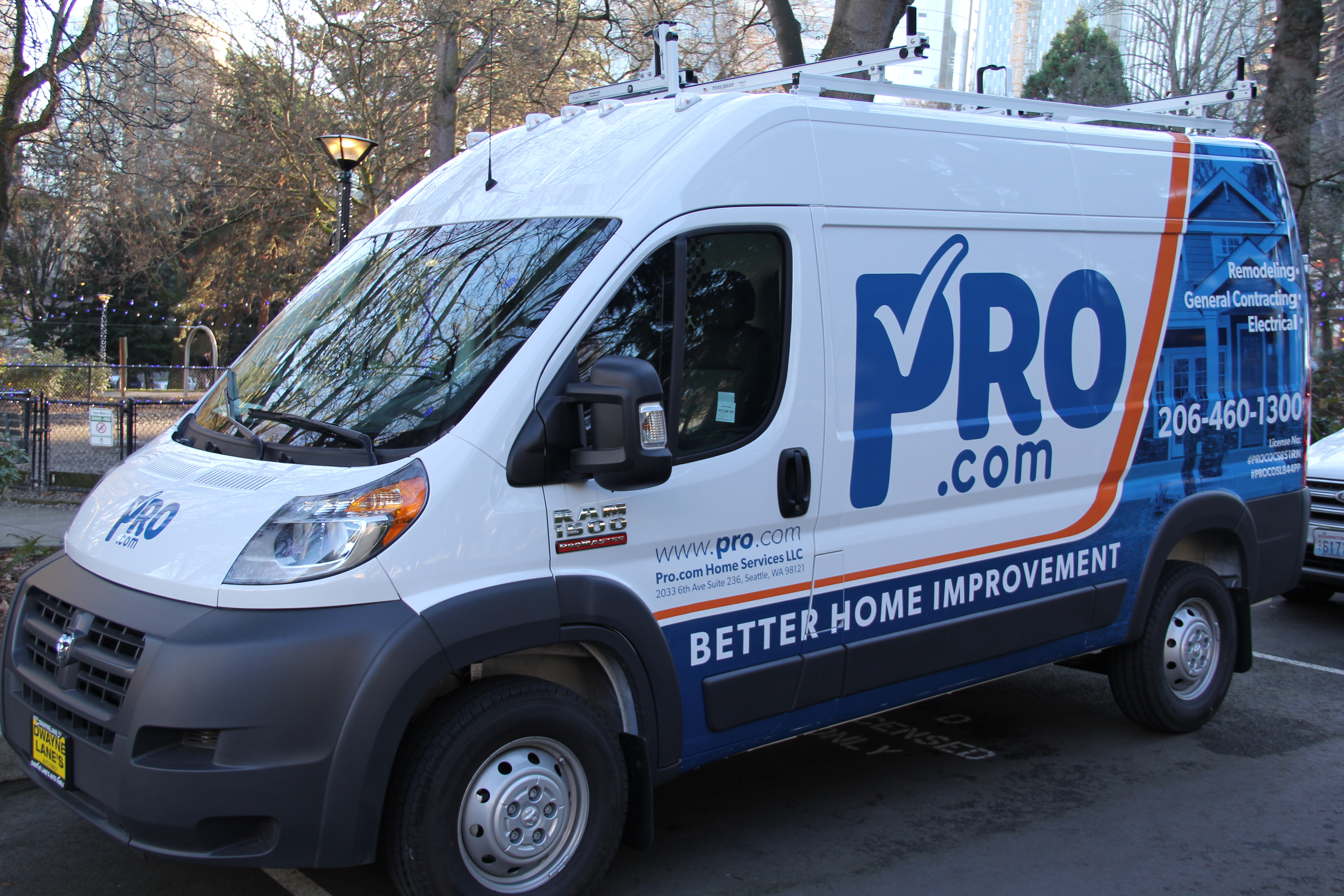
The company tells me that the round caps off a successful 2018, where Pro.com saw its job bookings grow by 275 percent over 2017, a number that was also driven by its expansion beyond the Seattle market (as well as the good economic climate that surely helped in driving homeowners to tackle more home improvement projects). The company now has 125 employees.
With this funding round, Pro.com has now raised a total of $60 million. It’ll use the funding to enter more markets, with Portland, Oregon being next on the list, and expand its team as it goes along.
It’s no secret that the home improvement market could use a bit of a jolt. The market is extremely local and fragmented — and finding the right contractor for any major project is a long and difficult process, where the outcome is never quite guaranteed. The process has enough vagueries that many people never get around to actually commissioning their projects. Pro.com wants to change that with a focus on transparency and technology. That’s a startup that’s harder to scale than the marketplace the company started out with, but it also gives the company a chance to establish itself as one of the few well-known brands in this space.

https://tcrn.ch/2HiLNwX Pro.com raises $33M for its home improvement platform https://tcrn.ch/2TUKWE8
Labels:
startups
Squad is the new screensharing chat app everyone will copy
Squad could be the next teen sensation because it makes it easy to do nothing… together. Spending time with friends in the modern age often means just being on your phones next to each other, occasionally showing off something funny you found. Squad lets you do this even while apart, and that way of punctuating video chat might make it the teen girl “third place” like Fortnite is for adolescent boys.
With Squad, you fire up a video chat with up to six people, but at any time you can screenshare what you’re seeing on your phone instead of showing your face. You can browse memes together, trash talk about DMs or private profiles, brainstorm a status update, co-work on a project or get consensus on your Tinder swipe. It’s deceptively simple, but remarkably alluring. And it couldn’t have happened until now.

How Squad screensharing looks
Squad takes advantage of Apple’s ReplayKit for screensharing. While it was announced in 2015, it wasn’t until June 2018’s iOS 12 that ReplayKit became stable and easy enough to be built into a consumer app for teens. Meanwhile, plus-size screens and speedy LTE and upcoming 5G networks make screensharing watchable. And with Instagram aging and Snapchat shrinking, there’s demand for a more intimately connected social network.
Squad only launched its app last week, but droves of Facebook and Snap employees have signed up to spy on and likely copy the startup, co-founder and CEO Esther Crawford tells me. Screensharing would fit well in group video chat startup Houseparty too. To fuel its head start, Squad has the $2.2 million it raised before it pivoted away from Molly, the team’s previous App where people can make FAQs about themselves. That cash came from betaworks, Y Combinator, #BUILTBYGIRLS, Basis Set Ventures, Jesse Draper, Gary Vaynerchuk, Niv Dror, and [Disclosure: former TechCrunch editor] Alexia Bonatsos. Next, Squad wants to let people tune in to screenshares via URL to unlock a new era of Live broadcasting, and equip other apps with the capability through a Squad SDK.
“People under 24 do video chat way different than people 25 and above” says Crawford. Adding screensharing is “an excuse for hanging out.”
Serious ideas are preludes to toys
Screensharing has long been common in enterprise communication apps like Webex, Zoom and Slack. I even called a collaborative browsing and desktop screensharing app my favorite project from Facebook’s 2011 college hackathon. But we don’t just use our screens for work any more. Teens and young adults live on the digital plane, navigating complex webs of friendships, entertainment and academia through their phones. Squad makes those experiences social — including the “social” networks we often scroll through in isolation. Charles and Ray Eames said “Toys are preludes to serious ideas,” but this time, it is happening in reverse.

Squad co-founders from left: Ethan Sutin, Esther Crawford
“The idea came from a combination of things — a pain we were experiencing as a team,” Crawford recalls. My development team is constantly sending each other screenshots and screen recordings. It seemed ridiculous that I can’t just show you what’s on my screen. It was a business use case internally.” But then came the wisdom of a 13-year-old. “My daughter over the summer was bugging me. ‘Why can’t I just show what’s on my screen with my friends?’ I said I think it’s not technically possible.” That’s when Crawford discovered advances in ReplayKit meant it suddenly was possible.
Crawford had already seen this cycle of tool to toy before, as she was an early YouTuber. Back in the mid-2000s, people thought of YouTube as a place to host videos about eBay listings, professional presentations or dating profile supplements. “They couldn’t imagine that if you let people just reliably and easily upload video content, there’d be all these creative enterprises.”
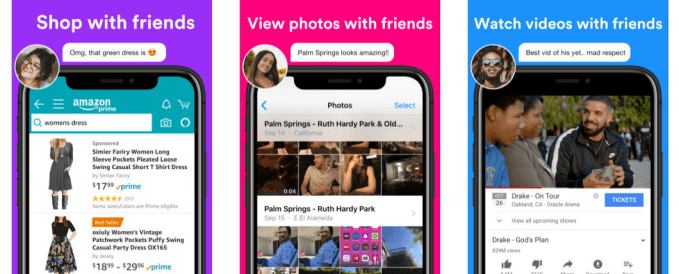
Use cases for Squad
After stints in product marketing at Coach.com and Stride Labs, she built Estherbot — a chatbot version of herself that let people learn about her. Indeed, 50,000 people ended up trying it, convincing her people needed new ways to reveal themselves to friends. She met Ethan Sutin through the project and together they co-founded FAQ app Molly before it fizzled out and was shut down. “Molly wasn’t working; it had high initial engagement sessions, but then they would drop off. Maybe it’s not the right time for the augmented version of you,” noted Crawford.
Crawford and Sutin pivoted Molly into Squad to keep exploring new formats for vulnerability. “What excited Ethan and I was this mission to help people feel less lonely.”
Alone, together
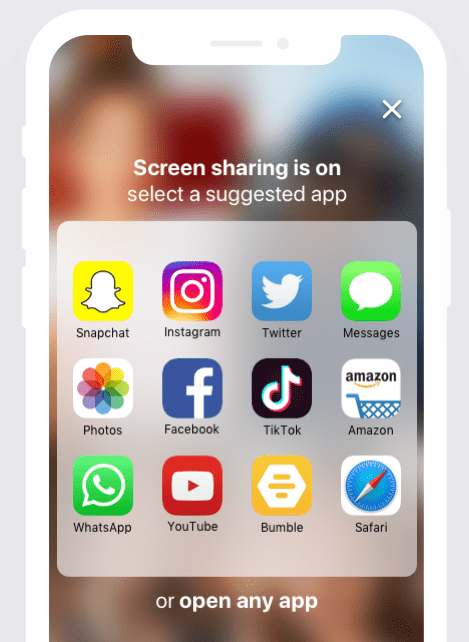
Squad recommends apps to screenshare
Squad worked, thanks to a slick way to activate screensharing. The app launches to the selfie camera similar to Snapchat, but with a + button for inviting friends to a video call. Tap the screenshare button at the bottom, select Squad and start the broadcast. To guide users toward the best screensharing experiences, a menu of apps emerges encouraging users to open Instagram, TikTok, Bumble, their camera roll and others.
People can bounce back and forth between screensharing and video chat, and tap a friend’s window to view it full-screen. And when they want another friend to see what they’re seeing, Squad goes viral. One concern is that Squad breaks privacy controls. You could have friends show you someone’s Instagram profile you’re blocked by or aren’t allowed to see. But the same goes for hanging out in person, and this is one reason Squad doesn’t let you download videos of your chats and is considering screenshot warnings.
What’s so special about Squad is that it lacks the intensity of traditional video chat, where you constantly feel pressured to perform. You can fire up a chat room, and then go back to phoning as you please with your screen displayed instead of your blank face (though the Android version in beta offers picture-in-picture so you can show your mug and the screen).
“There’s no picture-in-picture on iOS, but younger users don’t even really care. I can point it at the bed and you can tell me when there’s something to look at,” Crawford tells me. A few people, alone in their houses, video chatting without looking at each other, still feel a sense of togetherness.
The future of Squad could grant that feeling to a massive audience of a celebrity or influencer. The startup is working on shareable URLs that creators could post on other social networks like Twitter or Facebook that their fans could click to watch. Tagging along as Kylie Jenner or Ninja play around on their phone could bring people closer to their heroes while serving as a massive growth opportunity for Squad. Similarly, colonizing other apps with an SDK for screensharing could allow Squad to recruit their users.
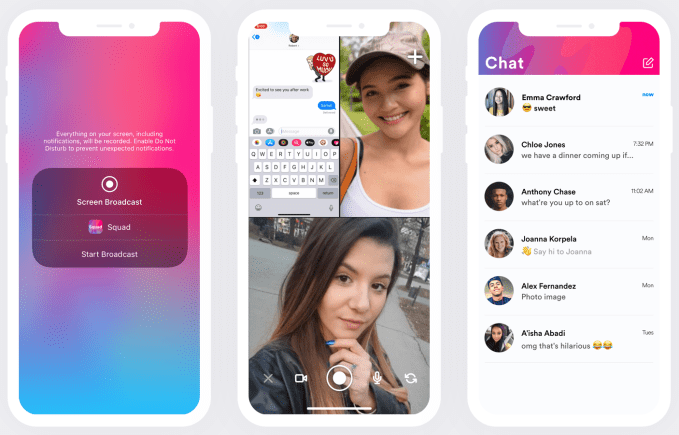
Squad makes starting a screenshare easy
The startup will face stiff technical challenges. Lag or low video quality destroy the feeling of delight it delivers, Crawford admits, so the team is focused on making sure the app works well even in rural areas like middle America where many early users live. But the real test will be whether it can build a new social graph upon the screensharing idea if already popular apps build competing features. Gaming tools like Discord and Twitch already offer web screensharing, and I suggested Facebook should bring the feature to Messenger when in late-2017 it launched in its Workplace office collaboration app.
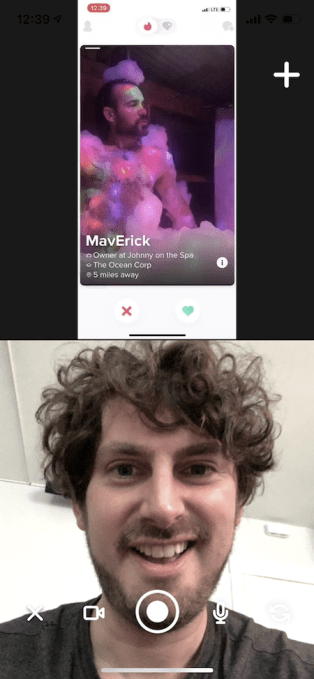
Helping a friend choose when to swipe right on Tinder via Squad
In June I wrote that Instagram and Snapchat would try to steal the voice-activated visual effects at the center of an app called Panda. Snapchat started testing those just two months later. Instagram’s whole Stories feature was cloned from Snapchat, and it also cribbed Q&A Stories from Polly. Overshadowed, Panda and Polly have faded from the spotlight. With Facebook and Snap already sniffing around Squad, it’s quite possible they’ll try to copy it. Squad will have to hope first-mover advantage and focus can defeat a screensharing feature bolted on to apps with hundreds of millions or even billions of users.
But regardless of who delivers this next phase of sharing, it’s coming. “Everyone knows that the content flooding our feeds is a filtered version of reality. The real and interesting stuff goes down in DMs because people are more authentic when they’re 1:1 or in small group conversations,” Crawford wrote.
Perhaps there’s no better antidote to the poison of social media success theater that revealing that beyond the Instagram highlights, we’re often just playing around on our phones. Squad might not be glamorous, but it’s authentic and a lot more fun.

from Social – TechCrunch https://tcrn.ch/2FER4wp Squad is the new screensharing chat app everyone will copy Josh Constine https://tcrn.ch/2syjEYI
via IFTTT
Labels:
social
Squad is the new screensharing chat app everyone will copy
{rss:content:encoded} Squad is the new screensharing chat app everyone will copy https://tcrn.ch/2syjEYI https://tcrn.ch/2FER4wp January 17, 2019 at 05:15PM


Squad could be the next teen sensation because it makes it easy to do nothing… together. Spending time with friends in the modern age often means just being on your phones next to each other, occasionally showing off something funny you found. Squad lets you do this even while apart, and that way of punctuating video chat might make it the teen girl “third place” like Fortnite is for adolescent boys.
With Squad, you fire up a video chat with up to six people, but at any time you can screenshare what you’re seeing on your phone instead of showing your face. You can browse memes together, trash talk about DMs or private profiles, brainstorm a status update, co-work on a project or get consensus on your Tinder swipe. It’s deceptively simple, but remarkably alluring. And it couldn’t have happened until now.
How Squad screensharing looks
Squad takes advantage of Apple’s ReplayKit for screensharing. While it was announced in 2015, it wasn’t until June 2018’s iOS 12 that ReplayKit became stable and easy enough to be built into a consumer app for teens. Meanwhile, plus-size screens and speedy LTE and upcoming 5G networks make screensharing watchable. And with Instagram aging and Snapchat shrinking, there’s demand for a more intimately connected social network.
Squad only launched its app last week, but droves of Facebook and Snap employees have signed up to spy on and likely copy the startup, co-founder and CEO Esther Crawford tells me. Screensharing would fit well in group video chat startup Houseparty too. To fuel its head start, Squad has the $2.2 million it raised before it pivoted away from Molly, the team’s previous App where people can make FAQs about themselves. That cash came from betaworks, Y Combinator, #BUILTBYGIRLS, Basis Set Ventures, Jesse Draper, Gary Vaynerchuk, Niv Dror, and [Disclosure: former TechCrunch editor] Alexia Bonatsos. Next, Squad wants to let people tune in to screenshares via URL to unlock a new era of Live broadcasting, and equip other apps with the capability through a Squad SDK.
“People under 24 do video chat way different than people 25 and above” says Crawford. Adding screensharing is “an excuse for hanging out.”
Serious ideas are preludes to toys
Screensharing has long been common in enterprise communication apps like Webex, Zoom and Slack. I even called a collaborative browsing and desktop screensharing app my favorite project from Facebook’s 2011 college hackathon. But we don’t just use our screens for work any more. Teens and young adults live on the digital plane, navigating complex webs of friendships, entertainment and academia through their phones. Squad makes those experiences social — including the “social” networks we often scroll through in isolation. Charles and Ray Eames said “Toys are preludes to serious ideas,” but this time, it is happening in reverse.
Squad co-founders from left: Ethan Sutin, Esther Crawford
“The idea came from a combination of things — a pain we were experiencing as a team,” Crawford recalls. My development team is constantly sending each other screenshots and screen recordings. It seemed ridiculous that I can’t just show you what’s on my screen. It was a business use case internally.” But then came the wisdom of a 13-year-old. “My daughter over the summer was bugging me. ‘Why can’t I just show what’s on my screen with my friends?’ I said I think it’s not technically possible.” That’s when Crawford discovered advances in ReplayKit meant it suddenly was possible.
Crawford had already seen this cycle of tool to toy before, as she was an early YouTuber. Back in the mid-2000s, people thought of YouTube as a place to host videos about eBay listings, professional presentations or dating profile supplements. “They couldn’t imagine that if you let people just reliably and easily upload video content, there’d be all these creative enterprises.”
Use cases for Squad
After stints in product marketing at Coach.com and Stride Labs, she built Estherbot — a chatbot version of herself that let people learn about her. Indeed, 50,000 people ended up trying it, convincing her people needed new ways to reveal themselves to friends. She met Ethan Sutin through the project and together they co-founded FAQ app Molly before it fizzled out and was shut down. “Molly wasn’t working; it had high initial engagement sessions, but then they would drop off. Maybe it’s not the right time for the augmented version of you,” noted Crawford.
Crawford and Sutin pivoted Molly into Squad to keep exploring new formats for vulnerability. “What excited Ethan and I was this mission to help people feel less lonely.”
Alone, together
Squad recommends apps to screenshare
Squad worked, thanks to a slick way to activate screensharing. The app launches to the selfie camera similar to Snapchat, but with a + button for inviting friends to a video call. Tap the screenshare button at the bottom, select Squad and start the broadcast. To guide users toward the best screensharing experiences, a menu of apps emerges encouraging users to open Instagram, TikTok, Bumble, their camera roll and others.
People can bounce back and forth between screensharing and video chat, and tap a friend’s window to view it full-screen. And when they want another friend to see what they’re seeing, Squad goes viral. One concern is that Squad breaks privacy controls. You could have friends show you someone’s Instagram profile you’re blocked by or aren’t allowed to see. But the same goes for hanging out in person, and this is one reason Squad doesn’t let you download videos of your chats and is considering screenshot warnings.
What’s so special about Squad is that it lacks the intensity of traditional video chat, where you constantly feel pressured to perform. You can fire up a chat room, and then go back to phoning as you please with your screen displayed instead of your blank face (though the Android version in beta offers picture-in-picture so you can show your mug and the screen).
“There’s no picture-in-picture on iOS, but younger users don’t even really care. I can point it at the bed and you can tell me when there’s something to look at,” Crawford tells me. A few people, alone in their houses, video chatting without looking at each other, still feel a sense of togetherness.
The future of Squad could grant that feeling to a massive audience of a celebrity or influencer. The startup is working on shareable URLs that creators could post on other social networks like Twitter or Facebook that their fans could click to watch. Tagging along as Kylie Jenner or Ninja play around on their phone could bring people closer to their heroes while serving as a massive growth opportunity for Squad. Similarly, colonizing other apps with an SDK for screensharing could allow Squad to recruit their users.
Squad makes starting a screenshare easy
The startup will face stiff technical challenges. Lag or low video quality destroy the feeling of delight it delivers, Crawford admits, so the team is focused on making sure the app works well even in rural areas like middle America where many early users live. But the real test will be whether it can build a new social graph upon the screensharing idea if already popular apps build competing features. Gaming tools like Discord and Twitch already offer web screensharing, and I suggested Facebook should bring the feature to Messenger when in late-2017 it launched in its Workplace office collaboration app.
Helping a friend choose when to swipe right on Tinder via Squad
In June I wrote that Instagram and Snapchat would try to steal the voice-activated visual effects at the center of an app called Panda. Snapchat started testing those just two months later. Instagram’s whole Stories feature was cloned from Snapchat, and it also cribbed Q&A Stories from Polly. Overshadowed, Panda and Polly have faded from the spotlight. With Facebook and Snap already sniffing around Squad, it’s quite possible they’ll try to copy it. Squad will have to hope first-mover advantage and focus can defeat a screensharing feature bolted on to apps with hundreds of millions or even billions of users.
But regardless of who delivers this next phase of sharing, it’s coming. “Everyone knows that the content flooding our feeds is a filtered version of reality. The real and interesting stuff goes down in DMs because people are more authentic when they’re 1:1 or in small group conversations,” Crawford wrote.
Perhaps there’s no better antidote to the poison of social media success theater that revealing that beyond the Instagram highlights, we’re often just playing around on our phones. Squad might not be glamorous, but it’s authentic and a lot more fun.
Labels:
mobile
Squad is the new screensharing chat app everyone will copy
Squad could be the next teen sensation because it makes it easy to do nothing… together. Spending time with friends in the modern age often means just being on your phones next to each other, occasionally showing off something funny you found. Squad lets you do this even while apart, and that way of punctuating video chat might make it the teen girl “third place” like Fortnite is for adolescent boys.
With Squad, you fire up a video chat with up to six people, but at any time you can screenshare what you’re seeing on your phone instead of showing your face. You can browse memes together, trash talk about DMs or private profiles, brainstorm a status update, co-work on a project or get consensus on your Tinder swipe. It’s deceptively simple, but remarkably alluring. And it couldn’t have happened until now.
How Squad screensharing looks
Squad takes advantage of Apple’s ReplayKit for screensharing. While it was announced in 2015, it wasn’t until June 2018’s iOS 12 that ReplayKit became stable and easy enough to be built into a consumer app for teens. Meanwhile, plus-size screens and speedy LTE and upcoming 5G networks make screensharing watchable. And with Instagram aging and Snapchat shrinking, there’s demand for a more intimately connected social network.
Squad only launched its app last week, but droves of Facebook and Snap employees have signed up to spy on and likely copy the startup, co-founder and CEO Esther Crawford tells me. Screensharing would fit well in group video chat startup Houseparty too. To fuel its head start, Squad has the $2.2 million it raised before it pivoted away from Molly, the team’s previous App where people can make FAQs about themselves. That cash came from betaworks, Y Combinator, #BUILTBYGIRLS, Basis Set Ventures, Jesse Draper, Gary Vaynerchuk, Niv Dror, and [Disclosure: former TechCrunch editor] Alexia Bonatsos. Next, Squad wants to let people tune in to screenshares via URL to unlock a new era of Live broadcasting, and equip other apps with the capability through a Squad SDK.
“People under 24 do video chat way different than people 25 and above” says Crawford. Adding screensharing is “an excuse for hanging out.”
Serious ideas are preludes to toys
Screensharing has long been common in enterprise communication apps like Webex, Zoom and Slack. I even called a collaborative browsing and desktop screensharing app my favorite project from Facebook’s 2011 college hackathon. But we don’t just use our screens for work any more. Teens and young adults live on the digital plane, navigating complex webs of friendships, entertainment and academia through their phones. Squad makes those experiences social — including the “social” networks we often scroll through in isolation. Charles and Ray Eames said “Toys are preludes to serious ideas,” but this time, it is happening in reverse.
Squad co-founders from left: Ethan Sutin, Esther Crawford
“The idea came from a combination of things — a pain we were experiencing as a team,” Crawford recalls. My development team is constantly sending each other screenshots and screen recordings. It seemed ridiculous that I can’t just show you what’s on my screen. It was a business use case internally.” But then came the wisdom of a 13-year-old. “My daughter over the summer was bugging me. ‘Why can’t I just show what’s on my screen with my friends?’ I said I think it’s not technically possible.” That’s when Crawford discovered advances in ReplayKit meant it suddenly was possible.
Crawford had already seen this cycle of tool to toy before, as she was an early YouTuber. Back in the mid-2000s, people thought of YouTube as a place to host videos about eBay listings, professional presentations or dating profile supplements. “They couldn’t imagine that if you let people just reliably and easily upload video content, there’d be all these creative enterprises.”
Use cases for Squad
After stints in product marketing at Coach.com and Stride Labs, she built Estherbot — a chatbot version of herself that let people learn about her. Indeed, 50,000 people ended up trying it, convincing her people needed new ways to reveal themselves to friends. She met Ethan Sutin through the project and together they co-founded FAQ app Molly before it fizzled out and was shut down. “Molly wasn’t working; it had high initial engagement sessions, but then they would drop off. Maybe it’s not the right time for the augmented version of you,” noted Crawford.
Crawford and Sutin pivoted Molly into Squad to keep exploring new formats for vulnerability. “What excited Ethan and I was this mission to help people feel less lonely.”
Alone, together
Squad recommends apps to screenshare
Squad worked, thanks to a slick way to activate screensharing. The app launches to the selfie camera similar to Snapchat, but with a + button for inviting friends to a video call. Tap the screenshare button at the bottom, select Squad and start the broadcast. To guide users toward the best screensharing experiences, a menu of apps emerges encouraging users to open Instagram, TikTok, Bumble, their camera roll and others.
People can bounce back and forth between screensharing and video chat, and tap a friend’s window to view it full-screen. And when they want another friend to see what they’re seeing, Squad goes viral. One concern is that Squad breaks privacy controls. You could have friends show you someone’s Instagram profile you’re blocked by or aren’t allowed to see. But the same goes for hanging out in person, and this is one reason Squad doesn’t let you download videos of your chats and is considering screenshot warnings.
What’s so special about Squad is that it lacks the intensity of traditional video chat, where you constantly feel pressured to perform. You can fire up a chat room, and then go back to phoning as you please with your screen displayed instead of your blank face (though the Android version in beta offers picture-in-picture so you can show your mug and the screen).
“There’s no picture-in-picture on iOS, but younger users don’t even really care. I can point it at the bed and you can tell me when there’s something to look at,” Crawford tells me. A few people, alone in their houses, video chatting without looking at each other, still feel a sense of togetherness.
The future of Squad could grant that feeling to a massive audience of a celebrity or influencer. The startup is working on shareable URLs that creators could post on other social networks like Twitter or Facebook that their fans could click to watch. Tagging along as Kylie Jenner or Ninja play around on their phone could bring people closer to their heroes while serving as a massive growth opportunity for Squad. Similarly, colonizing other apps with an SDK for screensharing could allow Squad to recruit their users.
Squad makes starting a screenshare easy
The startup will face stiff technical challenges. Lag or low video quality destroy the feeling of delight it delivers, Crawford admits, so the team is focused on making sure the app works well even in rural areas like middle America where many early users live. But the real test will be whether it can build a new social graph upon the screensharing idea if already popular apps build competing features. Gaming tools like Discord and Twitch already offer web screensharing, and I suggested Facebook should bring the feature to Messenger when in late-2017 it launched in its Workplace office collaboration app.
Helping a friend choose when to swipe right on Tinder via Squad
In June I wrote that Instagram and Snapchat would try to steal the voice-activated visual effects at the center of an app called Panda. Snapchat started testing those just two months later. Instagram’s whole Stories feature was cloned from Snapchat, and it also cribbed Q&A Stories from Polly. Overshadowed, Panda and Polly have faded from the spotlight. With Facebook and Snap already sniffing around Squad, it’s quite possible they’ll try to copy it. Squad will have to hope first-mover advantage and focus can defeat a screensharing feature bolted on to apps with hundreds of millions or even billions of users.
But regardless of who delivers this next phase of sharing, it’s coming. “Everyone knows that the content flooding our feeds is a filtered version of reality. The real and interesting stuff goes down in DMs because people are more authentic when they’re 1:1 or in small group conversations,” Crawford wrote.
Perhaps there’s no better antidote to the poison of social media success theater that revealing that beyond the Instagram highlights, we’re often just playing around on our phones. Squad might not be glamorous, but it’s authentic and a lot more fun.

https://tcrn.ch/2FER4wp Squad is the new screensharing chat app everyone will copy https://tcrn.ch/2syjEYI
Labels:
startups
Index has backed Immersive Games Lab, a new startup from founder of Tough Mudder
Immersive Games Lab, a new venture from Tough Mudder co-founder and Chairman Will Dean, has picked up around £2.5 million in seed funding, TechCrunch has learned. According to sources, London-based Index Ventures has led the round.
In a call confirming the close, Dean told me Sweet Capital, and JamJar Investments (the VC fund set up by the 3 Innocent Drinks founders) also participated.
Developing the “next generation” of immersive group gaming, Immersive Games Lab describes itself as “part indoor theme park, part video game, part escape room” and says it will launch a new breed of “captivating group experiences” in London in early 2019.
Little else is known regarding what Immersive Games Lab’s first experience will be, although Dean told me it will be sold in retail spaces, in ticket form, and will be a blend of technology and in-person group activity. It is currently being prototyped and tested in a warehouse in North London.
More broadly, he said the idea of creating a new kind of immersive gaming experience is partly based on the sentiment that we spend too much screen time on our devices, consuming social media in a way that isn’t always good for our mental health.
His previous and hugely successful venture Tough Mudder was all about creating a new, fun experience around exercise — and ultimately helping people become more physically active. Dean says he is keen for Immersive Games Lab to also make a positive dent on people’s lives.
The new venture also builds nicely on Dean’s track record building an experience and community-led consumer proposition — and the type of go-to market strategy that requires. Which is undoubtedly what caught the interest of Index and other investors, in what I understand was an oversubscribed round.
Immersive Games Lab’s other co-founder is David Spindler, who also played a key role at Tough Mudder.

https://ift.tt/eA8V8J Index has backed Immersive Games Lab, a new startup from founder of Tough Mudder https://tcrn.ch/2FFQQFf
Labels:
startups
Google’s Pixel 3 Lite could bring back the headphone jack
{rss:content:encoded} Google’s Pixel 3 Lite could bring back the headphone jack https://tcrn.ch/2Fz3Sp0 http://bit.ly/2RArShW January 17, 2019 at 03:15PM


Word about the next member of the Pixel family started leaking out just after Christmas. Now the rumored Pixel 3 Lite is getting some more time to shine, courtesy of a three minute YouTube video that highlights what appears to be a budget addition to Google’s flagship hardware line.
Perhaps most interesting here (aside from the mere existence of a third Pixel 3 model) is the apparent return of the headphone jack. After making a stink about including the port on the first Pixel, the company quickly reversed course for its predecessor.
The addition of a mid-range handset would, however, be the ideal reason to bring back the port (likely for a limited time). After all, while bluetooth headset have become far more accessible in recent years, specialized headphone are still a big ask for folks looking to save a few (or few hundred) bucks.
There are some cost cutting measures throughout, including a Snapdragon 670, plastic body and no second selfie-camera. In all, the device is a bit like Google’s take on the iPhone XR, though it notably appears to have roughly the same rear-facing camera configuration as its more expensive siblings. That could well owe to the fact that AI — not hardware — is doing most of the heavy imaging lifting on the new handsets.
Notably, Pixel devices are generally already lower cost than flagships from Apple and Samsung, but a new addition could be a nice opportunity for Google to show how Android can shine on lower cost devices.
Labels:
mobile


 Posts
Posts


