l
l
blogger better. Powered by Blogger.

Search

Labels

blogger better

Followers

Blog Archive

Total Pageviews

Labels

Download

Blogroll

Featured 1

Curabitur et lectus vitae purus tincidunt laoreet sit amet ac ipsum. Proin tincidunt mattis nisi a scelerisque. Aliquam placerat dapibus eros non ullamcorper. Integer interdum ullamcorper venenatis. Pellentesque habitant morbi tristique senectus et netus et malesuada fames ac turpis egestas.

Featured 2

Curabitur et lectus vitae purus tincidunt laoreet sit amet ac ipsum. Proin tincidunt mattis nisi a scelerisque. Aliquam placerat dapibus eros non ullamcorper. Integer interdum ullamcorper venenatis. Pellentesque habitant morbi tristique senectus et netus et malesuada fames ac turpis egestas.

Featured 3

Curabitur et lectus vitae purus tincidunt laoreet sit amet ac ipsum. Proin tincidunt mattis nisi a scelerisque. Aliquam placerat dapibus eros non ullamcorper. Integer interdum ullamcorper venenatis. Pellentesque habitant morbi tristique senectus et netus et malesuada fames ac turpis egestas.

Featured 4

Curabitur et lectus vitae purus tincidunt laoreet sit amet ac ipsum. Proin tincidunt mattis nisi a scelerisque. Aliquam placerat dapibus eros non ullamcorper. Integer interdum ullamcorper venenatis. Pellentesque habitant morbi tristique senectus et netus et malesuada fames ac turpis egestas.

Featured 5

Curabitur et lectus vitae purus tincidunt laoreet sit amet ac ipsum. Proin tincidunt mattis nisi a scelerisque. Aliquam placerat dapibus eros non ullamcorper. Integer interdum ullamcorper venenatis. Pellentesque habitant morbi tristique senectus et netus et malesuada fames ac turpis egestas.

Thursday, December 19, 2019

Subscription-based social network MeWe launches premium features and a business product

MeWe, the subscription-based social network that emphasizes privacy and bills itself as the anti-Facebook, is launching a premium tier of its service and spinning up a business-focused product to take on enterprise networking and communication tools like Slack.

Founded by Mark Weinstein, a gregarious serial entrepreneur who credits himself with being an early developer of the social media concept, MeWe has amassed several million users in its drive to be the alternative to Facebook.

Launching after Ello, Weinstein says the challenges he witnessed that company going through provided some invaluable lessons for how he wanted to build out his own challenge to Facebook’s social media dominance.

“We were engineering when Ello had their shot at the moon and then crashed back to earth. They may have motivated 21 million people, but their servers couldn’t handle it, they were desktop only and the project was too soon,” Weinstein said. 

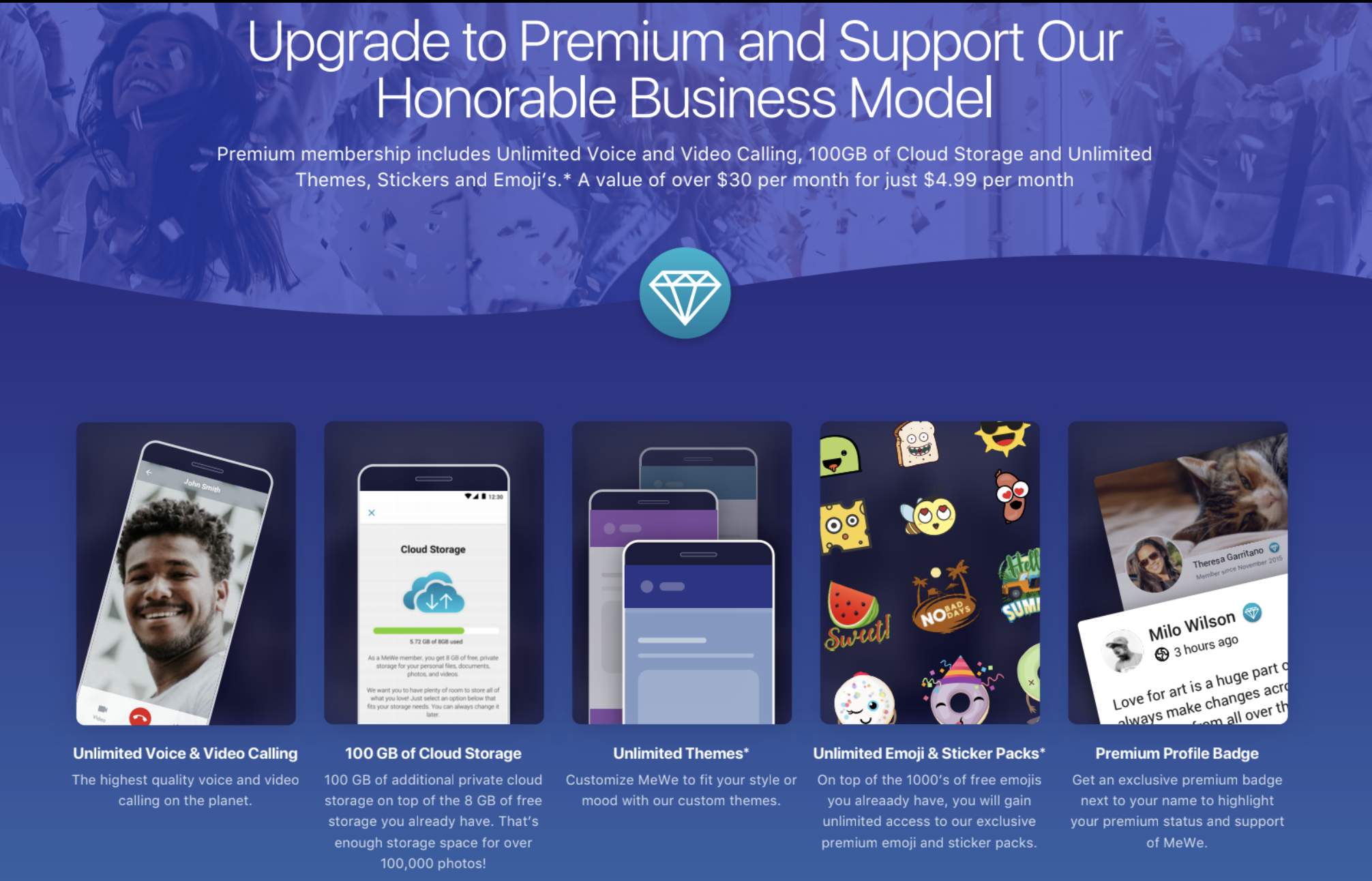
The company operates under a freemium model, where its newsfeed, custom camera, ephemeral content, 8 gigs of storage, life voice and video and custom stickers are all free. Businesses can pay for additional features for $1.99 per month.
“Social media wasn’t invented for surveillance capitalism,” says Weinstein. And while MeWe is relatively permissive when it comes to speech, Weinstein says it has rules around posting hate speech, inciting violence and bullying. That said, “we’re not going to censor you because you’re talking about a political view we do or don’t agree with.”

Alongside the premium MeWe product for social networking, the company is also launching a separate business line for enterprise collaboration.

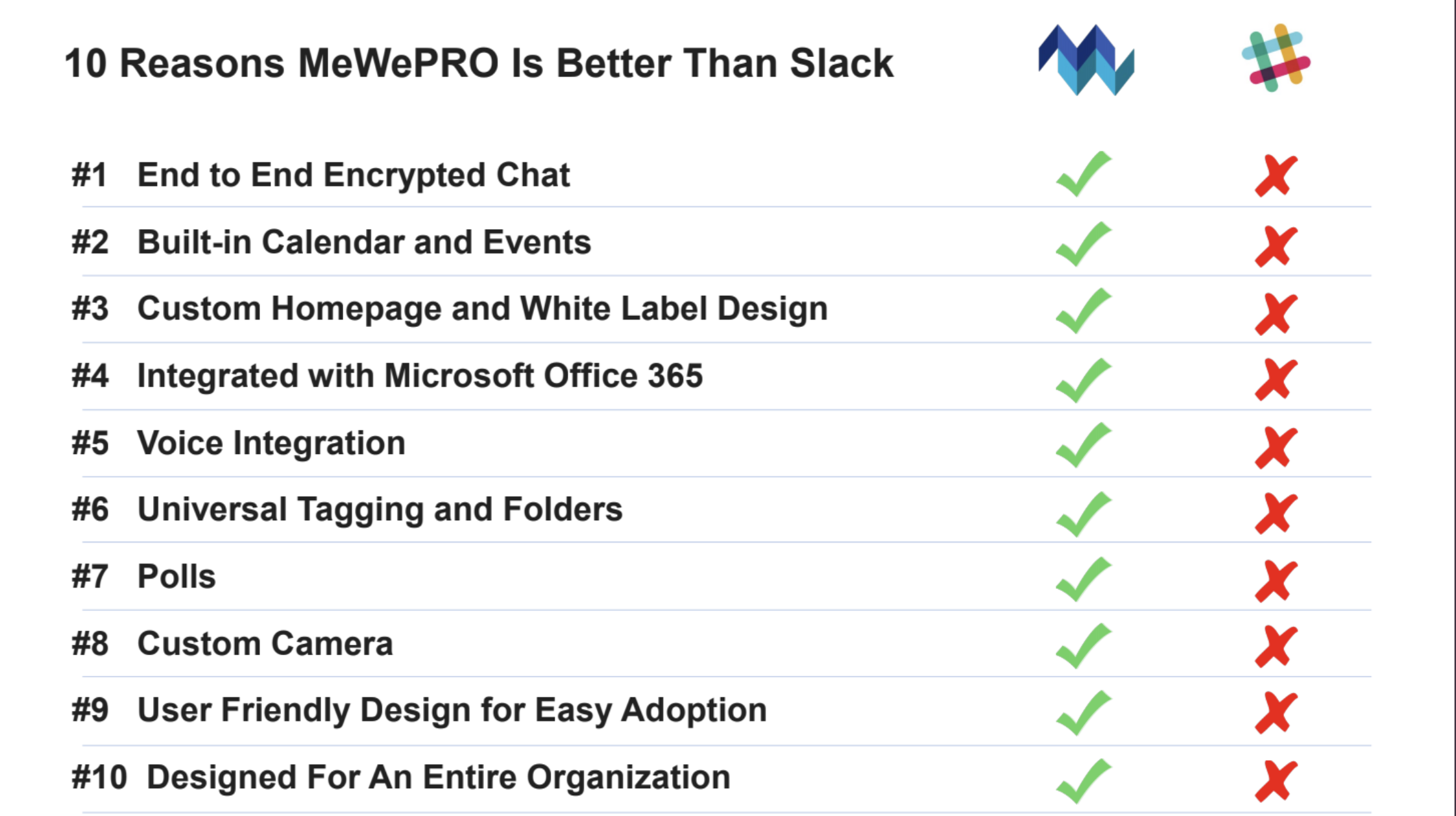
Weinstein says there are already several thousand users on the enterprise toolkit, which is out of beta and includes end-to-end encrypted chat, integrations with Windows 360 and features for tagging, polls, a custom camera and voice and video conferencing embedded in its suite of services.

MeWe’s premium tier will cost $4.99 per month and the company’s professional service has a two-tiered approach, with a $3.99 and $7.99 price point.


from Social – TechCrunch https://ift.tt/38Rzi5f Subscription-based social network MeWe launches premium features and a business product Jonathan Shieber https://ift.tt/38O5578
via IFTTT

Despite winter’s chill, the Northeast’s tech ecosystem is white-hot

Hello and welcome back to our regular morning look at private companies, public markets and the grey space in between.

Today, we’re digging into a host of data concerning the East Coast venture capital scene, specifically looking into the performance of its two key startup markets.

It’s 12 degrees Fahrenheit as I write this in my office situated between Boston and New York City — a perfect vantage point for studying these vibrant tech ecosystems. Let’s see what the data tells us.

The information we’re examining today comes from White Star Capital (often via CBInsights), a venture capital firm that describes itself as “transatlantic” and takes part in seed, Series A and Series B rounds around the globe. The group last raised a $180 million fund that TechCrunch covered here, noting at the time that capital pool was “oversubscribed from an initial target of $140 million” and would be invested into “around 20 new companies from the new fund, writing opening cheques of between $1 million and $6 million.”

With boots on the ground in New York, White Star cares about the East Coast, so the fund’s put dossier on the region isn’t unexpected. What it includes, however, is.

We’ll start with NYC and its surprising 2019 before turning to Boston, digging into its super-giant venture totals and hearing from Founder Collective’s Eric Paley on the state of things in urban Massachusetts.

New York City

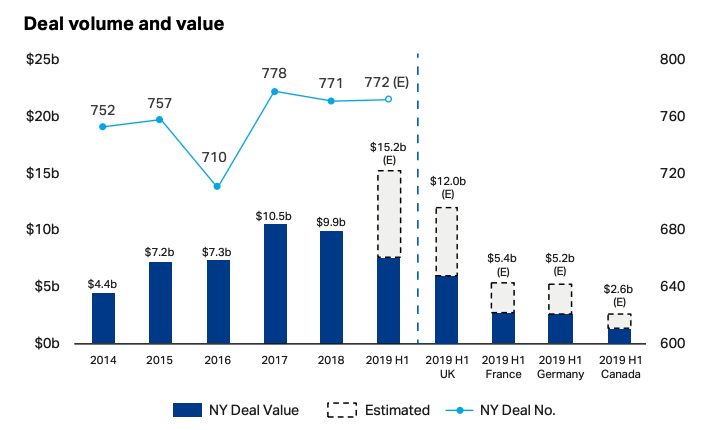
White Star’s report details record-breaking figures for NYC’s current year. Off of effectively flat deal volume (New York City sees around 775 venture deals per year at the moment, or a little more than two per day), the overgrown town should set record venture dollar volume in 2019.

Observe the following, astounding chart detailing the abnormality of 2019 from a comparative venture dollar perspective:

By smashing 2017’s local maximum, 2019 appears set to crush the city’s record — and rich — venture investment totals. The graphic also manages to point out (somewhat embarrassingly) that Gotham will manage to best a number of European countries’ aggregate venture dollar investments by itself this year.

That’s is a useful bit of context as in the United States, New York City is always Number Two to Silicon Valley. But, this chart argues, being number two in the number-one market is still a hell of a lot of capital.

Putting New York City’s venture into even sharper comparative perspective, observe the following table:


https://ift.tt/2Q5802D Despite winter’s chill, the Northeast’s tech ecosystem is white-hot https://ift.tt/2rb38AT

Levelset raises $30 million to improve money management for contractors in construction

Scott Wolfe, chief executive officer of the New Orleans-based money management and payment startup for contractors in the construction industry, always thought he’d be in the grocery business.

His family owned a number of grocery stores around New Orleans and he was readying himself to go into the family business when Hurricane Katrina hit.

As the family business faced significant losses in their stores, the construction and contracting service they’d built to develop the land the stores were on had a tremendous opportunity. Within the span of a year, Wolfe had pivoted the family’s operations to focus on renovations and restorations and launched fully into construction.

It was during that time that Wolfe saw the need for some sort of software service that could manage cash flow and payment for the tens to hundreds of small business contractors involved in getting a project done.

So he built Levelset to be that service.

Now the company has closed on $30 million in financing from Horizons Ventures, the investment firm backed by Li Ka-shing who is one of the world’s wealthiest billionaire property developers.

When Bart Swanson, an advisor to Horizons met Levelset through a mutual friend who did some investing around the New Orleans-based Tulane University ecosystem, he immediately felt it was an opportunity that Horizons investment committee would understand.

“This is a global issue,” says Swanson. “64 percent of construction businesses fail in their first five years because they have nowhere to turn for help,” when it comes to ensuring payment.

For now, Levelset is focused on digitizing billing and payments and providing insights into who is actually on a job site and the responsibilities that those workers have on site, according to Wolfe.

“There’s a ton of investment that has gone into the field,” says Wolfe. “What has seen a lack of as prolific an investment are things behind the scenes outside of the field that happen in the office. This is the accountants and administrative workers who have to take the information that’s in the field and turn it into money.”

For developers like Cheung Kong Holdings, Li’s development business, the promise of Levelset’s software is a huge boon. The construction industry runs on small businesses that lack software and services to process payments quickly. The time it takes to deal with paperwork can delay a project and ultimately cost developers money.

Horizons was joined in the new round by S3 Ventures, Operating Venture Capital, Altos Ventures and Darren Bechtel of Brick & Mortar Ventures. As a result of the investment, Swanson will take a seat on the company’s board.

In a recent survey of contractors by Levelset and T-Sheets by Quickbooks, more than half of contractors stated they were not paid on time and had significant cash flow challenges, and more than 75% craved more transparency in the payment process. This is no surprise given PWC’s working capital studies in the past decade demonstrating that construction industry payment speeds are the slowest of all (83+ days). 

“The effort required to get paid, and the cash stress put on contractors is unbelievable,” said Wolfe, in a statement.  “The world’s biggest industry is full of small and medium businesses who are the fabric of our economy. It’s crucial that they can do their work without worrying about cash.”


https://ift.tt/eA8V8J Levelset raises $30 million to improve money management for contractors in construction https://ift.tt/34DH93h

Osano, a risk and compliance startup, raises $5M in Series A

Risk and compliance startup Osano, which earlier this year debuted on the Battlefield stage at TechCrunch Disrupt SF, has raised $5.4 million in its Series A round.

The company told TechCrunch that the round was led by LiveOak Venture Partners and Next Coast Ventures, both of which invested in the company’s seed round. Its Series A fundraise also included participation from several individual investors, putting Osano’s total amount raised to date at $8.4 million.

The Austin, Texas-based startup bills itself as a privacy platform that helps businesses understand and address their compliance with state and international privacy laws, like Europe’s GDPR and California’s new statewide privacy law, set to take effect on January 1. One of the company’s flagship features is providing cookie and consent management on customer websites, allowing users to choose their privacy settings in their own language.

To date, the turnkey platform is used by more than 750,000 companies — including some Fortune 500 companies — to secure over 3.5 million websites.

Osano plans to use the new funds to further invest in research and development, marketing and hiring to meet “growing demand” for its service, the company said.

“We are proud to continue into the next round with our original investors,” said Arlo Gilbert, Osano’s co-founder and chief executive. “Heading into 2020, we are moving quickly to add talent to our growing team and to deepen Osano’s position as a leading data privacy platform.”

“There is a definitive need to bring transparency to the process of how companies deal with privacy, and we are very excited about taking on this challenge to empower both individuals and organizations,” said Gilbert.


https://ift.tt/eA8V8J Osano, a risk and compliance startup, raises $5M in Series A https://ift.tt/2SeW2GJ

Xilis believes cultivating micro-tumors may hold the key to more effective cancer treatments

Despite near-miraculous advances in the treatment of cancer in the U.S. and around the world, the disease remains the second leading cause of death in America.

The problem is that every manifestation of the disease is unique to the patient that is afflicted by it, because everyone’s body is actually different. Most cancer treatments are determined by their ability to cure the largest population afflicted with a particular cancer type.

As understanding of the disease has advanced, more targeted treatments are coming to market to treat particular types of the disease. And now, Xilis has developed a process that its founders hope will make those treatments even more effective.

Founded by Xiling Shen and Dr. David Hsu, two Duke University professors and researchers, the company’s technology is based on research conducted by the Dutch research scientist Hans Clevers. Clevers, who won the Breakthrough Prize for life sciences in 2004 and serves on the board of directors of Roche, helped refine a technique for growing small versions of human organs for research.

Shen and Hsu have taken that research and advanced it, developing a process that can cultivate and sustain tumors from a cancer patient — allowing physicians and pharmaceutical companies to develop even more tailored treatments that can respond to the particular type of cancer.

“Our technology creates 10,000 micro tumors from a single cancer biopsy which then tests which cancer treatments will or won’t work for a patient, saving them critical time in his/her cancer treatment plan,” said Shen in a statement. “Already in clinical trials, we have data showing our technology can successfully predict treatment success and finding new therapy for drug resistant patients.”

Shen and his co-founder first initiated clinical trials on their new discovery early in 2019. Their results were so promising that the two decided to form a company around the innovation and raise capital to accelerate the time-to-clinic so that patients could reap the benefits of these more targeted therapies.

Indeed, the technology is so compelling that Clevers, the progenitor of the company’s technology, has agreed to join the company as a co-founder and collaborate on future development, according to an interview with Shen.

“What we have invented is this microfluidics droplet,” says Shen. “We’re growing miniature organoids so these cancer cells are growing in a 3D tumor micro environment.”

To accelerate the commercialization of the technology, Xilis has raised $3 million in seed funding from investors including Felicis Ventures, an early investor in the multibillion-dollar cancer treatment technology developer Guardant Health, former NFL superstar Joe Montana’s Liquid 2 Ventures fund, along with Pear and 8VC.

While the near-term value of the company’s technology is in its ability to better target therapies for patients, longer term, there’s value in the data set that the company is amassing. “We’re accumulating a micro-organoid bank that pharma would love to test these things on,” says Shen.

The potential to save pharmaceutical companies millions of dollars to do initial testing on how effective a treatment is can’t be overlooked, according to Shen. Using the technology, pharma companies “can do massive drug screening at a much higher throughput with a much lower cost.” 


https://ift.tt/eA8V8J Xilis believes cultivating micro-tumors may hold the key to more effective cancer treatments https://ift.tt/36RTane

Mental health startup eQuoo joins UK’s NHS app library, closes in on seed round

U.K.-based mental health startup eQuoo has become the only game in the U.K.’s National Health Service App Library and is set to shortly close its seed funding round. The app is an emotional fitness game that aims to teach healthy psychological skills.

The NHS announcement means a U.K. doctor can now formally refer eQuoo to their patients to improve their mental health and well-being.

The app has also now achieved a top rating at ORCHA, the leading health app assessment platform, and now has clients including Barmer, the largest insurance company in Germany.

Founder and CEO Silja Litvin says she created the startup because of the mental health crisis. “While working in an NHS Trust for eating and mood disorders I was dismayed about the fact that many of our young clients had to wait months to see us for a measly six sessions. Psychologists are not scalable, but apps are, so I decided to make an app. After developing PsycApps, an evidence-based anti-depression app, I learned the hard way that mental health apps all struggle with drop-off rates of up to 90% in week 1, so we pivoted towards gamification with the launch of eQuoo, as casual games can have a positive mental health effect and intrinsically get players to stick to them.”

A spokesperson for the NHS said: “Approximately 58% GPs across England now have the ability to refer patients directly to eQuoo, as its now live on the EMIS App Library. The EMIS App Library is powered by IQVIA’s AppScript® platform, which enables clinical users of the EMIS Web clinical system to find and recommend high-quality digital health apps to their patients via text or email, directly from their existing workflow. All apps listed on the platform (including eQuoo) have been evaluated under NHS Digital’s digital assessment questions (DAQ) and assessed for their clinical safety, data protection, security and usability.”

Earlier this year the startup also gained scientific backing for its app, going through a “three-arm,” five-week, randomized control trial with more than 350 participants, with Bosch UK. By contrast Woebot, a highly lauded mental health chatbot startup, went through only a two-week trial with 70 participants.

Results showed “statistically significant increases in well-being metrics” and a significant decrease in anxiety when using the app over a time frame of five weeks.


https://ift.tt/eA8V8J Mental health startup eQuoo joins UK’s NHS app library, closes in on seed round https://ift.tt/2PEhums

Huel brings its nutrition bars to the US

Huel, the European purveyor of nutritional bars, supplements and meal-replacement shakes, is bringing its snack bars to the U.S.

The company, which has been selling the bars in Europe for a while, is launching with two flavors in the U.S.: chocolate and salted caramel.

The bars contain 27 vitamins and minerals and are 200 calories apiece. Huel is selling the bars online for now at $28 per-box of 15 bars.

The bars are made using oat flour, rolled oats, pea and brown rice proteins, cocoa powder, coconut, date syrup, flax seed and a blend of vitamins and minerals, which the company adds to its mixture.

To date the company has sold more than 50 million shakes, powders or bars in 80 countries around the world.

“As Huel has continued its rapid growth in the United States, with millions of meals from our powders and ready-to-drinks being enjoyed from coast to coast, we are proud to introduce the Huel Bar to the U.S. marketplace,” said Julian Hearn, CEO and co-founder of Huel. “We have created a truly unique bar that not only tastes great but provides the important nutrition you need between meals or on-the-go.”

Huel’s bars enter a crowded market where nutritional supplements and meal replacements are big business. In 2017, Kellogg’s bought RxBar for $600 million and the acquisition has proven to be a huge boon for the company — boosting sales as cereal sales decline.

Soylent, the startup darling that rejuvenated the meal-replacement market in the U.S. with a new formulation and a pitch to Silicon Valley’s coders, is also making snack bars.


https://ift.tt/eA8V8J Huel brings its nutrition bars to the US https://ift.tt/2sLdZC4

Leapfin raises $4.5M to help companies track revenue while keeping its own profitability in view

Leapfin, a startup selling corporate finance tooling, announced a $4.5 million round this morning. The funding event was led by Bowrey Capital, and included dollars from a number of former technology executives.

Before its newly announced investment, the company had raised just a small seed round. The small capital amounts may seem inconsequential, but they’re more strategic than anything. According to Leapfin CEO Raymond Lau, the company is running lean and keeping an eye on profitability.

After being founded in 2015 and starting commercialization of its product in 2018, the company is stepping a bit further out of the shadows this morning. Let’s talk about what it does, and why both its product and business philosophy are neat.

What it does

Leapfin helps companies track their revenue and cost of revenue expenses.

In more human terms, Leapfin helps companies track sales, and how much it costs to create and distribute its goods and services to customers. “Cost of revenue,” also known (roughly) as “cost of goods sold,” may sound like a jargony accounting term, but in reality it’s a bedrock business concept that anyone involved with startups needs to understand.

Let’s explain why. Once you deduct costs of revenue from revenue itself, you’re left with gross profit. That’s what businesses use to cover their operating costs. And, crucially, the larger a company’s gross profit is in relation to its revenue, the higher margin its revenue is; investors love high gross margin revenue.

In part, their high gross margins are why software startups are worth so much.

Back to Leapfin, its product is a shot at making business a more limpid process. In a call with TechCrunch, Leapfin’s Lau explained that many companies only have “one-in-thirty” visibility into their operations; that business owners only manage to fully collate their revenue and cost of revenue results monthly, meaning that the rest of the time they are flying at least partially blind.

The goal of Leapfin, according to Lau, is to provide a “single source of truth” for ongoing business results, using “robotic process automation” to help companies cut down on repetitive work. So Lepafin does two things: helps companies know where they stand financially, and saves them time on rote tasks that tend to come with accounting.

The company is pretty happy with its ability to sell its product so far. Lau told TechCrunch that it has found “very, very strong product market fit,” for example. Asked to describe when he felt that Leapfin had gelled with the market, Lau explained that in his view, product market fit is more “process” than a “tipping point,” but that he was confident in Leapfin’s product-market harmony when its customers began referring other companies (to a product that costs six-figures annually), and its sales cycle tightened.

Why the company is cool

Leapfin is run a bit differently from most SaaS companies that we cover. Instead of raising lots to invest in blow-out sales and marketing expenses, Leapfin is running pretty lean.

TechCrunch asked Lau why he only raised $4.5 million in the new round, which, given the product progress his company has made, felt modest. He said that the Leapfin staff “are outsiders in a way,” and that while his “peers are raising tens of millions,” his company could be profitable by the third quarter of next year. So Leapfin doesn’t need more money, and selling shares ahead of growth is an expensive way to raise capital.

Lau also said, however, that his company’s small raise “doesn’t mean that [it] won’t raise more down the road.” Another check in 2020 to ward off any downturn fears would make some sense. But Leapfin probably won’t sweat a crash too much, as the company keeps profitability and cash flow positivity “in sight,” according to its CEO.

Despite that, the company expects to hire quickly, expanding from around 20 people today to 50 by the end of next year. What we need next from Leapfin is an ARR number so we can vet just how much product market fit it really has.


https://ift.tt/eA8V8J Leapfin raises $4.5M to help companies track revenue while keeping its own profitability in view https://ift.tt/2s55521

Facebook is building an operating system so it can ditch Android

{rss:content:encoded} Facebook is building an operating system so it can ditch Android https://ift.tt/34Cu5Lh https://ift.tt/3072p2R December 19, 2019 at 05:15PM

Facebook doesn’t want its hardware like Oculus and Portal to be at the mercy of Google because they rely on its Android operating system. That’s why Facebook has tasked a co-author of Microsoft’s Windows NT named Mark Lucovsky with building the social network an operating system from scratch, according the The Information’s Alex Heath.

“We really want to make sure the next generation has space for us” says Facebook’s VP of hardware Andrew ‘Boz’ Bosworth. “We don’t think we can trust the marketplace or competitors to ensure that’s the case. And so we’re gonna do it ourselves.”

By moving to its own OS, Facebook could have more freedom to bake social interaction — and hopefully privacy — deeper into its devices. It could also prevent a disagreement between Google and Facebook from derailing the roadmaps of Oculus, Portal, or future gadgets. We’ve asked Facebook for more details on its homegrown operating system.

One added bonus of moving to a Facebook-owned operating system? It could make it tougher to force Facebook to spin out some of its acquisitions, especially if Facebook goes with Instagram branding for its future augmented reality glasses.

Facebook Portal Lineup

Facebook has always been sore about not owning an operating system and having to depend on the courtesy of some of its biggest rivals. Those include Apple, who’s CEO Tim Cook has repeatedly thrown jabs at Facebook and its chief Mark Zuckerberg over privacy and data collection. In a previous hedge against the power of the mobile operating systems, Facebook worked on a secret project codenamed Oxygen circa 2013 that would help it distribute Android apps from outside the Google Play store if necessary, Vox’s Kurt Wagner reported.

Now Facebook is ramping up its hardware efforts with a new office for the team in Burlingame, 15 miles north of the company’s headquarters. The 70,000-square-foot space is designed to house roughly 4,000 employees.

Interested in potentially controlling more of the hardware stack, Facebook held acquisition talks with $4.5 billion market cap semiconductor company Cirrus Logic, which makes audio chips for Apple and more, The Information reports. That deal never happened, and it’s unclear how far the talks went given tech giants constantly keep their M&A teams open to discussions. But it shows how serious Facebook is taking hardware, even if Portal and Oculus sales have been slow to date.

That could start to change next year, though, as flagship virtual reality experiences hit the market. I got a press preview of the upcoming Medal Of Honor first-person shooter that will launch on the Oculus Quest in 2020. An hour of playing the World War 2 game flew by, and it was one of the first VR games that felt like you could enjoy it week after week rather than being just a tech demo. Medal Of Honor could prove to be the killer app that convinces gamers they have to get a Quest.

Facebook has also been working on hardware experiences for the enterprise. Facebook Workplace video calls can now run on Portal, with its smart camera auto-zooming to keep everyone in the board room in frame or focus on the action. The Information reports Facebook is also prototyping a VR videoconferencing system that Boz has been testing with his team.

The hardware initiatives meanwhile feed back into Facebook’s core ad business. It’s now using some data about what people do on their Oculus or Portal to target them with ads. From playing certain games to accessing kid-focused experiences to virtually teleporting to vacation destinations, there’s plenty of lucrative data for Facebook to potentially mine.

Facebook even wants to know what’s on our mind before we act on it. The Information reports that Facebook’s brain-computer interface hardware for controlling interfaces by employing sensors to recognize a word a user is thinking has been shrunk down. It’s gone from the size of a refridgerator to something hand-held but still far from ready for integration into a phone.

Selling Oculus headsets, Portal screens, and mind-readers might never generate the billions in profits Facebook earns from its efficient ads business. But they could ensure the social network isn’t locked out of the next waves of computing. Whether those are fully immersive like virtual reality, convenient complements to our phones like smart displays, or minimally-invasive sensors, Facebook wants them to be social. If it can bring your friends along to your new gadgets, Facebook will find some way to squeeze out revenue while keeing these devices from making us more isolated and less human.

Extra Crunch members get 25% off Otter.ai voice meeting notes

Extra Crunch community perks have a new offer from voice meeting notes service, Otter.ai. Starting today, annual and two-year Extra Crunch members can receive 25% off an annual plan for Otter Premium or Otter for Teams.

Otter.ai is an AI-powered assistant that generates rich notes from meetings, interviews, lectures and other voice conversations. You can record, review, search and edit the notes in real time, and organize the conversations from any device. We also use Otter.ai regularly here at TechCrunch to produce transcripts and voice notes from panels at our events, and it’s a great way to easily organize and search the conversations. Learn more about Otter.ai here. 

To qualify for the Otter.ai community perk from Extra Crunch, you must be an annual or two-year Extra Crunch member. The 25% discount only applies to annual plans with Otter.ai, but it can be used for either the Premium or Teams plan. You can learn more about the pricing for Otter.ai here, and you can sign up for Extra Crunch here.

Extra Crunch is a membership program from TechCrunch that features how-tos and interviews on company building, intelligence on the most disruptive opportunities for startups, an experience on TechCrunch.com that’s free of banner ads, discounts on TechCrunch events and several community perks like the one mentioned in this article. Our goal is to democratize information about startups, and we’d love to have you join our community.

You can sign up for Extra Crunch here.

After signing up for an annual or two-year Extra Crunch membership, you’ll receive a welcome email with a link to sign up for Otter.ai and claim the discount. Otter.ai offers a free plan with capped minutes, and if you are interested in unlocking the full potential, you can purchase the annual plan with the 25% discount.

If you are already an annual or two-year Extra Crunch member, you will receive an email with the offer at some point over the next 24 hours. If you are currently a monthly Extra Crunch subscriber and want to upgrade to annual in order to claim this deal, head over to the “my account” section on TechCrunch.com and click the “upgrade” button.

This is one of several community perks we’ve launched for Extra Crunch annual members. Other community perks include a 20% discount on TechCrunch events, 100,000 Brex rewards points upon credit card sign up and an opportunity to claim $1,000 in AWS credits. For a full list of perks from partners, head here.

If there are other community perks you want to see us add, please let us know by emailing travis@techcrunch.com.

Sign up for an annual Extra Crunch membership today to claim this community perk. You can purchase an annual Extra Crunch membership here.

Disclaimer:

This offer is provided as a business partnership between TechCrunch and Otter.ai, but it is not an endorsement from the TechCrunch editorial team. TechCrunch’s business operations remain separate to ensure editorial integrity. 


https://ift.tt/eA8V8J Extra Crunch members get 25% off Otter.ai voice meeting notes https://ift.tt/2Sb3L8n

Extra Crunch members get 25% off Otter.ai voice meeting notes

{rss:content:encoded} Extra Crunch members get 25% off Otter.ai voice meeting notes https://ift.tt/2Sb3L8n https://ift.tt/38RhCqp December 19, 2019 at 04:45PM

Extra Crunch community perks have a new offer from voice meeting notes service, Otter.ai. Starting today, annual and two-year Extra Crunch members can receive 25% off an annual plan for Otter Premium or Otter for Teams.

Otter.ai is an AI-powered assistant that generates rich notes from meetings, interviews, lectures and other voice conversations. You can record, review, search and edit the notes in real time, and organize the conversations from any device. We also use Otter.ai regularly here at TechCrunch to produce transcripts and voice notes from panels at our events, and it’s a great way to easily organize and search the conversations. Learn more about Otter.ai here. 

To qualify for the Otter.ai community perk from Extra Crunch, you must be an annual or two-year Extra Crunch member. The 25% discount only applies to annual plans with Otter.ai, but it can be used for either the Premium or Teams plan. You can learn more about the pricing for Otter.ai here, and you can sign up for Extra Crunch here.

Extra Crunch is a membership program from TechCrunch that features how-tos and interviews on company building, intelligence on the most disruptive opportunities for startups, an experience on TechCrunch.com that’s free of banner ads, discounts on TechCrunch events and several community perks like the one mentioned in this article. Our goal is to democratize information about startups, and we’d love to have you join our community.

You can sign up for Extra Crunch here.

After signing up for an annual or two-year Extra Crunch membership, you’ll receive a welcome email with a link to sign up for Otter.ai and claim the discount. Otter.ai offers a free plan with capped minutes, and if you are interested in unlocking the full potential, you can purchase the annual plan with the 25% discount.

If you are already an annual or two-year Extra Crunch member, you will receive an email with the offer at some point over the next 24 hours. If you are currently a monthly Extra Crunch subscriber and want to upgrade to annual in order to claim this deal, head over to the “my account” section on TechCrunch.com and click the “upgrade” button.

This is one of several community perks we’ve launched for Extra Crunch annual members. Other community perks include a 20% discount on TechCrunch events, 100,000 Brex rewards points upon credit card sign up and an opportunity to claim $1,000 in AWS credits. For a full list of perks from partners, head here.

If there are other community perks you want to see us add, please let us know by emailing travis@techcrunch.com.

Sign up for an annual Extra Crunch membership today to claim this community perk. You can purchase an annual Extra Crunch membership here.

Disclaimer:

This offer is provided as a business partnership between TechCrunch and Otter.ai, but it is not an endorsement from the TechCrunch editorial team. TechCrunch’s business operations remain separate to ensure editorial integrity. 

Facebook is building an operating system so it can ditch Android

Facebook doesn’t want its hardware like Oculus and Portal to be at the mercy of Google because they rely on its Android operating system. That’s why Facebook has tasked a co-author of Microsoft’s Windows NT named Mark Lucovsky with building the social network an operating system from scratch, according the The Information’s Alex Heath.

“We really want to make sure the next generation has space for us” says Facebook’s VP of hardware Andrew ‘Boz’ Bosworth. “We don’t think we can trust the marketplace or competitors to ensure that’s the case. And so we’re gonna do it ourselves.”

By moving to its own OS, Facebook could have more freedom to bake social interaction — and hopefully privacy — deeper into its devices. It could also prevent a disagreement between Google and Facebook from derailing the roadmaps of Oculus, Portal, or future gadgets. We’ve asked Facebook for more details on its homegrown operating system.

One added bonus of moving to a Facebook-owned operating system? It could make it tougher to force Facebook to spin out some of its acquisitions, especially if Facebook goes with Instagram branding for its future augmented reality glasses.

Facebook Portal Lineup

Facebook has always been sore about not owning an operating system and having to depend on the courtesy of some of its biggest rivals. Those include Apple, who’s CEO Tim Cook has repeatedly thrown jabs at Facebook and its chief Mark Zuckerberg over privacy and data collection. In a previous hedge against the power of the mobile operating systems, Facebook worked on a secret project codenamed Oxygen circa 2013 that would help it distribute Android apps from outside the Google Play store if necessary, Vox’s Kurt Wagner reported.

Now Facebook is ramping up its hardware efforts with a new office for the team in Burlingame, 15 miles north of the company’s headquarters. The 70,000-square-foot space is designed to house roughly 4,000 employees.

Interested in potentially controlling more of the hardware stack, Facebook held acquisition talks with $4.5 billion market cap semiconductor company Cirrus Logic, which makes audio chips for Apple and more, The Information reports. That deal never happened, and it’s unclear how far the talks went given tech giants constantly keep their M&A teams open to discussions. But it shows how serious Facebook is taking hardware, even if Portal and Oculus sales have been slow to date.

That could start to change next year, though, as flagship virtual reality experiences hit the market. I got a press preview of the upcoming Medal Of Honor first-person shooter that will launch on the Oculus Quest in 2020. An hour of playing the World War 2 game flew by, and it was one of the first VR games that felt like you could enjoy it week after week rather than being just a tech demo. Medal Of Honor could prove to be the killer app that convinces gamers they have to get a Quest.

Facebook has also been working on hardware experiences for the enterprise. Facebook Workplace video calls can now run on Portal, with its smart camera auto-zooming to keep everyone in the board room in frame or focus on the action. The Information reports Facebook is also prototyping a VR videoconferencing system that Boz has been testing with his team.

The hardware initiatives meanwhile feed back into Facebook’s core ad business. It’s now using some data about what people do on their Oculus or Portal to target them with ads. From playing certain games to accessing kid-focused experiences to virtually teleporting to vacation destinations, there’s plenty of lucrative data for Facebook to potentially mine.

Facebook even wants to know what’s on our mind before we act on it. The Information reports that Facebook’s brain-computer interface hardware for controlling interfaces by employing sensors to recognize a word a user is thinking has been shrunk down. It’s gone from the size of a refridgerator to something hand-held but still far from ready for integration into a phone.

Selling Oculus headsets, Portal screens, and mind-readers might never generate the billions in profits Facebook earns from its efficient ads business. But they could ensure the social network isn’t locked out of the next waves of computing. Whether those are fully immersive like virtual reality, convenient complements to our phones like smart displays, or minimally-invasive sensors, Facebook wants them to be social. If it can bring your friends along to your new gadgets, Facebook will find some way to squeeze out revenue while keeing these devices from making us more isolated and less human.


from Social – TechCrunch https://ift.tt/3072p2R Facebook is building an operating system so it can ditch Android Josh Constine https://ift.tt/34Cu5Lh
via IFTTT

blogger better Headline Animator