l
l
blogger better. Powered by Blogger.

Search

Labels

blogger better

Followers

Blog Archive

Total Pageviews

Labels

Download

Blogroll

Featured 1

Curabitur et lectus vitae purus tincidunt laoreet sit amet ac ipsum. Proin tincidunt mattis nisi a scelerisque. Aliquam placerat dapibus eros non ullamcorper. Integer interdum ullamcorper venenatis. Pellentesque habitant morbi tristique senectus et netus et malesuada fames ac turpis egestas.

Featured 2

Curabitur et lectus vitae purus tincidunt laoreet sit amet ac ipsum. Proin tincidunt mattis nisi a scelerisque. Aliquam placerat dapibus eros non ullamcorper. Integer interdum ullamcorper venenatis. Pellentesque habitant morbi tristique senectus et netus et malesuada fames ac turpis egestas.

Featured 3

Curabitur et lectus vitae purus tincidunt laoreet sit amet ac ipsum. Proin tincidunt mattis nisi a scelerisque. Aliquam placerat dapibus eros non ullamcorper. Integer interdum ullamcorper venenatis. Pellentesque habitant morbi tristique senectus et netus et malesuada fames ac turpis egestas.

Featured 4

Curabitur et lectus vitae purus tincidunt laoreet sit amet ac ipsum. Proin tincidunt mattis nisi a scelerisque. Aliquam placerat dapibus eros non ullamcorper. Integer interdum ullamcorper venenatis. Pellentesque habitant morbi tristique senectus et netus et malesuada fames ac turpis egestas.

Featured 5

Curabitur et lectus vitae purus tincidunt laoreet sit amet ac ipsum. Proin tincidunt mattis nisi a scelerisque. Aliquam placerat dapibus eros non ullamcorper. Integer interdum ullamcorper venenatis. Pellentesque habitant morbi tristique senectus et netus et malesuada fames ac turpis egestas.

Tuesday, November 24, 2020

New venture firm The-Wolfpack takes a fresh approach to D2C startups

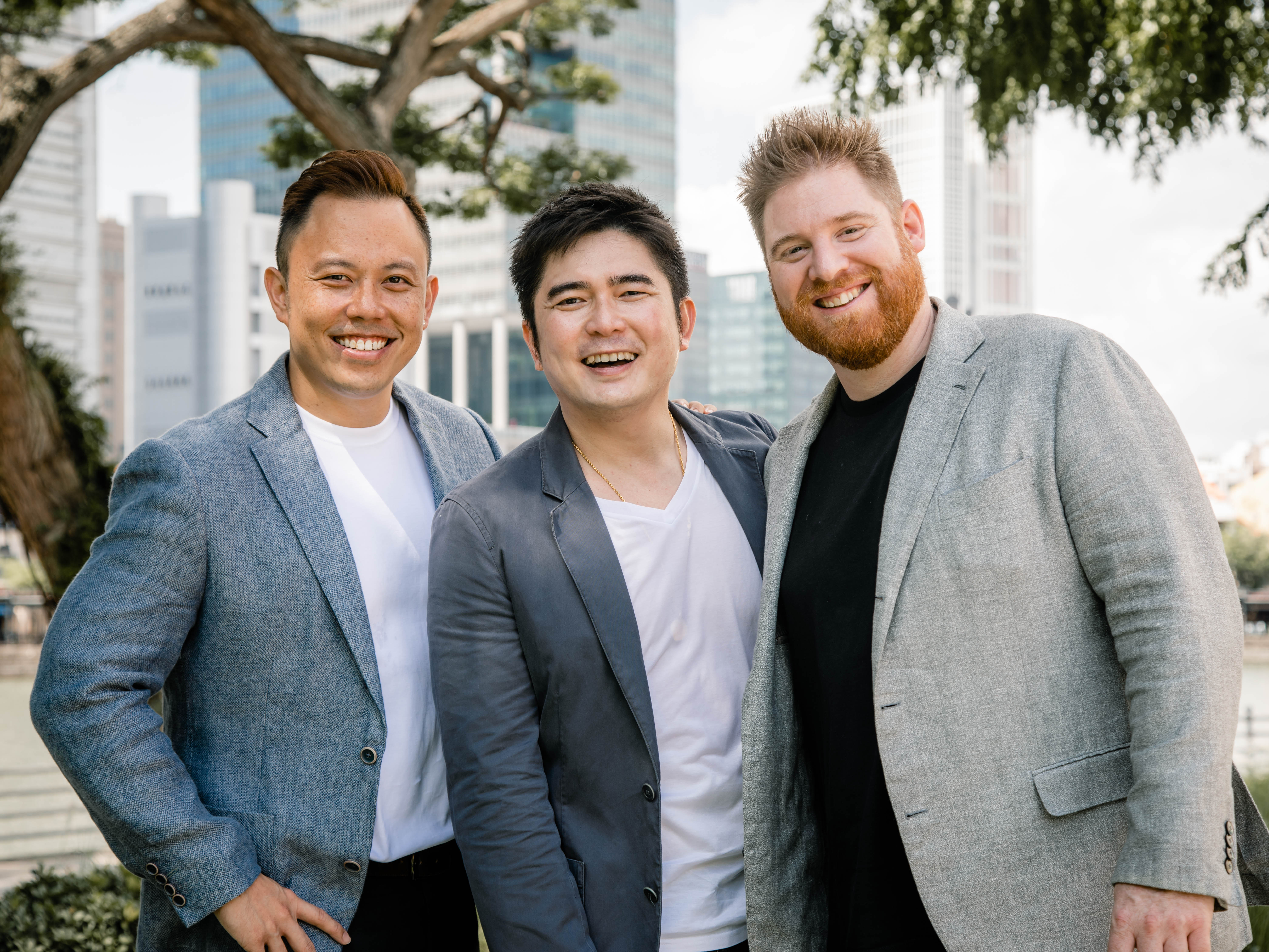
The-Wolfpack’s co-founders, Toh Jin Wei, Tan Kok Chin and Simon Nichols

The-Wolfpack’s co-founders, Toh Jin Wei, Tan Kok Chin and Simon Nichols (Image Credit: The-Wolfpack)

The COVID-19 pandemic has hit the consumer, leisure and media companies hard, but a new venture firm called The-Wolfpack is still very upbeat on those sectors. Based in Singapore, the firm was founded by former managing directors at GroupM, one of the world’s largest advertising and media companies, and plans to work very closely with each of its portfolio companies. Its name was chosen because they believe “entrepreneurs thrive best in a wolfpack.”

The-Wolfpack’s debut fund, called the Wolfpack Pioneer VCC, is already fully subscribed at $5 million USD, and will focus on direct-to-consumer companies, with plans to invest in eight to 10 startups. The firm is already looking to raise a second fund, with a target of $20 million SGD (about $14.9 million USD) and above, and will set up another office in Thailand, with plans to expand into Indonesia as well.

The-Wolfpack was founded by Toh Jin Wei and Simon Nichols, who met while working at GroupM, and Tan Kok Chin, a former director at Sunray Woodcraft Construction who has worked on projects with Marina Bay Sands, Raffles Hotel and the Singapore Tourism’s offices.

In addition to providing financial capital, The-Wolfpack wants to build ecosystems around its portfolio companies by connecting them with IP owners, digital marketing experts, content producers and designers who can help create offline experiences. It also plans to invest in startups based on opportunities for them to collaborate or cross-sell with one another.

Toh told TechCrunch that formal planning on The-Wolfpack began at the end of 2019, but he and Nichols started thinking of launching their own business five years ago while working together at GroupM.

“Our perspective on what the industry needed was similar — strategic investors who truly knew how to get behind D2C founders,” Toh said.

The COVID-19 pandemic and its economic impact has hurt spending in The-Wolfpack’s three key sectors (consumer, leisure and media). But it also presents opportunities for innovation as consumer habits shift, Nichols said.

For example, even though consumer spending has dropped, people are still “drawn towards brands that build towards higher-quality engagements,” he said. “There is a real business advantage for D2C brands who’ve recognized this shift and know how to act on it.”

The-Wolfpack hasn’t disclosed its investments yet since deals are still being finalized, but some of the brands its debut fund are interested in include one launched by an Australian makeup artist who wants to scale to Southeast Asia, and an online gaming company whose ecosystem includes original content, gaming teams and studios. The-Wolfpack plans to help them set up a physical studio to create an offline experience, too.

“Typically brands have talked at customers, but it’s become a two-way conversation, and startups who get D2C right have a real potential for exponential growth that’s worth investing in,” said Toh.


https://ift.tt/3fDKFSk New venture firm The-Wolfpack takes a fresh approach to D2C startups https://ift.tt/33f6tPf

Daily Crunch: Twitter will bring back verification

Twitter prepares to hand out more blue checkmarks, YouTube suspends OANN and Discord is raising a big funding round. This is your Daily Crunch for November 24, 2020.

The big story: Twitter will bring back verification

Twitter paused its blue checkmark verification system in 2017 as it faced controversy over who gets verified — specifically over the decision to verify the organizer of the infamous and deadly white supremacist rally in Charlottesville.

Since then, Twitter has done occasional verifications for medical experts tweeting about COVID-19 and candidates running for public office, but it hasn’t brought back the program in a systematic way.

Now Twitter says it will relaunch verification in 2021, and that it’s currently soliciting feedback on the policy. Initially, verification will focus on six types of accounts: government officials, companies/brands/nonprofits, news, entertainment, sports and activists/organizers/other influential individuals.

The tech giants

YouTube suspends and demonetizes One America News Network over COVID-19 video — YouTube said, “After careful review, we removed a video from OANN and issued a strike on the channel for violating our COVID-19 misinformation policy.”

Instagram businesses and creators may be getting a Messenger-like ‘FAQ’ feature — This new feature will allow people to start conversations with businesses or creators’ accounts by tapping on a commonly asked question within a chat.

Fortnite adds a $12 monthly subscription bundle — The $11.99 monthly Fortnite Crew fee entitles players to a full season battle pass, 1,000 monthly bucks and a Crew Pack featuring an exclusive outfit bundle.

Startups, funding and venture capital

Discord is close to closing a round that would value the company at up to $7B — The new funding comes just months after a $100 million investment that gave the company a $3.5 billion valuation.

Dija, a new delivery startup from former Deliveroo employees, is closing in on a $20M round led by Blossom — Few details are public about Dija, except that it will offer convenience and fresh food delivery using a “dark” convenience store mode.

Marie Ekeland launches 2050, a new fund with radically ambitious, long-term goals —  Ekeland used to be an investor at French VC firm Elaia, where she backed adtech firm Criteo.

Advice and analysis from Extra Crunch

As edtech grows cash rich, some lessons for early stage — The valuation bumps for both Duolingo and Udemy underscore just how much investor confidence there is in edtech’s remote learning boom.

Working to understand C3.ai’s growth story — As its IPO looms, how quickly did C3.ai grow in its October quarter?

Decrypted: Apple and Facebook’s privacy feud, Twitter hires Mudge, mysterious zero-days — Zack Whittaker’s latest roundup of cybersecurity-related news.

(Extra Crunch is our membership program, which aims to democratize information about startups. And until November 30, you can get 25% off an annual membership.)

Everything else

Biden-Harris team finally get their transition .gov domain — This comes after the General Services Administration gave the green light for the Biden-Harris team to transition from political campaign to government administration.

India bans 43 more Chinese apps over cybersecurity concerns — India is not done banning Chinese apps.

The Daily Crunch is TechCrunch’s roundup of our biggest and most important stories. If you’d like to get this delivered to your inbox every day at around 3pm Pacific, you can subscribe here.


from Social – TechCrunch https://ift.tt/2CoAoqu Daily Crunch: Twitter will bring back verification Anthony Ha https://ift.tt/3lbgWRX
via IFTTT

Mobile banking app Current raises $131M Series C, tops 2 million members

U.S. challenger bank Current, which has doubled its member base in less than six months, announced this morning it raised $131 million in Series C funding, led by Tiger Global Management. The additional financing brings Current to over $180 million in total funding to date, and gives the company a valuation of $750 million.

The round also brought in new investors Sapphire Ventures and Avenir. Existing investors returned for the Series C, as well, including Foundation Capital, Wellington Management Company and QED.

Current began as a teen debit card controlled by parents, but expanded to offer personal checking accounts last year, using the same underlying banking technology. The service today competes with a range of mobile banking apps, offering features like free overdrafts, no minimum balance requirements, faster direct deposits, instant spending notifications, banking insights, check deposits using your phone’s camera and other now-standard baseline features for challenger banks.

In August 2020, Current debuted a points rewards program in an effort to better differentiate its service from the competition, which as of this month now includes Google Pay.

When Current raised its Series B last fall, it had over 500,000 accounts on its service. Today, it touts over 2 million members. Revenue has also grown, increasing by 500% year-over-year, the company noted today.

“We have seen a demonstrated need for access to affordable banking with a best-in-class mobile solution that Current is uniquely suited to provide,” said Current founder and CEO Stuart Sopp, in a statement about the fundraise. “We are committed to building products specifically to improve the financial outcomes of the millions of hard-working Americans who live paycheck to paycheck, and whose needs are not being properly served by traditional banks. With this new round of funding we will continue to expand on our mission, growth and innovation to find more ways to get members their money faster, help them spend it smarter and help close the financial inequality gap,” he added.

The additional funds will be used to further develop and expand Current’s mobile banking offerings, the company says.


https://ift.tt/eA8V8J Mobile banking app Current raises $131M Series C, tops 2 million members https://ift.tt/361RQ3r

Instagram businesses and creators may be getting a Messenger-like ‘FAQ’ feature

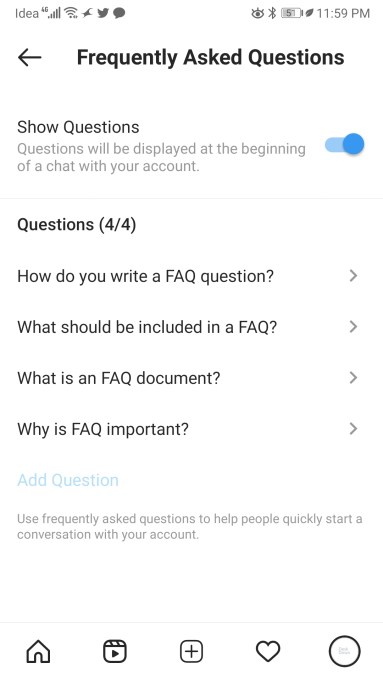
Instagram is developing a new product, Frequently Asked Questions (FAQ), that will allow people to start conversations with businesses or creators’ accounts by tapping on a commonly asked question within a chat. Those who already have the feature available report they’re able to create set of up to four questions which can optionally be displayed at the beginning of a conversation with other users.

The feature could be useful for businesses that are often responding to customer inquiries about their products or services, or for creators who receive a number of inbound requests from fans or brands interested in collaborations, for example.

The product’s introduction highlights the extent that Instagram’s messaging platform now overlaps with Facebook Messenger, following the recent launch of the new Instagram messaging experience. In September, Facebook announced Instagram users would have the option to upgrade to a new inbox that now offers a number of Messenger-inspired features — like the ability to change your chat color, react with any emoji, set messages to disappear, and more. The upgrade also introduced cross-app communication between Instagram and Messenger’s platforms.

With these changes, it appears Facebook is paving a road towards making the Instagram messaging experience more on par with Messenger.

Today, the Messenger app offers a similar FAQ option for Facebook Page owners under the Automated Responses section in Messenger’s settings. Here, Page owners or admins can set up a series of frequently asked questions and their responses to those questions which can be presented at the beginning of conversations with their Page — just like this new Instagram feature offers.

The Instagram FAQ option had been spotted earlier this year while in development, but seemed to be only for Business accounts, according to the app’s code.


However, new reports and screenshots from one Instagram user with access to the feature indicate the FAQ will be available for creator accounts, in addition to businesses.

The feature was spotted on Monday by social media consultant Matt Navarra, who credited @thenezvm for the new discovery.

Given that @thenezvm has access to the feature now, as the above credited screenshots show, the FAQ option could either be in early testing or starting to roll out more broadly.

It’s likely the former, however, as Instagram declined to comment or provide details, when TechCrunch asked for more information.


from Social – TechCrunch https://ift.tt/373KGLs Instagram businesses and creators may be getting a Messenger-like ‘FAQ’ feature Sarah Perez https://ift.tt/3fzjwQf
via IFTTT

Ignore the social media echo chambers

After Election Day, NPR, The Washington Post and various blogs described America as bitterly divided or on the brink of civil war. These were by the same journalists, pundits and intellectuals who only know how to sell fear.

“They want to take away your guns!” and “They want to take your children away!” were their cries, while praising BLM’s protesters on one screen and promoting videos of the infinitesimal number of rioters on another.

The Atlantic speculated about widespread violence depending on the outcome, but I never believed these seemingly well-researched reports that have become commonplace in our clickbait-driven world. And as we saw, nothing of real concern happened; instead of violence, there were relatively small protests and dancing in the streets.
The gap that supposedly divides our nation is narrower than the doomsaying pundits, intellectuals, politicians and cause leaders want you to believe. Why do they want you to believe this? Because promoting division and conflict sells and grants a perverse glue that unites people within their tribal communities. Behind these labels of conflict are seeds of fear that can grow into irrational fears. Fears without reason, fears beyond facts. Sometimes these fears become things we hate  —  and our society and nation should have no place for hate, because it is an unproductive emotion without any possible positive outcome.

I’ve learned to ignore much of the headline-driven news and social media echo chambers where ridiculous ideas fester across our political spectrum. There are obviously ridiculous ideas, such as QAnon, but the subtly ridiculous ideas can be more dangerous and potentially even more destructive. These ideas can be diminished by simple questions to the average reasonable person.
One idea spawned in some progressive echo chambers was the notion that Trump would stage a coup d’état if Joe Biden won the election (i.e., “Did you see those unmarked federal police!?” which signaled to some that a coup was coming).

A basic element of a coup d’état is military support or control, which obviously Trump did not have. I would ask basic questions around this idea, but always ask the rhetorical question, “Do you know how difficult it is to conduct a coup d’état?” Meanwhile, in some conservative echo chambers, a similar concern made rounds that “defund the police” was an effort to install a “federal police force” that Biden would control once in the Oval Office. So there really isn’t much original thought inside the echo chambers of America.

Maybe both sides with such fantasies recently watched that Patrick Swayze classic, “Red Dawn,” where a tiny militia of high school students held off the combined forces of the old Soviet Union and Cuba. Or maybe they saw “300,” in which Sparta’s army held off more than 300,000 invaders. After watching either of these inspirational movies, I might possibly believe such a militia or “federal force” could overpower the whole might of the U.S. military. Ahem.

For those warmongers and soothsayers warning of civil war, where do they want the country to go? Static echo chambers of America, or a vision of suburban folks with pitchforks and handguns versus urban dwellers carrying machine guns and Blue Bottle coffee mugs?

Since the level of violence after the election did not in fact match the crystal balls of these oracles, the definitions and terms have of course changed. As Bertrand Russell stated, “fear is the main source of superstition”  —  to which I would add that fear is also the source of really stupid predictions and ideas.
And let’s be clear that while I do criticize the echo chambers of social media, they are only tools of promotion, because echo chambers are not limited to the online social media. Echo chambers can be homes, bars, lodge meetings, yoga studios and Sunday bridge clubs. The enablers are the pundits, intellectuals, politicians and cause leaders that seed these ideas.

Conspiracy theories, misinformation and outlandish statements were quite capable of spreading before the recommendation engines of Facebook and others were fully developed. For example, in 2006, over 50% of Democrats believed the U.S. government was involved in the 9/11 terrorist attack. More than half of registered Democrats believed in this conspiracy theory! And let’s not forget the Obama “birther” conspiracy, where at least 57% of Republicans continued to believe that President Obama was born in Kenya even after he released his birth certificate in 2008.

But today, Facebook, YouTube, Twitter and other social media sites have become extremely powerful accelerants for such provocative ideas and strange fictions. Tristan Harris, co-founder and president of the Center for Humane Technology, was recently featured in the Netflix documentary “The Social Dilemma,” where he discussed how social media tends to feed content to retain people’s attention and can spiral downward.

This can become an abyss of outright misinformation, or — even more importantly in my estimation — for subtle, ignorant ideas, such as coups d’état and civil wars. And those destructive ideas and irrational conspiracy theories from the 2000s that probably took months to spread, are now supercharged by today’s social media giants to infect our society in a matter of days or weeks.

The fabric of our nation was delicately woven, but after countless turns of the loom between conflicts and enlightenment, our country has proven itself extremely resilient. Indestructible beyond today’s calls for racism and ignorance, for anarchy and destruction, and for civil wars.

Biden is our President-elect with a mandate to lead our nation beyond this divide  —  a divide that I believe has been overstated. Many citizens met in the middle to provide Biden with a mandate to bridge the gap. The “blue wave” didn’t occur and House Republicans gained 10 seats, which means many Republicans and independents voted “red” down-ballot but also voted for Biden.

Trump had the largest number of minority votes for a Republican presidential candidate in history, including from 18% of Black male voters  —  and that number would have been much higher pre-pandemic. I see all of this as a positive, because our citizens are not voting party line or becoming beholden to one party.

In reality, many of the major issues that supposedly separate us are much closer than we know. For example, I’ve sat down behind closed doors with a senior adviser on healthcare for a major Republican leader, who stated that Obamacare isn’t far off from what they were planning. The difference was that their plan was more small business friendly and their cost savings would be among the younger demographic. I also sat down with a senior adviser for Obamacare, who explained that they believed it wasn’t sustainable unless the cost savings were for those 65 and above. So the differences on such critical policies are not miles apart but only steps away from each other. Although at times politics are about credit and conflict, hopefully such differences can be resolved in the near future.

I hope this election will change the temperament of our nation and its citizens. I hope it will lead more people to ignore the tactics of both political parties and organizations seeking their attention and support. Their shortsighted methods should be cast away like the relics of the past and conflict should not be the tool of this new America. Instead, let’s focus on productive dialogue to find common ground, and thoughtful, practical policies to move our nation forward.


from Social – TechCrunch https://ift.tt/eA8V8J Ignore the social media echo chambers Walter Thompson https://ift.tt/3kXp7kp
via IFTTT

Twitter to relaunch account verifications in early 2021, asks for feedback on policy

Twitter announced today it’s planning to relaunch its verification system in 2021, and will now begin the process of soliciting public feedback on the new policy ahead of its implementation. Under the policy, Twitter will initially verify six types of accounts, including those belonging to government officials; companies, brands and nonprofit organizations; news; entertainment; sports; and activists, organizers and other influential individuals. The number of categories could expand in time.

Twitter’s verification system, which provides a blue checkmark to designate accounts belonging to public figures, was paused in 2017 as the company tried to address confusion over what it meant to be verified.

The issue at the time was that Twitter had verified the account belonging to Jason Keller, the person who organized the deadly white supremacist rally in Charlottesville, Virginia. In response to the wave of criticism directed at Twitter as a result of this action, the company defended its decision by pointing to its policies around account verification, which explained its blue badges were awarded to accounts of “public interest.”

Critics argued that genuinely noteworthy figures were still struggling to get their own accounts verified, and that verifying a known white supremacist was not something that should ever be in the “public interest.” As a result, Twitter in November 2017 decided to pause all account verifications.

The following year, the company announced work on the verification system would be placed on a longer, more indefinite hold, so Twitter could direct its resources to focus on election integrity. That proved to be a significant undertaking, as it turned out.

Though the company this year verified medical experts tweeting about COVID-19 and labeled candidates running for public office, these efforts were managed in more of a one-off fashion.

Now, with the 2020 U.S. presidential election having wrapped, and with a transition underway, Twitter says work on its new verification system will finally resume.

The company today shared a draft of its new verification policy in order to gain public feedback. The policy details more specifically which accounts can be verified and introduces additional guidelines that could limit some accounts from receiving the blue badge.

For example, Twitter says the account must be “notable and active,” and the badge won’t be awarded to any accounts with incomplete profiles. Twitter will also deny or remove verification badges from otherwise qualified individuals if their accounts are found to be in repeated violation of the Twitter Rules.

The company additionally admitted it had verified accounts over the years which should not be, as based on these guidelines. To correct this, Twitter will begin to automatically remove badges from accounts that are inactive or have incomplete profiles, to help it streamline its work going forward.

The policy also lays out specifics about how it will determine whether an account in a supported category will qualify.

For example, news organizations will have to adhere to professional standards for journalism, and independent or freelance journalists will need to provide at least three bylines in qualifying organizations published in the last six months. Entertainers will need to be able to point to credits on their IMDb page or to references in verified news publications. Government officials will need to show a public reference on an official government website, party website or multiple references by news media. Sports figures will have to appear on team websites, rosters or in sports data services like Sportradar. There are a few other ways to be verified in these categories, too.

The guidelines for public figures are more detailed, as they must meet two different criteria for “notability” — one that quantifies their Twitter activity and another that highlights their off-Twitter notability, like a Wikipedia page, Google Trends profile, profile on an official advocacy site and more.

“We know we can’t solve verification with a new policy alone — and that this initial policy won’t cover every case for being verified — but it is a critical first step in helping us provide more transparency and fairer standards for verification on Twitter as we reprioritize this work,” a company announcement stated. “This version of the policy is a starting point, and we intend to expand the categories and criteria for verification significantly over the next year,” it noted.

Twitter users will be able to offer feedback on the new verification policy starting today, November 24, 2020, and continuing through December 8, 2020. The policy is being made available in English, Hindi, Arabic, Spanish, Portuguese and Japanese. Users can either respond to the survey Twitter has posted or they can choose to tweet their feedback publicly, using the hashtag #VerificationFeedback.

In addition, Twitter says it’s working with local non-governmental organizations and its Trust and Safety Council to gain a range of other perspectives.

After December 8, 2020, Twitter will train its team on the new policy and introduce the final version by Decemeber 17, 2020. The verification system itself, which will include a new public application process, will begin in early 2021.

Though Twitter is giving itself time to make policy changes based on public feedback, it had already begun to develop the underlying technology for the verification application process.

Twitter confirmed to TechCrunch this June it was in the process of building a new in-app system for requesting verification. The feature had been found buried in the app’s code by reverse engineer Jane Manchun Wong, who tweeted a screenshot of a new option, “Request Verification,” that appeared under Twitter’s account settings. At the time, Twitter wouldn’t confirm when the new system would go live.

Though not everyone will qualify for verification, Twitter says it’s working on other features that will help to better distinguish accounts on its platform. Also in 2021, the company will introduce new account types and labels that will help Twitter users identify themselves on their profiles. More details on these features will be announced in the weeks to come, Twitter says.


from Social – TechCrunch https://ift.tt/3iAQ9xu Twitter to relaunch account verifications in early 2021, asks for feedback on policy Sarah Perez https://ift.tt/376pjco
via IFTTT

Dija, a new delivery startup from former Deliveroo employees, is closing in on a $20M round led by Blossom

Dija, a new U.K. based startup founded by senior former Deliveroo employees, is closing in on $20 million funding, TechCrunch has learned.

According to multiple sources, the round, which has yet to close, is being led by Blossom Capital, the early stage venture capital firm founded by ex-Index and LocalGlobe VC Ophelia Brown. It’s not clear who else is in the running, although I understand it was highly contested and the startup had offers from several top tier funds. Blossom Capital and Dija declined to comment.

Playing in the convenience store and delivery space, yet to launch Dija is founded by Alberto Menolascina and Yusuf Saban, who both spent a number of years at Deliveroo in senior positions.

Menolascina was previously Director of Corporate Strategy and Development at the takeout delivery behemoth and held several positions before that. He also co-founded Everli (formerly Supermercato24), the Instacart-styled grocery delivery company in Italy, and also worked at Just Eat.

Saban is the former Chief of Staff to CEO at Deliveroo and also worked at investment bank Morgan Stanley.

In other words, both are seasoned operators in food logistics, from startups to scales-ups. Both Menolascina and Saban were also instrumental in Deliveroo’s Series D, E, and F funding rounds.

Meanwhile, few details are public about Dija, except that it will offer convenience and fresh food delivery using a “dark” convenience store mode, seeing it build out hyper local fulfilment centers in urban high population areas for super quick delivery. It’s likely akin to Accel and Softbank-backed goPuff in the U.S. or perhaps startup Weezy in the U.K.

That said, the model is yet to be proven everywhere it’s been tried and will likely be a capital intensive race in which Dija is off to a good start. And, of course, with everybody making the shift to online groceries while in a pandemic, as ever, timing is everything.


https://ift.tt/eA8V8J Dija, a new delivery startup from former Deliveroo employees, is closing in on a $20M round led by Blossom https://ift.tt/361r3Ew

Looking to emulate Venmo, JoomPay preps a Euro launch for easy bill splitting and cash payments

JoomPay, a startup with a similar product to PayPal-owned Venmo in the U.S., is set to launch in Europe shortly after being granted a Luxembourg Electronic Money Institution (EMI) license. The app allows people to send and receive money with anyone, instantly and for free. “Venmo me” has become a common phrase in the U.S., where people use it to split bills in restaurants or similar instances. Venmo is in common use in the U.S., but it’s not available in Europe, although dozens of other innovative mobile peer to peer transfer options exist, such as Revolut, N26, Monese and Monzo. The waitlist for the app’s beta is open now (iOS, Android).

Europe leads the world’s instant payments industry, with $18 trillion in worldwide volume predicted by 2025, up from $3 trillion in 2020 — a growth of more than 500%. Western Europe — and COVID-19 — is now driving that innovation and will account for 38% of instant payment transaction value by 2025. While Europe lacks simple peer-to-peer payments solutions such as Venmo or Square Cash App in the U.S., challenger banks have stepped up to provide similar kinds of services. JoomPay’s opportunity lies in being able to be a middle-man between these various banking systems.

Shopping app Joom, which has been downloaded 150 million times in Europe, has spun-off JoomPay to solve this problem. The app allows users to send and receive money from any person, regardless of whether they use JoomPay or not — and you only need to know their email or the phone number. JoomPay connects to any existing debit/credit card or a bank account. It also provides its users with a European IBAN and an optional free JoomPay card with cashback and bonuses.

Yuri Alekseev, CEO and co-founder of JoomPay, said: “Since COVID-19 started, we’ve seen a significant decline in cash usage. People can’t meet as easily as before but still need to send money, and we offer a viable alternative.”

JoomPay may have an uphill struggle. Its main competitors in Europe are the huge TransferWise, Paysend and, of course, PayPal itself.


https://ift.tt/eA8V8J Looking to emulate Venmo, JoomPay preps a Euro launch for easy bill splitting and cash payments https://ift.tt/37ady4O

Marie Ekeland launches 2050, a new fund with radically ambitious, long-term goals

Marie Ekeland has unveiled her next act — and it’s a new fund called 2050. But it’s not your average French VC fund as it’s going to be an evergreen fund focused on building a better world. It sounds ambitious, but Ekeland isn’t just daydreaming as she has a detailed action plan.

If you’re not familiar with Marie Ekeland, she used to be an investor at French VC firm Elaia. She invested in adtech firm Criteo, which later became a public company in the U.S. She is also one of the founding members of France Digitale, the main startup lobby in France.

More recently, she co-founded Daphni, her own VC firm. While she’s no longer involved with Daphni’s day-to-day activities, she still follows her own investments in Daphni’s first fund. Her investments include Shine, Swile, Holberton School and Lifen.

With 2050, Ekeland is going back to the drawing board with a different vision when it comes to investment thesis, fund structure and the firm’s own values.

“Investment is self-fulfilling,” Ekeland told me. “When you invest in this company instead of that one, you’re shaping the future of society.”

During our lengthy discussion, it became quite clear that Ekeland both suffers from tech fatigue and also still believes she can have a positive impact through her investments.

Let’s start with the investment thesis. 2050 wants to focus on five fundamental areas — the future of food, better healthcare, improving education, shaping a sustainable lifestyle and fostering trust in the media and financial institutions.

As the name suggests, 2050 has a lot of time to think about these issues. The firm is willing to invest over the long haul. But if an entrepreneur wants to sell their company, that’s OK too. The idea is that there shouldn’t be any time frame pressure.

With traditional VC firms, limited partners invest in a fund and expects returns 10 years later. That’s why most VC funds have to sell their positions within eight to 10 years. It could lead to some pressure to go public, get acquired or find other investors to buy back previous investors.

So how do you remove short-term financial pressure from investment firms? 2050 is a fonds de pérennité, which works a bit like a trust fund, a mission-driven fund.

As an evergreen fund, investors in 2050 can invest whenever they want. Regularly, 2050 will open up liquidity distribution windows. It means that existing investors will be able to sell their positions in 2050. New investors will purchase those positions.

“What we’re doing is quite innovative, so we’re learning by doing,” Ekeland said. 2050 is still expecting regulatory approvals from France’s financial regulator AMF. In the meantime, 2050 has already participated in Withings’ latest funding round. Along with Ekeland, Anne-Lise Bance, Aicha Ben Dhia, Charly Berthet, Meyha Camara and Aude Duprat have already joined the team.

2050 also plans to dedicate 10% of investments in the fund and 50% of the team’s carried interest for digital commons. Arguably, this is the most interesting part of 2050. It proves that the team is committed to its vision beyond blog posts.

For instance, 2050 will contribute to Université Paris Dauphine’s class on the ecological challenges of the 21st century. The idea is to share that class as broadly as possible under an open license.

Some key concepts will be turned into actionable items for entrepreneurs. If you browse the business book section of your local bookshop, chances are you’ll see a ton of books about building a startup, growing as fast as possible and not paying attention to structural damage.

By investing in (often underfunded) knowledge, 2050 could share a different kind of actionable items with its portfolio companies and the tech ecosystem at large. Other investments in commons could include infrastructure investments that help everyone, or mutualized research.

Tech isn’t just about building companies. Public institutions, individuals and nonprofit organizations also have a say in the tech ecosystem. And I’m glad to see that 2050 understands that tech investment isn’t just about financing private companies. It’s such an important shift and I hope other investors will follow suit.


https://ift.tt/eA8V8J Marie Ekeland launches 2050, a new fund with radically ambitious, long-term goals https://ift.tt/2UVJIuO

Learn how to access funding for your startup at TC Sessions: Space 2020

Building tech startups takes cash — and lots of it. But when you’re talking space startups, you’re talking galactic-level money. Costs blast right through Earth’s exosphere and become, literally, astronomical. If space is your jam, you’re going to need financial help, and you’ll learn where and how to access it at TC Sessions Space 2020 (December 16-17).

Set your transporter coordinates for our Fast Money breakout sessions. You’ll hear presentations from leading space accelerators and funding programs. You’ll learn how to access grant money and — wait for it — you can schedule individual appointments with representatives from each program.

PSA: Don’t have a pass yet? We’re offering a BOGO deal. Buy one Late Registration ticket for $175 and get one free. You and a colleague pay just $87.50 each — that’s less than the early-bird price. Buy your passes before this deal ends on Sunday, November 29, at 11:59 p.m. PST.

Attend these Fast Money breakout sessions and then use CrunchMatch to schedule private meetings with program reps.

  • Fast Money — Space Force Innovation Ecosystem: The USSF wants to partner with innovative non-traditional companies as we look to build out the space architecture of the future. Come learn how to join us. Major Ryan Pennington, Deputy, Space Force Ventures, SMC Space Ventures.
  • Fast Money — The Space Force Accelerators: Learn how the Hyperspace Challenge, Catalyst Space Accelerator, and other government accelerators can connect you to the U.S. Space Force. Gabe Mounce, Director, Space Force Accelerators, Air Force Research Laboratory.
  • Fast Money — Working with the Army to Operationalize Science for Transformational Overmatch: Learn about DEVCOM Army Research Laboratory and the xTech Program of prize competitions that accelerate innovative solutions that can help solve Army challenges. Peter Khooshabeh, Regional Lead, DEVCOM, ARL West.
  • Fast Money — Advancing Space Technology with NASA SBIR: Learn about the Small Business Innovation Research (SBIR) and the Small Business Technology Transfer (STTR) programs powered by NASA. Jenn Gustetic, Early Stage Innovations and Partnerships Program Director, NASA HQ Space Technology Mission Directorate.
  • Fast Money — NAVWAR SBIR/STTR Primer: The SBIR/STTR is a robust program designed to help small businesses address government needs while promoting commercialization. This session is dedicated to providing a primer on the program with tips on getting involved and getting engaged with the Naval Information Warfare Systems Command (NAVWAR). Shadi Azoum, Small Business Innovation Research & Rapid Innovation Fund Program Manager, Naval Information Warfare Systems Command.
  • Fast Money — Introduction to In-Q-Tel’s investing activities in the commercial space sector: In-Q-Tel is a strategic investment firm that works with the national security community of the United States. For 20 years, In-Q-Tel has served one mission: to deliver the most sophisticated strategic technical knowledge and capabilities to the U.S. government and its allies through its unique investment model. Over the past decade, In-Q-Tel has been one of the most active investors in the commercial space sector, with a broad investment thesis that touches many aspects of the sector. This session will provide an overview of In-Q-Tel as a whole, as well as a discussion of the firm’s activities in the commercial space sector. Tom Gillespie, Managing Partner and Investment lead for In-Q-Tel’s Field Technologies Practice.
  • Fast Money – Enabling a dual-use business model with Defense Innovation Unit (DIU)

Explore all the TC Sessions: Space presentations in the event agenda and start planning your schedule now. And don’t sweat any conflicts — with VOD, you can catch anything you miss at your convenience.

Learn how to find and access the funding to fuel your space startup. Don’t miss the Fast Money breakouts at TC Sessions: Space 2020. And get your buy-one-get-one-free ticket before our week-long Black Friday sale ends Sunday, November 29, at 11:59 p.m. PST.

Is your company interested in sponsoring TC Sessions: Space 2020? Click here to talk with us about available opportunities.


https://ift.tt/eA8V8J Learn how to access funding for your startup at TC Sessions: Space 2020 https://ift.tt/3nKYEZk

Decrypted: Apple and Facebook’s privacy feud, Twitter hires Mudge, mysterious zero-days

Trump’s election denialism saw him retaliate in a way that isn’t just putting the remainder of his presidency in jeopardy, it’s already putting the next administration in harm’s way.

In a stunning display of retaliation, Trump fired CISA director Chris Krebs last week after declaring that there was “no evidence that any voting system deleted or lost votes, changed votes or was in any way compromised,” a direct contradiction to the conspiracy-fueled fever dreams of the president who repeatedly claimed, without evidence, that the election had been hijacked by the Democrats. CISA is left distracted by disarray, with multiple senior leaders leaving their posts — some walked, some were pushed — only for the next likely chief to stumble before he even starts because of concerns with his security clearance.

Until yesterday, Biden’s presidential transition team was stuck in cybersecurity purgatory because the incumbent administration refused to trigger the law that grants the incoming team access to government resources, including cybersecurity protections. That’s left the incoming president exposed to ongoing cyber threats, all while being shut out from classified briefings that describe those threats in detail.

As Biden builds his team, Silicon Valley is also gearing up for a change in government — and temperament. But don’t expect too much of the backlash to change. Much of the antitrust allegations, privacy violations and net neutrality remain hot button issues, and the tech titans resorting to cheap “charm offenses” are likely to face the music under the Biden administration — whether they like it or not.

Here’s more from the week.


THE BIG PICTURE

Apple and Facebook spar over privacy — again

Apple and Facebook are back in the ring, fighting over which company is a bigger existential threat to privacy. In a letter to a privacy rights group, Apple said its new anti-tracking feature will launch next year, which will give users the choice of blocking in-app tracking, a move that’s largely expected to cause havoc to the online advertising industry and data brokers.

Given an explicit option between being tracked and not, as the feature will do, most are expected to decline.

Apple’s letter specifically called out Facebook for showing a “disregard for user privacy.” Facebook, which made more than 98% of its global revenue last year from advertising, took its own potshot back at Apple, claiming the iPhone maker was “using their dominant market position to self-preference their own data collection, while making it nearly impossible for their competitors to use the same data.”


https://ift.tt/eA8V8J Decrypted: Apple and Facebook’s privacy feud, Twitter hires Mudge, mysterious zero-days https://ift.tt/373vHBc

Industrial drone maker Percepto raises $45M and integrates with Boston Dynamics’ Spot

Consumer drones have over the years struggled with an image of being no more than expensive and delicate toys. But applications in industrial, military and enterprise scenarios have shown that there is indeed a market for unmanned aerial vehicles, and today, a startup that makes drones for some of those latter purposes is announcing a large round of funding and a partnership that provides a picture of how the drone industry will look in years to come.

Percepto, which makes drones — both the hardware and software — to monitor and analyze industrial sites and other physical work areas largely unattended by people, has raised $45 million in a Series B round of funding.

Alongside this, it is now working with Boston Dynamics  and has integrated its Spot robots with Percepto’s Sparrow drones, with the aim being better infrastructure assessments, and potentially more as Spot’s agility improves.

The funding is being led by a strategic backer, Koch Disruptive Technologies, the investment arm of industrial giant Koch Industries (which has interests in energy, minerals, chemicals and related areas), with participation also from new investors State of Mind Ventures, Atento Capital, Summit Peak Investments, Delek-US. Previous investors U.S. Venture Partners, Spider Capital and Arkin Holdings also participated. (It appears that Boston Dynamics and SoftBank are not part of this investment.)

Israel-based Percepto has now raised $72.5 million since it was founded in 2014, and it’s not disclosing its valuation, but CEO and founder Dor Abuhasira described as “a very good round.”

“It gives us the ability to create a category leader,” Abuhasira said in an interview. It has customers in around 10 countries, with the list including ENEL, Florida Power and Light and Verizon.

While some drone makers have focused on building hardware, and others are working specifically on the analytics, computer vision and other critical technology that needs to be in place on the software side for drones to work correctly and safely, Percepto has taken what I referred to, and Abuhasira confirmed, as the “Apple approach”: vertical integration as far as Percepto can take it on its own.

That has included hiring teams with specializations in AI, computer vision, navigation and analytics as well as those strong in industrial hardware — all strong areas in the Israel tech landscape, by virtue of it being so closely tied with its military investments. (Note: Percepto does not make its own chips: these are currently acquired from Nvidia, he confirmed to me.)

“The Apple approach is the only one that works in drones,” he said. “That’s because it is all still too complicated. For those offering an Android-style approach, there are cracks in the complete flow.”

It presents the product as a “drone-in-a-box”, which means in part that those buying it have little work to do to set it up to work, but also refers to how it works: its drones leave the box to make a flight to collect data, and then return to the box to recharge and transfer more information, alongside the data that is picked up in real time.

The drones themselves operate on an on-demand basis: they fly in part for regular monitoring, to detect changes that could point to issues; and they can also be launched to collect data as a result of engineers requesting information. The product is marketed by Percepto as “AIM”, short for autonomous site inspection and monitoring.

News broke last week that Amazon has been reorganising its Prime Air efforts — one sign of how some more consumer-facing business applications — despite many developments — may still have some turbulence ahead before they are commercially viable. Businesses like Percepto’s stand in contrast to that, with their focus specifically on flying over, and collecting data, in areas where there are precisely no people present.

It has dovetailed with a bigger focus from industries on the efficiencies (and cost savings) you can get with automation, which in turn has become the centerpiece of how industry is investing in the buzz phrase of the moment, “digital transformation.”

“We believe Percepto AIM addresses a multi-billion-dollar issue for numerous industries and will change the way manufacturing sites are managed in the IoT, Industry 4.0 era,” said Chase Koch, President of Koch Disruptive Technologies, in a statement. “Percepto’s track record in autonomous technology and data analytics is impressive, and we believe it is uniquely positioned to deliver the remote operations center of the future. We look forward to partnering with the Percepto team to make this happen.”

The partnership with Boston Dynamics is notable for a couple of reasons: it speaks to how various robotics hardware will work together in tandem in an automated, unmanned world; and it speaks to how Boston Dynamics is pulling up its socks.

On the latter front, the company has been making waves in the world of robotics for years, specifically with its agile and strong dog-like (with names like “Spot” and “Big Dog”) robots that can cover rugged terrains and handle tussles without falling apart.

That led it into the arms of Google, which acquired it as part of its own secretive moonshot efforts, in 2013. That never panned out into a business, and probably gave Google more complicated optics at a time when it was already being seen as too powerful. Then, SoftBank stepped in to pick it up, along with other robotics assets, in 2017. That hasn’t really gone anywhere either, it seems, and just this month it was reported that Boston Dynamics was reportedly facing yet another suitor, Hyundai.

All of this is to say that partnerships with third parties that are going places (quite literally) become strong signs of how Boston Dynamics’ extensive R&D investments might finally pay off with enterprising dividends.

Indeed, while Percepto has focused on its own vertical integration, longer term and more generally there is an argument to be made for more interoperability and collaboration between the various companies building “connected” and smart hardware for industrial, physical applications.

It means that specific industries can focus on the special equipment and expertise they require, while at the same time complementing that with hardware and software that are recognised as best-in-class. Abuhasira said that he expects the Boston Dynamics partnership to be the first of many.

That makes this first one an interesting template. The partnership will see Spot carrying Percepto’s payloads for high resolution imaging and thermal vision “to detect issues including hot spots on machines or electrical conductors, water and steam leaks around plants and equipment with degraded performance, with the data relayed via AIM.” It will also mean a more thorough picture, beyond what you get from the air. And, potentially, you might imagine a time in the future when the data that the combined devices source, results even in Spot (or perhaps a third piece of autonomous hardware) carrying out repairs or other assistance.

“Combining Percepto’s Sparrow drone with Spot creates a unique solution for remote inspection,” said Michael Perry, VP of Business Development at Boston Dynamics, in a statement. “This partnership demonstrates the value of harnessing robotic collaborations and the insurmountable benefits to worker safety and cost savings that robotics can bring to industries that involve hazardous or remote work.”


https://ift.tt/eA8V8J Industrial drone maker Percepto raises $45M and integrates with Boston Dynamics’ Spot https://ift.tt/36ZhpRY

blogger better Headline Animator