l
l
blogger better. Powered by Blogger.

Search

Labels

blogger better

Followers

Blog Archive

Total Pageviews

Labels

Download

Blogroll

Featured 1

Curabitur et lectus vitae purus tincidunt laoreet sit amet ac ipsum. Proin tincidunt mattis nisi a scelerisque. Aliquam placerat dapibus eros non ullamcorper. Integer interdum ullamcorper venenatis. Pellentesque habitant morbi tristique senectus et netus et malesuada fames ac turpis egestas.

Featured 2

Curabitur et lectus vitae purus tincidunt laoreet sit amet ac ipsum. Proin tincidunt mattis nisi a scelerisque. Aliquam placerat dapibus eros non ullamcorper. Integer interdum ullamcorper venenatis. Pellentesque habitant morbi tristique senectus et netus et malesuada fames ac turpis egestas.

Featured 3

Curabitur et lectus vitae purus tincidunt laoreet sit amet ac ipsum. Proin tincidunt mattis nisi a scelerisque. Aliquam placerat dapibus eros non ullamcorper. Integer interdum ullamcorper venenatis. Pellentesque habitant morbi tristique senectus et netus et malesuada fames ac turpis egestas.

Featured 4

Curabitur et lectus vitae purus tincidunt laoreet sit amet ac ipsum. Proin tincidunt mattis nisi a scelerisque. Aliquam placerat dapibus eros non ullamcorper. Integer interdum ullamcorper venenatis. Pellentesque habitant morbi tristique senectus et netus et malesuada fames ac turpis egestas.

Featured 5

Curabitur et lectus vitae purus tincidunt laoreet sit amet ac ipsum. Proin tincidunt mattis nisi a scelerisque. Aliquam placerat dapibus eros non ullamcorper. Integer interdum ullamcorper venenatis. Pellentesque habitant morbi tristique senectus et netus et malesuada fames ac turpis egestas.

Friday, August 20, 2021

Communication software startup Channels takes on event management with text workflow

Three University of Michigan students are building Channels Inc., a communication software tailored for physical workers, and already racking up some big customers in the event management industry.

Siddharth Kaul, 18, Elan Rosen, 20, and Ibrahim Mohammed, 20, started the company after finding some common ground in retail and events. The company’s customer list boasts names like Marriott Hotels, and it announced a $520,000 seed round, led by Sahra Growth Capital, to give it nearly $570,000 in total funding.

Kaul grew up going to a lot of events in Kuwait and Dubai, but started noticing there was a delay in things that should happen and many processes were being done on pen and paper.

“The technology that was available was inharmonious and made it hard for physical workers to fulfill tasks,” Kaul told TechCrunch. “We saw it happening in the event management space, forcing workers to coordinate across technologies.”

Legacy communication platforms like Slack are aggregating communications, but are better for remote workers; for physical workers, they rely more on text communication, he said. However, the disadvantage with texting is that you have to keep scrolling to get to the new message, and old communication is lost amid all of the replies.

They began developing a platform for small hotels to help them transition to digital and provide communication in a non-chronological order that is easier to access, enables discussion and can be searched. Users of the SaaS platform can build live personnel maps to see where employees are and what the event floor looks like, prioritize alerts and automate tasks while monitoring progress.

Marriott became a customer after one of its employees saw the Channels platform was being tested at an event. He saw employees pulling out their phones and asked the manager why they were doing that, and was told they were testing out the product and referred him to Kaul.

“What they thought was helpful was that it was communication, and though the employees were checking their phones, it was quick and they remained attentive,” Kaul said.

Channels provides a solid platform in terms of analytics and graphical representation, which is a major selling point for customers, leading to initial traction and revenue for the company that Rosen said he expects can occur at the convention level the company is striving for.

The new funding will be used to grow in development and bring additional engineering talent to the team. In addition, it will allow Kaul and Rosen to continue with their studies, while Mohammed will be doing more full-time work. They want to increase their recurring revenue in the Middle East while building up operations in the United States.

Jamal Al-Barrak, managing partner of Sahra Growth Capital, said Channels was on his firm’s radar ever since they won the 2020 Dubai X-Series competition it sponsors. As a result of winning the competition, he was able to see the founders on multiple occasions and hear their growth.

Sahra doesn’t typically invest in companies like Channels, but the firm started a “seed sourcing effort” to make investments of between $200,000 and $800,000 into early-stage companies, Al-Barrak said. Channels is one of the first investments with that effort.

“Channels is one of our first investments in this initiative and they look very promising so far even compared to our investments before we started this initiative,” Al-Barrak said. He liked the founders’ work ethic and their focus on the event industry, which he called, “historically outdated and bereft of technological innovation.”

“Sid, Elan and Ibrahim are some of the youngest yet brightest entrepreneurs I have come across to this day and I have invested in over 25 technology startups,” he said. “Additionally, I enjoyed that they had proof of concept with a prior customer base and revenue. I was most impressed by their vision past their current industry and bounds as they want to encapsulate communication for all physical workers, whether it is events, retail or more.”


https://ift.tt/eA8V8J Communication software startup Channels takes on event management with text workflow https://ift.tt/2W8yKGA

Facebook launches program to help small Indian businesses secure loans

Facebook is launching a new program in India to help small and medium-sized businesses secure loans in the South Asian market as the company makes further push to expand its presence among merchants.

The social conglomerate said its new program, called Small Business Loans Initiative, addresses some of the biggest pain points small businesses face when securing loans.

The company, which last year announced a $4.3 million grant for small businesses in India, said the new program will allow its lending partners to grant small ticket loans — ranging between 500,000 Indian rupees ($6,720) to 50,00,000 ($67,200) — at a predefined interest rate of 17%-20% per annum and won’t require the businesses to provide any collateral or joining fee, the firm told TechCrunch.

At the time of launch, company’s pilot lending partner is CDC Group-backed Gurgaon-headquartered Indifi, which will disburse the loan amount within five working days of the borrower completing all documentation formalities after acceptance of the offer by Indifi. The company expects more partners to join the program.

Facebook said it’s working in “arm’s length” with its lending partners, but those partners will be handling all the risks of loan payments and determining the eligibility criteria. (On Facebook website, the company says a business must have advertised on the Facebook family of apps for at least 180 days at the time of application as one of the factors for eligibility.)

Facebook, on its part, is making businesses aware of the lending program and has worked to improve the underlying lending framework such as boundaries for interest rate, engagement responsiveness between the lending partner and businesses (there will be an on-call support system within one day of applying) and ticket size of the credit amount.

In a call with reporters on Friday, Facebook India head Ajit Mohan said that small businesses in 200 Indian cities can apply for the loan starting today.

Businesses wholly or partially run by women will additionally be able to secure the loan at a special 0.2% reduction rates per annum.

This is the first time Facebook has launched a program of this kind in any market, the company told TechCrunch.

According to a survey conducted by Facebook in collaboration with OECD and the World Bank last year, almost a third of operational small and medium-sized businesses on Facebook in 2020 said that they expected cash flow to be one of their primary challenges.

No monetization

The company is not monetizing this program. “We believe it is in our self-interest for there to be a massive growth in the small business ecosystem in India because as a company we are playing this for the long term. We will disproportionately benefit because a lot of these small business activity happens on our apps as they grow,” said Mohan at the briefing.

“We are not looking to make money from this program. We don’t have any revenue sharing agreement. We are not putting any constraint on how this money is spent,” he said. “Frankly, we are also hoping that on the back of a program like this other companies will also create programs so that there is more access to credit in the market. That will be good for us all. There is no transactional objective here.”

For Facebook, Friday’s announcement is the latest in a series of efforts it has made to tap the South Asian nation’s small and medium-sized businesses. The firm, which identifies India as its largest market by users, last year invested $5.7 billion in Indian tech giant Jio Platforms to work on, among other things, digitizing small businesses in the country.

“MSMEs will play a significant role in reviving India’s economic growth and achieving its vision of becoming more self-reliant. Digital transformation will act as a catalyst for India’s development story going forward, and access to finances will be crucial to this transformation,” said Amitabh Kant, chief executive of government-backed highly influential think tank Niti Aayog, at a virtual conference Friday.

“In this context, Facebook’s Small Business Loans initiative is a big step in the right direction and I’m happy to note that India is the first country where the company is launching such an initiative.”


from Social – TechCrunch https://ift.tt/eA8V8J Facebook launches program to help small Indian businesses secure loans Manish Singh https://ift.tt/3z8N5RK
via IFTTT

Alerzo raises $10.5M Series A to bring Nigeria’s informal retail sector online

The process of digitizing the operations of mom and pop stores in Nigeria is serious business right now. In fact, it might be the second-best thing after fintech at the moment.

Today’s news is from Alerzo, a little-known B2B e-commerce retail startup based in Ibadan, Nigeria. The company is announcing a $10.5 million Series A round led by New York-based Nosara Capital. FJ Labs and several family offices from the U.S., Europe and Asia, including Michael Novogratz’s, participated in the round.

In total, Alerzo has raised more than $20 million since its launch. Early investors include the Baobab Network, an Africa-focused accelerator based in London, and Signal Hill, a Singapore-based fund manager that participated in its $5.5 million seed round last year. The company also said it closed a $2.5 million working capital facility to serve its customers.

Adewale Opaleye founded Alerzo in 2018 as a last-mile distribution platform that helps retailers stock inventory directly from manufacturers. Its business, officially launched in 2019, is centered on helping street-side vendors and shops in Nigeria’s south-western cities access household supplies quicker and efficiently.

Speaking with TechCrunch, Opaleye said he started Alerzo to empower the millions of women who are the backbone of consumer commerce in Nigeria’s $100 billion informal retail sector.

The need to solve this problem stemmed from observing firsthand the challenges his mom faced while operating two mom-and-pop stores.

“Growing up in Ibadan, I watched my mother operate two informal retail stores to raise my three siblings and me. Seeing the many challenges she faced running her stores, and I decided to start a business that uniquely catered to the needs of retailers just like her,” he told TechCrunch in an interview

These retailers are beholden to an inefficient distribution system that results in inconsistent inventory availability, opaque pricing and limited access to formal financial and banking services.

The founder says Ibadan was the ideal market to establish its headquarters because informal retailers in the region experience these challenges more than those in Lagos.

Alerzo

Adewale Opaleye (Founder & CEO, Alerzo)

Alerzo’s core business distributes FMCG goods using a first-party relationship platform which allows suppliers to clear inventory faster and lets Alerzo control the supply chain and delivery.

Given the lack of trust in the marketplace and the requirement to pay on delivery, Opaleye says this was the most inclusive business model where the economics made sense for the company.

Alerzo claims to have built up a network of up to 100,000 small businesses, 90% of which are women-led. The company exclusively serves the country’s tier-2 to tier-4 cities in Southwest Nigeria — Ibadan, Ekiti and Abeokuta, to name a few. It connects retailers to local and multinational distributors of consumer brands, like Unilever, Nestlé, Procter & Gamble, Dangote, and PZ.

“Without Alerzo, these retailers need to take a day off from the store to visit a central market, pay for transportation and haul a large amount of inventory back to the store. Alerzo replaces this stressful experience by not only reducing costs and time spent running a retail shop but also improving the livelihood of these working women,” said the founder about the company’s growth.

About one-third of the total retailers on Alerzo use the platform monthly. According to its website, retailers can order products via SMS, voice and WhatsApp and deliver them to their stores in less than 10 hours. The company claims to have processed over 1 million orders this past year.

Alerzo owns and operates its full-stack tech-driven supply chain and logistics to process these orders. The company provides warehousing and fulfillment solutions to suppliers and storefront delivery to informal retailers. It currently owns over 200 vehicles and 20 warehouses to serve its thousands of customers.

The last couple of years have seen a rise in last-mile delivery and distribution companies with a large increase in on-demand services across many sectorsWhile most players in Nigeria tend to focus on Lagos and Nigeria’s capital city Abuja, Alerzo’s approach to covering other cities has seemingly paid off so far.

But though Alerzo has enjoyed almost a first-mover advantage in less crowded markets, stiff competition will play out as other key players look to come in. Omnibiz, for instance, has Ibadan in its sights, and TradeDepot is setting up a presence in 10 to 15 cities, aiming to cover all major cities in the country by the end of the year.

Nevertheless, Alerzo’s investors remain bullish on the company’s potentials.

“We’ve studied informal retail marketplaces globally over the last couple of years and Alerzo really stood out to us due to a strong management team led by a founder with a unique understanding of his customer and an attractive business model with exceptional unit economics,” said Ian Loizeaux, the managing partner at Nosara Capital, in a statement. “The company is at the beginning of a compelling multi-decade opportunity to streamline and digitize Nigeria’s retail supply chain.

Seed investor Kevin Jung of Signal Hill cites Alerzo’s focus on the informal retail market outside Lagos as one of the reasons why he backed Alerzo earlier on. He also referred to the company’s orientation toward Asia (a playbook Opaleye adopted when he went to China for studies in 2016), as the best reference point for the emerging business model of digitizing informal retail markets

Alerzo has an office in Singapore that the CEO says serves as a regional hub to identify best practices among similar high-growth businesses operating across Southeast Asia and India and adapt them to the Nigerian market. Likewise, to expand its digital footprint, the company recently launched an office in Lagos.   

The proceeds from this Series A round will be used to expand geographically to northern Nigeria. Alerzo also plans to launch AlerzoPay, the company’s cashless payments and lending platform, as well as a portfolio of new business support services.


https://ift.tt/2W7nqKz Alerzo raises $10.5M Series A to bring Nigeria’s informal retail sector online https://ift.tt/3D5Yfcc

Thursday, August 19, 2021

Indonesian D2C insurance marketplace Lifepal raises $9M Series A

Choosing an insurance policy is one of the most complicated financial decisions a person can make. Jakarta-based Lifepal wants to simplify the process for Indonesians with a marketplace that lets users compare policies from more than 50 providers, get help from licensed agents and file claims. The startup, which says it is the country’s largest direct-to-consumer insurance marketplace, announced today it has raised a $9 million Series A. The round was led by ProBatus Capital, a venture firm backed by Prudential Financial, with participation from Cathay Innovation and returning investors Insignia Venture Partners, ATM Capital and Hustle Fund.

Lifepal was founded in 2019 by former Lazada executives Giacomo Ficari and Nicolo Robba, along with Benny Fajarai and Reza Muhammed. The new funding brings its total raised to $12 million.

The marketplace’s partners currently offer about 300 policies for life, health, automotive, property and travel coverage. Ficari, who also co-founded neobank Aspire, told TechCrunch that Lifepal was created to make comparing, buying and claiming insurance as simple as shopping online.

“The same kind of experience a customer has today on a marketplace like Lazada—the convenience, all digital, fast delivery—we saw was lacking in insurance, which is still operating with offline, face-to-face agents like 20 to 30 years ago,” he said.

Indonesia’s insurance penetration rate is only about 3%, but the market is growing along with the country’s gross domestic product thanks to a larger middle-class. “We are really at a tipping point for GDP per capita and a lot of insurance carriers are focusing more on Indonesia,” said Ficari.

Other venture-backed insurtech startups tapping into this demand include Fuse, PasarPolis and Qoala. Both Qoala and PasarPolis focus on “micro-policies,” or inexpensive coverage for things like damaged devices. PasarPolis also partners with Gojek to offer health and accident insurance to drivers. Fuse, meanwhile, insurance specialists an online platform to run their businesses.

Lifepal takes a different approach because it doesn’t sell micro-policies, and its marketplace is for customers to purchase directly from providers, not through agents.
Based on Lifepal’s data, about 60% of its health and life insurance customers are buying coverage for the first time. On the other hand, many automotive insurance shoppers had policies before, but their coverage expired and they decided to shop online instead of going to an agent to get a new one.

Ficari said Lifepal’s target customers overlap with the investment apps that are gaining traction among Indonesia’s growing middle class (like Ajaib, Pluang and Pintu). Many of these apps provide educational content, since their customers are usually millennials investing for the first time, and Lifepal takes a similar approach. Its content side, called Lifepal Media, focuses on articles for people who are researching insurance policies and related topics like personal financial planning. The company says its site, including its blog, now has about 4 million monthly visitors, creating a funnel for its marketplace.

While one of Lifepal’s benefits is enabling people to compare policies on their own, many also rely on its customer support line, which is staffed by licensed insurance agents. In fact, Ficari said about 90% of its customers use it.

“What we realize is that insurance is complicated and it’s expensive,” said Ficari. “People want to take their time to think and they have a lot of questions, so we introduced good customer support.” He added Lifepal’s combination of enabling self-research while providing support is similar to the approach taken by PolicyBazaar in India, one of the country’s largest insurance aggregators.

To keep its business model scalable, Lifepal uses a recommendation engine that matches potential customers with policies and customer support representatives. It considers data points like budget (based on Lifepal’s research, its customers usually spend about 3% to 5% of their yearly income on insurance), age, gender, family composition and if they have purchased insurance before.

Lifepal’s investment from ProBatus will allow it to work with Assurance IQ, the insurance sales automation platform acquired by Prudential Financial two years ago.

In a statement, ProBatus Capital founder and managing partner Ramneek Gupta said Lifepal’s “three-pronged approach” (its educational content, online marketplace and live agents for customer support) has the “potential to change the way the Indonesian consumer buys insurance.”

Part of Lifepal’s funding will be used to build products to make it easier to claim policies. Upcoming products include Insurance Wallet, which will include an application process with support on how to claim a policy—for example, what car repair shop or hospital a customer should go to—and escalation if a claim is rejected. Another product, called Easy Claim, will automate the claim process.

“The goal is to stay end-to-end with the customer, from reading content, comparing policies, buying and then renewing and using them, so you really see people sticking around,” said Ficari.

Lifepal is Cathay Innovation’s third insurtech investment in the past 12 months. Investment director Rajive Keshup told TechCrunch in an email that it backed Lifepal because “the company grew phenomenally last year (12X) and is poised to beat its aggressive 2021 plan despite the proliferation of the COVID delta variant, accentuating the fact that Lifepal is very much on track to replicate the success of similar global models such as Assurance IQ (US) and PolicyBazaar (India).”


https://ift.tt/eA8V8J Indonesian D2C insurance marketplace Lifepal raises $9M Series A https://ift.tt/2XISwsP

Arianna Simpson of a16z on Yield Guild Games, the firm’s newest bet on crypto + gaming

As one of four general partners at Andreessen Horowitz who are now investing the venture firm’s third crypto fund, a $2.2 billion vehicle, Arianna Simpson is very focused on how to return that capital and much more to the firm’s limited partners.

Toward that end, she has been more focused of late on startups that combine crypto with gaming. Last month, for example, her team co-led an investment in Virtually Human Studio, the startup behind a digital horse racing service Zed Run, wherein users buy, sell and breed virtual horses whose value rises depending on their performance against other virtual horses. (Each is essentially a non-fungible token, or NFT, meaning it is unique.)

Simpson is relatedly intrigued with NFT-based “play-to-earn” models, wherein gamers can earn cryptocurrency that they can then cash out for their local currency if they so choose. Indeed, a16z is announcing today that it just led a $4.6 million investment in the tokens of Yield Guild Games (YGG), a decentralized gaming startup based in the Philippines that invites players to share in the company’s revenue by playing games like “Axie Infinity,” a blockchain-based game where players breed, battle and trade digital creatures named Axies in order to earn tokens called “Small Love Potion” that they can eventually cash out. YGG lends players the money to buy the Axies and other digital assets to start the game, so they can start earning money. (The obvious hope is that they earn more than they have to pay YGG for the use of its assets.)

We talked yesterday with Simpson — who joined a16z after first backing some of the same startups, including the blockchain infrastructure company Dapper Labs and the global payment platform Celo — to learn more about what’s happening at the intersection of crypto and gaming. She also shared which platforms a16z tracks most closely to identify up-and-coming crypto startups. Our chat, edited for length, follows.

TC: Zed Run is really interesting. How did you first come across this digital horse racing business?

AS: I think it was crypto Twitter, which honestly is where we’re finding a lot of our gaming investments. The community on there is really incredible and often one of the first places where really exciting new projects are surfaced.

Zed really marks the advent of kind of a new type of more involved gameplay in crypto. If you look at [the collectibles game] CryptoKitties, it was one of the first NFT-based games that really caught the attention of people outside of the crypto sphere. Zed is definitely a derivative extension in the sense that you have a digital animal that you’re playing with, but the gameplay is much more complex, and the thing that’s been incredible to watch is just how excited the community is. People are putting together all kinds of very sophisticated guides around how to play the game, to read [race] courses, how to do all kinds of different things in the game, and tens of thousands of people all over the world [are playing].

TC: Maybe these already exist, but are there endless opportunities across verticals here, like, say, a digital car racing equivalent or a UFC-style equivalent, or are people buying and betting on digital fighters and hoping they’ll rise in value?

AS: There’s an incredibly broad range of possibilities in terms of what’s happening and what will happen in the universe of crypto games. I think at the core of this movement is really the idea of giving more of the value and ownership in these game assets back to the players. That’s something that has historically been a problem. You might spend years and years building up your arsenal of skins or in-game assets, and then a game will change the rules, take [some of your winnings] away from you or do any number of things that can leave players feeling very disappointed and kind of ripped off. The idea [with blockchain-based games] is to make them more open and allow players to have actual ownership in the space themselves.

TC: Which leads us to your newest investment, Yield Guild Games, or YGG. Why did this company capture the firm’s attention?

AS: During the pandemic, a lot of people were put out of work and not able to provide for themselves and for their families. This time kind of coincided with the rise of a game called “Axie Infinity,” one of the first games to pioneer a play-to-earn model, which is becoming a very important theme in crypto games.

In order to play “Axie Infinity,” you need to have three Axies, and generally speaking, that means you need
to buy them upfront. Obviously if you’re out of work, you have no money [so buying these digital pets] can become a very challenging proposition. So [YGG founder] Gabby Dizon in the Philippines, who played “Axie Infinity” started lending out his Axies so other people could play the game and earn tokens that could then be converted to local currency. And so basically YGG emerged as sort of the productization of what they were doing here, so YGG either purchases or breeds in-game assets that are yield-earning, then loans them to out “scholars,” who are the recipients of these in-game assets, and YGG then takes a small cut of the in-game revenue that the players generate over time.

TC: Does a “scholar” have to be a sophisticated player?

AS: There are managers who basically manage teams of scholars; they’re the ones who effectively decide who to bring into the guild.

TC: So these Axies can be cashed out for currency, but where, and who is buying them?

AS: They can be bought or sold on exchanges and other players are buying them if they need to breed in “Axie” and needs some [Axies]; others are buying them for investment purposes. Also, they aren’t necessarily selling the NFTs but they may be selling the tokens that they earn as part of the gameplay.

TC: There are now 5,000 of these scholars playing the game. Are they mostly in Southeast Asia?

AS: A majority of the players and scholars are in Southeast Asia, but we’re seeing really strong international growth as well, both for “Axie Infinity” and YGG, in particular. At this point, scaling internationally is definitely a core focus for the YGG team.

TC: You mentioned crypto Twitter. What about Discord and Reddit? Where else are you looking around for new crypto projects that are bubbling up and capturing people’s imagination?

AS: All of the above. Discord in particular is very actively used by the crypto community, and the thing that’s interesting there is it really allows you to get a pulse for how active a community is, how engaged people are, how frequently they’re talking, and what they’re talking about. It gives you a look into the community at large and that’s a very important thing to consider when looking to make an investment or assess the health of a project.


https://ift.tt/eA8V8J Arianna Simpson of a16z on Yield Guild Games, the firm’s newest bet on crypto + gaming https://ift.tt/3ANnSga

Today’s real story: The Facebook monopoly

Facebook is a monopoly. Right?

Mark Zuckerberg appeared on national TV today to make a “special announcement.” The timing could not be more curious: Today is the day Lina Khan’s FTC refiled its case to dismantle Facebook’s monopoly.

To the average person, Facebook’s monopoly seems obvious. “After all,” as James E. Boasberg of the U.S. District Court for the District of Columbia put it in his recent decision, “No one who hears the title of the 2010 film ‘The Social Network’ wonders which company it is about.” But obviousness is not an antitrust standard. Monopoly has a clear legal meaning, and thus far Lina Khan’s FTC has failed to meet it. Today’s refiling is much more substantive than the FTC’s first foray. But it’s still lacking some critical arguments. Here are some ideas from the front lines.

To the average person, Facebook’s monopoly seems obvious. But obviousness is not an antitrust standard.

First, the FTC must define the market correctly: personal social networking, which includes messaging. Second, the FTC must establish that Facebook controls over 60% of the market — the correct metric to establish this is revenue.

Though consumer harm is a well-known test of monopoly determination, our courts do not require the FTC to prove that Facebook harms consumers to win the case. As an alternative pleading, though, the government can present a compelling case that Facebook harms consumers by suppressing wages in the creator economy. If the creator economy is real, then the value of ads on Facebook’s services is generated through the fruits of creators’ labor; no one would watch the ads before videos or in between posts if the user-generated content was not there. Facebook has harmed consumers by suppressing creator wages.

A note: This is the first of a series on the Facebook monopoly. I am inspired by Cloudflare’s recent post explaining the impact of Amazon’s monopoly in their industry. Perhaps it was a competitive tactic, but I genuinely believe it more a patriotic duty: guideposts for legislators and regulators on a complex issue. My generation has watched with a combination of sadness and trepidation as legislators who barely use email question the leading technologists of our time about products that have long pervaded our lives in ways we don’t yet understand. I, personally, and my company both stand to gain little from this — but as a participant in the latest generation of social media upstarts, and as an American concerned for the future of our democracy, I feel a duty to try.

The problem

According to the court, the FTC must meet a two-part test: First, the FTC must define the market in which Facebook has monopoly power, established by the D.C. Circuit in Neumann v. Reinforced Earth Co. (1986). This is the market for personal social networking services, which includes messaging.

Second, the FTC must establish that Facebook controls a dominant share of that market, which courts have defined as 60% or above, established by the 3rd U.S. Circuit Court of Appeals in FTC v. AbbVie (2020). The right metric for this market share analysis is unequivocally revenue — daily active users (DAU) x average revenue per user (ARPU). And Facebook controls over 90%.

The answer to the FTC’s problem is hiding in plain sight: Snapchat’s investor presentations:
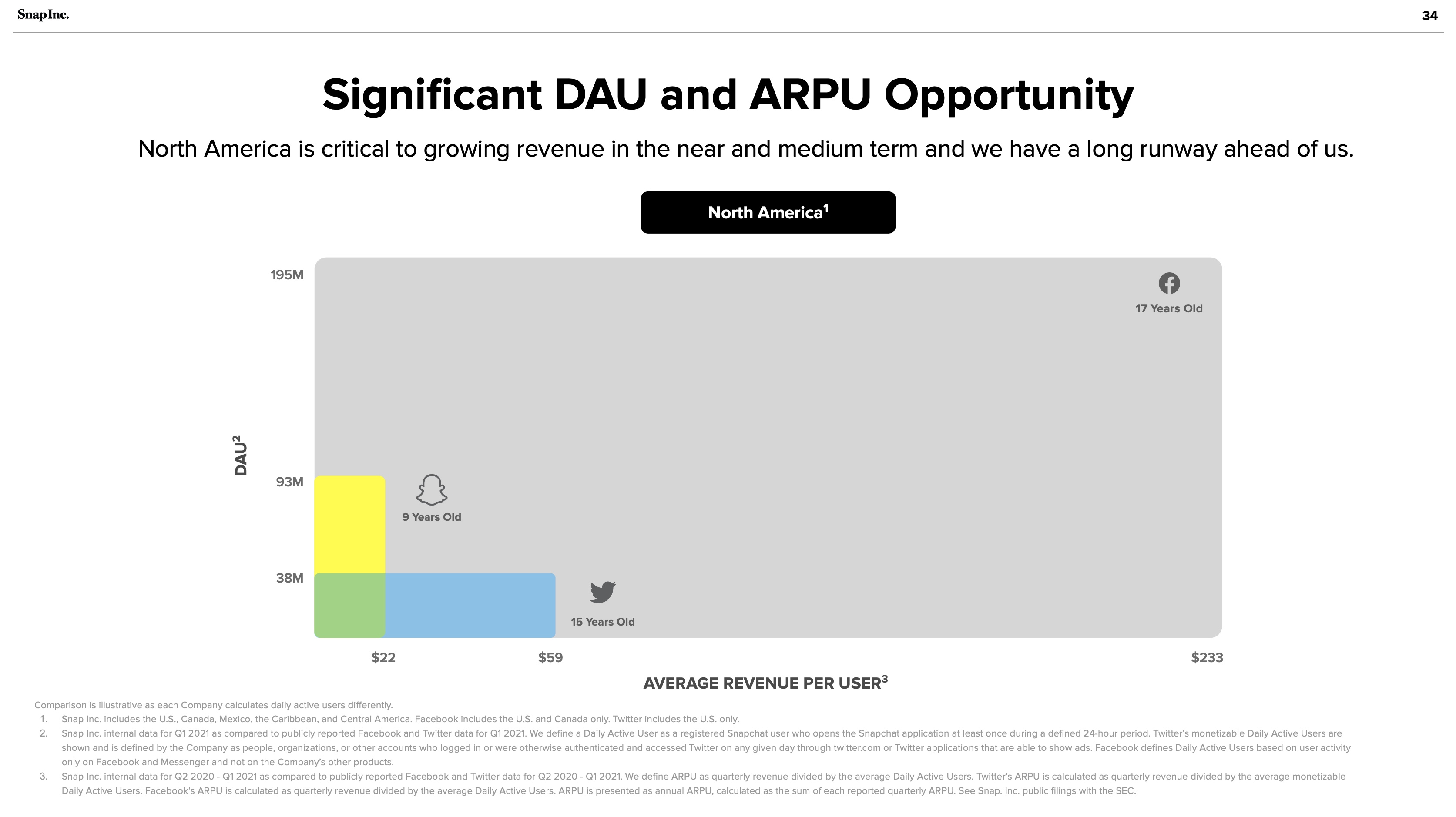
Snapchat July 2021 investor presentation: Significant DAU and ARPU Opportunity

Snapchat July 2021 investor presentation: Significant DAU and ARPU Opportunity. Image CreditsSnapchat

This is a chart of Facebook’s monopoly — 91% of the personal social networking market. The gray blob looks awfully like a vast oil deposit, successfully drilled by Facebook’s Standard Oil operations. Snapchat and Twitter are the small wildcatters, nearly irrelevant compared to Facebook’s scale. It should not be lost on any market observers that Facebook once tried to acquire both companies.

The market Includes messaging

The FTC initially claimed that Facebook has a monopoly of the “personal social networking services” market. The complaint excluded “mobile messaging” from Facebook’s market “because [messaging apps] (i) lack a ‘shared social space’ for interaction and (ii) do not employ a social graph to facilitate users’ finding and ‘friending’ other users they may know.”

This is incorrect because messaging is inextricable from Facebook’s power. Facebook demonstrated this with its WhatsApp acquisition, promotion of Messenger and prior attempts to buy Snapchat and Twitter. Any personal social networking service can expand its features — and Facebook’s moat is contingent on its control of messaging.

The more time in an ecosystem the more valuable it becomes. Value in social networks is calculated, depending on whom you ask, algorithmically (Metcalfe’s law) or logarithmically (Zipf’s law). Either way, in social networks, 1+1 is much more than 2.

Social networks become valuable based on the ever-increasing number of nodes, upon which companies can build more features. Zuckerberg coined the “social graph” to describe this relationship. The monopolies of Line, Kakao and WeChat in Japan, Korea and China prove this clearly. They began with messaging and expanded outward to become dominant personal social networking behemoths.

In today’s refiling, the FTC explains that Facebook, Instagram and Snapchat are all personal social networking services built on three key features:

  1. “First, personal social networking services are built on a social graph that maps the connections between users and their friends, family, and other personal connections.”
  2. “Second, personal social networking services include features that many users regularly employ to interact with personal connections and share their personal experiences in a shared social space, including in a one-to-many ‘broadcast’ format.”
  3. “Third, personal social networking services include features that allow users to find and connect with other users, to make it easier for each user to build and expand their set of personal connections.”

Unfortunately, this is only partially right. In social media’s treacherous waters, as the FTC has struggled to articulate, feature sets are routinely copied and cross-promoted. How can we forget Instagram’s copying of Snapchat’s stories? Facebook has ruthlessly copied features from the most successful apps on the market from inception. Its launch of a Clubhouse competitor called Live Audio Rooms is only the most recent example. Twitter and Snapchat are absolutely competitors to Facebook.

Messaging must be included to demonstrate Facebook’s breadth and voracious appetite to copy and destroy. WhatsApp and Messenger have over 2 billion and 1.3 billion users respectively. Given the ease of feature copying, a messaging service of WhatsApp’s scale could become a full-scale social network in a matter of months. This is precisely why Facebook acquired the company. Facebook’s breadth in social media services is remarkable. But the FTC needs to understand that messaging is a part of the market. And this acknowledgement would not hurt their case.

The metric: Revenue shows Facebook’s monopoly

Boasberg believes revenue is not an apt metric to calculate personal networking: “The overall revenues earned by PSN services cannot be the right metric for measuring market share here, as those revenues are all earned in a separate market — viz., the market for advertising.” He is confusing business model with market. Not all advertising is cut from the same cloth. In today’s refiling, the FTC correctly identifies “social advertising” as distinct from the “display advertising.”

But it goes off the deep end trying to avoid naming revenue as the distinguishing market share metric. Instead the FTC cites “time spent, daily active users (DAU), and monthly active users (MAU).” In a world where Facebook Blue and Instagram compete only with Snapchat, these metrics might bring Facebook Blue and Instagram combined over the 60% monopoly hurdle. But the FTC does not make a sufficiently convincing market definition argument to justify the choice of these metrics. Facebook should be compared to other personal social networking services such as Discord and Twitter — and their correct inclusion in the market would undermine the FTC’s choice of time spent or DAU/MAU.

Ultimately, cash is king. Revenue is what counts and what the FTC should emphasize. As Snapchat shows above, revenue in the personal social media industry is calculated by ARPU x DAU. The personal social media market is a different market from the entertainment social media market (where Facebook competes with YouTube, TikTok and Pinterest, among others). And this too is a separate market from the display search advertising market (Google). Not all advertising-based consumer technology is built the same. Again, advertising is a business model, not a market.

In the media world, for example, Netflix’s subscription revenue clearly competes in the same market as CBS’ advertising model. News Corp.’s acquisition of Facebook’s early competitor MySpace spoke volumes on the internet’s potential to disrupt and destroy traditional media advertising markets. Snapchat has chosen to pursue advertising, but incipient competitors like Discord are successfully growing using subscriptions. But their market share remains a pittance compared to Facebook.

An alternative pleading: Facebook’s market power suppresses wages in the creator economy

The FTC has correctly argued for the smallest possible market for their monopoly definition. Personal social networking, of which Facebook controls at least 80%, should not (in their strongest argument) include entertainment. This is the narrowest argument to make with the highest chance of success.

But they could choose to make a broader argument in the alternative, one that takes a bigger swing. As Lina Khan famously noted about Amazon in her 2017 note that began the New Brandeis movement, the traditional economic consumer harm test does not adequately address the harms posed by Big Tech. The harms are too abstract. As White House advisor Tim Wu argues in “The Curse of Bigness,” and Judge Boasberg acknowledges in his opinion, antitrust law does not hinge solely upon price effects. Facebook can be broken up without proving the negative impact of price effects.

However, Facebook has hurt consumers. Consumers are the workers whose labor constitutes Facebook’s value, and they’ve been underpaid. If you define personal networking to include entertainment, then YouTube is an instructive example. On both YouTube and Facebook properties, influencers can capture value by charging brands directly. That’s not what we’re talking about here; what matters is the percent of advertising revenue that is paid out to creators.

YouTube’s traditional percentage is 55%. YouTube announced it has paid $30 billion to creators and rights holders over the last three years. Let’s conservatively say that half of the money goes to rights holders; that means creators on average have earned $15 billion, which would mean $5 billion annually, a meaningful slice of YouTube’s $46 billion in revenue over that time. So in other words, YouTube paid creators a third of its revenue (this admittedly ignores YouTube’s non-advertising revenue).

Facebook, by comparison, announced just weeks ago a paltry $1 billion program over a year and change. Sure, creators may make some money from interstitial ads, but Facebook does not announce the percentage of revenue they hand to creators because it would be insulting. Over the equivalent three-year period of YouTube’s declaration, Facebook has generated $210 billion in revenue. one-third of this revenue paid to creators would represent $70 billion, or $23 billion a year.

Why hasn’t Facebook paid creators before? Because it hasn’t needed to do so. Facebook’s social graph is so large that creators must post there anyway — the scale afforded by success on Facebook Blue and Instagram allows creators to monetize through directly selling to brands. Facebooks ads have value because of creators’ labor; if the users did not generate content, the social graph would not exist. Creators deserve more than the scraps they generate on their own. Facebook suppresses creators’ wages because it can. This is what monopolies do.

Facebook’s Standard Oil ethos

Facebook has long been the Standard Oil of social media, using its core monopoly to begin its march upstream and down. Zuckerberg announced in July and renewed his focus today on the metaverse, a market Roblox has pioneered. After achieving a monopoly in personal social media and competing ably in entertainment social media and virtual reality, Facebook’s drilling continues. Yes, Facebook may be free, but its monopoly harms Americans by stifling creator wages. The antitrust laws dictate that consumer harm is not a necessary condition for proving a monopoly under the Sherman Act; monopolies in and of themselves are illegal. By refiling the correct market definition and marketshare, the FTC stands more than a chance. It should win.

A prior version of this article originally appeared on Substack.


https://ift.tt/3AVRWpP Today’s real story: The Facebook monopoly https://ift.tt/3j1hgov

Companies betting on data must value people as much as AI

The Pareto principle, also known as the 80-20 rule, asserts that 80% of consequences come from 20% of causes, rendering the remainder way less impactful.

Those working with data may have heard a different rendition of the 80-20 rule: A data scientist spends 80% of their time at work cleaning up messy data as opposed to doing actual analysis or generating insights. Imagine a 30-minute drive expanded to two-and-a-half hours by traffic jams, and you’ll get the picture.

As tempting as it may be to think of a future where there is a machine learning model for every business process, we do not need to tread that far right now.

While most data scientists spend more than 20% of their time at work on actual analysis, they still have to waste countless hours turning a trove of messy data into a tidy dataset ready for analysis. This process can include removing duplicate data, making sure all entries are formatted correctly and doing other preparatory work.

On average, this workflow stage takes up about 45% of the total time, a recent Anaconda survey found. An earlier poll by CrowdFlower put the estimate at 60%, and many other surveys cite figures in this range.

None of this is to say data preparation is not important. “Garbage in, garbage out” is a well-known rule in computer science circles, and it applies to data science, too. In the best-case scenario, the script will just return an error, warning that it cannot calculate the average spending per client, because the entry for customer #1527 is formatted as text, not as a numeral. In the worst case, the company will act on insights that have little to do with reality.

The real question to ask here is whether re-formatting the data for customer #1527 is really the best way to use the time of a well-paid expert. The average data scientist is paid between $95,000 and $120,000 per year, according to various estimates. Having the employee on such pay focus on mind-numbing, non-expert tasks is a waste both of their time and the company’s money. Besides, real-world data has a lifespan, and if a dataset for a time-sensitive project takes too long to collect and process, it can be outdated before any analysis is done.

What’s more, companies’ quests for data often include wasting the time of non-data-focused personnel, with employees asked to help fetch or produce data instead of working on their regular responsibilities. More than half of the data being collected by companies is often not used at all, suggesting that the time of everyone involved in the collection has been wasted to produce nothing but operational delay and the associated losses.

The data that has been collected, on the other hand, is often only used by a designated data science team that is too overworked to go through everything that is available.

All for data, and data for all

The issues outlined here all play into the fact that save for the data pioneers like Google and Facebook, companies are still wrapping their heads around how to re-imagine themselves for the data-driven era. Data is pulled into huge databases and data scientists are left with a lot of cleaning to do, while others, whose time was wasted on helping fetch the data, do not benefit from it too often.

The truth is, we are still early when it comes to data transformation. The success of tech giants that put data at the core of their business models set off a spark that is only starting to take off. And even though the results are mixed for now, this is a sign that companies have yet to master thinking with data.

Data holds much value, and businesses are very much aware of it, as showcased by the appetite for AI experts in non-tech companies. Companies just have to do it right, and one of the key tasks in this respect is to start focusing on people as much as we do on AIs.

Data can enhance the operations of virtually any component within the organizational structure of any business. As tempting as it may be to think of a future where there is a machine learning model for every business process, we do not need to tread that far right now. The goal for any company looking to tap data today comes down to getting it from point A to point B. Point A is the part in the workflow where data is being collected, and point B is the person who needs this data for decision-making.

Importantly, point B does not have to be a data scientist. It could be a manager trying to figure out the optimal workflow design, an engineer looking for flaws in a manufacturing process or a UI designer doing A/B testing on a specific feature. All of these people must have the data they need at hand all the time, ready to be processed for insights.

People can thrive with data just as well as models, especially if the company invests in them and makes sure to equip them with basic analysis skills. In this approach, accessibility must be the name of the game.

Skeptics may claim that big data is nothing but an overused corporate buzzword, but advanced analytics capacities can enhance the bottom line for any company as long as it comes with a clear plan and appropriate expectations. The first step is to focus on making data accessible and easy to use and not on hauling in as much data as possible.

In other words, an all-around data culture is just as important for an enterprise as the data infrastructure.


https://ift.tt/eA8V8J Companies betting on data must value people as much as AI https://ift.tt/37WBhpA

Today’s real story: The Facebook monopoly

Facebook is a monopoly. Right?

Mark Zuckerberg appeared on national TV today to make a “special announcement.” The timing could not be more curious: Today is the day Lina Khan’s FTC refiled its case to dismantle Facebook’s monopoly.

To the average person, Facebook’s monopoly seems obvious. “After all,” as James E. Boasberg of the U.S. District Court for the District of Columbia put it in his recent decision, “No one who hears the title of the 2010 film ‘The Social Network’ wonders which company it is about.” But obviousness is not an antitrust standard. Monopoly has a clear legal meaning, and thus far Lina Khan’s FTC has failed to meet it. Today’s refiling is much more substantive than the FTC’s first foray. But it’s still lacking some critical arguments. Here are some ideas from the front lines.

To the average person, Facebook’s monopoly seems obvious. But obviousness is not an antitrust standard.

First, the FTC must define the market correctly: personal social networking, which includes messaging. Second, the FTC must establish that Facebook controls over 60% of the market — the correct metric to establish this is revenue.

Though consumer harm is a well-known test of monopoly determination, our courts do not require the FTC to prove that Facebook harms consumers to win the case. As an alternative pleading, though, the government can present a compelling case that Facebook harms consumers by suppressing wages in the creator economy. If the creator economy is real, then the value of ads on Facebook’s services is generated through the fruits of creators’ labor; no one would watch the ads before videos or in between posts if the user-generated content was not there. Facebook has harmed consumers by suppressing creator wages.

A note: This is the first of a series on the Facebook monopoly. I am inspired by Cloudflare’s recent post explaining the impact of Amazon’s monopoly in their industry. Perhaps it was a competitive tactic, but I genuinely believe it more a patriotic duty: guideposts for legislators and regulators on a complex issue. My generation has watched with a combination of sadness and trepidation as legislators who barely use email question the leading technologists of our time about products that have long pervaded our lives in ways we don’t yet understand. I, personally, and my company both stand to gain little from this — but as a participant in the latest generation of social media upstarts, and as an American concerned for the future of our democracy, I feel a duty to try.

The problem

According to the court, the FTC must meet a two-part test: First, the FTC must define the market in which Facebook has monopoly power, established by the D.C. Circuit in Neumann v. Reinforced Earth Co. (1986). This is the market for personal social networking services, which includes messaging.

Second, the FTC must establish that Facebook controls a dominant share of that market, which courts have defined as 60% or above, established by the 3rd U.S. Circuit Court of Appeals in FTC v. AbbVie (2020). The right metric for this market share analysis is unequivocally revenue — daily active users (DAU) x average revenue per user (ARPU). And Facebook controls over 90%.

The answer to the FTC’s problem is hiding in plain sight: Snapchat’s investor presentations:

Snapchat July 2021 investor presentation: Significant DAU and ARPU Opportunity

Snapchat July 2021 investor presentation: Significant DAU and ARPU Opportunity. Image CreditsSnapchat

This is a chart of Facebook’s monopoly — 91% of the personal social networking market. The gray blob looks awfully like a vast oil deposit, successfully drilled by Facebook’s Standard Oil operations. Snapchat and Twitter are the small wildcatters, nearly irrelevant compared to Facebook’s scale. It should not be lost on any market observers that Facebook once tried to acquire both companies.

The market Includes messaging

The FTC initially claimed that Facebook has a monopoly of the “personal social networking services” market. The complaint excluded “mobile messaging” from Facebook’s market “because [messaging apps] (i) lack a ‘shared social space’ for interaction and (ii) do not employ a social graph to facilitate users’ finding and ‘friending’ other users they may know.”

This is incorrect because messaging is inextricable from Facebook’s power. Facebook demonstrated this with its WhatsApp acquisition, promotion of Messenger and prior attempts to buy Snapchat and Twitter. Any personal social networking service can expand its features — and Facebook’s moat is contingent on its control of messaging.

The more time in an ecosystem the more valuable it becomes. Value in social networks is calculated, depending on whom you ask, algorithmically (Metcalfe’s law) or logarithmically (Zipf’s law). Either way, in social networks, 1+1 is much more than 2.

Social networks become valuable based on the ever-increasing number of nodes, upon which companies can build more features. Zuckerberg coined the “social graph” to describe this relationship. The monopolies of Line, Kakao and WeChat in Japan, Korea and China prove this clearly. They began with messaging and expanded outward to become dominant personal social networking behemoths.

In today’s refiling, the FTC explains that Facebook, Instagram and Snapchat are all personal social networking services built on three key features:

  1. “First, personal social networking services are built on a social graph that maps the connections between users and their friends, family, and other personal connections.”
  2. “Second, personal social networking services include features that many users regularly employ to interact with personal connections and share their personal experiences in a shared social space, including in a one-to-many ‘broadcast’ format.”
  3. “Third, personal social networking services include features that allow users to find and connect with other users, to make it easier for each user to build and expand their set of personal connections.”

Unfortunately, this is only partially right. In social media’s treacherous waters, as the FTC has struggled to articulate, feature sets are routinely copied and cross-promoted. How can we forget Instagram’s copying of Snapchat’s stories? Facebook has ruthlessly copied features from the most successful apps on the market from inception. Its launch of a Clubhouse competitor called Live Audio Rooms is only the most recent example. Twitter and Snapchat are absolutely competitors to Facebook.

Messaging must be included to demonstrate Facebook’s breadth and voracious appetite to copy and destroy. WhatsApp and Messenger have over 2 billion and 1.3 billion users respectively. Given the ease of feature copying, a messaging service of WhatsApp’s scale could become a full-scale social network in a matter of months. This is precisely why Facebook acquired the company. Facebook’s breadth in social media services is remarkable. But the FTC needs to understand that messaging is a part of the market. And this acknowledgement would not hurt their case.

The metric: Revenue shows Facebook’s monopoly

Boasberg believes revenue is not an apt metric to calculate personal networking: “The overall revenues earned by PSN services cannot be the right metric for measuring market share here, as those revenues are all earned in a separate market — viz., the market for advertising.” He is confusing business model with market. Not all advertising is cut from the same cloth. In today’s refiling, the FTC correctly identifies “social advertising” as distinct from the “display advertising.”

But it goes off the deep end trying to avoid naming revenue as the distinguishing market share metric. Instead the FTC cites “time spent, daily active users (DAU), and monthly active users (MAU).” In a world where Facebook Blue and Instagram compete only with Snapchat, these metrics might bring Facebook Blue and Instagram combined over the 60% monopoly hurdle. But the FTC does not make a sufficiently convincing market definition argument to justify the choice of these metrics. Facebook should be compared to other personal social networking services such as Discord and Twitter — and their correct inclusion in the market would undermine the FTC’s choice of time spent or DAU/MAU.

Ultimately, cash is king. Revenue is what counts and what the FTC should emphasize. As Snapchat shows above, revenue in the personal social media industry is calculated by ARPU x DAU. The personal social media market is a different market from the entertainment social media market (where Facebook competes with YouTube, TikTok and Pinterest, among others). And this too is a separate market from the display search advertising market (Google). Not all advertising-based consumer technology is built the same. Again, advertising is a business model, not a market.

In the media world, for example, Netflix’s subscription revenue clearly competes in the same market as CBS’ advertising model. News Corp.’s acquisition of Facebook’s early competitor MySpace spoke volumes on the internet’s potential to disrupt and destroy traditional media advertising markets. Snapchat has chosen to pursue advertising, but incipient competitors like Discord are successfully growing using subscriptions. But their market share remains a pittance compared to Facebook.

An alternative pleading: Facebook’s market power suppresses wages in the creator economy

The FTC has correctly argued for the smallest possible market for their monopoly definition. Personal social networking, of which Facebook controls at least 80%, should not (in their strongest argument) include entertainment. This is the narrowest argument to make with the highest chance of success.

But they could choose to make a broader argument in the alternative, one that takes a bigger swing. As Lina Khan famously noted about Amazon in her 2017 note that began the New Brandeis movement, the traditional economic consumer harm test does not adequately address the harms posed by Big Tech. The harms are too abstract. As White House advisor Tim Wu argues in “The Curse of Bigness,” and Judge Boasberg acknowledges in his opinion, antitrust law does not hinge solely upon price effects. Facebook can be broken up without proving the negative impact of price effects.

However, Facebook has hurt consumers. Consumers are the workers whose labor constitutes Facebook’s value, and they’ve been underpaid. If you define personal networking to include entertainment, then YouTube is an instructive example. On both YouTube and Facebook properties, influencers can capture value by charging brands directly. That’s not what we’re talking about here; what matters is the percent of advertising revenue that is paid out to creators.

YouTube’s traditional percentage is 55%. YouTube announced it has paid $30 billion to creators and rights holders over the last three years. Let’s conservatively say that half of the money goes to rights holders; that means creators on average have earned $15 billion, which would mean $5 billion annually, a meaningful slice of YouTube’s $46 billion in revenue over that time. So in other words, YouTube paid creators a third of its revenue (this admittedly ignores YouTube’s non-advertising revenue).

Facebook, by comparison, announced just weeks ago a paltry $1 billion program over a year and change. Sure, creators may make some money from interstitial ads, but Facebook does not announce the percentage of revenue they hand to creators because it would be insulting. Over the equivalent three-year period of YouTube’s declaration, Facebook has generated $210 billion in revenue. one-third of this revenue paid to creators would represent $70 billion, or $23 billion a year.

Why hasn’t Facebook paid creators before? Because it hasn’t needed to do so. Facebook’s social graph is so large that creators must post there anyway — the scale afforded by success on Facebook Blue and Instagram allows creators to monetize through directly selling to brands. Facebooks ads have value because of creators’ labor; if the users did not generate content, the social graph would not exist. Creators deserve more than the scraps they generate on their own. Facebook suppresses creators’ wages because it can. This is what monopolies do.

Facebook’s Standard Oil ethos

Facebook has long been the Standard Oil of social media, using its core monopoly to begin its march upstream and down. Zuckerberg announced in July and renewed his focus today on the metaverse, a market Roblox has pioneered. After achieving a monopoly in personal social media and competing ably in entertainment social media and virtual reality, Facebook’s drilling continues. Yes, Facebook may be free, but its monopoly harms Americans by stifling creator wages. The antitrust laws dictate that consumer harm is not a necessary condition for proving a monopoly under the Sherman Act; monopolies in and of themselves are illegal. By refiling the correct market definition and marketshare, the FTC stands more than a chance. It should win.

A prior version of this article originally appeared on Substack.


from Social – TechCrunch https://ift.tt/3AVRWpP Today’s real story: The Facebook monopoly Walter Thompson https://ift.tt/3j1hgov
via IFTTT

Twitter rolls out a series of improvements to its Direct Message system

Have you ever tried to share a funny tweet with a few friends via Twitter DM, only to accidentally start a group chat? You’re not alone. Today, Twitter announced that it will roll out a few quality of life improvements to its direct messaging system over the next few weeks, including the ability to DM a tweet to multiple people at once in individual conversations. Researcher Jane Manchun Wong noticed that Twitter was working on this functionality last month.

A potential downside of this update is that it might invite more spam — you can’t send a message to more than 20 people at once, but that’s still a lot of people. And users receiving these messages now may not realize they were a part of group spam, as the individual DMs will seem like private 1:1 messages.

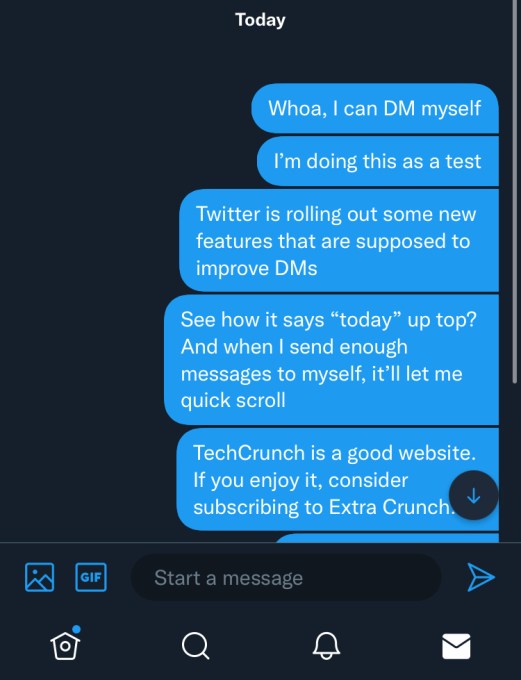
Twitter says Android users will have to wait a bit longer than iOS and web tweeters to gain access to this feature — and it’s unclear how long that will take, because in the past, it’s taken years for iOS DM updates to reach Android. But as a consolation prize, on both Android and iOS, if you scroll up in a DM conversation, you’ll be able to return to the latest message by pressing a down arrow button to quick-scroll.

Twitter’s other two DM improvements are only rolling out so far on iOS — instead of timestamping individual messages with the date and time, messages will be grouped by day. Individual DMs will still have a timestamp, but Twitter says that this change will yield “less timestamp clutter.

Finally, in DMs, iOS users will be able to access the “add reaction” menu from both double-tapping and long-pressing on a message. Long-pressing a friend’s message also gives you the option to delete the message on your account only, report the message or copy the text.

A demonstration of new Twitter DM features

Image Credits: Twitter, screenshot by TechCrunch

Twitter also announced today that it’s testing a feature that puts users’ Revue newsletters on their profile (Twitter acquired the newsletter platform earlier this year). But last week, it unveiled more noticeable UI updates that experts believe made the platform less accessible. Within two days of the update, Twitter made contrast changes on its buttons and identified issues with its proprietary font Chirp on Windows.


from Social – TechCrunch https://ift.tt/3y1eqUK Twitter rolls out a series of improvements to its Direct Message system Amanda Silberling https://ift.tt/38cGie9
via IFTTT

Let’s make a deal: A crash course on corporate development

Wash, rinse, repeat: A startup is founded, first product ships, customers engage, and then a larger company’s corporate development team sends a blind email requesting to “connect and compare notes.”

If you’re a venture-backed startup, it would be wise to generate a return at some point, which means either get acquired or go public.

If you’re going to get acquired, chances are you’re going to spend a lot of time with corporate development teams. With a hot stock market, mountains of cash and cheap debt floating around, the environment for acquisitions is extremely rich.

And as I’ve been on both sides of these equations, an increasing number of my FriendDA partners have been calling for advice on corporate development mating rituals.

Here are the highlights.

Before my first company was acquired, I believed that every acquisition I’d ever read about was strategic and well thought out. I was blindingly wrong.

You need to take the meeting

Book a 45-minute initial meeting. Give yourself an hour on the calendar, but only burn the full 60 minutes if things are going well. Don’t be overly excited, be a pleaser and or ramble on. Pontificate? Yes, but with precision.

You need to demonstrate a command of the domain you’ve chosen. Also, demonstrate that you’re humble and thoughtful, but never come to the first meeting with a written list of “ways we can work together.” That will smell of desperation.

In the worst-case scenario, you’ll get a few new LinkedIn connections and you’re now a known quantity. The best-case scenario will be a second meeting.

But they’re going to steal my brilliant idea!

No, they aren’t. I hear this a lot and it’s a solid tell that an entrepreneur has never operated within a large enterprise before. That’s fine, as not everyone gets to have an employee ID number with five or six digits.

Big companies manage operational expenses, including salaries and related expenses, pretty tightly. And there frequently aren’t enough experts to go around the moneyball startups for new domains, let alone older enterprises.

So there’s no secret lab with dozens of developers and subject matter experts waiting for a freshly minted MBA to return with their meeting notes and start pilfering your awesomeness. Plus, a key component to many successful startups is go-to-market (GTM), and most larger enterprises don’t have the marketing and sales domain knowledge to sell a stolen product.

They still need you and your team.


https://ift.tt/eA8V8J Let’s make a deal: A crash course on corporate development https://ift.tt/3z4gJYf

blogger better Headline Animator